 Fireblaze
Learning Guides
20 Machine Learning Projects for Beginners (with Datasets)
20 machine learning projects for beginners with free datasets, including Indian data, the right metric for each, and a 3-project portfolio plan.

You've watched the tutorials. You know what a decision tree is.
But when someone asks "what have you built?", you go quiet.
That's the gap these machine learning projects close. Below are 20 beginner projects, each with a dataset link, the algorithm to start with, and the metric to judge it by.
You'll also get:
- 3 projects built on Indian data (used car prices in rupees, crop production, city air quality)
- The Project Ladder: how to pick 3 projects that actually impress recruiters
- A template to describe each project on your resume
Let's get started.
Machine learning projects are hands-on exercises where you take a real dataset, clean it, train a model to predict or group something, and measure how well it works. For beginners, good projects use small, clean datasets, one clear question and simple algorithms like logistic regression, decision trees or K-means, so you learn the full workflow without getting stuck.
Quick answer: machine learning projects for beginners (November 2026)
- A good first project is Iris flower classification, a 150-row UCI dataset you can model in a single notebook session.
- The best beginner portfolio has 3 projects: one clean tabular project, one messy real-world project and one text, image or deployed project.
- India-specific beginner projects include used car price prediction on CarDekho listing data, crop production prediction on data.gov.in data and city air quality prediction on CPCB-based data.
- Pick the metric by the problem: accuracy for balanced classes, F1 or recall for imbalanced ones such as fraud, and RMSE for prices.
- Iris and Titanic are good practice but too common to stand out on a resume.
Contents
- Before You Start: Tools You Need
- The Project Ladder: Pick 3, Not 20
- All 20 Machine Learning Projects at a Glance
- Level 1: Clean Tabular Projects (1 to 7)
- Level 2: Real-World and Indian Data Projects (8 to 14)
- Level 3: Text, Image and Deployed Projects (15 to 20)
- How to Present Machine Learning Projects on Your Resume
- FAQ
Before You Start: Tools You Need
You need Python, a few libraries and a free notebook to do every project on this list. No GPU, no paid software.
- Python with pandas (data), scikit-learn (models) and matplotlib (charts). See our guide to Python libraries for machine learning.
- Jupyter or Google Colab to run code in your browser.
- GitHub to publish your work.
- Basic ML concepts: train-test split, classification vs regression, and overfitting. Our post on types of machine learning covers these.
Every project follows the same six steps: load the data, explore it, clean it, split into train and test sets, train a model, and evaluate it. Repeat that loop 20 times and it becomes second nature.
The Project Ladder: Pick 3, Not 20
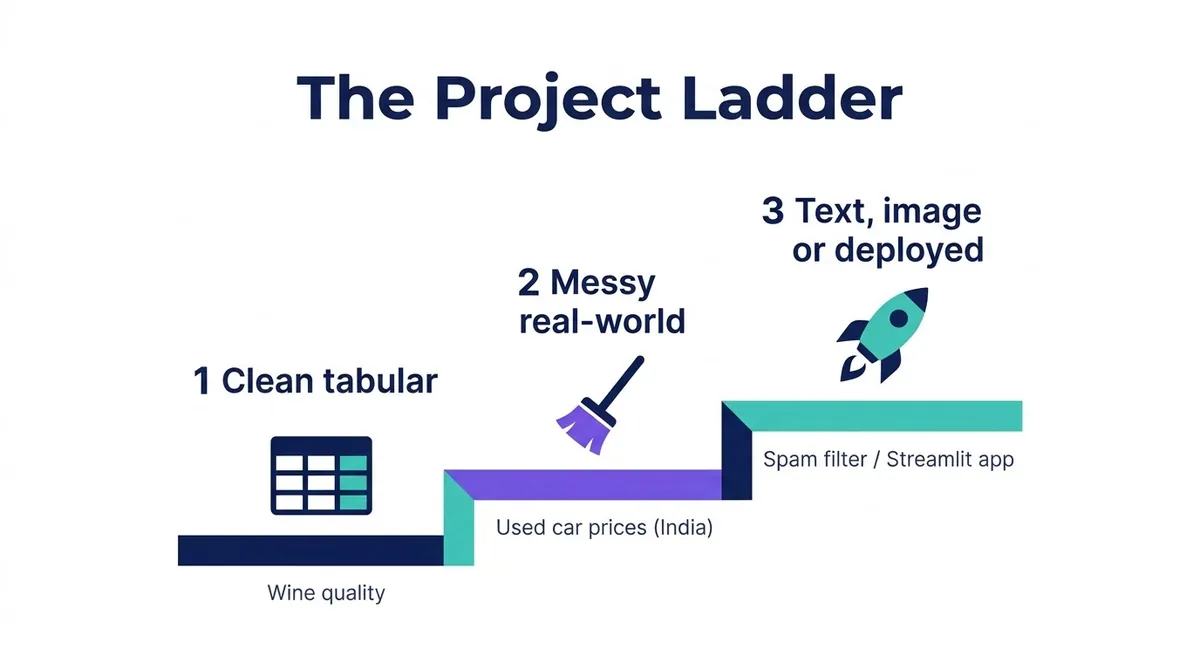
The Project Ladder is a simple rule for building a portfolio: do one project from each of three levels instead of 20 shallow ones. Recruiters skim. Three solid projects with clear write-ups beat a GitHub full of half-finished notebooks.
| Level | What it proves | Pick one like |
|---|---|---|
| 1. Clean tabular | You know the ML workflow | Wine quality, bike demand |
| 2. Messy real-world | You can clean data and choose the right metric | Car prices (India), churn, fraud |
| 3. Text, image or deployed | You can go beyond tables or ship something | Spam filter, digit recognition, Streamlit app |
Here's the contrarian part: Iris and Titanic are great practice reps, but don't make them your portfolio. They're the "Hello World" of ML, so many candidates show the same notebook.
All 20 Machine Learning Projects at a Glance
Here are all 20 machine learning project ideas with the dataset, the task, a starting algorithm and the metric to report. Use it to pick, then jump to the details below.
| # | Project | Dataset source | Task | Start with | Metric |
|---|---|---|---|---|---|
| 1 | Iris flower classification | UCI | Classification | Logistic regression | Accuracy |
| 2 | California house prices | scikit-learn | Regression | Linear regression | RMSE |
| 3 | Titanic survival | Kaggle | Classification | Decision tree | Accuracy |
| 4 | Wine quality | UCI | Regression or classification | Random forest | RMSE / accuracy |
| 5 | Breast cancer diagnosis | UCI / scikit-learn | Classification | Logistic regression | Recall |
| 6 | Student performance | UCI | Regression | Linear regression | RMSE |
| 7 | Bike sharing demand | UCI | Regression | Random forest | RMSE |
| 8 | Used car prices (India) | Kaggle (CarDekho) | Regression | Random forest | RMSE in ₹ |
| 9 | Crop production (India) | data.gov.in | Regression | Gradient boosting | RMSE |
| 10 | City air quality (India) | Kaggle (CPCB-based) | Regression | Random forest | RMSE |
| 11 | Customer churn | Kaggle (Telco) | Classification | Logistic regression | F1 |
| 12 | Bank term deposit | UCI | Classification | Decision tree | F1 |
| 13 | Credit card fraud | Kaggle | Classification | Random forest | Precision-recall AUC |
| 14 | Customer segmentation | UCI (Online Retail) | Clustering | K-means | Silhouette score |
| 15 | SMS spam filter | UCI | Text classification | Naive Bayes + TF-IDF | F1 |
| 16 | Movie review sentiment | Stanford (IMDB) | Text classification | Logistic regression + TF-IDF | Accuracy |
| 17 | Movie recommender | GroupLens (MovieLens) | Recommendation | Collaborative filtering | RMSE |
| 18 | Handwritten digits | MNIST | Image classification | Neural network | Accuracy |
| 19 | Clothing classifier | Fashion-MNIST | Image classification | Simple CNN | Accuracy |
| 20 | Diabetes risk app | Kaggle (Pima) | Classification + deployment | Random forest + Streamlit | Recall |
Resource: Bookmark this table. It's the "project menu" you can come back to whenever you finish one.
Level 1: Clean Tabular Projects (1 to 7)
Level 1 machine learning projects use small, clean tables so you can focus on the workflow instead of fighting the data. Do one or two of these in your first week.
1. Iris Flower Classification
Predict the species of an iris flower (setosa, versicolor or virginica) from four petal and sepal measurements. The UCI Iris dataset has just 150 rows, so it's the classic first model.
You'll learn: train-test split, logistic regression, accuracy and a confusion matrix.
2. California House Price Prediction
Predict median house values for California districts from income, house age, rooms and location. The dataset ships with scikit-learn as fetch_california_housing (scikit-learn docs), with 20,640 rows.
You'll learn: regression, feature scaling and RMSE. Read our linear regression guide first.
3. Titanic Survival Prediction
Predict which passengers survived the Titanic from age, sex, class and fare. Kaggle's Titanic competition gives you an 891-row training set and a leaderboard to submit to.
You'll learn: handling missing values (age is often blank), encoding categories and decision trees. See our decision tree guide.
4. Wine Quality Prediction
Predict a wine's quality score from 11 chemical measurements like acidity and alcohol. The UCI Wine Quality dataset covers red and white Portuguese wines.
You'll learn: treating a problem as regression vs classification, and random forests.
5. Breast Cancer Diagnosis
Classify tumours as malignant or benign from 30 cell measurements. The Breast Cancer Wisconsin (Diagnostic) dataset has 569 rows and is also built into scikit-learn.
You'll learn: why recall matters more than accuracy when missing a positive case is costly. Our logistic regression guide fits this one well.
6. Student Performance Prediction
Predict a student's final grade from study time, past failures, absences and family background. The UCI Student Performance dataset comes from two Portuguese schools.
You'll learn: feature importance and spotting "leaky" features (earlier grades predict the final grade almost too well).
7. Bike Sharing Demand
Predict hourly bike rentals from weather, season and time of day. The UCI Bike Sharing dataset has 17,379 hourly rows.
You'll learn: time-based features (hour, weekday, holiday) and why random splits can leak future data into training.
Level 2: Real-World and Indian Data Projects (8 to 14)
Level 2 machine learning projects use messier, more realistic data, including three Indian datasets most project lists skip. These are the projects that make your portfolio different.
8. Used Car Price Prediction (India)
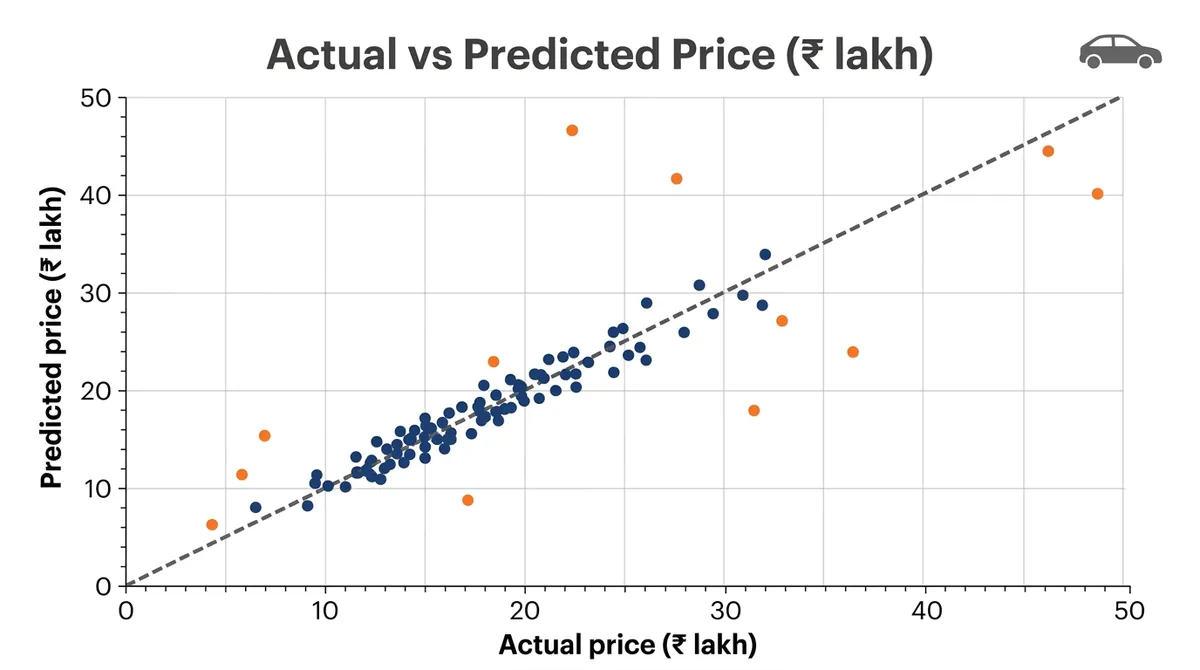
Predict the resale price of a used car in rupees from attributes such as brand, year, kilometres driven, fuel type, transmission and owner count. The CarDekho vehicle dataset on Kaggle was gathered by web scraping, so check its columns and licence on the Kaggle page before you start.
You'll learn: cleaning text fields (like "1197 CC"), log-transforming skewed prices and reporting error in ₹ so a business person understands it.
9. Crop Production Prediction (India)
Predict crop production from district, season, crop and area. The government's district-wise, season-wise crop production statistics on data.gov.in cover crop area in hectares and production in tonnes by district, season and year.
You'll learn: working with large public data that can have gaps and inconsistent district names, and gradient boosting.
10. City Air Quality Prediction (India)
Predict next-day AQI or PM2.5 for Indian cities from past pollutant readings. The Air Quality Data in India dataset on Kaggle compiles readings for major cities from the Central Pollution Control Board (CPCB).
You'll learn: lag features, seasonality (Delhi in November vs July) and time-series train-test splits.
Pro tip: Pick the Indian project closest to the job you want. Car prices suit fintech and marketplaces, crop data suits agritech, and AQI suits climate and public-sector analytics.
11. Customer Churn Prediction
Predict which telecom customers will cancel their service from tenure, contract type and monthly charges. The Telco Customer Churn dataset has 7,043 customers.
You'll learn: imbalanced classes, F1 score and turning a model into a business recommendation, such as offering a discount to month-to-month customers in their first six months.
12. Bank Term Deposit Prediction
Predict whether a bank customer will sign up for a term deposit after a marketing call. The UCI Bank Marketing dataset has 45,211 rows from a Portuguese bank.
You'll learn: spotting a feature you couldn't know in advance (call duration) and removing it, plus precision vs recall trade-offs.
13. Credit Card Fraud Detection
Flag fraudulent card transactions. The Credit Card Fraud Detection dataset has 284,807 transactions, of which only 492 are fraud.
You'll learn: why 99.8% accuracy can be useless, and how to use precision-recall AUC, class weights and resampling instead.
14. Customer Segmentation
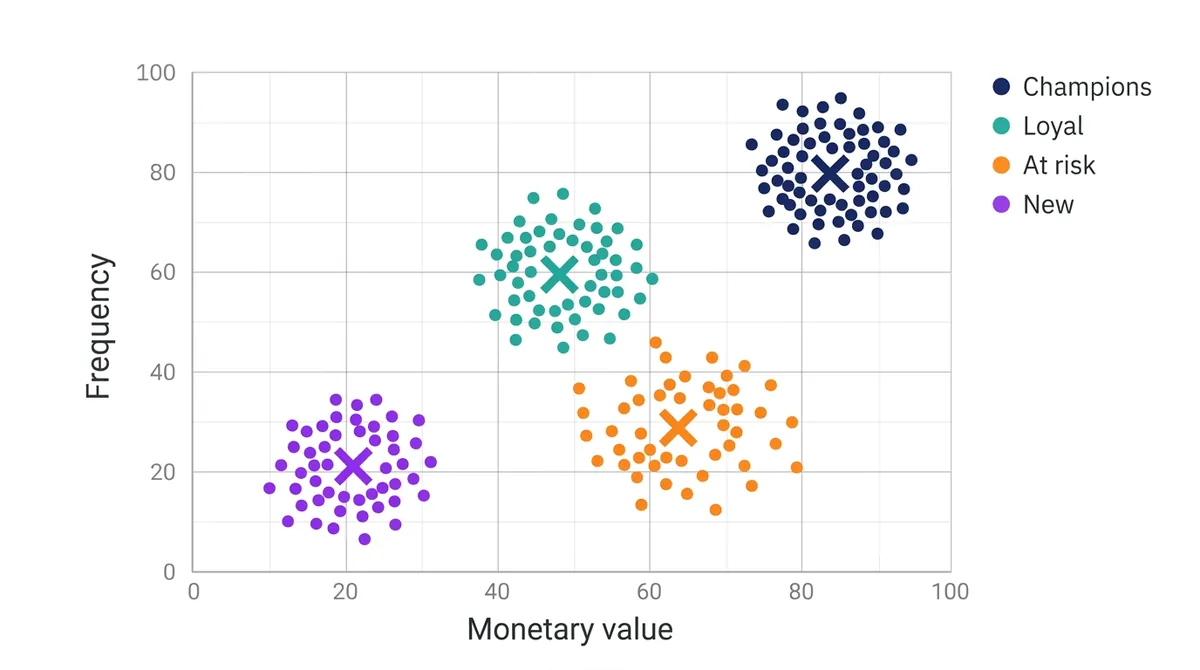
Group shoppers into segments by how recently, how often and how much they buy (RFM). The UCI Online Retail dataset has 541,909 transactions from a UK online store.
You'll learn: unsupervised learning with K-means, choosing the number of clusters and describing each segment in plain English.
Level 3: Text, Image and Deployed Projects (15 to 20)
Level 3 machine learning projects move beyond tables to text, images or a working app. One of these shows you can handle new data types or ship something people can use.
15. SMS Spam Filter
Classify text messages as spam or not. The UCI SMS Spam Collection has 5,574 labelled messages.
You'll learn: text cleaning, TF-IDF features and Naive Bayes, the fastest route into NLP.
16. Movie Review Sentiment Analysis
Classify movie reviews as positive or negative. Stanford's Large Movie Review Dataset has 50,000 IMDB reviews split evenly into training and test sets.
You'll learn: TF-IDF with logistic regression, then (optionally) comparing it with a small neural network.
17. Movie Recommender System
Recommend movies based on what similar users rated highly. The MovieLens datasets from GroupLens start with a 100,000-rating version that runs on any laptop.
You'll learn: collaborative filtering, the cold-start problem and evaluating recommendations.
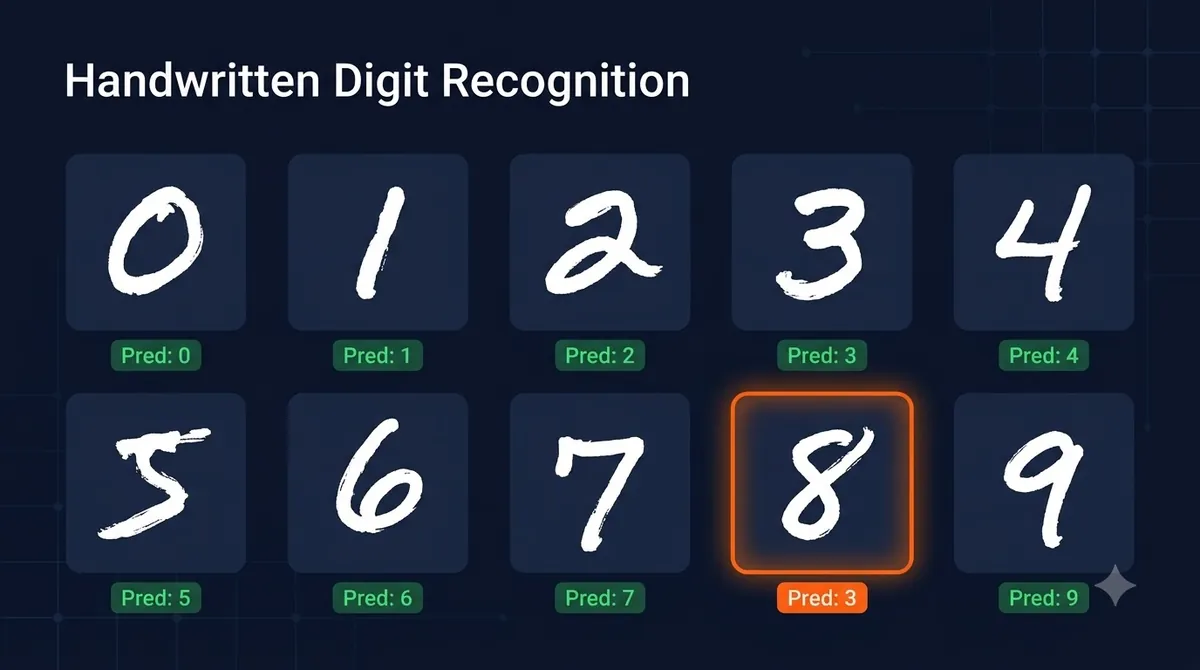
18. Handwritten Digit Recognition
Recognise handwritten digits 0 to 9 from images. The MNIST database has a training set of 60,000 examples and a test set of 10,000, and it loads in one line from Keras or scikit-learn.
You'll learn: image data as arrays, your first neural network and why images need different models than tables.
19. Clothing Image Classifier
Classify clothing images (shirt, sneaker, bag and seven more classes). Zalando's Fashion-MNIST has 70,000 small greyscale images and is harder than MNIST.
You'll learn: a simple convolutional neural network (CNN) and data augmentation.
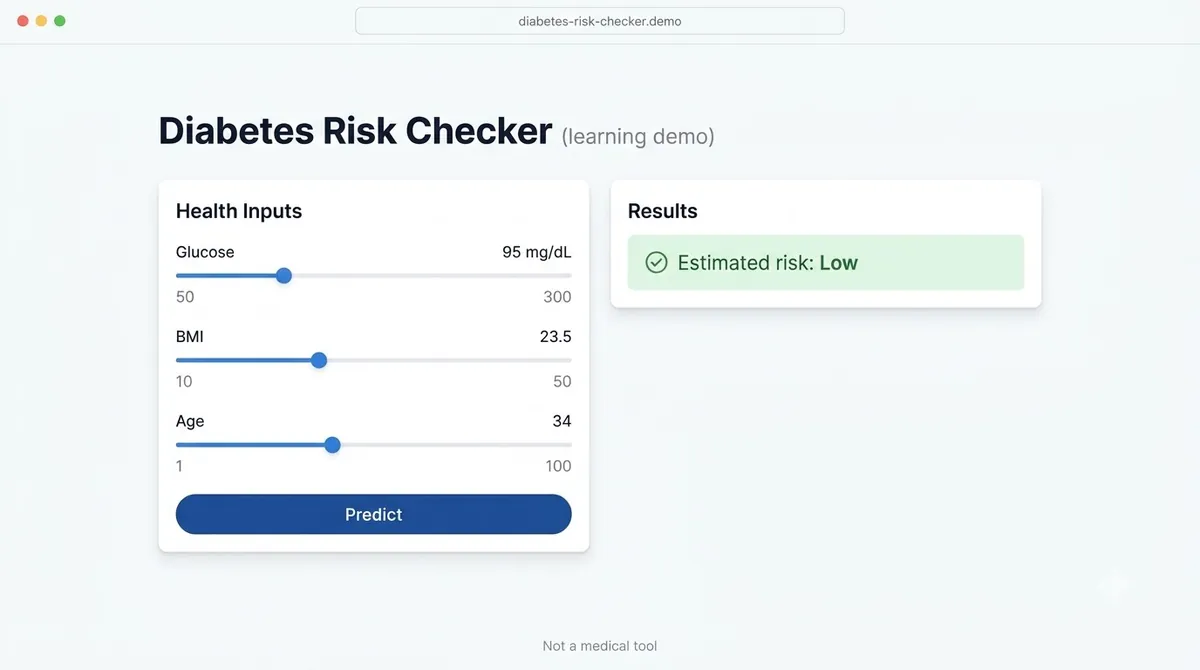
20. Diabetes Risk App with Streamlit
Train a model to flag diabetes risk, then turn it into a web app anyone can try. The Pima Indians Diabetes dataset has 768 records with glucose, BMI, age and other measures.
You'll learn: saving a model, building a form in Streamlit and deploying it free so recruiters can click a link instead of reading a notebook.
Important: Health projects are for learning only. Add a clear note in your app that it isn't a medical tool.
How to Present Machine Learning Projects on Your Resume
The way you present machine learning projects matters as much as the projects themselves. Each one needs a short README on GitHub and a one-line, results-first bullet on your resume.
Use this template for every project:
Project name | Python, pandas, scikit-learn, model used Built a model to predict or group the target from the dataset; reported the metric and value on held-out data; add one business takeaway or a deployment link.
For example, the structure looks like this (replace every figure with your own result):
Used Car Price Predictor (India) | Python, pandas, scikit-learn, Random Forest Built a random forest to predict resale prices from CarDekho listing data; reported RMSE in rupees on held-out data; noted which features drove the largest price differences.
And give every GitHub README these five sections:
- Problem: one sentence on what you predict and why it matters.
- Data: source link, rows, columns and cleaning steps.
- Approach: models tried and why you picked the final one.
- Results: the metric, a chart and what it means in plain words.
- Next steps: what you'd do with more time or data.
Preparing for interviews next? Our machine learning interview questions guide covers what interviewers ask about your projects.
Machine Learning Projects: Your Next Step
The best machine learning projects for beginners are the ones you finish and explain well. Start with one Level 1 project this week, then climb the Project Ladder to a messy Indian dataset and one text, image or deployed project.
Three finished projects, three clean READMEs, three resume bullets. That's a portfolio. With projects, finishing matters more than starting.
Want a structured path with mentor reviews? See the Fireblaze Data Science certification, or follow our data science roadmap. Which of these machine learning projects will you start first?
FAQ
Which machine learning project is best for beginners?
Iris flower classification is a good first machine learning project because the dataset has only 150 rows and four clean features. After that, move to a slightly messier dataset such as wine quality or bike sharing demand to practise cleaning and evaluation.
How many machine learning projects do I need for a job?
Three well-documented machine learning projects are a sensible target for an entry-level resume: one clean tabular project, one messy real-world project and one text, image or deployed project. Depth and a clear write-up matter more than the number of projects.
Where can I find free machine learning datasets?
Free machine learning datasets are available on the UCI Machine Learning Repository, Kaggle, data.gov.in for Indian government data, and built into libraries like scikit-learn and Keras. Each project in this list links to its dataset.
Do I need a GPU for beginner machine learning projects?
No. Most projects in this list run on a normal laptop or free Google Colab. The image projects (18 and 19) are the ones that benefit from a GPU, and Google Colab offers one free with usage limits.
Are Titanic and Iris projects good for a resume?
They're good for practice but weak for a resume, because many beginners have done them. Use them to learn the workflow, then showcase projects on less common or Indian datasets, such as used car prices or crop production.
How long does a beginner machine learning project take?
It depends on the project and your pace. Start with a small Level 1 project and time-box it, then give Level 2 and Level 3 projects more time. Most of the effort goes into cleaning data and writing up results, not training the model.
Sources
- UCI Machine Learning Repository: datasets for projects 1, 4, 5, 6, 7, 12, 14 and 15
- scikit-learn: real-world datasets
- Kaggle: Titanic competition
- Kaggle: CarDekho vehicle dataset
- data.gov.in: District-wise, season-wise crop production statistics
- Kaggle: Air Quality Data in India
- Kaggle: Telco Customer Churn
- Kaggle: Credit Card Fraud Detection
- Stanford: Large Movie Review Dataset
- GroupLens: MovieLens
- Zalando Research: Fashion-MNIST
- Kaggle: Pima Indians Diabetes Database