 Fireblaze
 Learning Guides
Top Python Libraries for Machine Learning
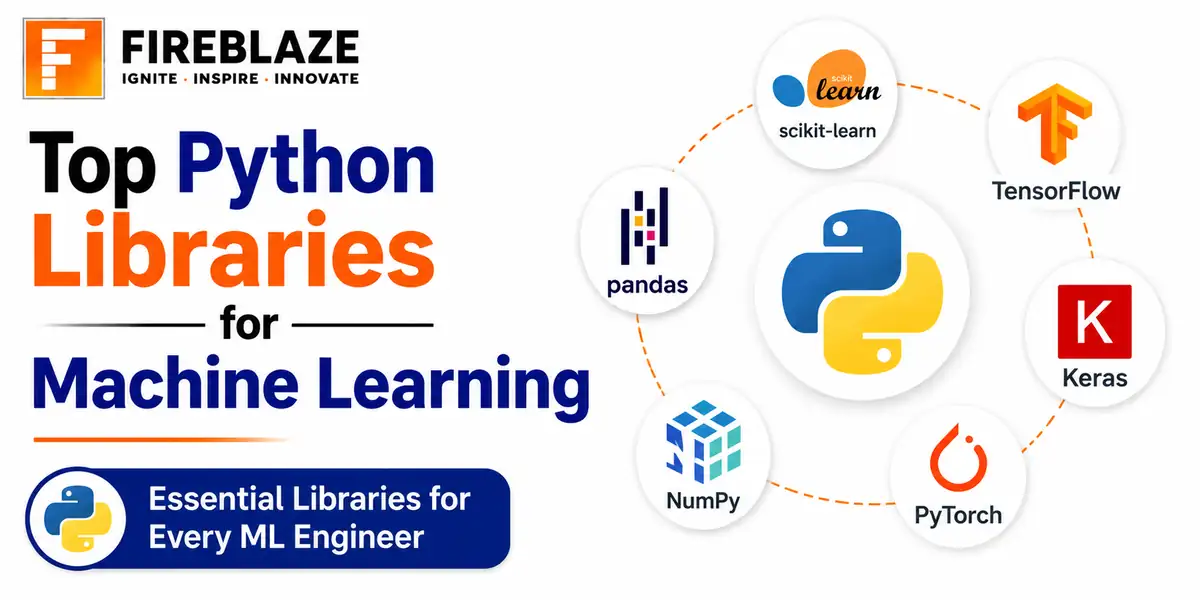
Quick answer: An overview of the essential Python libraries for Machine Learning, including NumPy, Pandas, Scikit-Learn, TensorFlow, PyTorch and Matplotlib, and when to use each.
Why Python Dominates Machine Learning
Python's combination of readable syntax and a mature, well maintained library ecosystem has made it the default language for Machine Learning work, from data preparation through to model deployment.
NumPy: Numerical Computing Foundation
NumPy provides fast array operations and is the foundation that most other Machine Learning libraries are built on top of.
import numpy as np

arr = np.array([1, 2, 3, 4])
print(arr.mean(), arr.std())
Pandas: Data Manipulation
Pandas provides the DataFrame structure for loading, cleaning and exploring tabular data, the step that comes before any modelling.
import pandas as pd

df = pd.read_csv('data.csv')
df = df.dropna()
print(df.groupby('category')['value'].mean())
Scikit-Learn: Classical Machine Learning
Scikit-Learn covers the standard classical algorithms, regression, classification, clustering, along with tools for preprocessing, model evaluation and cross validation.
from sklearn.model_selection import train_test_split
from sklearn.ensemble import RandomForestClassifier

X_train, X_test, y_train, y_test = train_test_split(X, y, test_size=0.2)
model = RandomForestClassifier()
model.fit(X_train, y_train)
TensorFlow and PyTorch: Deep Learning
Both are used for building neural networks. TensorFlow, developed by Google, is widely used in production deployment. PyTorch, developed by Meta, is popular in research for its more flexible, Python-native feel. Most practitioners today lean toward PyTorch for new projects, though both remain in active use.
Matplotlib and Seaborn: Visualisation
Matplotlib is the foundational plotting library. Seaborn builds on it with a higher level interface and better default styling for statistical plots.
import seaborn as sns
sns.histplot(df['age'])
Other Notable Libraries
| Library | Purpose |
|---|---|
| XGBoost / LightGBM | High performance gradient boosting, common in competitions and production |
| NLTK / spaCy | Natural language processing |
| OpenCV | Computer vision and image processing |
| Statsmodels | Detailed statistical modelling and hypothesis testing |
Choosing the Right Library
Start with Pandas and NumPy for any project, since data cleaning always comes first. Use Scikit-Learn for classical problems on structured, tabular data. Reach for TensorFlow or PyTorch specifically when working with unstructured data like images or text, where deep learning tends to outperform classical methods.
Common Interview Questions
What is the difference between TensorFlow and PyTorch?
Both build neural networks. TensorFlow has historically had stronger production deployment tooling, while PyTorch is favoured in research for its more flexible, debuggable style, though the gap between the two has narrowed considerably.
Why is Scikit-Learn preferred over deep learning libraries for many business problems?
Most structured, tabular business data does not need deep learning's complexity, and classical algorithms in Scikit-Learn are often faster to train, easier to interpret, and perform just as well on this kind of data.
FAQ
Frequently Asked Questions
What are the most essential Python libraries for Machine Learning?
NumPy and Pandas for data handling, Scikit-Learn for classical Machine Learning algorithms, and TensorFlow or PyTorch for deep learning.
What is the difference between TensorFlow and PyTorch?
Both build neural networks. TensorFlow has strong production deployment tooling, while PyTorch is favoured in research for its flexible, Python-native style.
Do you need TensorFlow or PyTorch for every Machine Learning project?
No. Most structured, tabular business problems are well served by Scikit-Learn's classical algorithms, which are simpler and often just as effective on that kind of data.
What is Scikit-Learn used for?
Classical Machine Learning tasks like regression, classification and clustering, along with tools for preprocessing, model evaluation and cross validation.
Keep Reading
Related Articles
Learning Guides
INNER JOIN in SQL with Examples: Complete Beginner's Guide
Learn INNER JOIN in SQL with practical examples, syntax, interview questions, and real-world use cases. A complete beginner-friendly SQL JOI
Learning Guides
OUTER JOIN in SQL: Complete Guide with Examples for Beginners
Master OUTER JOIN in SQL with practical examples and real-world scenarios. Learn LEFT JOIN, RIGHT JOIN, FULL OUTER JOIN, syntax, use cases,
Learning Guides
Multi-Row Functions in SQL: Complete Guide with Examples
Learn multi-row (aggregate) functions in SQL including SUM, AVG, COUNT, MIN, MAX, GROUP BY and HAVING, with practical examples, NULL handlin