 Fireblaze
Career Roadmaps
Data Science Roadmap 2026: Skills, Tools and Timeline
A data science roadmap for 2026 built for India: 5 stages, the data scientist skills and tools to learn, and a month-by-month timeline for every background.


Most people who want to get into data science do not fail because it is too hard. They fail because they learn things in the wrong order.
Three months on deep learning videos, no SQL. A dozen certificates, no project a recruiter can open.
This data science roadmap fixes the order. It is built for Indian learners in 2026: freshers, career switchers and working professionals. You will get:
- The 5 stages, in the order that hiring managers actually test them
- The tools to learn, and the ones you can safely skip for now
- A month-by-month timeline for three different starting points
Let's get into it.
A data science roadmap is a step-by-step learning plan that takes you from zero to job-ready as a data scientist. In 2026 it usually runs through five stages: Python and SQL, statistics and data analysis, machine learning, generative AI and deployment, then a portfolio and job search. Most beginners need 8 to 12 months of steady practice to finish it.
Quick answer: data science roadmap (November 2026)
- Stage 1 is Python and SQL, because SQL is tested in almost every data science and analyst interview in India.
- Stage 2 is statistics, exploratory data analysis and a BI tool such as Power BI, so you can explain data before you model it.
- Stage 3 is machine learning with scikit-learn: regression, classification, model evaluation and feature engineering.
- Stage 4 adds generative AI and deployment, since AI/ML hiring rose 32% year on year in October 2026 (Staffing Industry Analysts).
- Stage 5 is 3 to 4 deployed projects and a targeted job search; a full-time learner can finish the roadmap in about 8 months, a working professional in about 12.
Why You Need a Data Science Roadmap in 2026
A data science roadmap matters more in 2026 because employers now test a wider skill set, and random learning leaves gaps that interviews expose quickly.
Demand is real, but it is selective. Naukri JobSpeak reported that AI and ML hiring in India grew 20% year on year in September 2026, while overall white-collar hiring grew only 2%. In October 2026, AI and ML hiring rose 32% year on year (Staffing Industry Analysts, November 2026).
The job itself is changing too. In the Indeed and Nasscom report released in May 2026, 86% of employers said AI had changed job roles and responsibilities, and 35% reported significant redefinition (CXOToday, 2026).
The same report found that 40% of employers prefer demonstrable AI skills or certifications over degrees. Looking further ahead, the World Economic Forum's Future of Jobs Report 2025 names big data specialists and AI and machine learning specialists among the fastest-growing roles in India.
So what does that mean for you? It means a 2026 data science roadmap has to add generative AI and deployment on top of the classic Python, statistics and machine learning core. And it has to end with proof of work, not just a certificate.
Note: Fresher hiring is improving but uneven. Naukri JobSpeak reported fresher AI/ML hiring inside the IT sector up 19% in September 2026, against just 1% growth for fresher hiring overall. Skills and projects decide who gets those roles.
The Fireblaze 5-Stage Data Science Roadmap
The Fireblaze 5-Stage Data Science Roadmap splits the journey into five stages that each end with a project, so you always have something to show before moving on.
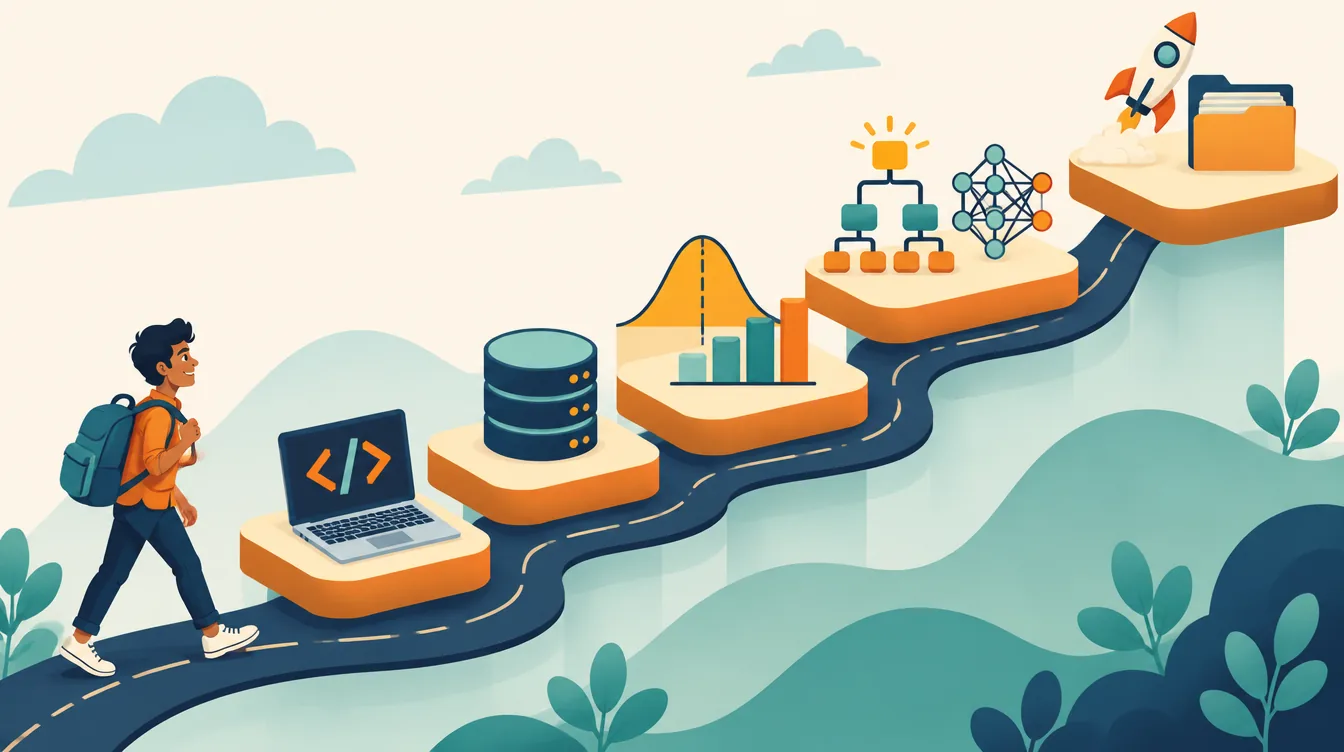
Each stage ends with a small project, so progress is visible.
| Stage | What you learn | Proof project at the end | Full-time | Part-time |
|---|---|---|---|---|
| 1. Foundations | Python, pandas, NumPy, SQL, Git | SQL analysis of a sales or e-commerce dataset | 6 to 8 weeks | 10 to 12 weeks |
| 2. Analysis | Statistics, probability, EDA, Power BI or Tableau | EDA report plus a dashboard with 3 business insights | 5 to 6 weeks | 8 to 10 weeks |
| 3. Machine learning | scikit-learn, regression, classification, evaluation, feature engineering | Churn or loan-default model with a clear metric | 8 to 10 weeks | 12 to 14 weeks |
| 4. GenAI and deployment | LLM APIs, prompt engineering, RAG, FastAPI, Docker, MLflow basics | A deployed model API and a small RAG chatbot | 6 to 8 weeks | 8 to 10 weeks |
| 5. Portfolio and jobs | GitHub, resume, LinkedIn, interview prep | 3 to 4 polished projects with live demo links | 4 to 6 weeks | 6 to 8 weeks |
These durations are our recommended plan, assuming about 25 to 30 hours a week for full-time learners and 10 to 12 hours a week for working professionals. Your pace may differ, and that is fine.
Now let's go stage by stage.
Stage 1: Python and SQL Foundations
Stage 1 of the data science roadmap covers the first two data scientist skills, Python and SQL, because every later stage depends on your ability to pull, clean and reshape data on your own.
Python is the main language for data science work. Focus on what you will actually use: variables, loops, functions, lists and dictionaries, then the pandas and NumPy libraries for working with tables of data. You do not need advanced object-oriented programming on day one.
SQL is the skill most beginners underrate. Job descriptions for data scientists in India routinely list SQL next to Python, and SQL rounds are common in analyst and data science interviews. Learn SELECT, WHERE, GROUP BY, JOINs, subqueries and window functions such as ROW_NUMBER and RANK.
Here's how to do Stage 1 well:
- Spend the first 3 weeks on core Python and pandas, using a real CSV file rather than toy examples.
- Spend the next 3 weeks on SQL, practising 3 to 5 questions a day.
- Learn basic Git and push every exercise to GitHub from the first week.
- Finish with one SQL project: answer five business questions on a sales dataset, such as a public Kaggle e-commerce dataset.
Resource: Our SQL interview questions for data analysts guide is a good practice bank for this stage.
Stage 2: Statistics, EDA and Visualisation
Stage 2 teaches you to understand data before you model it: statistics, exploratory data analysis (EDA) and a business intelligence tool.
Statistics and probability cover mean, median, variance, distributions, sampling, hypothesis testing, p-values and correlation. You need enough to know whether a pattern is real or just noise. You do not need a maths degree.
EDA is the habit of profiling a dataset: missing values, outliers, distributions and relationships between columns. Most real projects spend more time here than on modelling.
Visualisation means telling the story. Learn Matplotlib or Seaborn in Python, plus one BI tool. Power BI is widely used by Indian employers, and our Power BI dashboard tutorial walks through building one step by step.
For example, a good Stage 2 project takes a public dataset (say, Indian e-commerce orders), finds three insights such as "repeat buyers in tier-2 cities order more in festive months", and presents them in a one-page dashboard. That single project shows statistics, EDA and communication together.
Stage 3: Machine Learning
Stage 3 is machine learning, where you learn to build models that predict or classify, using the scikit-learn library in Python.
Start with supervised learning, since it covers most business problems. Our guide to the types of machine learning explains supervised, unsupervised and reinforcement learning with examples.
The core topics for this stage of the data science roadmap:
- Regression: linear regression for predicting numbers such as sales or prices.
- Classification: logistic regression, decision trees, random forest and gradient boosting for yes/no outcomes such as churn or fraud.
- Unsupervised learning: k-means clustering for customer segmentation.
- Model evaluation: train/test split, cross-validation, accuracy, precision, recall, F1-score and ROC-AUC.
- Feature engineering: encoding categories, scaling, handling imbalance and creating new features from dates or text.
Why does evaluation matter so much? Because a model with 95% accuracy can be useless. If only 5% of customers churn, a model that predicts "no churn" for everyone also scores 95%. Interviewers ask this exact question to check whether you understand precision and recall.
Resource: Once you finish this stage, test yourself with our machine learning interview questions.
Stage 4: Generative AI, MLOps and Deployment
Stage 4 adds the skills that separate a 2026 data scientist from a 2020 one: generative AI, deployment and basic MLOps.
Employer demand for AI skills has grown sharply. Naukri's World AI Day Report 2026 found that AI-related skills appear in 15.4% of technology job descriptions, up from 0.9% in 2020.
What to learn in this stage:
| Skill | What it means | Tools to start with |
|---|---|---|
| LLM APIs and prompt engineering | Calling a large language model from Python and getting reliable output | OpenAI or Gemini API, Python |
| RAG (retrieval-augmented generation) | Letting an LLM answer from your own documents | LangChain or LlamaIndex, a vector database such as Chroma |
| Model serving | Wrapping a model in an API others can call | FastAPI, Streamlit |
| Packaging | Making your app run the same everywhere | Docker |
| Experiment tracking | Recording models, parameters and results | MLflow |
| Cloud basics | Hosting a model or app online | AWS, Azure or Google Cloud free tiers |
You do not need to master all of these. Aim for one deployed model API and one small RAG chatbot. That is enough to talk confidently about generative AI and deployment in an interview.
Pro tip: Build your RAG project on documents that matter in India, such as a chatbot that answers questions from RBI circulars or a college prospectus. A local, specific use case is far more memorable to a recruiter than another generic PDF chatbot.
If you want to go deeper into AI engineering after this stage, see what a forward deployed engineer does.
Stage 5: Portfolio and Job Search
Stage 5 turns your learning into interviews: a portfolio of 3 to 4 deployed projects, a focused resume and a targeted job search.
A strong data science portfolio in 2026 usually has:
- One SQL and dashboard project that answers real business questions.
- One classic machine learning project with a clear metric and a short write-up of trade-offs.
- One generative AI project, such as a RAG chatbot, with a live demo link.
- One end-to-end project that goes from raw data to a deployed API.
Each project needs a GitHub README that explains the problem, the data, your approach, the result and what you would do next. Write the result in business terms: "flags 70% of churners in the top 20% of scores" lands better than "built XGBoost".
Where to apply? Product companies, global capability centres (GCC teams) and analytics firms all hire data talent. Many people enter as a data analyst first and move into a data scientist role after a year or two, which is a perfectly good path. For more on entry-level openings, read our guide to data science jobs for freshers.
For pay expectations, our data science salary in India guide explains why sources differ and what different CTC offers mean as in-hand pay.
Data Science Tools: Learn Now, Learn Later, Skip
Data science tools fall into three groups for a beginner: tools to learn now, tools to learn once you have the basics, and tools you can skip until a job needs them.

Learn a small set of tools well before adding more.
| Group | Tools | Why |
|---|---|---|
| Learn now | Python, pandas, NumPy, SQL, Git and GitHub, Jupyter or VS Code, Excel | Used in almost every data job from day one |
| Learn now | Power BI or Tableau (pick one) | Needed to present results to business teams |
| Learn after basics | scikit-learn, Matplotlib, Seaborn | Core machine learning and charting |
| Learn after basics | LLM APIs, LangChain, a vector database, FastAPI, Docker, MLflow | Generative AI and deployment skills employers now list |
| Skip for now | R (unless your target role asks for it), Hadoop, advanced deep learning research, Kubernetes | Useful in specific roles, but rarely tested for entry-level data science jobs |
Bottom line: depth in a few tools beats a long list on your resume. Interviewers will pick any tool you list and ask you to use it.
Data Science Roadmap Timeline by Background
A realistic data science roadmap timeline depends on where you start and how many hours you can give each week. Here is our recommended plan for three common starting points:
| Your starting point | Hours per week | Stage 1 to 3 | Stage 4 to 5 | Total |
|---|---|---|---|---|
| Final-year student or fresh graduate (any stream), studying full-time | 25 to 30 | Months 1 to 5 | Months 6 to 8 | About 8 months |
| BCA, BSc CS or engineering graduate with some coding | 20 to 25 | Months 1 to 4 | Months 5 to 7 | About 7 months |
| Working professional switching careers, part-time | 10 to 12 | Months 1 to 8 | Months 9 to 12 | About 12 months |
These are planning estimates, not guarantees. Missed weeks are normal. What matters is coming back to the plan rather than restarting from scratch.
Important: Do not wait until the end to start applying. Begin applying for analyst and junior roles once you finish Stage 3, and keep building Stage 4 projects in parallel.
How to Become a Data Scientist from a Non-Tech Background
You can become a data scientist from a non-tech background (BCom, BBA, BA, BSc non-CS) by following the same data science roadmap, with extra time on Python and statistics and a deliberate focus on your domain knowledge.
Here's how to adapt the roadmap:
- Add 3 to 4 weeks to Stage 1. Programming is new, so give Python basics more time before pandas.
- Use your domain. A commerce graduate can build finance and sales projects; a biology graduate can work with healthcare data. Domain context makes your projects stand out.
- Consider the analyst route. A data analyst role uses Stage 1 and 2 skills and is a common first step. Our data analyst course fees guide compares classroom, online and free options.
- Get feedback early. Self-study works, but code reviews and mock interviews catch gaps much faster.

Guided practice and reviews help career switchers move through the roadmap faster.
7 Mistakes That Slow Down Your Data Science Roadmap
Most delays in a data science roadmap come from a handful of avoidable habits:
- Collecting certificates instead of projects. Employers increasingly check skills, not just credentials.
- Skipping SQL. It is one of the most commonly tested skills in data interviews.
- Starting with deep learning. Neural networks are exciting, but classic machine learning solves most business problems and is what entry-level interviews test.
- Tutorial loops. Watching without building. Aim for at least as much time coding as watching.
- Ignoring generative AI. In 2026, at least one LLM project is expected for many data roles.
- Notebook-only projects. Deploy at least one project so a recruiter can click and use it.
- Applying too late. Start applying after Stage 3, not after you feel "ready".
Data Science Roadmap: Your Next Step
A data science roadmap works when you follow it in order: Python and SQL, then statistics and EDA, then machine learning, then generative AI and deployment, then a portfolio. Each stage ends with a project, so you are building proof the whole way.
If you would rather follow this data science roadmap with trainers, structured projects and mock interviews, Fireblaze's PG Program in Data Science and Analytics with GenAI covers Python, SQL, statistics, machine learning, Power BI and generative AI, in classroom and live online formats.
Which stage are you starting from today?
FAQ
What is the data science roadmap for beginners?
The data science roadmap for beginners has five stages: Python and SQL, statistics and exploratory data analysis, machine learning, generative AI and deployment, and finally a portfolio and job search. Each stage should end with a small project so you build proof as you learn.
How long does it take to become a data scientist in India?
Most beginners need about 8 months of full-time study or about 12 months of part-time study to become job-ready, based on our recommended plan. Learners with a coding background can often finish in about 7 months. Your pace depends on weekly hours and consistency.
How to become a data scientist after 12th or graduation?
After graduation, you can follow the same five-stage roadmap and start with Python and SQL. After 12th, a degree in a quantitative field such as BSc Data Science, BCA or engineering helps, but many employers in India hire based on skills and projects, not only degrees.
Is coding required for data science?
Yes, coding is required for data science. Python and SQL are the two languages you must know. You do not need to be a software engineer, but you should be able to clean data, build models and write queries on your own.
Do I need to learn generative AI to become a data scientist in 2026?
Yes, basic generative AI skills help in 2026. Naukri's World AI Day Report 2026 found AI skills in 15.4% of tech job descriptions, up from 0.9% in 2020. One LLM or RAG project in your portfolio is a good starting point.
Can a non-IT student follow this data science roadmap?
Yes. Non-IT students from commerce, arts or science streams can follow this data science roadmap by giving extra time to Python and statistics. Domain knowledge from your degree can make your projects more convincing to employers.
Sources
- Naukri JobSpeak: White-collar hiring holds steady in September; AI/ML roles continue growth streak, 6 October 2026
- Staffing Industry Analysts: India's white-collar hiring jumps 14% in October, 3 November 2026
- CXOToday: Skills Over Degrees, Nasscom and Indeed report on India's AI hiring, 2026
- Telangana Today: AI skills feature in 15.4% of tech job descriptions, Naukri report, July 2026
- World Economic Forum: The future of jobs in India, 2025