 Fireblaze
Learning Guides
Types of Machine Learning Explained with Real Examples (2026)
Learn the 5 types of machine learning with real examples from Gmail, food delivery apps, UPI and ChatGPT, plus a 2-question test to pick the right type for a problem.

Every machine learning course starts with the same slide: supervised, unsupervised, reinforcement.
Then you open ChatGPT and wonder which of the three it is. (Answer: all of them, plus one most slides skip.)
In this guide you'll learn the types of machine learning the way they're used in practice, with examples you already use: Gmail, food delivery apps, UPI payments and ChatGPT.
You'll also get:
- A side-by-side comparison table of all 5 machine learning types
- The "2-Question Test" to pick the right type for a problem
- A breakdown of how one chatbot uses three types in a row
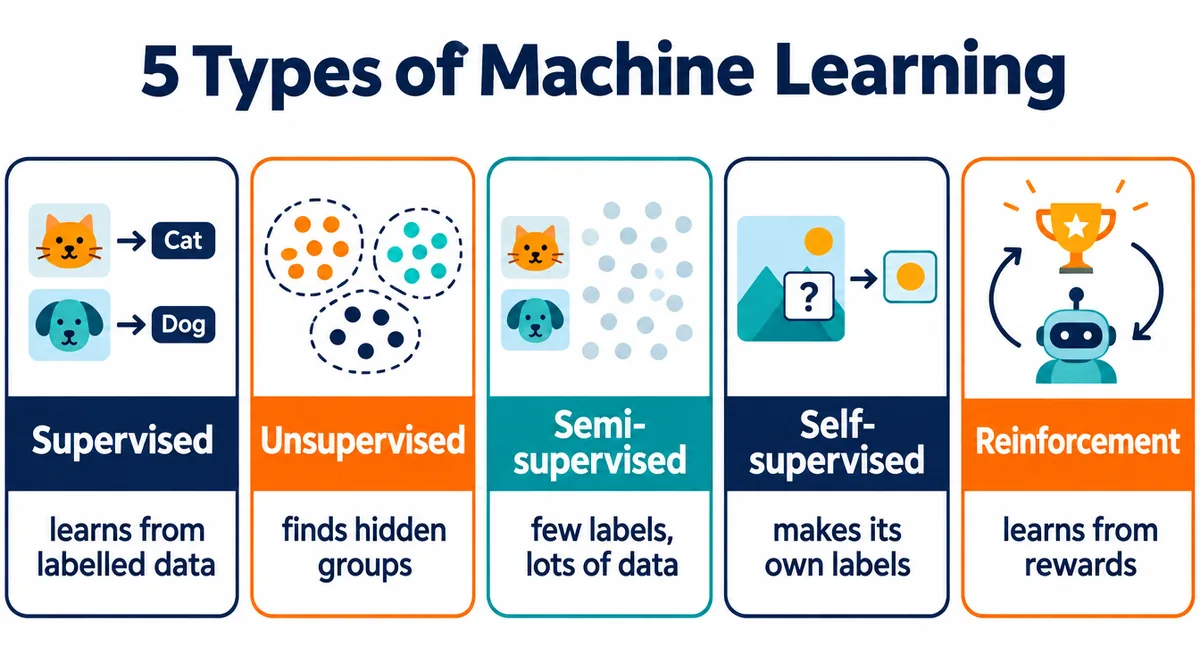
The types of machine learning are the different ways a model learns from data: supervised learning (from labelled answers), unsupervised learning (finding hidden groups), semi-supervised learning (a few labels plus lots of raw data), self-supervised learning (creating its own labels) and reinforcement learning (learning from rewards). The type depends on what data you have and what you want to predict.
Quick answer: types of machine learning (November 2026)
- Supervised learning trains on labelled examples, as in an email spam filter that learns from messages users mark as spam.
- Unsupervised learning finds groups in unlabelled data, such as customer segments found with k-means clustering.
- Semi-supervised learning mixes a small set of labelled data with a large set of unlabelled data to cut labelling costs.
- Self-supervised learning creates labels from raw data, which is how large language models learn by predicting the next word.
- Reinforcement learning improves through rewards, as in game-playing agents and the RLHF step OpenAI used to train InstructGPT.
Contents
- What Are the Types of Machine Learning?
- Type 1: Supervised Learning
- Type 2: Unsupervised Learning
- Type 3: Semi-Supervised Learning
- Type 4: Self-Supervised Learning
- Type 5: Reinforcement Learning
- Types of Machine Learning Compared Side by Side
- How ChatGPT Uses Three Types of Machine Learning
- The 2-Question Test: Which Type Should You Use?
- Where Generative AI and Deep Learning Fit
- How to Start Learning These Machine Learning Types
- FAQ
What Are the Types of Machine Learning?
Machine learning is usually split into types based on one thing: the kind of feedback the model gets while it learns. Labelled answers, no answers, a few answers, self-made answers, or rewards for actions each create a different type.
Different sources count differently, and that confuses students. Most Indian course pages list four types. Google's introduction to machine learning covers supervised, unsupervised and reinforcement learning, and introduces generative models as a further category.
This guide uses five types, because self-supervised learning is now how the largest language models are pretrained, and skipping it leaves a gap in a 2026 interview answer.
Type 1: Supervised Learning
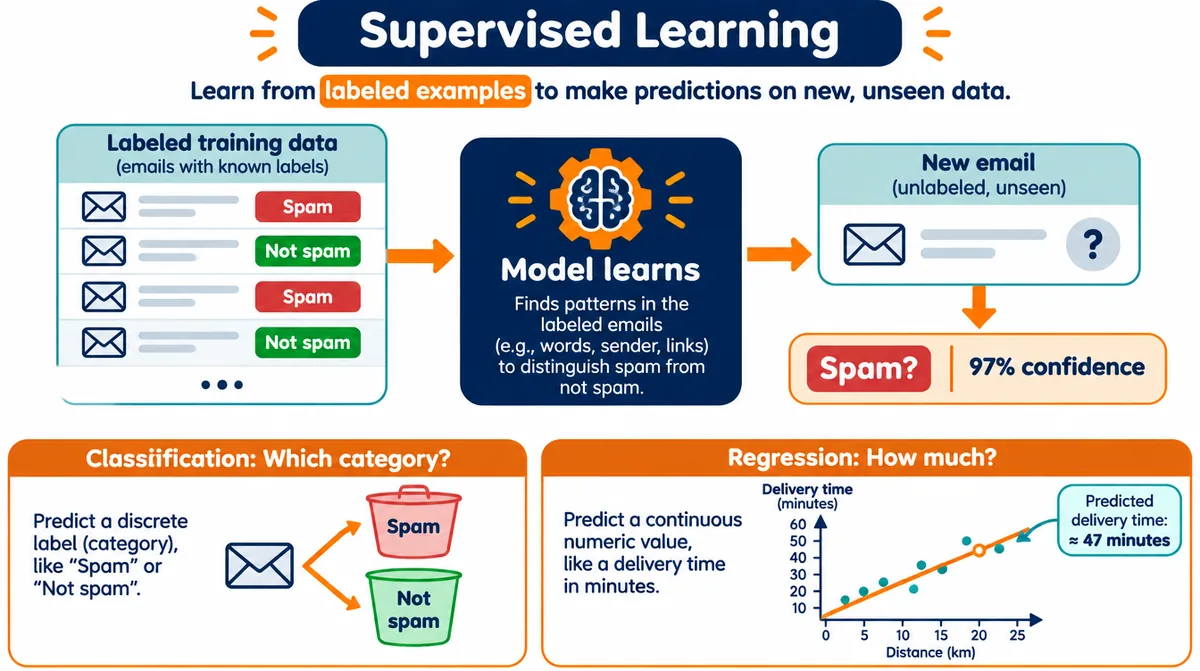
Supervised learning is the machine learning type where a model trains on labelled data, meaning every example comes with the correct answer. Google describes these systems as supervised because a human provides the ML system with data that has known correct results.
Think of it like studying with past exam papers that include the answer key.
Supervised learning solves two kinds of problems:
- Classification predicts a category. Is this email spam or not? Will this customer churn, yes or no?
- Regression predicts a number. How many minutes will this delivery take? What price will this flat sell for?
Real Example: Gmail's Spam Filter (Classification)
Email spam filtering is the classic supervised learning example. In 2017, Google said machine learning helped Gmail keep spam and phishing out of inboxes with over 99.9% accuracy, and that 50 to 70% of the messages Gmail receives are spam. Those are company claims from that period, not current figures.
Every time you click "Report spam", you add a label the model can learn from.
Real Example: Delivery Time (Regression)
Predicting how many minutes a food order will take is a regression problem, because the output is a number. Delivery apps train models on past orders, distances and restaurant times to estimate arrival, then update the estimate as the order moves.
Common algorithms: linear regression, logistic regression, decision trees, random forest, XGBoost, support vector machines and neural networks.
Pro tip: In interviews, always say classification or regression when you mention supervised learning. It shows you understand the output, not just the label.
Type 2: Unsupervised Learning
Unsupervised learning is the machine learning type where a model finds patterns in data that has no labels at all. Nobody tells the model the right answer, so it groups or simplifies the data on its own.
Here's the simplest way to think about it: you give a model 10,000 customer records and ask, "Do these people fall into natural groups?"
The three main jobs of unsupervised learning are:
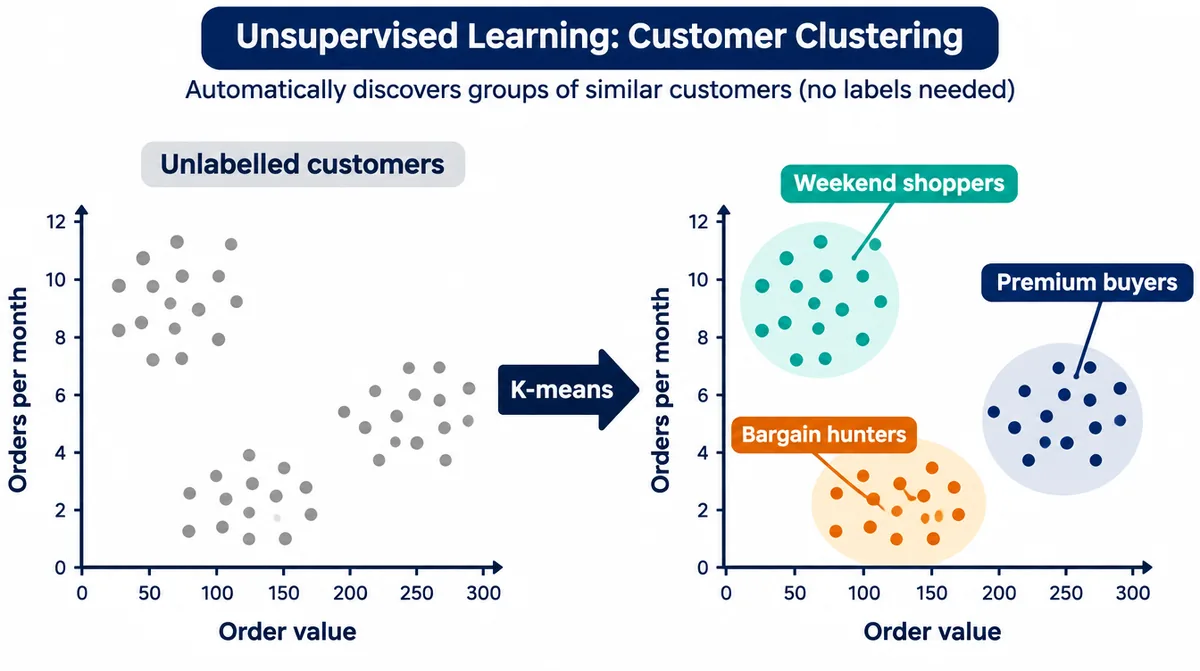
- Clustering: grouping similar items, such as customer segments.
- Dimensionality reduction: squeezing many columns into a few that keep most of the information (PCA is the common method).
- Anomaly detection: spotting records that don't fit any normal pattern, like an unusual transaction.
Real Example: Customer Segmentation with K-Means
Retailers, banks and telecom companies use k-means clustering to split customers into segments based on spending, frequency and recency. A marketing team then names the segments ("bargain hunters", "premium buyers") and builds a different campaign for each.
The key point: the model found the groups. Humans only named them afterwards.
Common algorithms: k-means, hierarchical clustering, DBSCAN, PCA and autoencoders.
Note: Unsupervised results are harder to judge, because there's no answer key to score them against. You check whether the groups make business sense.
Type 3: Semi-Supervised Learning
Semi-supervised learning is the machine learning type that combines a small amount of labelled data with a large amount of unlabelled data. It sits between supervised and unsupervised learning, and it exists because labelling data is slow and expensive.
For example, a hospital may have 1,00,000 chest X-rays but only 2,000 labelled by radiologists. Semi-supervised methods train on the labelled images, guess labels for the rest, and keep the most confident guesses to train further. This trick is called pseudo-labelling.
Fraud detection is another good fit, because confirmed fraud cases are rare while unlabelled transactions are plentiful.
Where it's used: medical imaging, speech recognition, document classification and fraud detection.
Bottom line: If someone says "we have lots of data but very few labels", semi-supervised learning is usually the first idea to try.
Type 4: Self-Supervised Learning
Self-supervised learning is the machine learning type where a model creates its own labels from raw data, usually by hiding part of the input and learning to predict it. It needs no human annotation, which is why it scales to very large datasets.
This is how large language models learn. In next-token prediction, the text itself supplies both the inputs and the targets, so annotators don't have to label anything.
Here's what that looks like: the model sees "The capital of Maharashtra is ___" and learns that "Mumbai" is the likely next word. Repeat that across billions of sentences and the model picks up grammar, facts and reasoning patterns.
Self-supervised vs unsupervised: both use unlabelled data. The difference is that self-supervised learning sets up a concrete prediction task with an automatic answer key, while unsupervised learning looks for structure.
Where it's used: large language model pretraining, image models that learn by filling in masked patches, and speech models.
Type 5: Reinforcement Learning
Reinforcement learning is the machine learning type where an agent learns by taking actions in an environment and receiving rewards or penalties. There's no answer key, only feedback on how good each action turned out to be.
It's how you learned to ride a bicycle: try, wobble, adjust, try again.
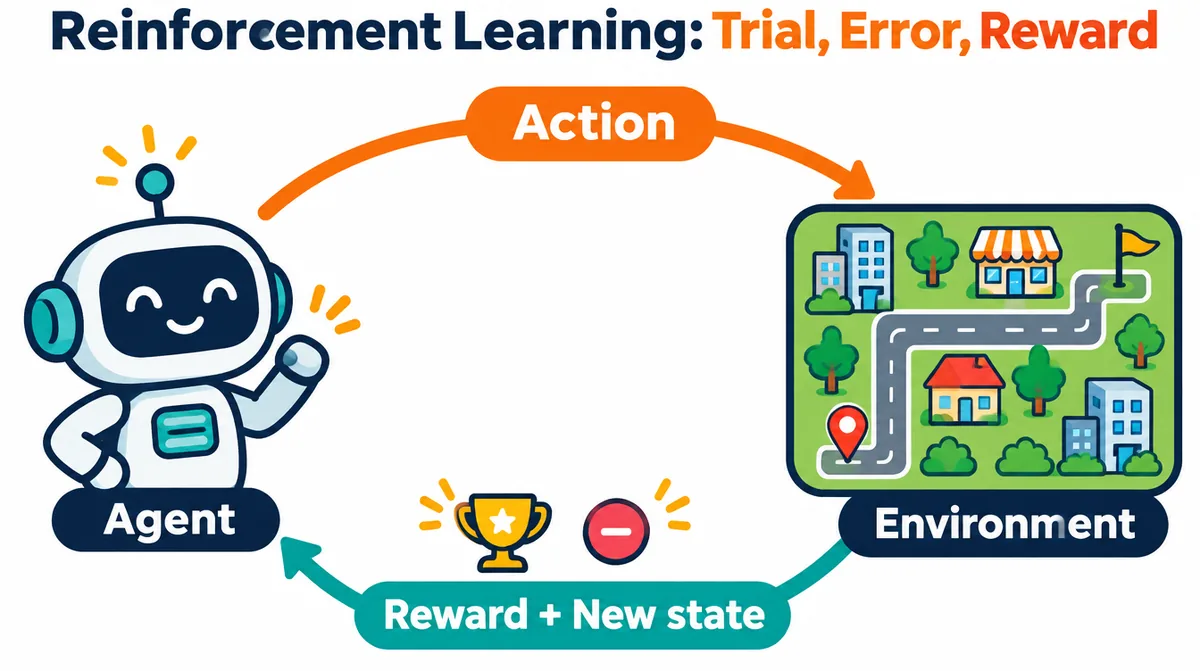
Real Examples of Reinforcement Learning
- Games: Google's course notes that reinforcement learning is used to train software programs like AlphaGo to play the game of Go.
- Robotics: training robots to walk, grip and move around a room.
- Chatbots: OpenAI's InstructGPT used reinforcement learning from human feedback (RLHF), where human rankings of answers act as the reward.
- Business: dynamic pricing, ad bidding and recommendation systems that optimise long-term engagement.
Important: Reinforcement learning needs a safe place to fail, usually a simulator, because the agent makes thousands of bad moves before it gets good. That's why most beginners meet it last.
Types of Machine Learning Compared Side by Side
The five machine learning types differ mainly in what data they need and what they produce. Use this table as a quick revision sheet before exams and interviews:
| Type | Data it needs | What it outputs | Real example | Common algorithms |
|---|---|---|---|---|
| Supervised | Labelled data | A category or a number | Spam filter, delivery time | Logistic regression, random forest, XGBoost |
| Unsupervised | Unlabelled data | Groups, patterns, outliers | Customer segmentation | K-means, DBSCAN, PCA |
| Semi-supervised | Few labels plus lots of unlabelled data | A category or a number | Medical image labelling | Pseudo-labelling, label propagation |
| Self-supervised | Raw data, labels made automatically | General-purpose representations | Large language model pretraining | Transformers (next-token, masked prediction) |
| Reinforcement | An environment and a reward signal | A strategy (policy) for actions | Game-playing agents, RLHF in chatbots | Q-learning, PPO |
Supervised vs Unsupervised Learning: The Short Version
Supervised vs unsupervised learning comes down to one question: do you have the answers in your training data? If yes, it's supervised. If no and you want to discover structure, it's unsupervised.
Machine Learning Types in Everyday Products
The apps you use every week rely on these types. Companies rarely publish their full ML stack, so the "likely type" column below is a teaching interpretation, not an official statement from any company.
| Product type | Problem | Likely type |
|---|---|---|
| Payment apps (UPI) | Flagging a suspicious payment | Supervised + anomaly detection |
| Food delivery apps | Predicting delivery minutes | Supervised (regression) |
| Shopping apps | Grouping shoppers for offers | Unsupervised (clustering) |
| Voice assistants in Hindi and Marathi | Understanding speech with few transcripts | Semi-supervised / self-supervised |
| Chatbots like ChatGPT and Gemini | Generating helpful answers | Self-supervised + supervised + reinforcement |
How ChatGPT Uses Three Types of Machine Learning
ChatGPT-style chatbots are the best proof that the ML types aren't separate boxes. Training one model usually uses three types in sequence: self-supervised pretraining, supervised fine-tuning and reinforcement learning from human feedback.
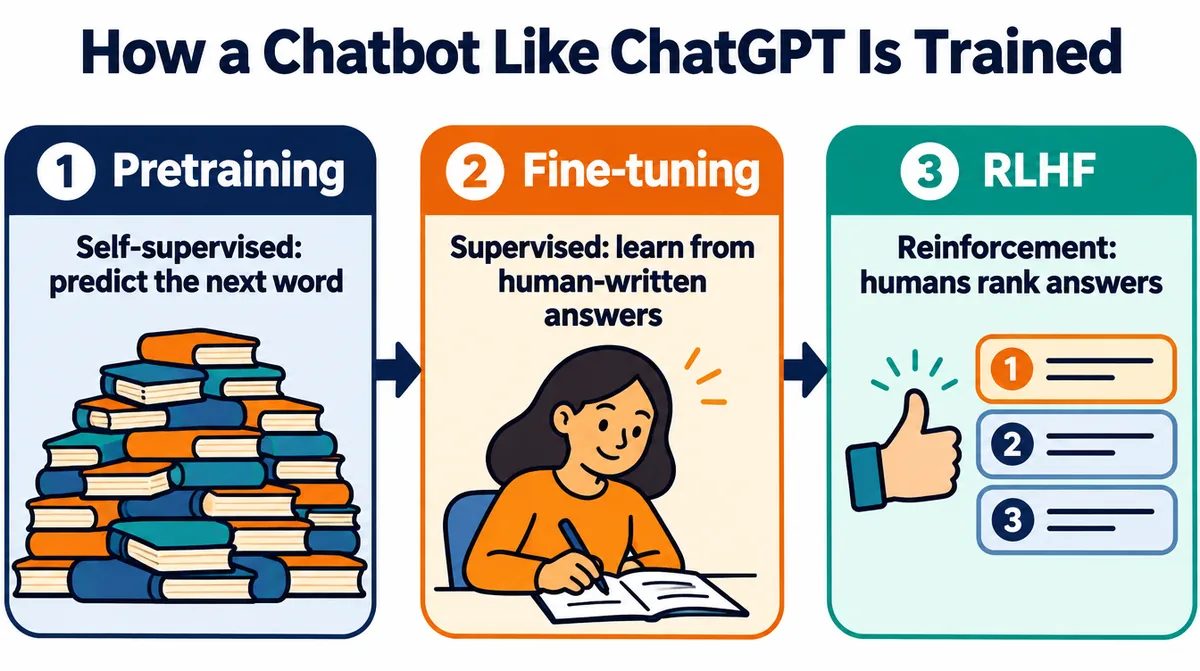
OpenAI's 2022 InstructGPT paper, Training language models to follow instructions with human feedback, describes the recipe:
- Self-supervised pretraining: the base model (GPT-3) learns language by predicting the next token on large amounts of text.
- Supervised fine-tuning: OpenAI collected demonstrations of the desired behaviour from human labellers and fine-tuned the model on them.
- Reinforcement learning (RLHF): labellers ranked several model outputs, a reward model learned those preferences, and the chatbot was tuned to score higher on it.
The result surprised many people. OpenAI reported that labellers preferred outputs from the 1.3B-parameter InstructGPT model over the 175B-parameter GPT-3, despite having more than 100 times fewer parameters.
This is the answer that impresses interviewers. Most candidates say "ChatGPT uses deep learning." You can say exactly which learning types it uses, and in what order.
The 2-Question Test: Which Type Should You Use?
The 2-Question Test is a simple way to choose between the five ML types for any problem. Ask two questions in order.
Question 1: Is the goal a sequence of actions judged by a reward? If yes, use reinforcement learning.
Question 2: Do you have labelled answers?
- Yes, plenty: supervised learning.
- Only a few: semi-supervised learning.
- None: unsupervised learning to find groups, or self-supervised learning to pretrain on raw data.
Let's test it on three problems:
| Problem | Q1: Rewards for actions? | Q2: Labels? | Type |
|---|---|---|---|
| Predict if a loan applicant will default | No | Yes, past loans marked default or not | Supervised (classification) |
| Group 50,000 shoppers for festive offers | No | None | Unsupervised (clustering) |
| Teach a warehouse robot to pick boxes | Yes | Not needed | Reinforcement |
Where Generative AI and Deep Learning Fit
Generative AI and deep learning are not extra learning types in the same sense. Deep learning is a technique (neural networks with many layers) that can be used inside any of the five types. Generative AI is a category of models that create new content.
Google's course describes generative models as models that learn patterns in data with the goal of producing new but similar data, and notes they are sometimes trained further using supervised or reinforcement learning.
So when someone asks, "Is generative AI supervised or unsupervised?", a precise answer is: its pretraining is usually self-supervised, and its fine-tuning is supervised and reinforcement.
How to Start Learning These Machine Learning Types
Learn supervised learning first, then unsupervised, then the rest. Supervised learning teaches the core ideas (training data, features, evaluation) that every other type builds on.
Here's a practical 8-week path:
- Weeks 1 to 2: Python, pandas and basic statistics.
- Weeks 3 to 4: Supervised learning with scikit-learn: linear regression, logistic regression, decision trees.
- Week 5: Unsupervised learning: k-means and PCA on a customer dataset.
- Week 6: Model evaluation: accuracy, precision, recall, train-test split.
- Week 7: One end-to-end project you can explain in an interview.
- Week 8: Read about self-supervised learning and RLHF so you can explain modern language models.
Prepare with these machine learning interview questions. If you lean towards analytics, also see our data analyst interview questions.
Want to build real projects with these types, with trainer feedback? Explore our Data Science certification course in Nagpur.
Now It's Your Turn
Machine learning types are simpler than they look: supervised learns from answers, unsupervised finds groups, semi-supervised stretches a few labels, self-supervised makes its own labels, and reinforcement learns from rewards.
Pick one problem you care about and run it through the 2-Question Test today.
Which of these types of machine learning do you want to try first?
About the Author
Aniruddha Abhay Kalbande is the founder of Fireblaze AI School, which he started in Nagpur on 31 October 2017. He is an Electronics and Telecommunication Engineer from Yeshwantrao Chavan College of Engineering (YCCE), Nagpur, with 10 years of experience in IT consulting and training. He has trained more than 20,000 students. The school is a NASSCOM partner for its Post Graduate Program in Data Science & Analytics and runs classroom batches at 3 Nagpur centers alongside live online batches across Maharashtra. He writes here on career roadmaps, interview preparation and how to evaluate a training institute honestly.
Sources
- What is Machine Learning? (Types of ML systems), Google for Developers
- Google claims to block 99.9% of phishing attacks using machine learning, IT Pro, 2017
- Training language models to follow instructions with human feedback, Ouyang et al., arXiv, 2022
- Aligning language models to follow instructions, OpenAI, 2022
FAQ
Frequently Asked Questions
What are the main types of machine learning?
The main types of machine learning are supervised, unsupervised and reinforcement learning. Many modern courses add semi-supervised and self-supervised learning, making five types. Self-supervised learning matters most today because it is how large language models are pretrained.
What is the difference between supervised and unsupervised learning?
Supervised learning trains on labelled data where the correct answer is known, so it can predict categories or numbers. Unsupervised learning works on unlabelled data and finds hidden groups or patterns on its own. Spam filtering is supervised; customer segmentation is unsupervised.
Which type of machine learning is used in ChatGPT?
ChatGPT-style models use three types. They are pretrained with self-supervised learning (predicting the next word), fine-tuned with supervised learning on human-written answers, and refined with reinforcement learning from human feedback (RLHF).
Is deep learning a type of machine learning?
Deep learning is a subset of machine learning that uses multi-layer neural networks, but it is not one of the learning types. A deep learning model can be trained in a supervised, unsupervised, self-supervised or reinforcement way.
Which type of machine learning should a beginner learn first?
Start with supervised learning, because it teaches training data, features and model evaluation in the simplest setting. Move to unsupervised clustering next, then read about self-supervised and reinforcement learning once you have built one project.
Keep Reading
Related Articles
Interview Preparation
Machine Learning Interview Questions and Answers (2026)
Machine learning interview questions for freshers and experienced candidates: fundamentals, algorithms, metrics, scenarios and how to answer
Interview Preparation
60 Data Analyst Interview Questions and Answers (2026)
Prepare with 60 data analyst interview questions and answers on SQL, Excel, Power BI, Python and case rounds, plus a 30-day plan for Indian
Learning Guides
How to Build a Dashboard with Power BI: Step-by-Step Tutorial (2026)
Build a dashboard with Power BI in 7 steps: get data, clean it, model it, write DAX, design the KTB layout, publish and pin. Free sample dat