 Fireblaze
Learning Guides
What Is Data Science? A Plain-English Guide with Indian Examples
What is data science? A plain-English guide with Indian examples like UPI and food delivery, the 5-step lifecycle, skills, tools, salary and how to start.

You have heard the term everywhere: in placement talks, in job ads, maybe from a relative who says "beta, data science mein scope hai". But nobody explains it simply.
So what is data science, really? This guide answers that in plain English, using examples you already know: UPI payments, food delivery ETAs, Flipkart recommendations and IPL match predictions.
You'll see:
- A one-paragraph definition you can repeat to anyone
- The 5-step lifecycle every data science project follows
- The skills, tools, salaries and jobs in India in 2026
Let's start.
Data science is the practice of using data, statistics and programming to answer questions and make predictions that help people take better decisions. A data scientist collects raw data, cleans it, finds patterns, builds models that predict what will happen next, and explains the results in simple language. Your food app's "arriving in 28 minutes" is data science at work.
Quick answer: what is data science (November 2026)
- Data science combines statistics, programming (mostly Python and SQL) and business knowledge to turn raw data into decisions and predictions.
- Every data science project follows a lifecycle: define the problem, collect data, clean it, analyse and model it, then communicate the result.
- India's UPI network processed 25.47 billion transactions worth ₹31.53 lakh crore in October 2026, according to NPCI data. That is the kind of data volume data scientists work with.
- Adecco India expects tech hiring to grow 12 to 15% in 2026, with demand for AI, data and cybersecurity roles up 51%.
- Self-reported 2026 salary data from AmbitionBox and Glassdoor India puts the average data scientist salary near ₹11 LPA, with freshers often starting between ₹5 and ₹8 LPA.

What Is Data Science in Simple Words?
The data science meaning, in simple words, is finding useful answers hidden inside data. It asks three questions: what happened, why did it happen, and what will happen next?
Think of a kirana shop owner in Nagpur. He notices that Maggi sells out every Sunday evening during the monsoon. Without any software, he has spotted a pattern and acted on it by stocking more. That is the instinct behind data science.
Now multiply that shop by 10 crore customers and 50,000 products. No human can spot patterns at that scale. Data science uses statistics and code to do it automatically.
IBM describes data science as a multidisciplinary field that blends maths, statistics, programming, AI and machine learning with subject expertise to find insights in an organisation's data (IBM). That is the textbook version. The kirana version is easier to remember.
Structured vs unstructured data
Data science works with two kinds of data:
- Structured data sits neatly in rows and columns: sales tables, Excel sheets, bank statements.
- Unstructured data has no fixed format: WhatsApp messages, product reviews, photos, voice notes, CCTV footage.
Most business data in India is still structured, which is why SQL and Excel remain the first skills to learn. But big data and generative AI have made unstructured data far more useful than it was five years ago.
Note: When people search "data science what is", they often mean "is it just coding?" No. Coding is one tool. The real work is asking the right question and trusting the answer only when the data supports it.
Examples from Everyday Indian Life
Data science examples are all around you, usually without you noticing. Here are six that most Indians touch every week.
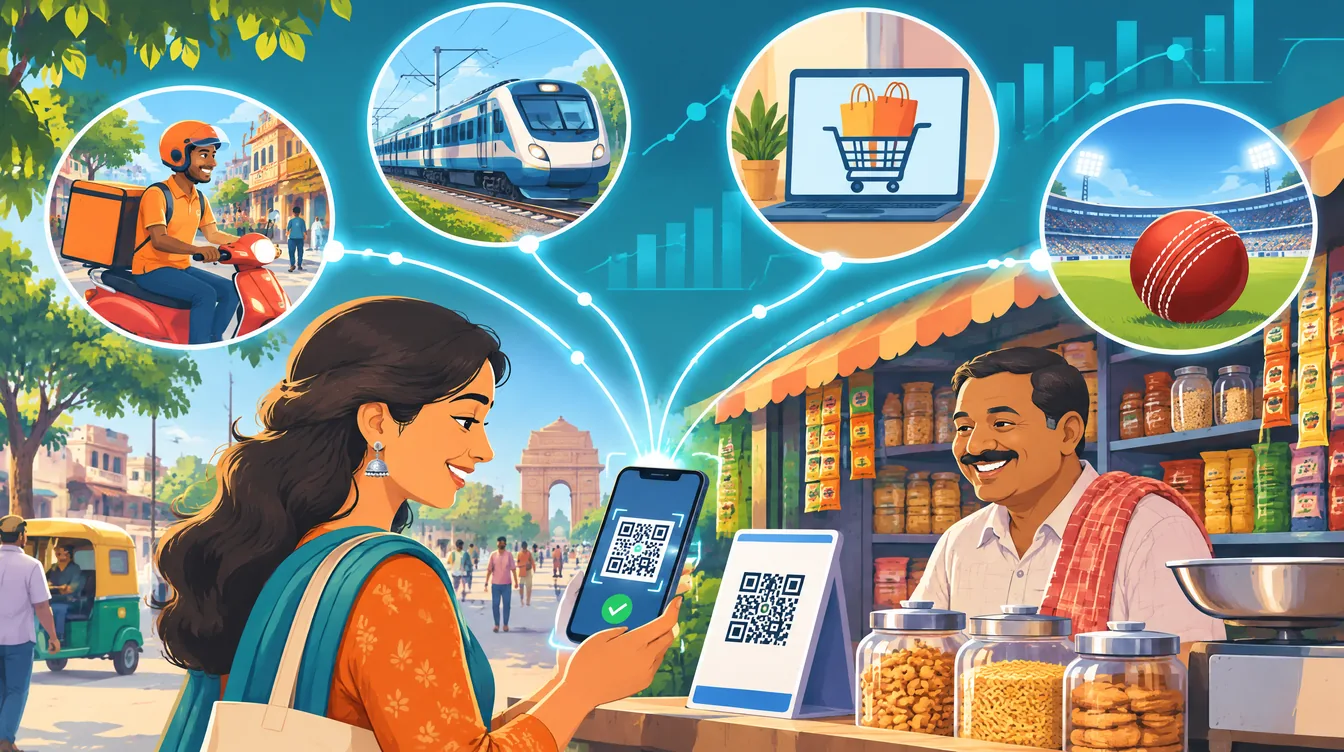
1. UPI fraud checks. India's UPI network processed 25.47 billion transactions worth ₹31.53 lakh crore in October 2026, according to NPCI data reported by Free Press Journal. Banks and payment apps use models trained on past transactions to flag payments that look unusual, such as a new device, a strange amount or an odd time, within seconds.
2. Food delivery time estimates. When Swiggy or Zomato shows "arriving in 28 minutes", a model has looked at distance, traffic, restaurant prep time, rain and how many riders are free nearby. It is a prediction, and the companies keep retraining it as patterns change.
3. Shopping recommendations. "Customers who bought this also bought..." on Flipkart, Amazon or Meesho comes from recommendation systems that learn from millions of past orders.
4. Train and flight pricing. Dynamic fares on airlines and premium train quotas rise and fall with demand forecasts built on past booking data.
5. Cricket analytics. IPL teams and broadcasters use ball-by-ball data to plan bowling changes, pick auction targets and show live win-probability graphs.
6. Farming and weather. Crop advisory apps combine weather forecasts, soil data and mandi prices to tell farmers when to sow and where to sell.
Notice the pattern? Each example takes past data, finds a pattern and uses it to predict or decide something. That is data science in one sentence.
The Data Science Lifecycle: 5 Steps
The data science lifecycle is the sequence of steps every project follows, from a business question to a decision. IBM's version has four stages: ingestion, storage and processing, analysis, and communication (IBM). This guide uses five steps because beginners most often skip the first one:
- Define the problem. Turn a vague goal into a measurable question.
- Collect the data. Pull it from databases, Excel files, APIs or surveys.
- Clean and prepare it. Fix missing values, duplicates and wrong formats.
- Analyse and model. Explore patterns, then build a model that predicts.
- Communicate the result. Share a dashboard or recommendation people can act on.
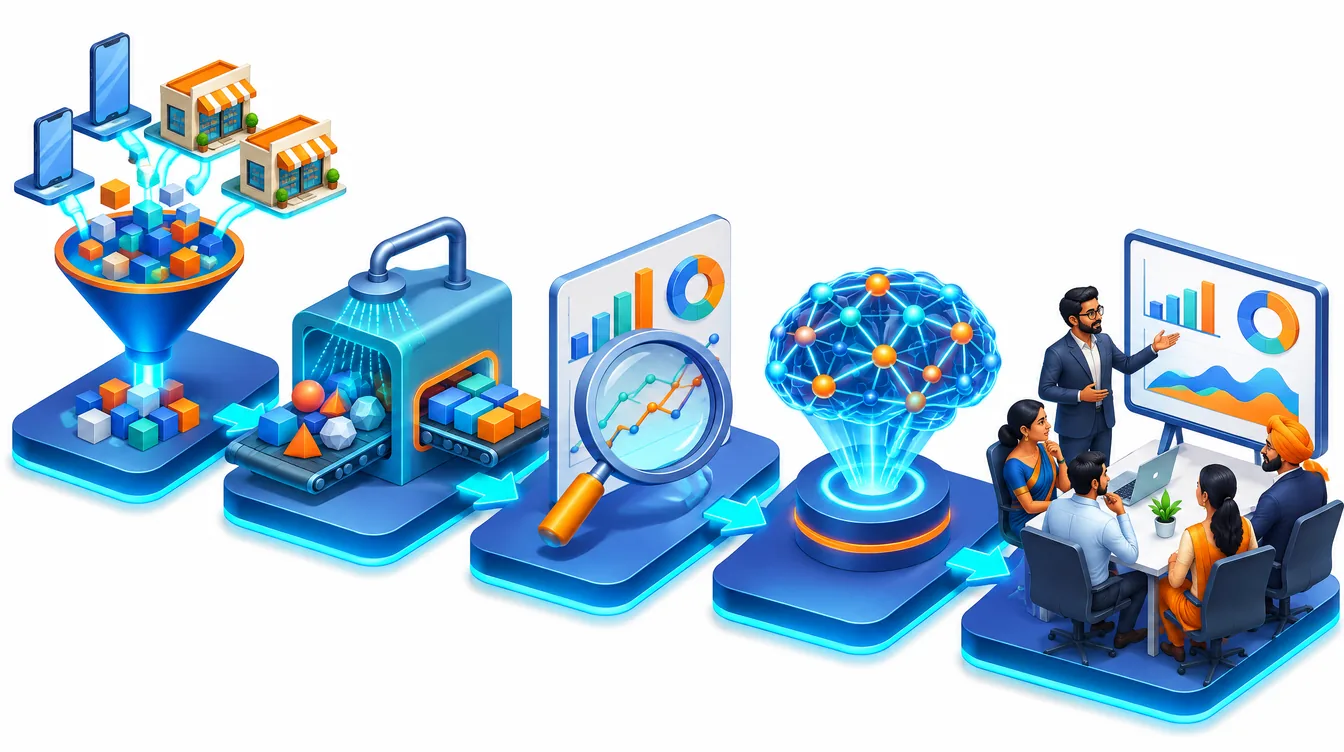
Here is how the five steps look on an illustrative problem. A two-wheeler showroom in Pune wants to know which enquiries will turn into bookings.
| Step | What happens | Typical tool |
|---|---|---|
| 1. Define | "Which leads are likely to book within 30 days?" | Conversation with the sales head |
| 2. Collect | Export 18 months of enquiries from the CRM | SQL, Excel |
| 3. Clean | Remove duplicate phone numbers, fix model names, fill missing sources | Python (pandas) |
| 4. Model | Train a classification model on past bookings | Python (scikit-learn) |
| 5. Communicate | A Power BI dashboard ranking today's hot leads | Power BI |
The model itself is one row of five. That surprises most beginners.
Why cleaning takes the longest
Data cleaning is the step that eats most of a project's time, because real business data is messy. Phone numbers are stored as text, dates come in three formats, and "Pune" is spelt four ways.
Expect the first real dataset to be a reality check. Beginners usually expect to start building models on day one, then spend most of the first project fixing date formats, merging duplicate customer records and deciding what to do with blank cells. Treating cleaning as part of the job, rather than a chore before the "real" work, usually produces much stronger projects. Being able to explain how you cleaned a dataset also tends to impress interviewers more than naming a fancy algorithm.
The 3 Pillars of Data Science
Data science rests on three pillars: statistics, programming and business knowledge. You need a working level of all three. Mastery in one cannot cover a gap in another.
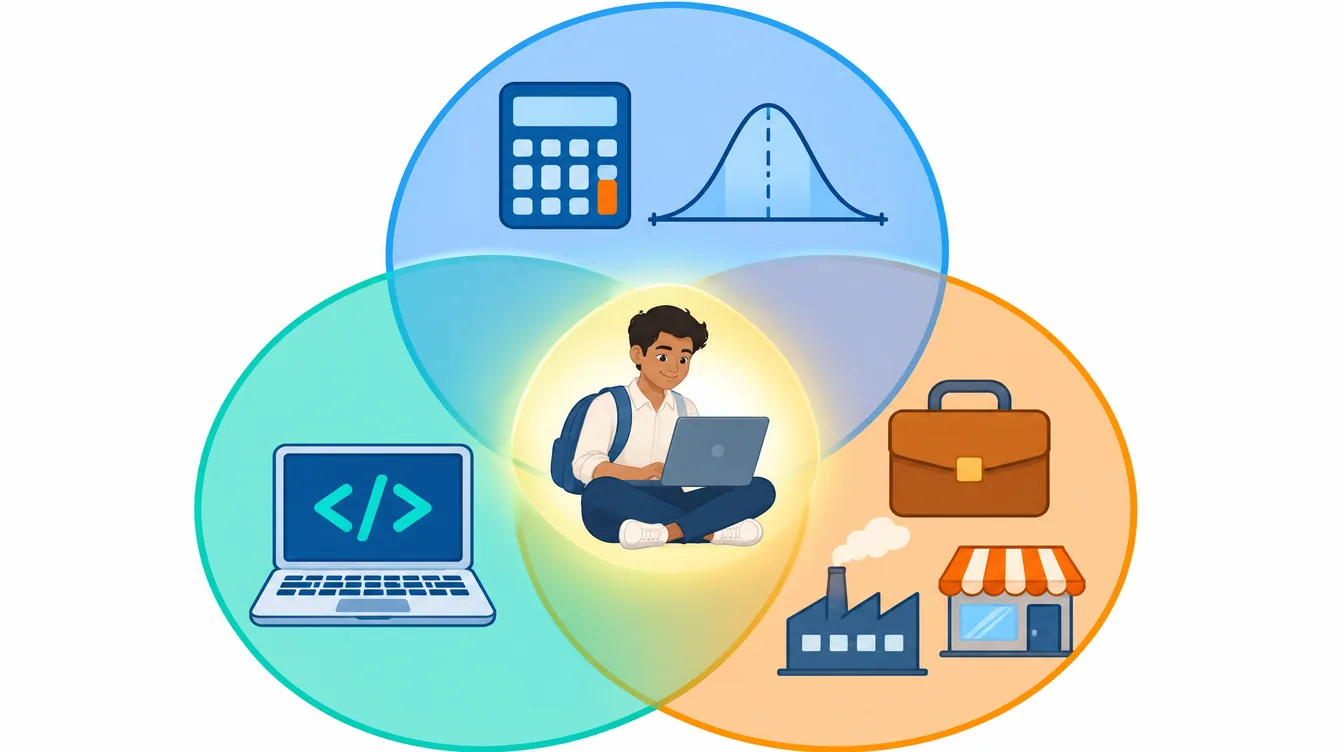
1. Statistics and maths. Averages, percentages, probability, distributions, correlation and hypothesis testing. Class 11 and 12 level maths is enough to begin. You learn the rest by applying it.
2. Programming. Python for analysis and machine learning, and SQL for pulling data from databases. You don't need to be a software engineer. You need to write clean scripts that load, transform and model data.
3. Business (domain) knowledge. Understanding how a bank, hospital, factory or D2C brand makes money. This is what turns a correct number into a useful recommendation.
A four-question check before you finish a project
Before calling any practice project finished, ask yourself four questions:
- Question: Can you state the business question in one sentence?
- Clean: Can you list every cleaning decision you made and why?
- Predict: Does the model beat a simple guess, such as "everyone books" or "last month's average"?
- Explain: Could a non-technical manager act on your final slide?
If any answer is "no", the project is not ready for a portfolio or an interview.
Data Science vs Data Analytics vs Machine Learning vs AI
Data science is the broad field. Data analytics, machine learning and AI are related areas that overlap with it. Students mix these up constantly, so here is the difference in one table.
| Field | Main question | Typical output | Core tools |
|---|---|---|---|
| Data analytics | What happened and why? | Reports, dashboards | Excel, SQL, Power BI, Tableau |
| Data science | What will happen and what should we do? | Predictions, models, recommendations | Python, SQL, statistics, ML libraries |
| Machine learning | How can a computer learn patterns from data? | Trained algorithms | scikit-learn, TensorFlow, PyTorch |
| Artificial intelligence | How can machines do tasks that need human-like intelligence? | Chatbots, vision systems, agents | ML, deep learning, LLMs |
A simple way to remember it: data analytics looks back, data science looks forward, machine learning is the engine data science often uses, and AI is the larger goal.
If the analytics side appeals to you more, read our guide on what a data analyst does. If models interest you, start with the types of machine learning.
Where generative AI fits in 2026
Generative AI tools like ChatGPT, Gemini and Claude have changed how data scientists work, but not what they need to understand. They can draft first-pass SQL and Python, summarise unstructured text and explain errors quickly.
Adecco India reports that about 40% of large enterprises have moved generative AI pilots into production (IANS via Free Press Journal, January 2026). Companies want people who can use these tools and still check whether the answer is right.
Tools Used in 2026: Python, SQL, Power BI and More
Data scientists in India mostly use a small, stable set of tools. You do not need to learn all of them at once.
| Category | Tools | When you need it |
|---|---|---|
| Spreadsheets | Excel, Google Sheets | Week 1: quick analysis, cleaning small files |
| Databases | SQL (MySQL, PostgreSQL) | Early: pulling and joining data |
| Programming | Python with pandas, NumPy | Core skill for analysis and modelling |
| Notebooks | Jupyter, Google Colab | Writing and sharing analysis step by step |
| Machine learning | scikit-learn, XGBoost | Building prediction models |
| Deep learning | TensorFlow, PyTorch | Images, text, advanced AI work |
| Visualisation | Power BI, Tableau, Matplotlib | Dashboards and charts for managers |
| GenAI assistants | ChatGPT, Gemini, Claude, Copilot | Drafting code, explaining errors, summarising text |
Pro tip: Start with Excel, SQL and Python in that order. Most Indian job descriptions for entry-level data roles list all three, and each one makes the next easier to learn.
What Does a Data Scientist Do All Day?
A data scientist spends most of the day understanding problems, preparing data and explaining results, and only part of it building models. A typical week in an Indian company might look like this (illustrative):
- Monday: Meeting with the marketing team to understand why app sign-ups dropped.
- Tuesday: Writing SQL queries to pull six months of sign-up and campaign data.
- Wednesday: Cleaning the data in Python and checking for tracking errors.
- Thursday: Testing a model that predicts which users will drop off.
- Friday: Presenting findings to managers with a simple dashboard and three recommendations.
Related roles split this work differently. A data analyst focuses mostly on Tuesday and Friday. A data engineer builds the pipelines that make Tuesday possible. A machine learning engineer takes Thursday's model and puts it into a live app.
Data Science Jobs and Salary in India (2026)
Data science remains one of India's better-paid tech careers in 2026, and demand is growing faster than general IT hiring.
Hiring trends:
- Adecco India expects India's tech job market to grow 12 to 15% in 2026, adding about 1.25 lakh roles, with demand for AI, data and cybersecurity skills up 51% (IANS via Free Press Journal).
- Globally, the US Bureau of Labor Statistics projects data scientist employment to grow 35% from 2025 to 2035, much faster than the average for all occupations (BLS).
Salary snapshot (self-reported, 2026):
| Experience | Typical range in India | Source |
|---|---|---|
| Fresher (0 to 1 year) | ₹5 to ₹8 LPA common; up to ₹14 LPA at top firms | AmbitionBox, Glassdoor India |
| Junior (1 to 4 years) | Around ₹8 LPA average | AmbitionBox |
| Mid-level (4 to 8 years) | ₹15 to ₹22 LPA | AmbitionBox |
| Senior and lead | ₹24 LPA and above | AmbitionBox, Glassdoor India |
These figures are compiled from salary platforms in 2026 (Masai School summary of AmbitionBox and Glassdoor data). Self-reported numbers can differ noticeably between sites, so treat them as ranges, not promises. For a fuller breakdown by city and skill, see our data science salary in India guide.
Common job titles include data scientist, data analyst, business analyst, ML engineer, data engineer and AI engineer. Freshers can explore openings in our guide to data science jobs for freshers.
Can You Learn It Without a Tech Background?
Yes. Many working data professionals in India come from commerce, science, management or arts backgrounds. What matters is comfort with basic maths, logical thinking and steady practice, not your degree name.
That said, be honest with yourself about three things:
- Maths anxiety. You will use percentages, averages and probability daily. If those scare you, spend two to three weeks revising Class 10 to 12 maths first.
- Time. Expect several months of consistent study, not a weekend crash course.
- Projects. Recruiters hire from portfolios. Plan to build at least three end-to-end projects.
How to Start Learning: A 7-Step Plan
The fastest way to start data science is to learn the tools in a fixed order and apply each one to a small project before moving on.
- Excel basics (2 to 3 weeks): formulas, pivot tables, charts.
- SQL (3 to 4 weeks): SELECT, JOIN, GROUP BY, window functions.
- Python for data (6 to 8 weeks): pandas, NumPy, Matplotlib.
- Statistics (ongoing): distributions, hypothesis tests, regression.
- Machine learning (8 to 10 weeks): start with linear regression and decision trees.
- Visualisation (2 to 3 weeks): Power BI or Tableau dashboards.
- Portfolio and interviews: three projects, a GitHub profile, and practice with machine learning interview questions.
Timelines vary with your background and hours per week. Our data science roadmap breaks each stage into weekly goals.
Resource: Use the four-question check from the pillars section on every practice project. It turns a tutorial copy into a portfolio piece.
Self-study or a structured program?
Self-study works if you are disciplined and know what to learn next. A structured program helps if you want mentorship, live doubt-solving, real datasets and interview preparation in one place.
If you prefer the structured route, Fireblaze AI School's PG Program in Data Science & Analytics with GenAI covers Excel, SQL, Python, statistics, machine learning, Power BI and generative AI tools, with hands-on projects and interview practice. Compare it with self-study honestly before you decide.
Now It's Your Turn
So, what is data science? It is the habit of asking good questions, cleaning messy data, predicting what comes next and explaining it so people can act.
The kirana owner stocking Maggi for monsoon Sundays had the instinct. Data science gives you the tools to do it at the scale of UPI and Flipkart.
Which part excites you most: the detective work in the data, the prediction models, or the business decisions at the end?
FAQ
What is data science in simple words?
Data science is using data, statistics and programming to answer questions and predict what will happen next. For example, a food delivery app uses data science to estimate when your order will arrive.
What is data science used for in India?
Data science in India is used for UPI fraud detection, food delivery time estimates, e-commerce recommendations, dynamic airline pricing, cricket analytics, credit scoring and crop advisory for farmers. Almost every large company in banking, retail, healthcare and logistics now uses it.
Is data science a good career in India in 2026?
Data science is a strong career option in 2026. Adecco India expects tech hiring to grow 12 to 15% this year, with demand for AI, data and cybersecurity roles up 51%. Self-reported salary data puts the average data scientist salary near ₹11 LPA, though figures vary widely by city, skill and employer.
Does data science require coding?
Yes, data science requires basic coding, mainly Python and SQL. You do not need software engineering depth, but you should be able to write scripts that load, clean, analyse and model data.
What is the difference between data science and data analytics?
Data analytics explains what happened and why using reports and dashboards, while data science predicts what will happen and recommends what to do using statistics and machine learning. Data analytics is often the first step into a data science career.
Can a commerce or arts student learn data science?
Yes, commerce and arts students can learn data science if they are comfortable with basic maths and practise regularly. Many start with Excel and SQL, which feel familiar, before moving to Python and machine learning.
Sources
- What is data science?, IBM
- UPI Transactions Hit 25.47 Billion in October, Value Soars to ₹31.53 Lakh Crore, Free Press Journal (NPCI data), November 2026
- India's Tech Job Market Set to Grow 12 to 15% in 2026, Add 1.25 Lakh Roles: Report, IANS via Free Press Journal (Adecco India), January 2026
- Data Scientists: Occupational Outlook Handbook, US Bureau of Labor Statistics
- Data Scientist salary in India 2026, Masai School (compiling AmbitionBox, Glassdoor India and Unstop data)