 Fireblaze
 Learning Guides
What is Data Mining? Complete Guide for Beginners
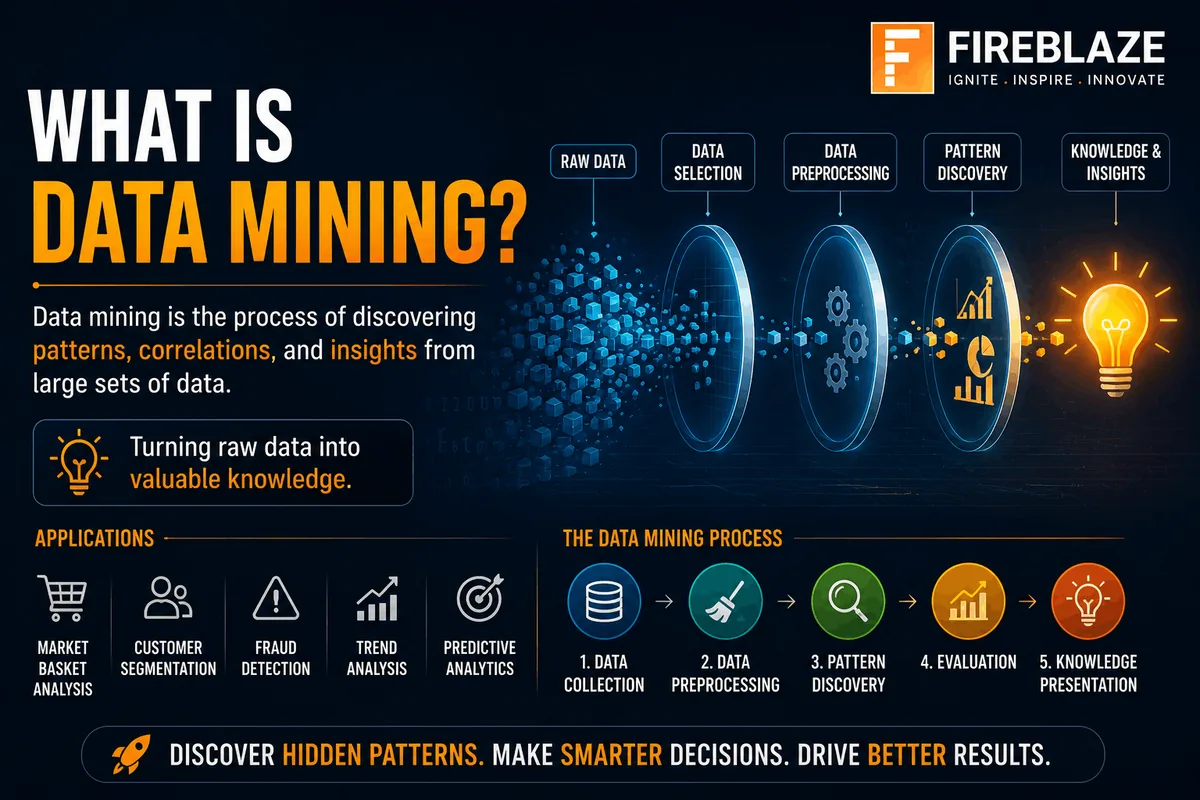
In today's digital world, organizations generate massive amounts of data every second. This data comes from websites, mobile applications, social media platforms, sensors, transactions, healthcare systems, and business operations.
However, collecting data alone is not enough.
The real value lies in discovering meaningful patterns and insights hidden within that data.
This process is known as:
Data Mining
Data Mining is one of the most important concepts in Data Science, Artificial Intelligence, Machine Learning, and Business Analytics.
In this guide, you'll learn:
What Data Mining is
How Data Mining works
Data Mining process
Techniques used in Data Mining
Real-world applications
Advantages and challenges
Career opportunities
What is Data Mining?
Data Mining is the process of extracting useful information, hidden patterns, relationships, and knowledge from large datasets.
In simple words:
Data Mining helps convert raw data into valuable business insights.
Organizations use Data Mining to:
Predict future trends
Understand customer behavior
Detect fraud
Improve decision-making
Optimize business operations
Why is Data Mining Important?
Modern businesses generate enormous amounts of information daily.
Examples include:
Customer purchases
Website visits
Banking transactions
Social media interactions
Healthcare records
Without Data Mining, valuable information remains hidden inside large datasets.
Benefits include:
Better business decisions
Increased profitability
Risk reduction
Improved customer experiences
Competitive advantages
Data Mining vs Data Analysis
Many beginners confuse Data Mining with Data Analysis.
| Data Mining | Data Analysis |
|---|---|
| Discovers hidden patterns | Examines known data |
| Uses advanced algorithms | Uses analytical methods |
| Predictive in nature | Descriptive and diagnostic |
| Often automated | Often manual |
Both are important components of Data Science.
How Does Data Mining Work?
Data Mining follows a structured process.
The goal is to identify meaningful information from raw datasets.
Steps in the Data Mining Process
1. Data Collection
The first step involves gathering data from various sources.
Examples:
Databases
Websites
CRM Systems
IoT Devices
Business Applications
2. Data Cleaning
Raw data often contains:
Missing values
Duplicate records
Errors
Inconsistent formats
Cleaning improves data quality.
3. Data Integration
Data from multiple sources is combined into a single dataset.
Example:
Customer information from:
Website
Mobile App
CRM Platform
4. Data Transformation
Data is converted into a suitable format for analysis.
Examples:
Normalization
Aggregation
Feature Engineering
5. Data Mining
Algorithms are applied to discover patterns and relationships.
This is the core stage of the process.
6. Pattern Evaluation
Discovered patterns are evaluated for usefulness and accuracy.
Not all patterns are meaningful.
7. Knowledge Presentation
Insights are presented through:
Reports
Dashboards
Visualizations
Business recommendations
Types of Data Mining Techniques
Several techniques are used depending on the business objective.
Classification
Classification predicts predefined categories.
Example:
Email → Spam or Not Spam
Popular algorithms:
Decision Trees
Random Forest
Logistic Regression
Clustering
Clustering groups similar data points together.
Example:
Customer Segmentation
Applications:
Marketing
Recommendation Systems
Behavioral Analysis
Regression
Regression predicts numerical values.
Examples:
House Prices
Revenue Forecasting
Sales Prediction
Popular algorithms:
Linear Regression
Polynomial Regression
Association Rule Mining
Association Rule Mining identifies relationships between items.
Example:
Customers who buy Bread
often buy Butter.
This technique is commonly used in retail.
Anomaly Detection
Anomaly Detection identifies unusual patterns.
Applications:
Fraud Detection
Cybersecurity
Risk Monitoring
Sequential Pattern Mining
Analyzes sequences of events.
Example:
Customer purchase journeys.
Applications:
E-commerce
User Behavior Analysis
Popular Data Mining Algorithms
Several Machine Learning algorithms are widely used.
Decision Trees
Used for classification and prediction.
Advantages:
Easy to understand
Interpretable results
Random Forest
An ensemble learning algorithm that combines multiple decision trees.
Benefits:
Higher accuracy
Reduced overfitting
K-Means Clustering
Used to group similar observations.
Applications:
Customer Segmentation
Market Analysis
Apriori Algorithm
Used for association rule mining.
Applications:
Market Basket Analysis
Naive Bayes
Probability-based classification algorithm.
Applications:
Spam Detection
Text Classification
Data Mining and Machine Learning
Data Mining and Machine Learning are closely related.
| Data Mining | Machine Learning |
|---|---|
| Finds patterns | Learns from data |
| Knowledge discovery | Prediction and automation |
| Business insights | Intelligent systems |
Machine Learning often acts as a tool within Data Mining projects.
Data Mining and Data Science
Data Mining is a major component of Data Science.
Data Science includes:
Data Collection
Data Cleaning
Data Mining
Machine Learning
Data Visualization
Decision Making
Tools Used in Data Mining
Popular tools include:
Python
Libraries:
Pandas
NumPy
Scikit-Learn
R
Used for:
Statistical Analysis
Data Mining
Visualization
RapidMiner
A no-code Data Mining platform.
KNIME
Open-source analytics and Data Mining software.
Weka
Popular educational Data Mining tool.
Real-World Applications of Data Mining
Data Mining is used across multiple industries.
Banking
Applications:
Fraud Detection
Credit Scoring
Risk Analysis
Healthcare
Applications:
Disease Prediction
Patient Monitoring
Medical Research
Retail
Applications:
Product Recommendations
Market Basket Analysis
Customer Segmentation
E-Commerce
Applications:
Personalized Recommendations
Customer Analytics
Sales Forecasting
Telecommunications
Applications:
Churn Prediction
Network Optimization
Customer Behavior Analysis
Manufacturing
Applications:
Predictive Maintenance
Quality Control
Demand Forecasting
Benefits of Data Mining
Better Decision-Making
Organizations make informed decisions using data-driven insights.
Improved Customer Understanding
Businesses can better understand customer needs and preferences.
Fraud Detection
Suspicious activities can be identified quickly.
Increased Revenue
Data Mining helps identify growth opportunities.
Competitive Advantage
Organizations gain deeper market insights.
Challenges of Data Mining
Despite its benefits, Data Mining faces several challenges.
Data Quality Issues
Poor-quality data leads to poor results.
Privacy Concerns
Sensitive customer information must be protected.
High Computational Requirements
Large datasets require significant processing power.
Complexity
Interpreting discovered patterns can sometimes be difficult.
Common Interview Questions on Data Mining
What is Data Mining?
Data Mining is the process of discovering useful patterns, relationships, and insights from large datasets.
What are the Main Data Mining Techniques?
Classification
Clustering
Regression
Association Rule Mining
Anomaly Detection
Difference Between Data Mining and Machine Learning?
Data Mining focuses on discovering patterns, while Machine Learning focuses on learning from data and making predictions.
What is Association Rule Mining?
Association Rule Mining identifies relationships between items in datasets.
What is Clustering?
Clustering groups similar data points together based on their characteristics.
Career Opportunities in Data Mining
Professionals with Data Mining skills can pursue roles such as:
Data Scientist
Data Analyst
Machine Learning Engineer
Business Intelligence Analyst
Data Engineer
Analytics Consultant
These roles are in high demand across industries worldwide.
Future of Data Mining
With the growth of:
Artificial Intelligence
Big Data
Cloud Computing
IoT
Predictive Analytics
Data Mining will continue to play a critical role in helping organizations uncover valuable insights and gain competitive advantages.
As businesses generate more data than ever before, the demand for Data Mining expertise will continue to rise.
Final Thoughts
Data Mining is a powerful process that transforms raw data into meaningful knowledge. It enables organizations to discover hidden patterns, predict future trends, improve decision-making, and create better customer experiences.
Whether you're pursuing a career in Data Science, Artificial Intelligence, Business Analytics, or Machine Learning, understanding Data Mining is essential. By mastering Data Mining concepts, techniques, tools, and applications, you'll build a strong foundation for solving real-world business problems and unlocking the true value of data.
Keep Reading
Related Articles
Learning Guides
Introduction to Computer Vision: A Beginner’s Guide
Discover the basics of Computer Vision, a rapidly growing field of Artificial Intelligence that enables machines to understand images and videos. Expl
All About PyCaret: Conversation with Mr. Moez Ali and Mr. Aniruddha Kalbande | EP-06
Explore PyCaret and its impact on machine learning development through an insightful conversation with PyCaret creator Moez Ali and AI expert Aniruddh
Targeted Advertising Using Machine Learning: A Complete Guide
Learn how targeted advertising uses machine learning to analyze user behavior, improve ad personalization, increase conversions, and optimize digital