 Fireblaze
 Learning Guides
Introduction to Computer Vision: A Beginner’s Guide
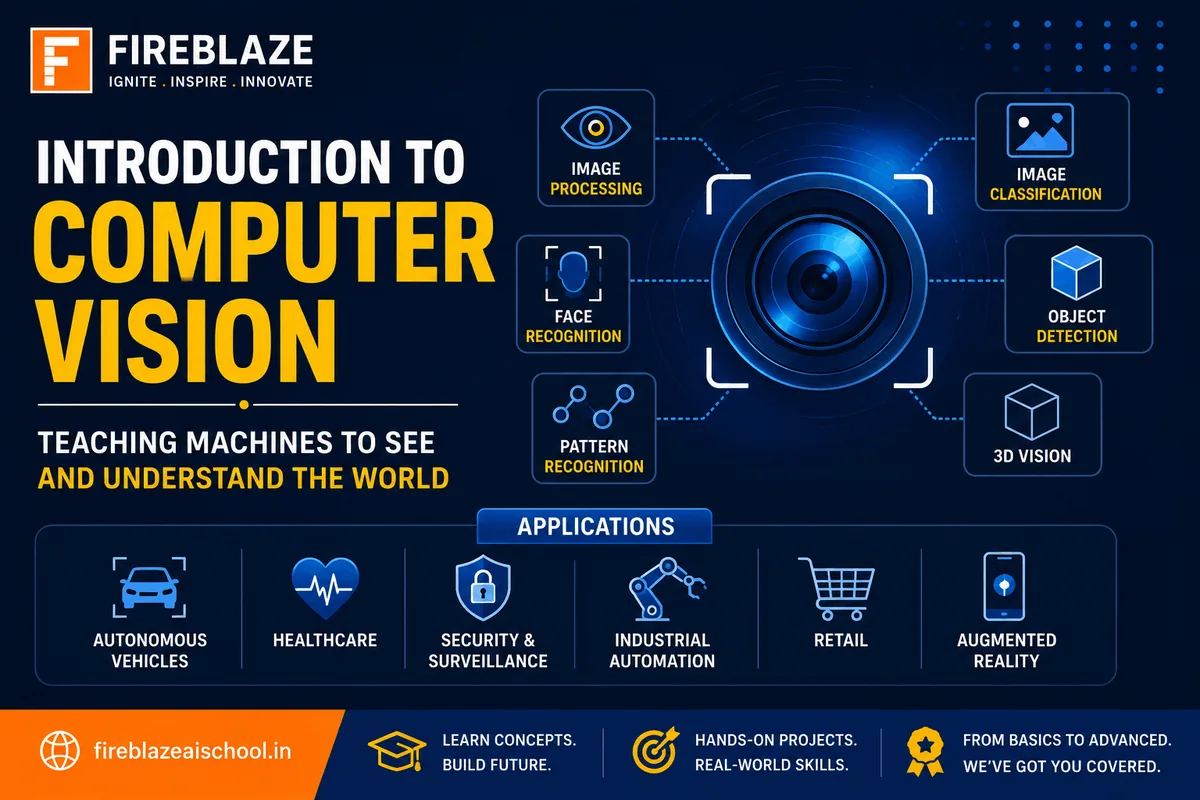
Computer Vision is one of the most exciting and rapidly evolving fields of Artificial Intelligence (AI). It enables machines to interpret, analyze, and understand visual information from images and videos, much like humans do.
From facial recognition systems and self-driving cars to medical image analysis and augmented reality, Computer Vision is transforming industries worldwide.
In this article, we’ll explore the fundamentals of Computer Vision, its techniques, applications, tools, and career opportunities.
What is Computer Vision?
Computer Vision is a branch of Artificial Intelligence that enables computers to extract meaningful information from digital images, videos, and visual inputs.
The goal of Computer Vision is to help machines:
Identify objects
Recognize faces
Understand scenes
Detect activities
Analyze visual patterns
It combines concepts from:
Artificial Intelligence
Machine Learning
Deep Learning
Image Processing
Mathematics
Computer Vision allows machines to "see" and make decisions based on visual data.
Why is Computer Vision Important?
Humans process visual information naturally, but computers require algorithms and models to understand images.
Computer Vision helps organizations:
Automate visual inspection
Improve security systems
Enhance healthcare diagnostics
Enable autonomous vehicles
Optimize industrial operations
With billions of images and videos generated daily, Computer Vision has become a critical technology in the AI era.
How Does Computer Vision Work?
Computer Vision typically follows a series of steps:
Step 1: Image Acquisition
Images are captured using:
Cameras
Mobile Devices
Satellites
Medical Equipment
Drones
Step 2: Image Processing
The captured image is enhanced and cleaned using techniques such as:
Noise Reduction
Contrast Enhancement
Edge Detection
Image Filtering
Step 3: Feature Extraction
Important information is extracted from images.
Examples include:
Corners
Edges
Shapes
Textures
Colors
Step 4: Object Recognition
Machine Learning and Deep Learning models identify objects within the image.
Examples:
Person
Vehicle
Animal
Product
Step 5: Decision Making
The system uses extracted information to make predictions or decisions.
Example:
A self-driving car detects a pedestrian and applies brakes automatically.
Key Concepts in Computer Vision
Image Classification
Image Classification assigns a label to an image.
Examples:
Cat
Dog
Car
Building
Applications:
Product Categorization
Medical Diagnosis
Wildlife Monitoring
Object Detection
Object Detection identifies and locates multiple objects in an image.
Example:
A security camera detecting:
People
Vehicles
Animals
Popular models:
YOLO
SSD
Faster R-CNN
Image Segmentation
Image Segmentation divides an image into meaningful regions.
Applications:
Medical Imaging
Autonomous Vehicles
Satellite Imaging
Segmentation helps identify object boundaries precisely.
Face Recognition
Face Recognition identifies individuals using facial features.
Applications:
Smartphone Unlocking
Attendance Systems
Security Surveillance
Optical Character Recognition (OCR)
OCR converts images containing text into machine-readable text.
Applications:
Document Digitization
Invoice Processing
License Plate Recognition
Popular OCR tool:
Tesseract OCR
Computer Vision Techniques
Image Processing
Image processing prepares images for analysis.
Techniques include:
Filtering
Thresholding
Edge Detection
Noise Removal
Feature Extraction
Feature extraction identifies important patterns within images.
Popular methods:
SIFT
SURF
ORB
Machine Learning
Traditional Computer Vision often uses Machine Learning algorithms such as:
Support Vector Machines (SVM)
Decision Trees
Random Forest
Deep Learning
Modern Computer Vision heavily relies on Deep Learning.
Advantages:
Higher Accuracy
Automatic Feature Learning
Better Performance on Large Datasets
What are Convolutional Neural Networks (CNNs)?
CNNs are specialized Deep Learning models designed for image analysis.
CNNs automatically learn:
Edges
Shapes
Patterns
Objects
Popular CNN architectures include:
LeNet
AlexNet
VGG16
ResNet
EfficientNet
CNNs are the foundation of modern Computer Vision systems.
Popular Computer Vision Libraries
OpenCV
Open-source library for image processing and computer vision.
Applications:
Face Detection
Object Tracking
Video Processing
Installation:
pip install opencv-python
TensorFlow
Deep Learning framework developed by Google.
Applications:
Image Classification
Object Detection
Neural Networks
PyTorch
Popular Deep Learning framework used for research and production.
Applications:
Computer Vision
Natural Language Processing
AI Development
Keras
User-friendly Deep Learning library.
Ideal for beginners learning Computer Vision.
Example: Reading an Image Using OpenCV
import cv2

image = cv2.imread("sample.jpg")

cv2.imshow("Image", image)

cv2.waitKey(0)
This code loads and displays an image using OpenCV.
Real-World Applications of Computer Vision
Healthcare
Applications:
MRI Analysis
Tumor Detection
X-Ray Interpretation
Computer Vision helps doctors diagnose diseases more accurately.
Autonomous Vehicles
Applications:
Lane Detection
Traffic Sign Recognition
Pedestrian Detection
Computer Vision is essential for self-driving technology.
Security and Surveillance
Applications:
Facial Recognition
Intrusion Detection
Crowd Monitoring
Retail
Applications:
Inventory Management
Customer Behavior Analysis
Automated Checkout Systems
Manufacturing
Applications:
Quality Inspection
Defect Detection
Process Automation
Agriculture
Applications:
Crop Monitoring
Disease Detection
Yield Prediction
Entertainment and Social Media
Applications:
Image Filters
Augmented Reality
Content Recommendation
Challenges in Computer Vision
Despite major advancements, Computer Vision still faces challenges.
Lighting Variations
Images captured under different lighting conditions may reduce accuracy.
Occlusion
Objects may be partially hidden.
Image Quality
Blurry or low-resolution images affect performance.
Large Data Requirements
Deep Learning models require large datasets for training.
Computational Cost
Computer Vision systems often require powerful GPUs and computing resources.
Future of Computer Vision
Emerging trends include:
Vision Transformers (ViTs)
AI-Powered Medical Imaging
Autonomous Robotics
Smart Cities
Real-Time Object Detection
Generative AI Vision Systems
Computer Vision will continue to play a major role in the future of Artificial Intelligence.
Career Opportunities in Computer Vision
Popular job roles include:
Computer Vision Engineer
Machine Learning Engineer
AI Engineer
Data Scientist
Robotics Engineer
Research Scientist
As AI adoption grows, demand for Computer Vision professionals continues to increase globally.
Skills Required for Computer Vision
To build a career in Computer Vision, learn:
Programming
Python
C++
Mathematics
Linear Algebra
Probability
Statistics
AI and Machine Learning
Supervised Learning
Deep Learning
Neural Networks
Tools
OpenCV
TensorFlow
PyTorch
Why Learn Computer Vision?
Computer Vision is one of the most impactful AI technologies today.
Benefits include:
High Demand Career Opportunities
Strong Salary Potential
Exciting Research Areas
Real-World Applications Across Industries
It serves as a foundation for advanced AI domains such as Robotics, Autonomous Systems, and Augmented Reality.
Final Thoughts
Computer Vision enables machines to understand and interpret visual information, making it one of the most transformative fields in Artificial Intelligence. From healthcare and autonomous vehicles to security systems and retail automation, Computer Vision is revolutionizing how machines interact with the world.
By learning Computer Vision concepts, tools, and techniques, aspiring AI professionals can unlock exciting opportunities in one of the fastest-growing areas of technology.
Suggested Internal Links
Core Operations in Image Processing
Convolutional Neural Networks (CNNs)
Object Detection Using Deep Learning
Artificial Intelligence Roadmap
Machine Learning Basics
Data Science Career Guide
Focus Keyword
Introduction to Computer Vision
Secondary Keywords
What is Computer Vision
Computer Vision Tutorial
Computer Vision Applications
Computer Vision in AI
Image Processing and Computer Vision
Deep Learning for Computer Vision
Keep Reading
Related Articles
Learning Guides
All About PyCaret: Conversation with Mr. Moez Ali and Mr. Aniruddha Kalbande | EP-06
Explore PyCaret and its impact on machine learning development through an insightful conversation with PyCaret creator Moez Ali and AI expert Aniruddh
What is Data Mining? Complete Guide for Beginners
Learn what Data Mining is, how it works, key techniques, tools, applications, advantages, challenges, and its role in Data Science, Machine Learning,
Targeted Advertising Using Machine Learning: A Complete Guide
Learn how targeted advertising uses machine learning to analyze user behavior, improve ad personalization, increase conversions, and optimize digital