 Fireblaze
 Learning Guides
Sentence Segmentation Using NLP: A Complete Beginner's Guide
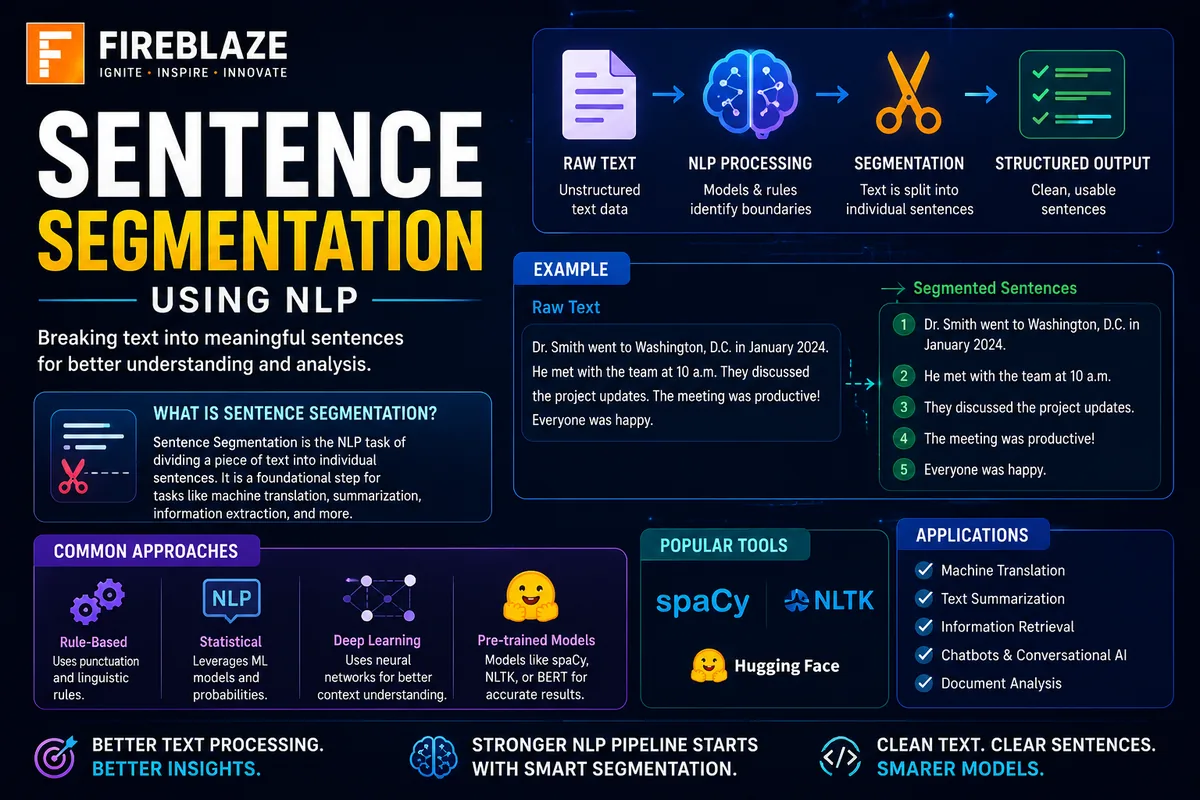
Natural Language Processing (NLP) enables computers to understand, analyze, and generate human language. One of the most fundamental tasks in NLP is Sentence Segmentation.
Before a machine can understand the meaning of a document, it must first identify where one sentence ends and another begins. This process is known as Sentence Segmentation.
In this guide, you'll learn:
What Sentence Segmentation is
Why it is important in NLP
How Sentence Segmentation works
Challenges in sentence boundary detection
Python implementation examples
Real-world applications
Career relevance in AI and Data Science
What is Sentence Segmentation?
Sentence Segmentation is the process of dividing a block of text into individual sentences.
For example:
Input Text
Artificial Intelligence is transforming industries. NLP helps machines understand language. Businesses use AI to improve efficiency.\nOutput
1. Artificial Intelligence is transforming industries.\n2. NLP helps machines understand language.\n3. Businesses use AI to improve efficiency.\nThe goal is to accurately identify sentence boundaries so that further NLP tasks can be performed effectively.
Why is Sentence Segmentation Important?
Most NLP applications process text sentence by sentence.
Without proper segmentation, machines may misunderstand the context and relationships between words.
Sentence Segmentation serves as a foundation for:
Text Classification
Sentiment Analysis
Chatbots
Machine Translation
Text Summarization
Question Answering Systems
Information Extraction
Speech Recognition
If sentence boundaries are incorrect, the performance of downstream NLP models can suffer significantly.
How Sentence Segmentation Works
The simplest approach uses punctuation marks such as:
Period (.)
Question Mark (?)
Exclamation Mark (!)
Example:
How are you? I am doing great! NLP is fascinating.\nCan be segmented into:
How are you?\nI am doing great!\nNLP is fascinating.\nHowever, real-world language is far more complex.
Challenges in Sentence Segmentation
Identifying sentence boundaries is not always straightforward.
Consider the following examples:
Abbreviations
Dr. Sharma works at Fireblaze AI School.\nThe period after "Dr." does not indicate the end of a sentence.
Decimal Numbers
The model achieved 95.7% accuracy.\nThe decimal point should not split the sentence.
URLs and Emails
Visit www.fireblazeaischool.in for details.\nThe periods inside the URL are not sentence boundaries.
Multiple Punctuation Marks
Really? That's amazing!\nThe algorithm must recognize multiple sentence-ending symbols.
Approaches to Sentence Segmentation
Several techniques are used in NLP.
1. Rule-Based Approach
Uses predefined grammar and punctuation rules.
Example:
Split after "."
Split after "?"
Split after "!"
Advantages:
Simple
Fast
Limitations:
Cannot handle complex language patterns effectively
2. Statistical Approach
Uses probabilities and language patterns learned from training data.
Advantages:
Better accuracy
Handles ambiguous situations
Limitations:
Requires training data
3. Machine Learning Approach
Models learn sentence boundary patterns from labeled datasets.
Common algorithms:
Logistic Regression
Random Forest
Conditional Random Fields (CRF)
Advantages:
More accurate than rule-based methods
4. Deep Learning Approach
Modern NLP systems use neural networks and transformer models.
Examples:
BERT
RoBERTa
DistilBERT
GPT Models
Advantages:
High accuracy
Context-aware predictions
Used in enterprise-level NLP systems.
Sentence Segmentation Using Python and NLTK
NLTK (Natural Language Toolkit) provides a simple way to perform sentence segmentation.
Install NLTK
pip install nltk\nExample Code
import nltk\nfrom nltk.tokenize import sent_tokenize\n\ntext = """\nArtificial Intelligence is changing the world.\nNLP enables machines to understand language.\nSentence segmentation is an important NLP task.\n"""\n\nsentences = sent_tokenize(text)\n\nfor sentence in sentences:\n print(sentence)\nOutput
Artificial Intelligence is changing the world.\nNLP enables machines to understand language.\nSentence segmentation is an important NLP task.\nSentence Segmentation Using SpaCy
SpaCy is another popular NLP library used in production systems.
Install SpaCy
pip install spacy\nDownload Language Model
python -m spacy download en_core_web_sm\nExample Code
import spacy\n\nnlp = spacy.load("en_core_web_sm")\n\ntext = "AI is transforming industries. NLP helps machines understand text."\n\ndoc = nlp(text)\n\nfor sent in doc.sents:\n print(sent.text)\nOutput
AI is transforming industries.\nNLP helps machines understand text.\nReal-World Applications of Sentence Segmentation
Chatbots and Virtual Assistants
Applications such as ChatGPT and customer support bots need to process individual sentences accurately.
Sentiment Analysis
Businesses analyze customer reviews sentence by sentence to understand opinions and emotions.
Search Engines
Search engines use NLP techniques to understand content structure and relevance.
Machine Translation
Sentence segmentation helps translation systems process content accurately before translating it.
Healthcare
Medical records often contain large amounts of unstructured text.
Sentence segmentation helps extract meaningful information from clinical documents.
Legal Document Processing
Law firms use NLP systems to analyze contracts and legal agreements efficiently.
Sentence Segmentation vs Tokenization
Many beginners confuse these concepts.
| Sentence Segmentation | Tokenization |
|---|---|
| Splits text into sentences | Splits text into words |
| Operates at sentence level | Operates at word level |
| First stage of NLP pipeline | Usually follows segmentation |
Example:
Sentence Segmentation
AI is amazing. NLP is powerful.\nOutput:
Sentence 1: AI is amazing.\nSentence 2: NLP is powerful.\nTokenization
AI is amazing.\nOutput:
["AI", "is", "amazing"]\nInterview Questions on Sentence Segmentation
What is Sentence Segmentation?
Sentence Segmentation is the process of identifying and separating individual sentences from a text document.
Why is it important?
It serves as the foundation for many NLP applications such as sentiment analysis, machine translation, and chatbots.
What challenges occur in sentence segmentation?
Abbreviations
Decimal numbers
URLs
Complex punctuation
Multiple languages
Which libraries support sentence segmentation in Python?
NLTK
SpaCy
Stanford NLP
Hugging Face Transformers
Why NLP Skills Matter in AI Careers
Natural Language Processing is one of the fastest-growing domains in Artificial Intelligence.
Organizations use NLP for:
Customer support automation
AI assistants
Recommendation systems
Content analysis
Document processing
Search and retrieval systems
Understanding concepts like Sentence Segmentation helps learners build a strong foundation in AI, Machine Learning, and Generative AI.
Professionals with NLP skills are increasingly in demand across industries including healthcare, finance, e-commerce, education, and technology.
Final Thoughts
Sentence Segmentation is one of the most fundamental steps in Natural Language Processing. By accurately identifying sentence boundaries, NLP systems can better understand and process human language.
Whether you're building chatbots, performing sentiment analysis, creating AI assistants, or working with large language models, mastering Sentence Segmentation is an essential skill in your NLP journey.
As AI continues to transform industries, understanding foundational NLP concepts will help you build stronger machine learning and language intelligence solutions.
Keep Reading
Related Articles
Learning Guides
Introduction to Computer Vision: A Beginner’s Guide
Discover the basics of Computer Vision, a rapidly growing field of Artificial Intelligence that enables machines to understand images and videos. Expl
All About PyCaret: Conversation with Mr. Moez Ali and Mr. Aniruddha Kalbande | EP-06
Explore PyCaret and its impact on machine learning development through an insightful conversation with PyCaret creator Moez Ali and AI expert Aniruddh
What is Data Mining? Complete Guide for Beginners
Learn what Data Mining is, how it works, key techniques, tools, applications, advantages, challenges, and its role in Data Science, Machine Learning,