 Fireblaze
Career Roadmaps
15 MERN Stack Project Ideas for Your Portfolio (Tested on Express 5 and Mongoose 9)
15 MERN stack project ideas by level, each with the hard part recruiters check, free hosting limits, and 9 old tutorial habits that break on Express 5.

You finished the MERN tutorials. You built the todo app. Maybe a weather app too.
And recruiters still scroll past your GitHub.
The problem usually isn't your skill. It's that your MERN stack project list looks exactly like everyone else's, and half the tutorial code behind it no longer runs on 2026 versions of Express and Mongoose.
This guide fixes both. You'll get 15 project ideas sorted by level, the one "hard part" in each that interviewers actually ask about, and the results of our own tests on old tutorial code.
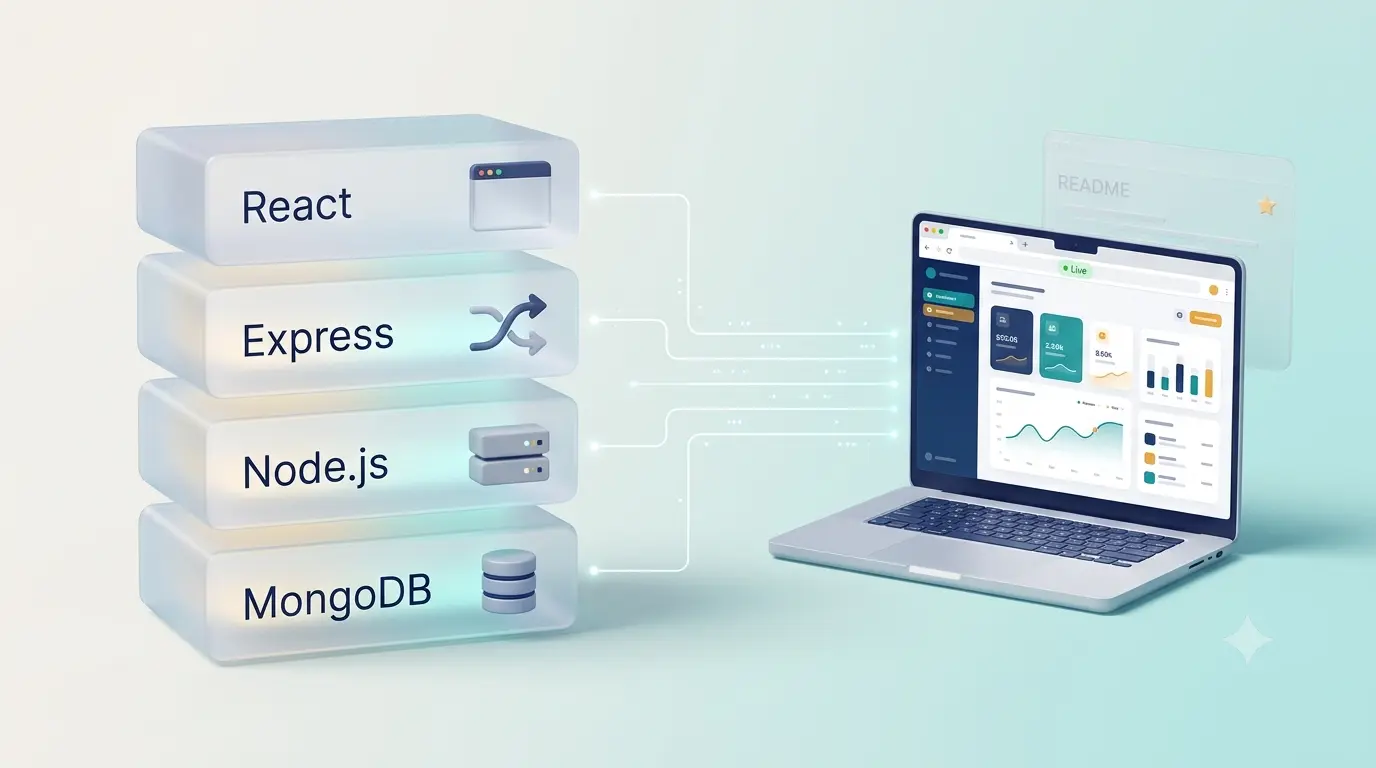
A MERN stack project is a full-stack web application built with MongoDB (database), Express.js (backend framework), React (frontend library) and Node.js (server runtime), all in JavaScript. A portfolio-ready one goes further: it is deployed live, has real authentication, handles errors, and solves a problem a real user has.
Quick answer: best MERN stack project ideas (November 2026)
- Beginner MERN projects: a coaching fee tracker, a URL shortener with click analytics, or an expense splitter, each in about 15 to 30 hours.
- Intermediate MERN projects add one hard part: real-time chat with Socket.IO, clinic booking without double-booked slots, or an inventory dashboard built on aggregation.
- Advanced MERN projects: e-commerce with Razorpay test mode and webhooks, an AI resume reviewer using an LLM API, or a multi-tenant SaaS.
- In our 26 November 2026 test, old Express 4 tutorial code such as
app.get('*')crashed at startup on Express 5.3.0.- You can host one MERN project free: MongoDB Atlas free tier (512 MB), Render free web service (sleeps after 15 idle minutes) and Vercel Hobby for the React app.
What Makes a MERN Stack Project Portfolio-Ready?
A portfolio-ready MERN stack project is one a stranger can open, use and understand in two minutes without your help. That means a live link, working login, sensible error handling, a clear README, and one genuinely hard feature you can explain in an interview.
Why does this matter so much? Because MERN skills are common.
In the Stack Overflow Developer Survey 2025, Node.js (48.7%) and React (44.7%) were the two most used web technologies. And GitHub's Octoverse 2025 report says India alone added more than 5 million developers in a year.
So "I know MERN" isn't a differentiator. Proof is.
We use a simple check called the 5-Proof Portfolio Test. A project passes only if it has all five:
| Proof | What it means | How a recruiter checks it |
|---|---|---|
| 1. Live | Deployed with a working URL, not just "clone and run" | Clicks the link in your README |
| 2. Real problem | Built for a named user (a clinic, a coaching class, a shop) | Reads the first line of your README |
| 3. Secure auth | Hashed passwords (bcrypt), JWT or sessions, protected routes, secrets in environment variables | Tries a protected page while logged out; scans the repo for .env |
| 4. Explained | README with a screenshot, architecture diagram, setup steps and decisions | Skims the README for 60 seconds |
| 5. One hard part | Real-time, payments, search, AI, roles or tricky data logic | Asks "what was the hardest bug?" in the interview |
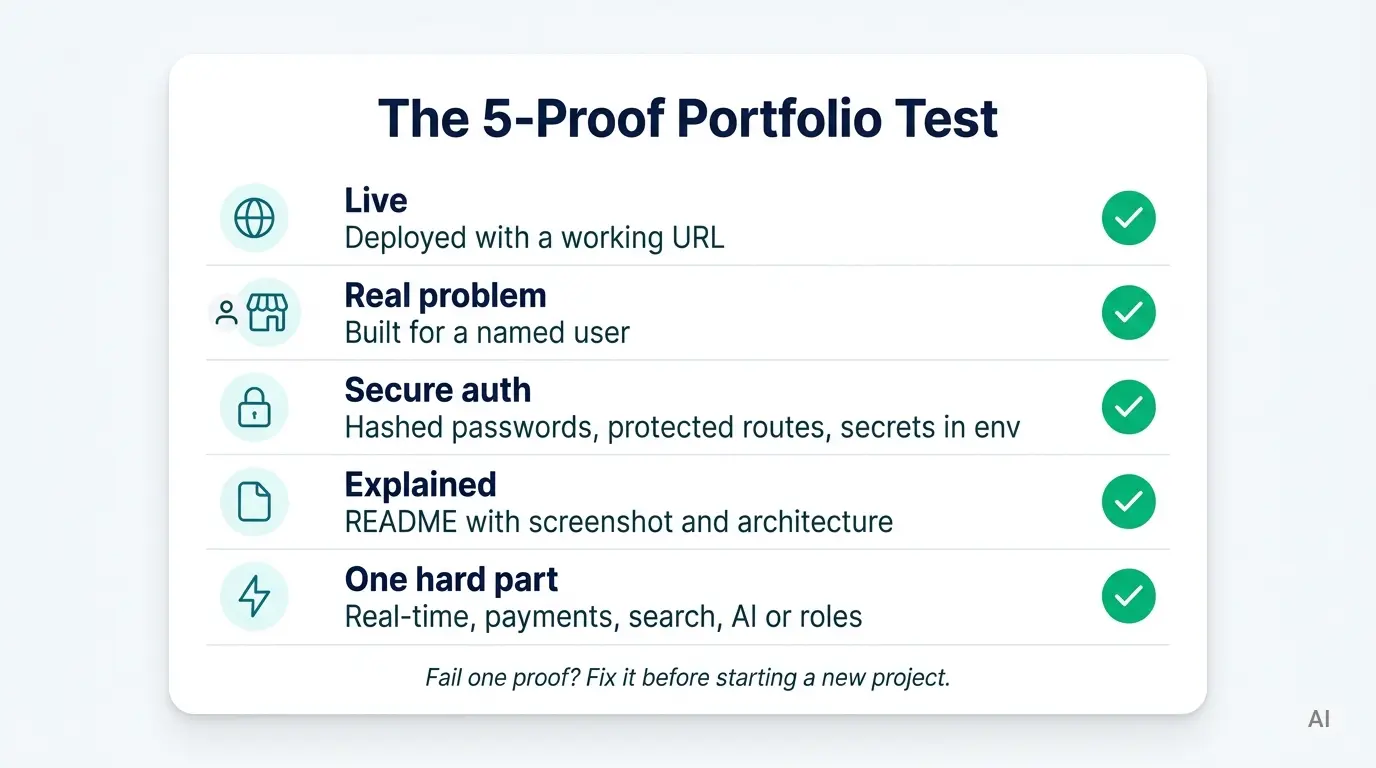
Notice what isn't on the list: project count. Two projects that pass all five proofs beat ten tutorial clones.
New to the role itself? Read what a MERN stack developer does first, then come back and pick a project.
All 15 Ideas at a Glance
Here are all 15 MERN stack project ideas in one table, with a rough build time for someone who already knows the basics of React and Express. Pick one from your level, ship it, then move up a tier.
| # | Project | Level | Rough build time | The hard part |
|---|---|---|---|---|
| 1 | Coaching class fee and attendance tracker | Beginner | 20 to 30 hours | Roles (admin vs student) |
| 2 | URL shortener with click analytics | Beginner | 15 to 20 hours | Unique index, aggregation |
| 3 | Group expense splitter | Beginner | 20 to 25 hours | Settle-up algorithm |
| 4 | Tiffin and menu board with photo upload | Beginner | 20 to 25 hours | File uploads to cloud storage |
| 5 | Job application tracker | Beginner | 20 to 30 hours | Filters, pagination, Kanban |
| 6 | Real-time chat app | Intermediate | 30 to 40 hours | Socket.IO, online status |
| 7 | Clinic appointment booking | Intermediate | 35 to 45 hours | No double-booked slots |
| 8 | Kirana store inventory dashboard | Intermediate | 30 to 40 hours | Aggregation pipeline, charts |
| 9 | Local job board with search | Intermediate | 35 to 45 hours | Text index, search ranking |
| 10 | Team Kanban board (Trello-style) | Intermediate | 40 to 50 hours | Drag and drop with live sync |
| 11 | E-commerce store with Razorpay | Advanced | 60 to 80 hours | Orders, webhooks, signature checks |
| 12 | AI resume reviewer | Advanced | 50 to 70 hours | LLM API, cost and rate limits |
| 13 | Multi-tenant SaaS for coaching institutes | Advanced | 70 to 90 hours | Tenant isolation, RBAC |
| 14 | "Chat with your notes" study assistant | Advanced | 60 to 80 hours | Embeddings, vector search |
| 15 | Live delivery tracker | Advanced | 60 to 80 hours | Geospatial queries, live maps |
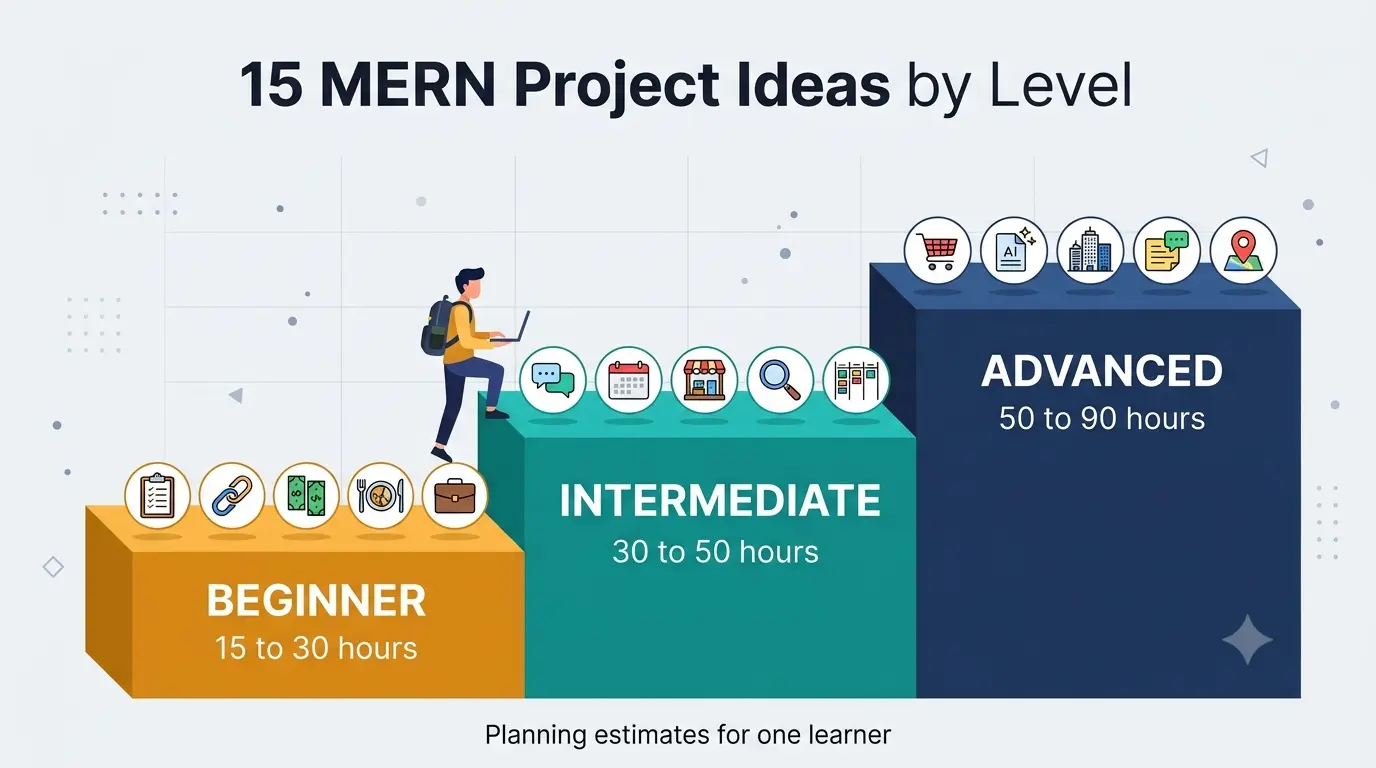
These hours are our planning estimates for one learner working alone, not measured averages. Your first project will take longer. That's normal.
Beginner MERN Stack Project Ideas (1 to 5)
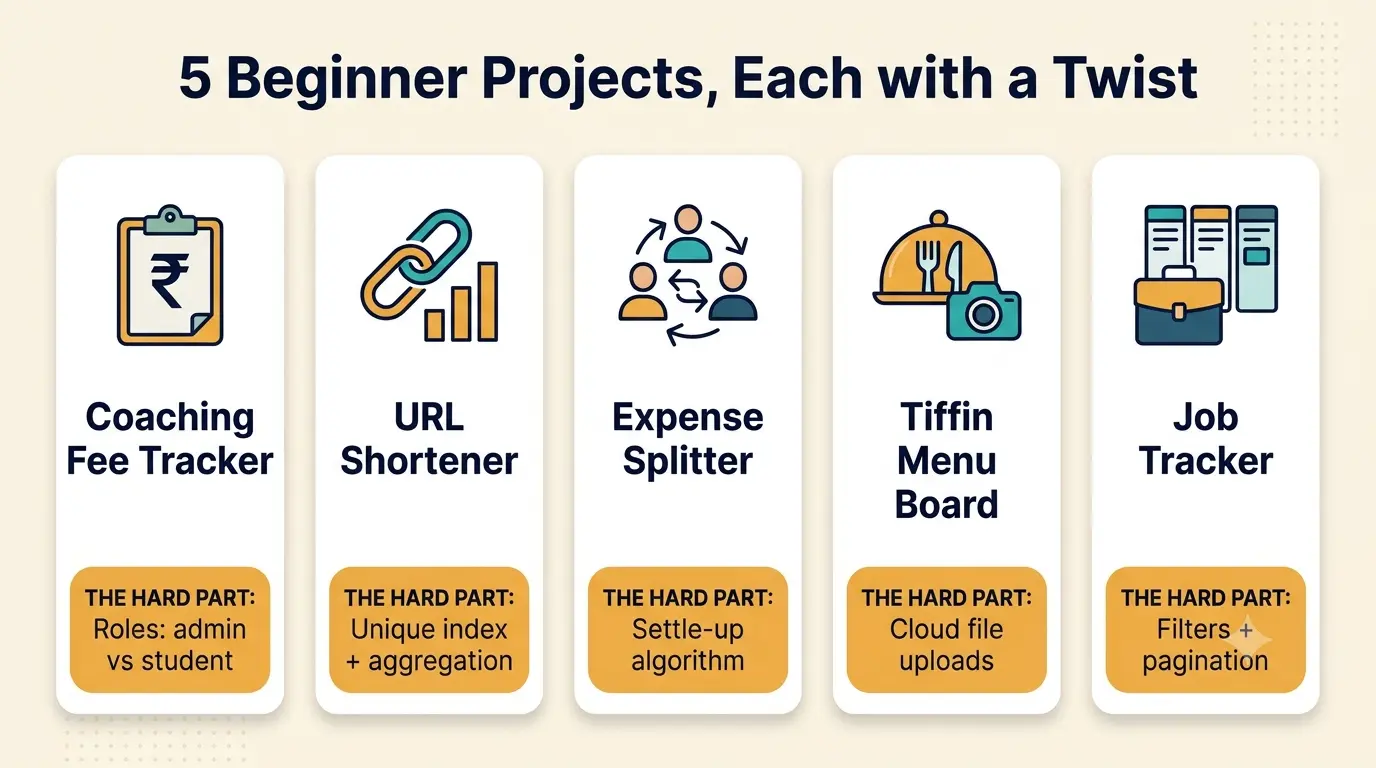
Beginner MERN stack project ideas teach the full CRUD loop: a React form sends data to an Express REST API, Mongoose saves it to MongoDB, and the UI updates. Each idea below adds one small twist so it doesn't look like a copied tutorial.
1. Coaching Class Fee and Attendance Tracker
Thousands of coaching classes across Maharashtra still track fees in a register or a WhatsApp group. Build them a simple web app.
Core features:
- Admin login; students added by the admin
- Mark daily attendance, record fee payments, show dues
- Student view: own attendance percentage and pending fees
The hard part: role-based access control. An admin route must reject a student's token on the server, not just hide a button in React.
Make it yours: add a monthly PDF fee receipt, or a "students below 75% attendance" report.
2. URL Shortener with Click Analytics
A URL shortener sounds simple until you count clicks properly.
Core features: create short links, redirect, and track clicks by date, device and referrer.
The hard part: a unique index on the short code in MongoDB (so two links can never collide) and an aggregation pipeline that groups clicks by day for a chart.
Make it yours: QR code download for each link, so a local shop can print it on a flyer.
3. Group Expense Splitter
Every hostel and flat in India has the "who owes whom" argument. Build the app that ends it.
Core features: groups, members, expenses split equally or by share, and a balance sheet.
The hard part: the settle-up algorithm. Turning 20 expenses into the fewest possible payments is a real logic problem, and interviewers love asking you to explain it.
Make it yours: show a "pay via UPI" button that copies the amount and note. You don't need real payments for this one.
4. Tiffin and Menu Board with Photo Upload
A daily menu board for a tiffin service or college canteen, with photos of each dish.
Core features: admin posts today's menu with photos and prices; customers view it and mark interest.
The hard part: file uploads. Use Multer to receive the image, then store it on a service like Cloudinary, not on your server's disk.
Why? Render's free web services have an ephemeral filesystem, so uploaded files are lost whenever the service restarts or spins down, according to Render's free tier docs. A lot of beginner projects "lose" their images for exactly this reason.
5. Job Application Tracker
Track every job you apply to, with status columns: Applied, Interview, Offer, Rejected.
The hard part: filters plus server-side pagination. Return 10 results per page from the API instead of loading everything into React.
Make it yours: a weekly summary card ("12 applications, 3 interviews, 25% response rate"). Bonus: you'll actually use this one during your own job search.
Intermediate MERN Project Ideas (6 to 10)
Intermediate MERN project ideas add one feature that tutorials usually skip: real-time updates, conflict handling, analytics or search. This is the tier where a portfolio starts to look employable, because each project now has a story worth telling in an interview.
6. Real-Time Chat App
Core features: one-to-one and group chat, typing indicators, online status, message history saved in MongoDB.
The hard part: Socket.IO alongside your Express API, plus reconnecting cleanly when a user's network drops.
Watch out: on a free host that sleeps, live sockets disconnect when the service spins down. Mention this trade-off in your README instead of hiding it.
7. Clinic Appointment Booking
A small clinic in Nagpur or Baramati wants patients to book slots online.
Core features: doctor schedules, slot booking, cancellation, and an admin day view.
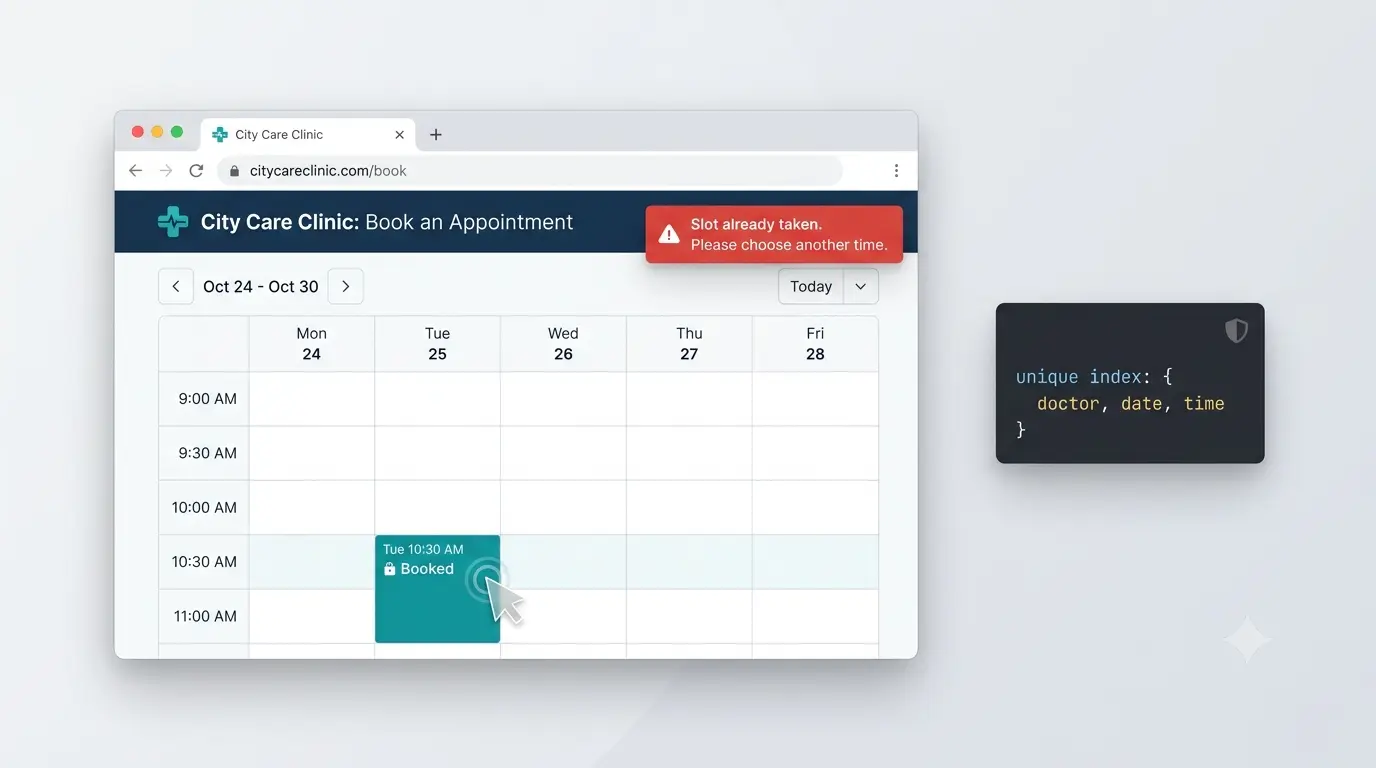
The hard part: stopping two patients from booking the same slot at the same moment. Use a unique compound index (doctor + date + time), so MongoDB itself rejects the second booking.
Make it yours: a reminder message the evening before. Even an email reminder shows you understand scheduled jobs.
8. Kirana Store Inventory Dashboard
Core features: products, stock in and out, low-stock alerts, and sales charts.
The hard part: MongoDB's aggregation pipeline for "top 5 products this month" and "stock value by category". This is real data work, not just saving forms.
Make it yours: a CSV import so the shop owner can upload last year's sales in one go.
9. Local Job Board with Search
Core features: employers post jobs, candidates search and apply, with filters for city, salary and experience.
The hard part: a MongoDB text index and ranked search results. Add debounce on the React search box so you don't send a request on every keystroke.
10. Team Kanban Board (Trello-Style)
The hard part: drag-and-drop ordering that syncs live for every team member, with optimistic updates in React (move the card instantly, roll back if the API fails).
Make it yours: an activity log ("Asha moved Login Bug to Done, 4:12 PM").
Advanced MERN Stack Project Ideas for Your Resume (11 to 15)
Advanced MERN stack project ideas are the ones to lead your resume with. Each combines several hard parts (payments, AI, multi-user data, maps) and gives you enough material for a 15-minute interview discussion.
11. E-Commerce Store with Razorpay Test Mode
E-commerce is the most common MERN project, so yours has to go deeper than a cart.
Core features: catalogue, cart, checkout, order history, admin order management.
The hard part: real payment flow in test mode. Create the order on your server, open Razorpay Checkout, then verify the payment signature on the server before marking the order paid. Handle the webhook too.
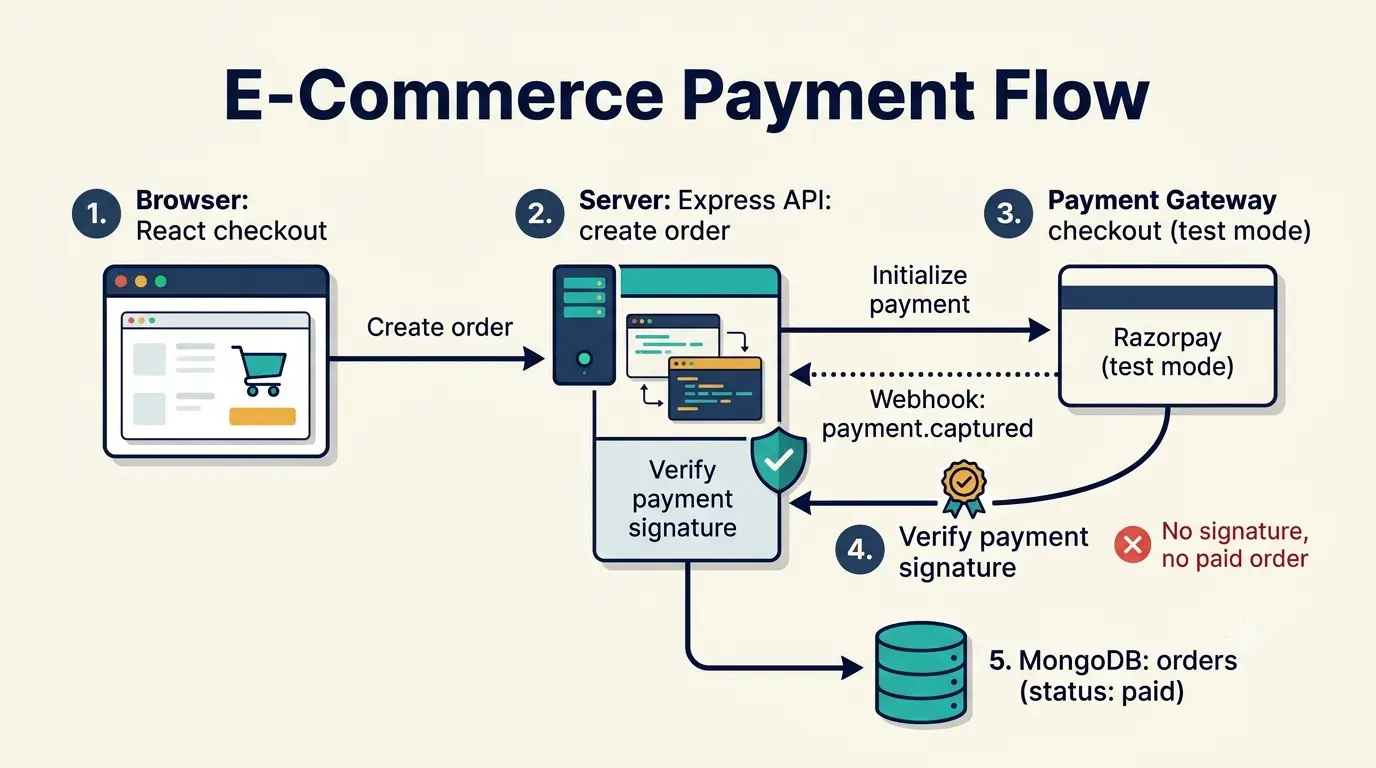
In Razorpay's Test Mode, you can enter the UPI ID success@razorpay to simulate a successful payment or failure@razorpay to simulate a failed one. No real money moves.
Make it yours: test the failure path on camera for your demo video. Most student stores only ever show the happy path.
12. AI Resume Reviewer
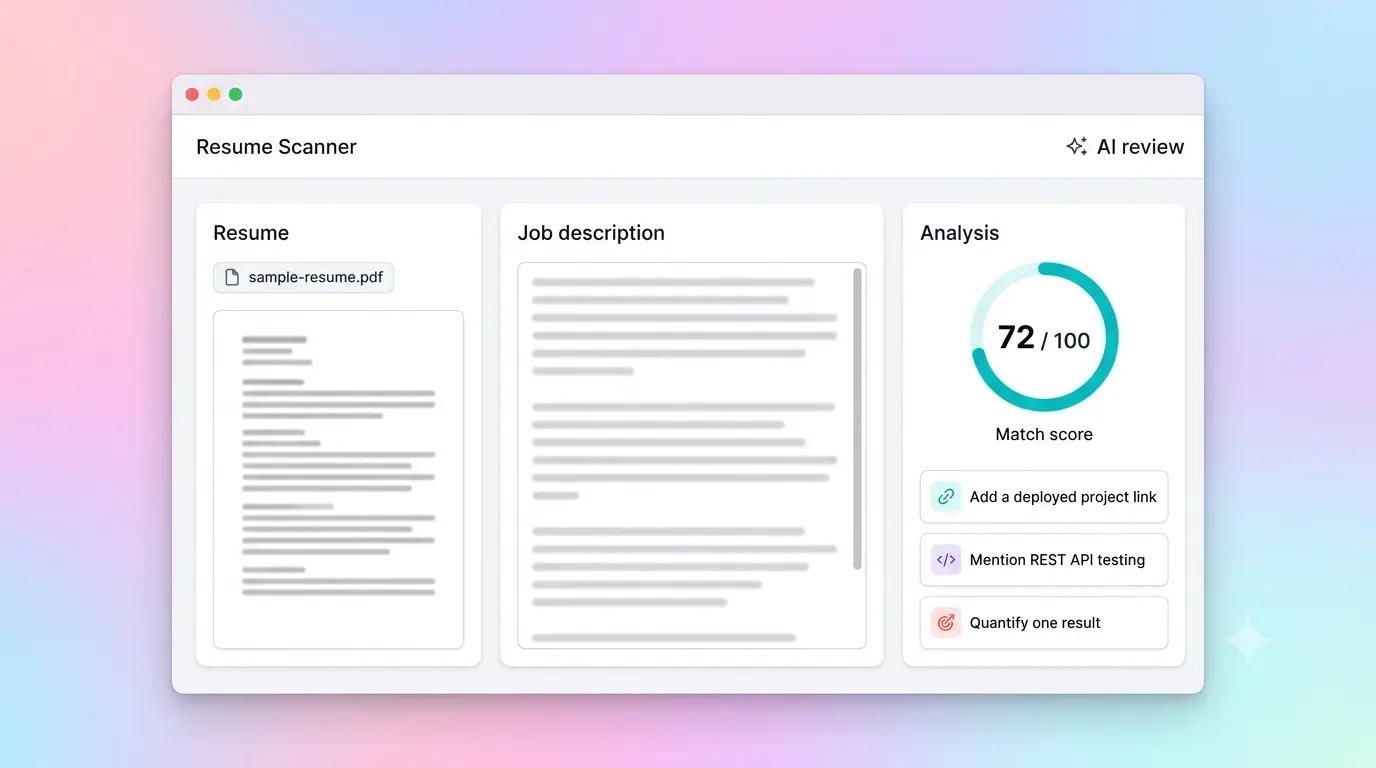
Core features: upload a resume, paste a job description, get a match score and specific suggestions.
The hard part: calling an LLM API safely from Express. Keep the API key on the server, add rate limiting so one user can't burn your quota, cache repeated requests, and validate the model's response before showing it.
The Gemini API has a free tier with lower rate limits for testing, which is enough for a portfolio demo. Note that free-tier prompts may be used to improve Google's products, so use sample resumes, not real people's data.
This project fits the AI-plus-web skill set behind roles like the forward deployed engineer.
13. Multi-Tenant SaaS for Coaching Institutes
Take project 1 and make it work for 50 institutes at once.
The hard part: tenant isolation. Every query must be scoped to the logged-in institute, so Institute A can never see Institute B's students, even with a tampered request.
This is the project that shows backend maturity. If you're aiming for product companies or remote IT jobs from Nagpur, this is the one to lead with.
14. "Chat with Your Notes" Study Assistant
Core features: upload class notes (PDF), ask questions, get answers that quote the right page.
The hard part: splitting documents into chunks, creating embeddings, and searching them with MongoDB Atlas Vector Search before sending the best chunks to an LLM. This is retrieval-augmented generation (RAG), built on the MERN stack you already know.
Check the current Atlas Vector Search limits for your cluster tier before you start. Curious where this skill leads? Our AI engineer roadmap covers it.
15. Live Delivery Tracker
Core features: a delivery partner shares location; the customer sees it move on a map.
The hard part: geospatial queries (a 2dsphere index and $near to find the closest partner) plus Socket.IO for live location updates.
Old MERN Tutorial Code That Breaks in 2026 (We Tested It)
Express 5 and Mongoose 7 to 9 removed several habits that older MERN tutorials still teach. Some now crash at startup, and some fail silently, which is worse. On 26 November 2026 we ran nine common habits on Express 4.22.3 and Express 5.3.0, and on Mongoose 6.13.13 and Mongoose 9.13.1, using Node.js 22.
| Old tutorial habit | Express 4 / Mongoose 6 result | Express 5.3.0 / Mongoose 9.13.1 result | Write this instead |
|---|---|---|---|
app.get('*', ...) catch-all | Registers fine | Crashes at startup: "Missing parameter name at index 1: *" | app.get('/*splat', ...) |
app.get('/user/:id?', ...) | Registers fine | Crashes at startup: "Unexpected ? at index 9" | app.get('/user{/:id}', ...) |
async route that throws, no try/catch | Unhandled promise rejection; on Node 22 the whole process crashes | Returns 500 through your error middleware | Keep an error middleware; Express 5 forwards async errors to it |
req.param('q') | Works (deprecated) | TypeError: req.param is not a function | req.query.q, req.params.id or req.body |
req.query = {...} to clean input | Overwrites the query | Silently ignored in a CommonJS file; throws in strict mode and ES modules | Copy it: const q = { ...req.query } |
POST with no body, then const { email } = req.body | req.body is {} | req.body is undefined, so destructuring throws and returns 500 | const { email } = req.body ?? {} |
res.send(201) | Status 201 | Status 200 with the text "201" as the body | res.sendStatus(201) |
User.find({}, (err, docs) => ...) | Works on Mongoose 6 | Throws "Model.find() no longer accepts a callback" | const docs = await User.find({}) |
mongoose.connect(uri, { useNewUrlParser: true, useUnifiedTopology: true }) | Accepted on Mongoose 6 | Rejects with MongoParseError: options not supported | mongoose.connect(uri) |
The res.send(201) row is the sneaky one.
Your API returns 200 and a weird body, your React code may still treat it as success, and nothing in the console tells you why your tests disagree.
The official Express 5 migration guide confirms each Express change above, and Express 5 needs Node.js 18 or newer. Callback removal dates back to Mongoose 7, which also removed doc.remove(). We confirmed it's undefined on Mongoose 9; use deleteOne().
One more: React deprecated Create React App on 14 February 2025 and recommends a framework or a build tool such as Vite instead. If a tutorial starts with npx create-react-app, start with Vite and follow the rest.
Pro tip: Before following any MERN tutorial, check its
package.json. If it says"express": "^4..."or"mongoose": "^6...", expect at least one row from this table to bite you.
The good news? Express 5's automatic async error handling means you can delete a lot of try/catch boilerplate and wrappers like express-async-handler.
How to Deploy a MERN App for Free (2026 Limits)
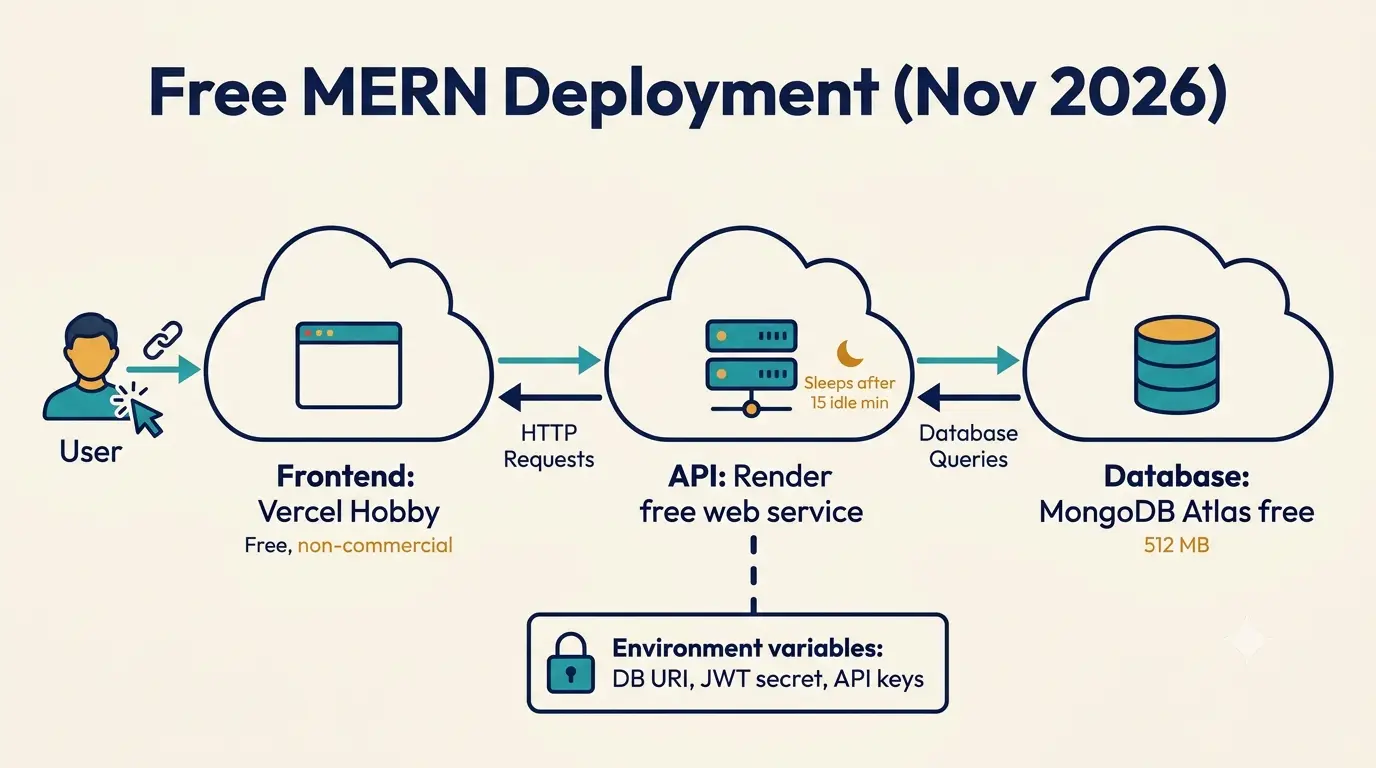
You can deploy a MERN stack project for free by putting the database on MongoDB Atlas, the Express API on a free web service like Render, and the React build on Vercel or Netlify. Each free tier has limits worth knowing before a recruiter clicks your link.
Here are the limits we checked on official pages in November 2026:
| Layer | Free option | Key limits | What it means for your demo |
|---|---|---|---|
| Database | MongoDB Atlas free cluster (formerly M0) | 512 MB storage, 100 operations per second, 32 MB in-memory sort | Plenty for a portfolio; use cloud storage for images, not MongoDB |
| API | Render free web service | Spins down after 15 minutes with no traffic; about a minute to spin back up; files on disk are lost on restart | First visit after idle is slow; warn in the README or wake it before interviews |
| Frontend | Vercel Hobby | Free for non-commercial, personal use only | Fine for a portfolio; a paying client's site needs a paid plan |
The deployment steps, in order:
- Create a free Atlas cluster, add a database user, and allow your API host to connect.
- Move every secret (MongoDB URI, JWT secret, API keys) into environment variables. Add
.envto.gitignorebefore your first commit. - Deploy the Express API to Render and set the same environment variables in its dashboard.
- Build the React app with Vite, set the API URL as an environment variable, and deploy it to Vercel.
- Restrict CORS to your frontend's domain, then test login, one create action and one error on the live site.
Important: If you ever pushed a
.envfile to GitHub, deleting it in a new commit is not enough. It stays in your Git history. Rotate the password or key immediately.
How to Show Your MERN Stack Project on GitHub and Your Resume
A MERN stack project only helps your job search if a recruiter can understand it quickly. Your README does that job on GitHub, and one strong bullet does it on your resume.
Use this README structure for every project:
# Project name: one-line problem it solves
Live demo: https://...   |   Demo video (2 min): https://...
Test login: demo@example.com / demo1234

## Who it's for
One sentence about the real user (e.g. a coaching class with 120 students).

## Screenshots
(2 to 3 images)

## Tech stack
React (Vite), Node.js, Express 5, MongoDB Atlas, Mongoose 9, JWT, Socket.IO

## Architecture
(simple diagram: React -> Express API -> MongoDB, plus any third-party service)

## The hard part
What was difficult, how you solved it, and what you'd do differently.

## Run locally
1. git clone ...  2. npm install  3. copy .env.example to .env  4. npm run dev

## Known limits
e.g. Free hosting sleeps after 15 minutes; first load may take about a minute.
A recruiter should find the live link in the first five seconds.
On your resume, write each project as one bullet with the problem, the stack and a result:
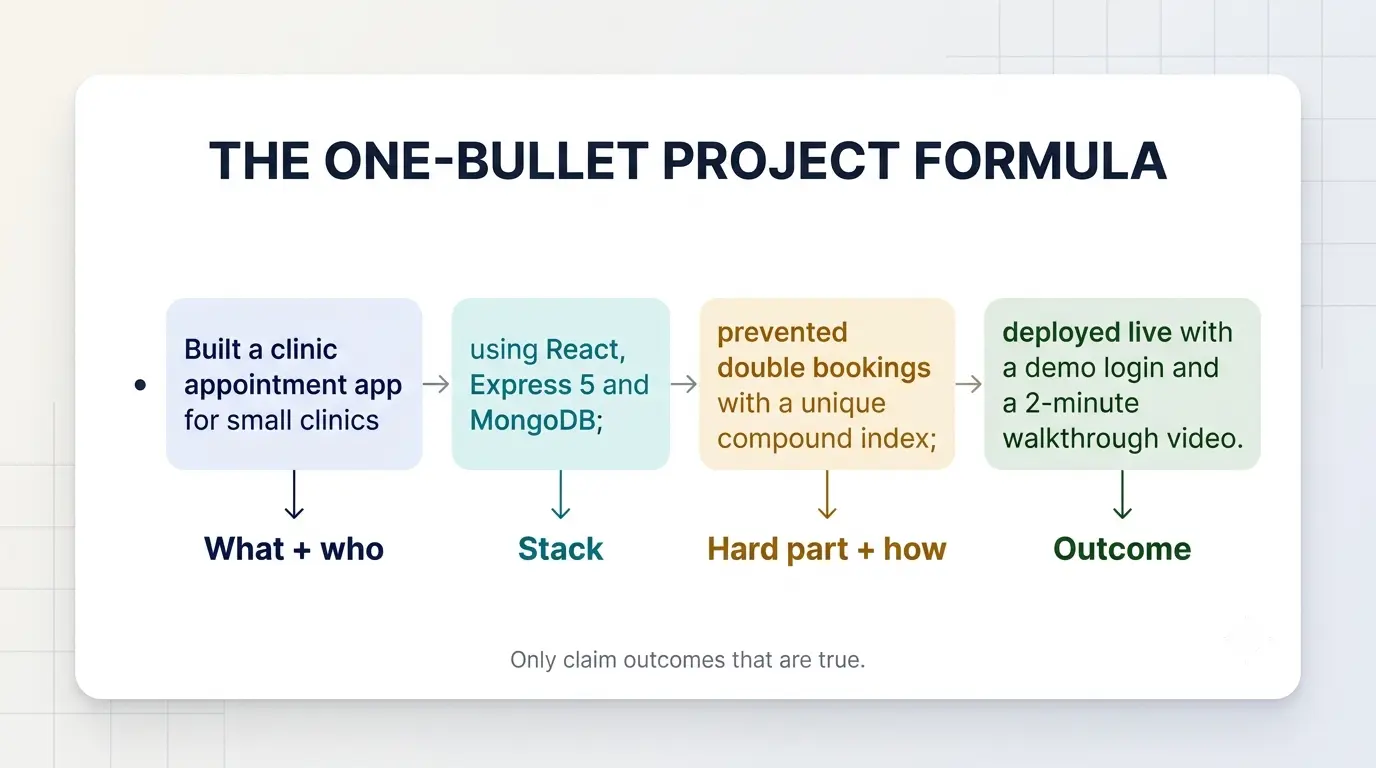
Formula: Built [what] for [who] using [stack]; solved [hard part] by [how]; [measurable outcome].
Example: Built a clinic appointment app for small clinics using React, Express 5 and MongoDB; prevented double bookings with a unique compound index; deployed live with a demo login and a 2-minute walkthrough video.
Only claim outcomes that are true. "Deployed live" and "used by my cousin's clinic for 3 weeks" are real outcomes. Made-up user counts get exposed in the first technical round.
Where to Find MERN Stack Project Source Code
Searching for a MERN stack project with source code, or browsing any MERN stack project GitHub topic page, is a good way to study folder structure and patterns. Just check the repo's package.json first: many popular repos still use Express 4, Mongoose 6 and Create React App, so they'll hit the breakages in our test table.
Study the code, close the tab, then build your own version with a different user and one new feature.
Next, prepare for the questions your projects will trigger with our list of MERN interview questions. And for a real example of projects turning into an offer, read Vinay's placement story.
Now It's Your Turn
The best MERN stack project isn't the most complex one. It's the one that passes the 5-Proof Portfolio Test: live, real problem, secure auth, explained, and one hard part you can talk about for ten minutes.
So pick one idea from your tier today. Build it on Express 5 and Mongoose 9 from the start, deploy it free, and write the README before you start the next one.
Which project are you building first?
If you'd like mentors to review your code and help you build three portfolio projects, Fireblaze's 5-month AI-Powered Full Stack Development course runs in classroom batches at Mate Square, Nandanvan and Sadar in Nagpur, or live online.
Its projects include an e-commerce build, a real-time chat app, a business dashboard and a team capstone. The listed fee is ₹75,000 including GST. Disclosure: Fireblaze AI School publishes this guide.
Not sure yet? Book a free career counselling session, or browse IT companies in Nagpur hiring freshers to see who you'd be applying to.
FAQ
Which MERN stack project is best for a resume?
The best MERN stack project for a resume is one that solves a real user's problem and includes a hard feature, such as payments with Razorpay test mode, real-time updates with Socket.IO, or an AI feature using an LLM API. An e-commerce store with verified payments or a multi-tenant SaaS usually gives you the most to discuss in interviews.
How many MERN projects do I need to get a job?
Two or three strong MERN projects are usually enough for a fresher portfolio. One beginner-level project done well, plus one or two intermediate or advanced projects that are deployed live with a clear README, beat a long list of tutorial clones.
Is a todo app a good MERN stack project for beginners?
A todo app is fine for learning CRUD, but it is a weak portfolio project because almost every applicant has one. Use it as practice, then build a beginner project with a real user and one twist, such as a coaching fee tracker with admin and student roles.
Can I use MERN projects from YouTube or GitHub in my portfolio?
You can learn from YouTube or GitHub MERN projects, but don't present a copied project as your own work. Rebuild it with a different use case, add at least one feature the tutorial didn't have, upgrade it to Express 5 and Mongoose 9, and credit the original in your README.
How long does it take to build a MERN stack project?
A beginner MERN project takes roughly 15 to 30 hours, an intermediate one 30 to 50 hours, and an advanced one 50 to 90 hours for one person who already knows the basics. Deployment and writing the README usually add another 3 to 5 hours.
What is a good MERN stack project for final year students?
For a final year project, choose an advanced MERN stack project that solves a local problem, such as a multi-tenant system for coaching institutes, a clinic booking platform, or a "chat with your notes" study assistant. These give you enough depth for a report, a live demo and viva questions.
Sources
- Stack Overflow Developer Survey 2025: Technology, 2025
- GitHub Octoverse 2025, October 2025
- Express: Migrating to Express 5, 2026
- Mongoose: Migrating from 6.x to 7.x, 2023
- Mongoose: Migrating from 8.x to 9.x, 2025
- React: Sunsetting Create React App, February 2025
- MongoDB Atlas pricing and Atlas free cluster limits, 2026
- Render: Deploy for Free, 2026
- Vercel Hobby plan, 2026
- Razorpay: Test integration, 2026
- Gemini API pricing, 2026
- Fireblaze AI School compatibility tests: Express 4.22.3 and Express 5.3.0, Mongoose 6.13.13 and Mongoose 9.13.1, on Node.js 22, run 26 November 2026