 Fireblaze
Career Roadmaps
What Is a MERN Stack Developer? Skills, Salary and Roadmap (2026)
A data science roadmap for 2026 built for India: 5 stages, the data scientist skills and tools to learn, and a month-by-month timeline for every background.


Every web development job post seems to ask for "MERN". But nobody explains what the job actually involves.
You see four letters, a long list of tools and salary claims that don't match each other.
This guide fixes that. You'll learn what a MERN stack developer does, the exact skills employers check in 2026, what the role pays in India (with dated sources), and a 6-month roadmap you can start this week.
Here's what's inside:
- The MERN stack full form, explained with one real request
- A 2026 skills checklist and salary table
- MERN stack vs full stack, and a month-by-month plan
Let's get started.
A MERN stack developer is a full stack web developer who builds complete applications with four JavaScript technologies: MongoDB (database), Express.js (backend framework), React (frontend library) and Node.js (server runtime). Because one language runs from the browser to the database, a single developer can design screens, write APIs and store data.
Quick answer: what a MERN stack developer does (November 2026)
- MERN stands for MongoDB, Express.js, React and Node.js, four tools that all run on JavaScript.
- A MERN developer builds the user interface in React, the API in Express on Node.js, and stores data in MongoDB.
- AmbitionBox lists fresher MERN salaries in India at roughly ₹0.8 lakh to ₹6 lakh a year (March 2025 data), rising to ₹3 lakh to ₹12 lakh by year four.
- Node.js (48.7%) and React (44.7%) were the two most used web technologies in the Stack Overflow Developer Survey 2025.
- A focused beginner can become job-ready in about 6 months by learning HTML and JavaScript first, then React, then Node, Express and MongoDB.
What Is MERN Stack? Full Form and Meaning
The MERN stack is a set of four open-source JavaScript technologies used together to build full web applications. A "stack" simply means the layers of software that sit on top of each other to make an app work, from the screen you tap to the database that remembers your data.
MERN stack full form
The MERN stack full form is MongoDB, Express.js, React and Node.js. Each letter covers one layer:
| Letter | Technology | Layer | What it does |
|---|---|---|---|
| M | MongoDB | Database | Stores data as JSON-like documents instead of rows and columns |
| E | Express.js | Backend framework | Handles routes, middleware and the REST API |
| R | React | Frontend library | Builds the user interface from reusable components |
| N | Node.js | Runtime | Runs JavaScript on the server, outside the browser |
The big advantage is one language everywhere. You write JavaScript (or TypeScript) in React, in Express and in your MongoDB queries through Mongoose.
That's why MERN is popular with beginners: you learn one language deeply instead of three languages shallowly.
Note: The tools have moved on since many older tutorials were written. The React team deprecated Create React App for new projects in February 2025 and now points developers to frameworks such as Next.js, or React Router with Vite (DevClass, 2025). Express v5 is now the current major version, and Node.js 26 became the Active LTS release in October 2026.
How the MERN Stack Works: One Request, Start to Finish
A MERN application works by passing JSON data between four layers: React sends a request, Express on Node.js processes it, MongoDB stores or returns the data, and React updates the screen. The easiest way to understand it is to follow one click.
Here's a real-world example: a tiffin service in Nagpur lets customers order lunch online.
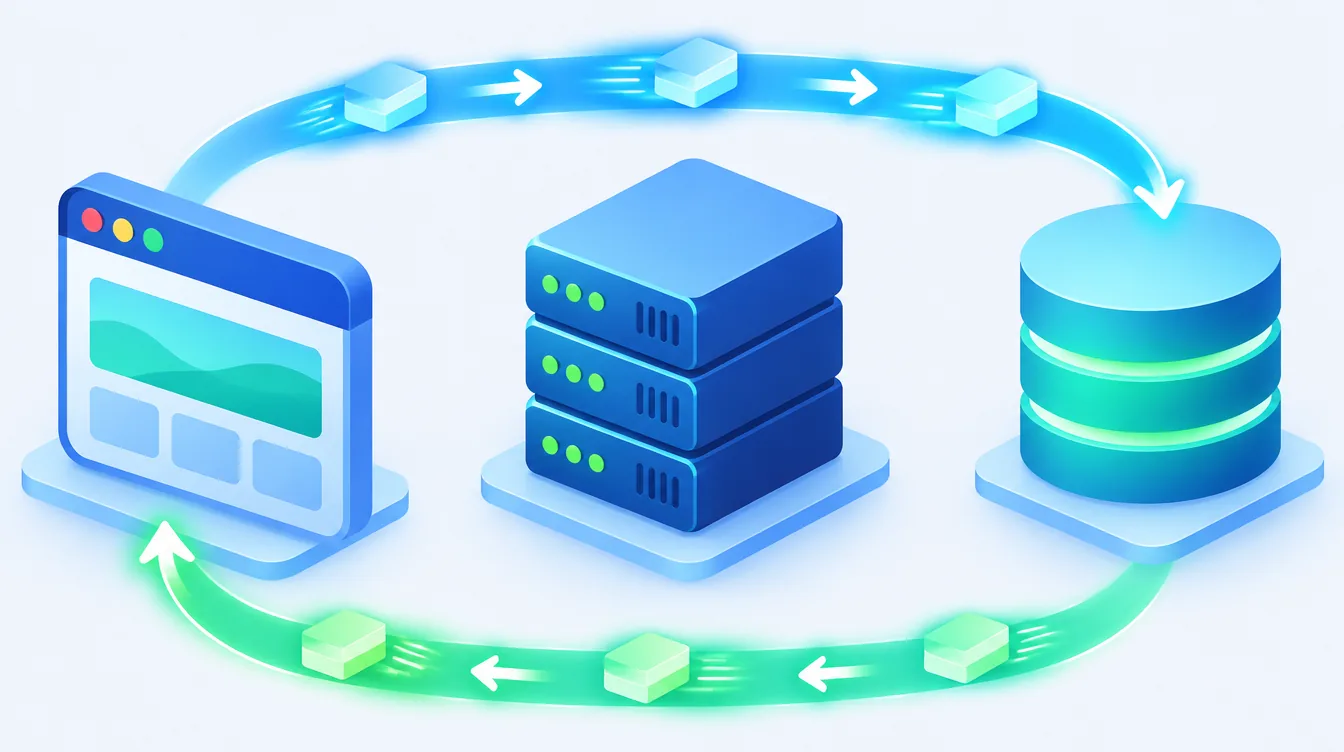
- React (browser): The customer picks "Veg Thali" and taps Order. A React component collects the item and quantity and sends a POST /api/orders request with a JSON body.
- Node.js (server): Node.js receives the request. It runs JavaScript on the server, so the same language you used in React now handles business logic.
- Express.js (API): An Express route checks the customer's login token (often a JWT), validates the order with middleware, and calculates the total.
- MongoDB (database): Through Mongoose, the order is saved as a document in an orders collection. MongoDB returns the saved order with its ID.
- Back to React: Express sends the saved order back as JSON. React updates the state and shows "Order placed. Arriving by 1 PM."
That loop is the whole job, repeated hundreds of times with different screens and data.
Pro tip: Draw this five-step loop for every feature before you code it. It forces you to decide what the frontend sends, what the backend checks and what the database stores.
What Does a MERN Stack Developer Do Every Day?
A MERN stack developer spends the day turning feature requests into working screens, APIs and database changes, then testing and shipping them. In small companies and startups, one MERN developer often owns a feature from design file to deployment.
A typical week includes:
- Building UI: turning a Figma design into React components with hooks like useState and useEffect.
- Writing APIs: creating Express routes for login, search, payments or reports.
- Modelling data: designing MongoDB collections and indexes so pages load fast.
- Fixing bugs: reading error logs, reproducing issues and writing fixes.
- Code review and Git: raising pull requests on GitHub and reviewing teammates' code.
- Deployment: pushing builds to cloud platforms and checking that nothing broke.
MERN Stack Developer Skills: The 2026 Checklist
MERN stack developer skills fall into three groups: core stack skills (JavaScript, React, Node.js, Express, MongoDB), supporting engineering skills (Git, APIs, authentication, deployment) and, increasingly, AI-assisted development. Employers test the first group in interviews and judge the other two through your projects.
Core technical skills
- HTML, CSS and responsive design: semantic HTML, Flexbox, Grid and mobile-first layouts.
- JavaScript (ES6+): variables, arrays, objects, the DOM, promises, async/await and fetch.
- React: components, props, state, hooks, routing and calling APIs.
- Node.js and npm: running servers, managing packages and environment variables.
- Express.js: routes, middleware, error handling and REST API design.
- MongoDB and Mongoose: schemas, CRUD operations, relationships and indexing.
Supporting skills employers check
- Git and GitHub: branches, pull requests and resolving merge conflicts.
- Authentication: sessions vs JWT, password hashing and protecting routes.
- Deployment: hosting the React frontend and Node backend, connecting a cloud database such as MongoDB Atlas. MongoDB's free M0 cluster offers 512 MB of storage, enough for portfolio projects.
- TypeScript basics: 43.6% of developers in the Stack Overflow Developer Survey 2025 used TypeScript, and many MERN job posts now list it.
- DSA fundamentals: arrays, strings, hashing and simple recursion for coding rounds.
AI-assisted development
AI coding assistants such as GitHub Copilot, ChatGPT and Claude are now part of a normal MERN workflow. They speed up boilerplate, tests and debugging.
But here's the catch: interviewers still expect you to explain every line you submit. Use AI to go faster, not to skip understanding.
The same skill is at the heart of newer roles like the forward deployed engineer, which many MERN developers grow into.
MERN Stack Developer Salary in India (2026)
MERN stack developer salary in India typically starts between ₹2 lakh and ₹6 lakh a year for freshers and can reach ₹10 lakh to ₹12 lakh within three to four years, depending on city, company and skills. Exact figures vary by source, so the table below shows each source with its date.
| Experience | Salary range (per year) | Source |
|---|---|---|
| Fresher | ₹0.8 lakh to ₹6 lakh | AmbitionBox, 630 salaries (updated Mar 2025) |
| 1 year | ₹1 lakh to ₹6 lakh | AmbitionBox, 1.3k salaries |
| 2 years | ₹2 lakh to ₹8 lakh | AmbitionBox, 1.1k salaries |
| 3 years | ₹3 lakh to ₹11.2 lakh | AmbitionBox, 578 salaries |
| 4 years | ₹3 lakh to ₹12 lakh | AmbitionBox, 99 salaries |
| All levels (job listings) | Average ₹7.04 lakh | Jooble, 2,069 salaries (as of Nov 2026) |
Sources: AmbitionBox, Jooble.
City matters too. AmbitionBox lists Pune as its top city for MERN salaries, with a range of ₹1.5 lakh to ₹10 lakh based on 256 reports. Jooble's November 2026 listing data shows Bengaluru and Hyderabad near ₹12 lakh a year for advertised roles.
Important: Self-reported salary sites skew towards junior roles, and job-listing averages skew towards experienced openings. Read the ranges as a band, not a promise. The low end of the fresher range often reflects internships and small agencies.
What pushes a MERN salary up?
- Deployed projects: a live app with real users beats five tutorial clones.
- TypeScript and Next.js: both appear often in higher-paying product company job posts.
- Backend depth: database design, caching and security separate a ₹4 lakh offer from an ₹8 lakh one.
MERN Stack vs Full Stack: What Is the Difference?
MERN stack vs full stack is not a competition: a MERN developer is a type of full stack developer. "Full stack" means you work on both frontend and backend with any tools, while MERN names one specific JavaScript toolset.
| Stack | Frontend | Backend | Database | Language |
|---|---|---|---|---|
| MERN | React | Express on Node.js | MongoDB | JavaScript |
| MEAN | Angular | Express on Node.js | MongoDB | JavaScript / TypeScript |
| MEVN | Vue.js | Express on Node.js | MongoDB | JavaScript |
| General full stack | Any (React, Angular, Vue) | Any (Java Spring, Django, .NET, Node.js) | Any (PostgreSQL, MySQL, MongoDB) | Often two or more |
The MEAN stack swaps React for Angular, and the MEVN stack swaps it for Vue.js. The backend and database stay the same, so skills transfer easily between all three.
So which should you pick? Start with MERN if you want one language, a fast path to your first project and the large React job market. Broaden later by adding PostgreSQL or a second backend language. In the Stack Overflow Developer Survey 2025, PostgreSQL was used by 55.6% of respondents and MongoDB by 24%, so knowing one SQL database makes a MERN developer far more employable.
Bottom line: MERN is a strong first stack, not a final one.
Is MERN Stack Still in Demand in 2026?
Yes. The MERN stack remains in demand in 2026 because React and Node.js are still the two most used web technologies worldwide, but the Indian market now rewards experienced developers more than freshers.
Here's what the data says:
- Global usage: Node.js (48.7%) and React (44.7%) topped web framework usage in the Stack Overflow Developer Survey 2025, with JavaScript used by 66% of all respondents.
- Indian hiring: Naukri JobSpeak reported IT hiring up 6% year-on-year in February 2026, with fresher hiring (0 to 3 years) up 8% in IT and AI/ML roles up 49% overall.
- Fresher squeeze: A PrepNPlaced analysis of 18,752 LinkedIn and Naukri postings, reported by Careers360 in October 2026, found full stack roles made up 5% of postings, while only 4.3% of all postings targeted entry-level candidates.
In other words: the jobs exist, but freshers compete for a smaller slice. A deployed portfolio and AI-assisted development skills are what get you shortlisted.
Our breakdown of the AI job market in India explains why. If you're open to remote roles, our guide on remote IT jobs from Nagpur shows where to look.
MERN Stack Roadmap: The 6-Month Build Ladder
The best MERN stack roadmap moves in one direction: browser basics, then JavaScript, then React, then the backend, then a full deployed project. We call this the 6-Month MERN Build Ladder: each month ends with one portfolio checkpoint, so you never study a layer without building with it.

| Month | Focus | Portfolio checkpoint |
|---|---|---|
| 1 | HTML, CSS, responsive design, Git basics | A responsive landing page on GitHub Pages |
| 2 | JavaScript: DOM, ES6+, async/await, fetch | A weather or quiz app using a public API |
| 3 | React: components, hooks, routing, Vite | A multi-page React app that consumes an API |
| 4 | Node.js, Express, REST APIs, middleware | A REST API with CRUD routes, tested in Postman |
| 5 | MongoDB, Mongoose, authentication (JWT) | Login and sign-up connected to MongoDB Atlas |
| 6 | Full MERN project, deployment, DSA, resume | One deployed full stack app with a README |
How to follow the ladder
- Study 2 hours a day, build 1 hour. Theory without a checkpoint fades within weeks.
- Don't skip month 2. JavaScript is the foundation for all four tools.
- Use modern tooling. Start React projects with Vite or Next.js rather than the deprecated Create React App.
- Push everything to GitHub. Recruiters read commit history as proof of consistency.
- Make month 6 personal. Build something a local business could use: a clinic booking app, a coaching-class fee tracker or a shop inventory dashboard.
MERN Stack Developer Interviews: What Freshers Get Wrong
MERN stack developer interviews for freshers usually include a JavaScript fundamentals round, a React and API discussion around your projects, a DSA coding round and an HR round. Most rejections come from shallow project explanations, not from missing tools.

Questions that come up again and again:
- What is the difference between let, const and var?
- Explain closures and the event loop with an example.
- Why does React re-render, and how does useEffect work?
- How does middleware work in Express?
- How did you secure your login API?
- Why did you choose MongoDB over a SQL database for this project?
For more practice, see our 60 data analyst interview questions for the SQL and problem-solving style many tech panels share, and our guide to IT companies in MIHAN Nagpur for where freshers apply locally.
Now It's Your Turn
A MERN stack developer builds complete web apps with MongoDB, Express.js, React and Node.js, all in one language. The demand is real, the salary curve rises quickly after the first two years, and the path is clear: JavaScript first, one layer per month, and a deployed project at the end.
The hard part is staying consistent and getting honest feedback on your code.
If you'd like a structured path with mentors, live projects and mock interviews, Fireblaze AI School's AI-Powered Full Stack Applications Development (MERN) program follows this same ladder over 5 months, in Nagpur classrooms or live online.
So, which month of the ladder are you starting from?
FAQ
What is the full form of MERN stack?
The full form of MERN stack is MongoDB, Express.js, React and Node.js. MongoDB is the database, Express.js is the backend framework, React builds the user interface and Node.js runs JavaScript on the server.
What is the salary of a MERN stack developer in India?
A MERN stack developer in India earns roughly ₹0.8 lakh to ₹6 lakh a year as a fresher, according to AmbitionBox data updated in March 2025. With three to four years of experience, the range rises to about ₹3 lakh to ₹12 lakh, and job-listing data from Jooble showed an average near ₹7 lakh in November 2026.
Can a non-IT graduate become a MERN stack developer?
Yes, a non-IT graduate can become a MERN stack developer by starting with HTML, CSS and JavaScript before moving to React and Node.js. Most beginners need about six months of consistent daily practice and two or three deployed projects to be ready for interviews.
Is MERN stack better than full stack?
MERN stack is not better or worse than full stack, because MERN is one type of full stack development. MERN uses only JavaScript tools, which makes it faster to learn, while general full stack roles may use Java, Python or .NET with SQL databases.
How long does it take to learn MERN stack?
Learning the MERN stack takes about 5 to 6 months for a beginner who studies 2 to 3 hours a day. Someone who already knows JavaScript can usually become productive with React, Express and MongoDB in 2 to 3 months.
Sources
- Stack Overflow Developer Survey 2025: Technology, 2025
- AmbitionBox: MERN Stack Developer Salary in India, updated March 2025
- AmbitionBox: MERN Stack Developer Salary in Pune, updated June 2025
- Jooble: MERN Stack Developer Salary in India, November 2026
- Naukri JobSpeak, February 2026, 2026
- Careers360: Tech Hiring in India 2026 (PrepNPlaced data), October 2026
- DevClass: React team deprecates Create React App, 2025
- Express.js: Introducing Express v5, 2024
- endoflife.date: Node.js release schedule, 2026
- MongoDB Atlas pricing, 2026