 Fireblaze
 Career Roadmaps
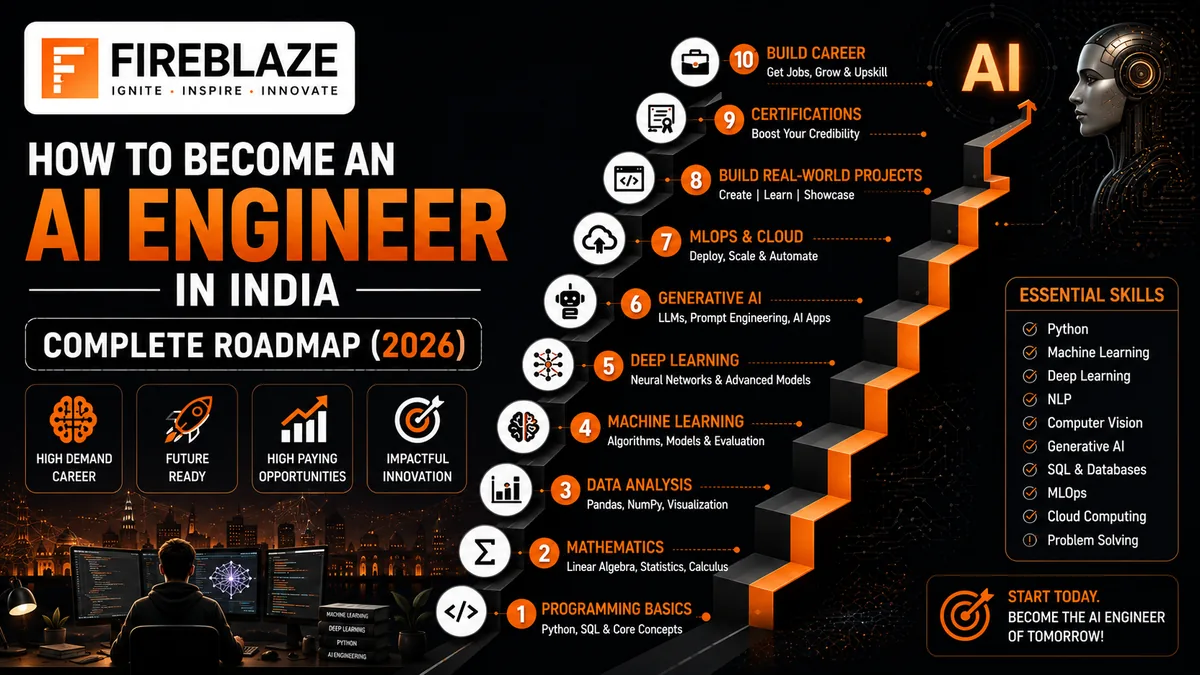
How to Become an AI Engineer in India: Complete Roadmap (2026) AI Engineer Roadmap
Introduction
Artificial Intelligence has become one of the most influential technologies shaping the future of every industry. From healthcare and finance to education, manufacturing, e commerce, and entertainment, AI is transforming the way businesses operate and make decisions. As organizations continue to invest in intelligent systems, the demand for skilled AI Engineers has reached an all time high. In India, startups, multinational companies, research organizations, and technology giants are actively hiring professionals who can develop AI powered applications and solve complex business problems using machine learning and deep learning.
For students and working professionals, Artificial Intelligence offers one of the most rewarding career opportunities in 2026. High salaries, exciting projects, continuous innovation, and global demand make AI Engineering an attractive career path. However, many beginners often wonder where to start, what skills to learn, which programming languages to master, and how to build a successful career in this field.
This complete roadmap will guide you through every step required to become an AI Engineer in India in 2026, from learning the fundamentals to securing your first job.
What Does an AI Engineer Do?
An AI Engineer designs, develops, and deploys intelligent systems that can perform tasks requiring human intelligence. These tasks include image recognition, speech processing, language understanding, recommendation systems, fraud detection, predictive analytics, robotics, and autonomous decision making.
AI Engineers work with large datasets, create machine learning models, train deep learning algorithms, optimize model performance, and deploy AI solutions into real world applications. They collaborate with software developers, data scientists, business analysts, and product managers to build scalable AI powered products.
The role requires both programming expertise and strong analytical thinking, making it one of the most dynamic careers in the technology industry.
Why Choose AI Engineering as a Career in 2026?
Artificial Intelligence is no longer limited to research laboratories. Businesses across every sector now use AI to automate processes, improve customer experiences, increase efficiency, and generate valuable insights from data. This rapid adoption has created thousands of job opportunities for AI professionals across India.
The growing startup ecosystem, government initiatives promoting AI innovation, increasing investment in digital transformation, and the expansion of cloud computing have further accelerated demand for AI Engineers. Professionals with practical AI skills are among the highest paid technology experts today, and this trend is expected to continue for many years.
Choosing AI Engineering means entering a field with continuous learning opportunities, strong career growth, international demand, and the ability to work on cutting edge technologies that shape the future.
Step One Build Strong Programming Skills
The first step toward becoming an AI Engineer is learning programming. Python has become the most widely used programming language in Artificial Intelligence because of its simplicity, readability, and extensive collection of AI libraries. Beginners should focus on understanding variables, loops, functions, object oriented programming, file handling, and error management before moving to advanced AI concepts.
Although Python is the primary language for AI development, learning SQL is equally important because AI Engineers frequently work with databases to collect and process information. Basic knowledge of Java, C++, or JavaScript can also be helpful depending on the type of AI applications you plan to build.
Programming forms the foundation of AI development, so spending adequate time mastering coding fundamentals is essential.
Step Two Learn Mathematics for Artificial Intelligence
Mathematics plays a critical role in understanding how AI algorithms work. While many AI libraries simplify implementation, having a strong mathematical foundation allows engineers to optimize models and solve complex problems effectively.
Linear Algebra helps in handling vectors, matrices, and transformations used in machine learning models. Probability and Statistics enable prediction, classification, and data analysis. Calculus supports optimization techniques used during model training, while basic algebra and mathematical reasoning improve overall analytical thinking.
You do not need to become a mathematician, but understanding these concepts makes learning advanced AI much easier.
Step Three Understand Data Structures and Algorithms
AI Engineers write efficient code that processes massive datasets quickly. Learning Data Structures and Algorithms improves problem solving ability and prepares candidates for technical interviews at leading technology companies.
Important topics include arrays, linked lists, stacks, queues, trees, graphs, sorting algorithms, searching algorithms, recursion, and dynamic programming. These concepts also strengthen your programming logic and make your AI applications more efficient.
Many companies evaluate Data Structures and Algorithms during recruitment, making this an important part of your preparation.
Step Four Learn Data Analysis and Data Visualization
Artificial Intelligence depends heavily on data. Before training machine learning models, engineers must clean, organize, and analyze datasets to identify meaningful patterns.
Learning libraries such as Pandas and NumPy enables efficient data manipulation, while visualization tools like Matplotlib and Plotly help present insights through charts and graphs. Understanding data preprocessing techniques, handling missing values, feature engineering, and exploratory data analysis is equally important.
Developing strong data analysis skills helps create better machine learning models with improved accuracy.
Step Five Master Machine Learning
Machine Learning is the core of Artificial Intelligence. Instead of programming every rule manually, machine learning enables computers to learn from data and improve their performance over time.
Beginners should understand supervised learning, unsupervised learning, and reinforcement learning before studying popular algorithms such as Linear Regression, Logistic Regression, Decision Trees, Random Forest, Support Vector Machines, K Nearest Neighbors, and Clustering techniques.
You should also learn model evaluation methods, feature selection, cross validation, overfitting, underfitting, and hyperparameter tuning. Practical implementation using Scikit Learn will strengthen your understanding of machine learning concepts.
Step Six Learn Deep Learning
Deep Learning powers many modern AI applications including image recognition, speech recognition, autonomous vehicles, recommendation systems, and Generative AI.
Understanding Artificial Neural Networks, Convolutional Neural Networks, Recurrent Neural Networks, Long Short Term Memory networks, and Transformer architectures will significantly expand your AI expertise.
Frameworks such as TensorFlow and PyTorch are widely used for developing deep learning models. Learning these technologies prepares you for advanced AI development and research projects.
Step Seven Explore Generative AI and Large Language Models
Generative AI has become one of the fastest growing areas of Artificial Intelligence in 2026. Businesses increasingly require professionals capable of developing AI assistants, chatbots, content generation tools, code assistants, and intelligent automation systems.
Understanding Large Language Models, Prompt Engineering, Retrieval Augmented Generation, Vector Databases, AI Agents, and Model Fine Tuning has become highly valuable. Learning how to integrate APIs from leading AI providers and build applications using frameworks such as LangChain and LlamaIndex can significantly improve your career opportunities.
Generative AI skills are becoming an important advantage for aspiring AI Engineers.
Step Eight Learn Cloud Computing and AI Deployment
Building AI models is only part of an AI Engineer's job. Companies also expect engineers to deploy models into production environments where users can interact with them.
Learning cloud platforms such as Microsoft Azure, Amazon Web Services, and Google Cloud Platform helps deploy scalable AI applications. Understanding Docker, Kubernetes, REST APIs, FastAPI, Flask, and model serving techniques enables smooth deployment of machine learning systems.
Knowledge of cloud computing makes AI solutions more practical and industry ready.
Step Nine Build Real World AI Projects
Practical experience is one of the most important factors employers consider during hiring. Building projects demonstrates your ability to apply theoretical knowledge to real business problems.
You can begin with simple applications such as spam email detection, movie recommendation systems, handwritten digit recognition, customer churn prediction, sentiment analysis, chatbot development, face recognition systems, resume screening tools, or AI powered document summarization.
As your skills improve, move toward advanced projects involving Generative AI, intelligent assistants, computer vision, predictive analytics, and autonomous decision making systems.
Every completed project strengthens your portfolio and improves your confidence.
Step Ten Create a Strong Portfolio
Your portfolio serves as proof of your technical abilities. Recruiters prefer candidates who can demonstrate working AI applications instead of simply listing completed courses.
Upload your projects to GitHub with clear documentation, screenshots, installation guides, and explanations of the technologies used. Create a professional LinkedIn profile showcasing your achievements, certifications, internships, and technical skills.
A well organized portfolio significantly increases your chances of receiving interview opportunities.
Step Eleven Earn Relevant Certifications
Although practical experience is more important than certifications, recognized credentials help validate your knowledge and strengthen your resume.
Completing certifications in Python, Machine Learning, Deep Learning, Cloud Computing, Data Science, and Generative AI demonstrates continuous learning and commitment to professional development. These certifications can also improve visibility during recruitment.
Choose certifications that include hands on projects rather than purely theoretical content.
Step Twelve Prepare for AI Interviews
Interview preparation should begin after developing practical experience. Recruiters commonly evaluate Python programming, SQL, Data Structures, Machine Learning algorithms, Deep Learning concepts, probability, statistics, data preprocessing, feature engineering, and project experience.
Practice coding regularly, review machine learning fundamentals, solve SQL interview questions, and prepare to explain every project in your portfolio. Interviewers often focus more on your thought process and practical implementation than on memorized definitions.
Mock interviews and coding practice platforms can further improve your confidence.
AI Engineer Salary in India in 2026
AI Engineering remains one of the highest paying technology careers in India. Freshers entering the field with strong programming skills, machine learning knowledge, and practical project experience can expect competitive salary packages. Professionals with expertise in Deep Learning, Computer Vision, Natural Language Processing, Generative AI, and Cloud AI solutions often receive significantly higher compensation.
As experience increases, AI Engineers can progress into roles such as Senior AI Engineer, Machine Learning Engineer, AI Architect, Research Scientist, Data Science Manager, or Artificial Intelligence Consultant. Continuous learning and specialization often lead to exceptional career growth.
Essential Skills Every AI Engineer Should Have
A successful AI Engineer combines technical expertise with problem solving ability and continuous learning. Strong programming skills, database knowledge, mathematics, machine learning, deep learning, cloud computing, data analysis, communication skills, and business understanding all contribute to long term success. Since Artificial Intelligence evolves rapidly, professionals who continuously upgrade their skills remain highly competitive in the job market.
Conclusion
Artificial Intelligence is redefining the future of technology, making AI Engineering one of the most exciting and rewarding career paths in India in 2026. While the learning journey may seem challenging at first, following a structured roadmap makes the process much more manageable. Begin by mastering Python and SQL, strengthen your understanding of mathematics and data structures, learn machine learning and deep learning, explore Generative AI, build practical projects, and create a professional portfolio that showcases your abilities.
Success in AI Engineering is not determined by the number of courses you complete but by your ability to solve real world problems using intelligent technologies. With consistent practice, hands on experience, and continuous learning, you can build a successful career as an AI Engineer and become part of the next generation of professionals driving innovation across industries.
For individual skills along that roadmap, our self-paced courses cover prompt engineering, RAG and agentic AI, each with a graded project and a month of doubt support.
Keep Reading
Related Articles
Career Roadmaps
Essential Skills for Data Scientists: A Complete Career Guide for 2026
Learn the most important technical and soft skills required to become a successful Data Scientist. Explore career-ready skills, tools, and technologie
Why Companies Prefer Full Stack Developers Over Specialized Roles Today
A Full Stack Developer is a professional capable of working across the entire technology stack: from the front-end user interface to the back-end serv
How to Become a Data Analyst in Nagpur in 2026: Complete Career Roadmap
Want to become a Data Analyst in Nagpur? This complete guide covers the skills, tools, salary expectations, career roadmap, and training required to s