 Fireblaze
 Learning Guides
INNER JOIN in SQL with Examples: Complete Beginner's Guide
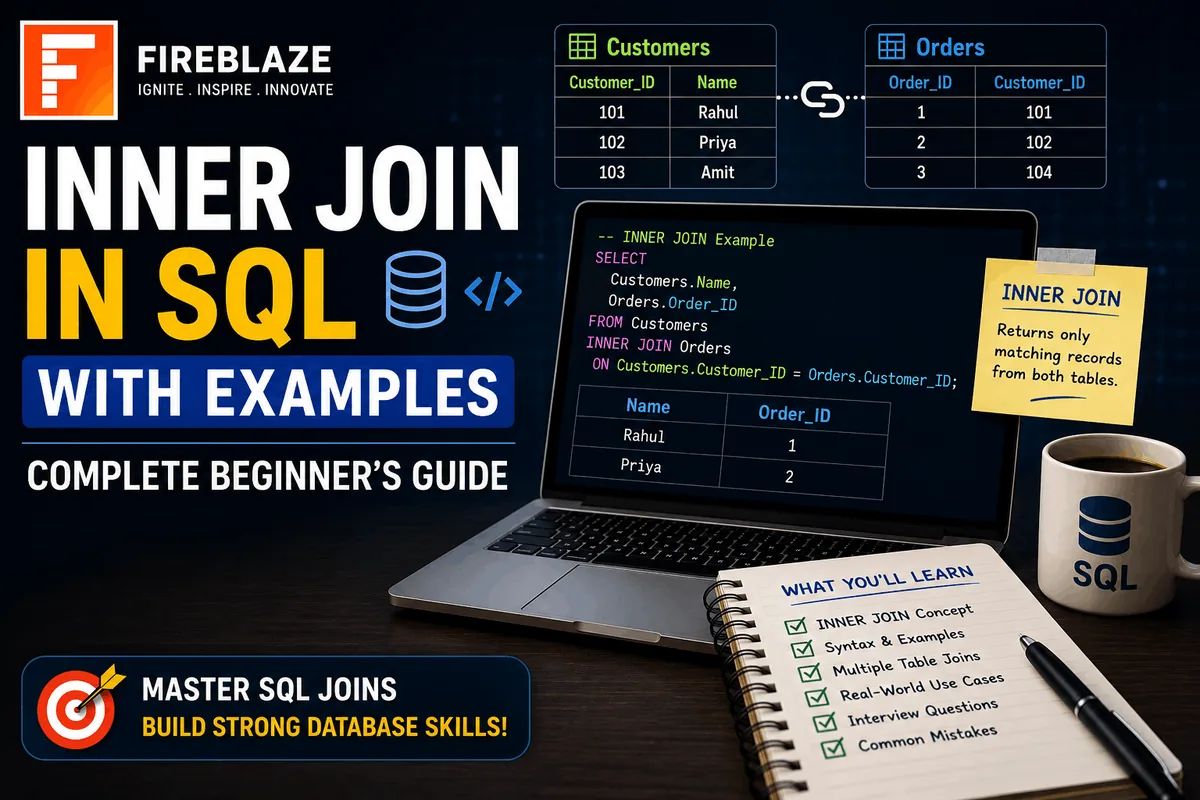
SQL is one of the most important skills for aspiring Data Analysts, Data Scientists, and Business Intelligence professionals. In real-world databases, information is often stored across multiple tables. To retrieve meaningful insights, we use SQL JOIN operations.
Among all JOIN types, INNER JOIN is the most commonly used.
In this guide, you'll learn:
What INNER JOIN is
Why INNER JOIN is used
INNER JOIN syntax
Practical examples
Real-world business applications
Common interview questions
What is INNER JOIN in SQL?
INNER JOIN is used to combine records from two or more tables based on a matching column.
It returns only those rows where matching values exist in both tables.
Think of it as finding the common records between two datasets.
For example:
You have:
Students Table
| Student_ID | Name |
|---|---|
| 101 | Rahul |
| 102 | Priya |
| 103 | Aman |
Courses Table
| Student_ID | Course |
|---|---|
| 101 | Data Analytics |
| 102 | Data Science |
| 104 | Full Stack Development |
Using INNER JOIN, SQL returns only the students that exist in both tables.
Result:
| Student_ID | Name | Course |
|---|---|---|
| 101 | Rahul | Data Analytics |
| 102 | Priya | Data Science |
Student 103 and Student 104 are excluded because they do not have matching records in both tables.
INNER JOIN Syntax
SELECT column_name(s)\nFROM table1\nINNER JOIN table2\nON table1.common_column = table2.common_column;\nThe ON clause specifies the relationship between the tables.
Example 1: Student and Course Database
Students Table
CREATE TABLE Students (\nStudent_ID INT,\nName VARCHAR(50)\n);\nEnrollments Table
CREATE TABLE Enrollments (\nStudent_ID INT,\nCourse VARCHAR(50)\n);\nQuery
SELECT\nStudents.Student_ID,\nStudents.Name,\nEnrollments.Course\nFROM Students\nINNER JOIN Enrollments\nON Students.Student_ID = Enrollments.Student_ID;\nOutput
| Student_ID | Name | Course |
|---|---|---|
| 101 | Rahul | Data Analytics |
| 102 | Priya | Data Science |
Example 2: Employee and Department Tables
Employees Table
| Employee_ID | Employee_Name | Department_ID |
|---|---|---|
| 1 | Amit | 101 |
| 2 | Sneha | 102 |
| 3 | Rohan | 103 |
Departments Table
| Department_ID | Department_Name |
|---|---|
| 101 | HR |
| 102 | Finance |
| 104 | Marketing |
Query
SELECT\nEmployee_Name,\nDepartment_Name\nFROM Employees\nINNER JOIN Departments\nON Employees.Department_ID =\nDepartments.Department_ID;\nOutput
| Employee_Name | Department_Name |
|---|---|
| Amit | HR |
| Sneha | Finance |
Rohan is excluded because Department 103 does not exist in the Departments table.
Real-World Applications of INNER JOIN
INNER JOIN is used extensively in industry.
E-commerce
Connect:
Customers
Orders
Products
to generate sales reports.
Banking
Combine:
Customer Accounts
Transactions
to analyze financial activities.
Healthcare
Join:
Patients
Appointments
to track medical histories.
Education
Connect:
Students
Courses
Results
for academic reporting.
Difference Between INNER JOIN and LEFT JOIN
| INNER JOIN | LEFT JOIN |
|---|---|
| Returns only matching records | Returns all records from left table |
| Excludes unmatched rows | Includes unmatched rows |
| Most commonly used | Used for data completeness checks |
Common SQL INNER JOIN Interview Questions
1. What is INNER JOIN?
INNER JOIN returns records that have matching values in both tables.
2. What happens if there is no match?
Rows without matching values are excluded.
3. Can INNER JOIN be used on multiple tables?
Yes.
Example:
SELECT *\nFROM Students\nINNER JOIN Enrollments\nON Students.Student_ID = Enrollments.Student_ID\nINNER JOIN Courses\nON Enrollments.Course_ID = Courses.Course_ID;\n4. Is INNER JOIN faster than OUTER JOIN?
Generally, INNER JOIN is more efficient because it processes only matching records.
Best Practices for Using INNER JOIN
Always use meaningful table aliases.
Ensure join columns are indexed.
Avoid joining unnecessary tables.
Verify data types of matching columns.
Use explicit JOIN syntax instead of old-style joins.
Example:
SELECT\ns.Name,\ne.Course\nFROM Students s\nINNER JOIN Enrollments e\nON s.Student_ID = e.Student_ID;\nWhy SQL JOINs Matter for Data Analytics Careers
In Data Analytics and Business Intelligence roles, data is rarely stored in a single table.
Professionals frequently join:
Sales data
Customer data
Product information
Marketing performance data
Financial reports
Mastering SQL JOINs is essential for building dashboards, generating reports, and solving real business problems.
Whether you're preparing for a Data Analyst interview or learning SQL from scratch, understanding INNER JOIN is a fundamental skill.
Final Thoughts
INNER JOIN is one of the most powerful and frequently used SQL operations. It helps combine related data from multiple tables and is essential for real-world database analysis.
By mastering INNER JOIN, you'll be better prepared for Data Analytics, Data Science, Business Intelligence, and SQL interview challenges.
If you're serious about building a career in Data Analytics or Data Science, SQL is one of the first skills you should learn, and INNER JOIN is one of the first concepts you should master.
Keep Reading
Related Articles
Learning Guides
Introduction to Computer Vision: A Beginner’s Guide
Discover the basics of Computer Vision, a rapidly growing field of Artificial Intelligence that enables machines to understand images and videos. Expl
All About PyCaret: Conversation with Mr. Moez Ali and Mr. Aniruddha Kalbande | EP-06
Explore PyCaret and its impact on machine learning development through an insightful conversation with PyCaret creator Moez Ali and AI expert Aniruddh
What is Data Mining? Complete Guide for Beginners
Learn what Data Mining is, how it works, key techniques, tools, applications, advantages, challenges, and its role in Data Science, Machine Learning,