 Fireblaze
 Learning Guides
Data Preprocessing in Data Science: Complete Beginner’s Guide
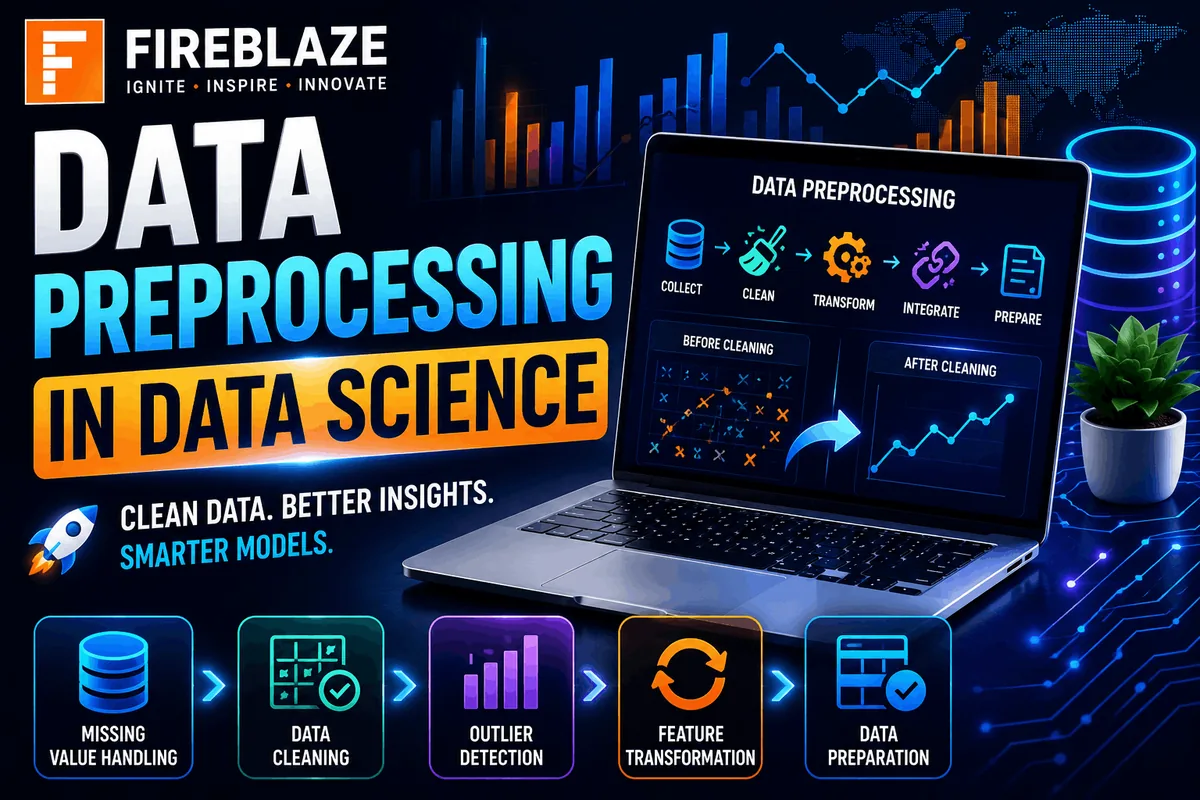
Data is the foundation of Data Science, Machine Learning, Artificial Intelligence, and Business Analytics. However, real-world data is rarely clean and ready for analysis.
Datasets often contain:
Missing values
Duplicate records
Inconsistent formats
Outliers
Incorrect entries
Unstructured information
Before building Machine Learning models or performing analysis, data must be cleaned and transformed.
This process is known as:
Data Preprocessing\nData preprocessing is one of the most important stages in the Data Science lifecycle because model performance heavily depends on data quality.
In this guide, you'll learn:
What Data Preprocessing is
Why it is important
Data preprocessing steps
Data cleaning techniques
Missing value treatment
Feature engineering
Data transformation
Machine Learning applications
What is Data Preprocessing?
Data Preprocessing is the process of converting raw data into a clean and structured format suitable for analysis and Machine Learning.
The goal is to improve:
Data quality
Model performance
Analytical accuracy
Business insights
Data preprocessing prepares data for:
Data Analysis
Machine Learning
Artificial Intelligence
Predictive Analytics
Why is Data Preprocessing Important?
Real-world data often contains errors and inconsistencies.
Without preprocessing:
Machine Learning models may perform poorly
Predictions may become inaccurate
Business decisions may be incorrect
Analytical reports may become unreliable
Benefits of preprocessing:
Improved model accuracy
Better data quality
Faster training
Reliable insights
Reduced noise in datasets
Data Preprocessing Workflow
The preprocessing pipeline generally includes:
Data Collection
Data Cleaning
Missing Value Treatment
Outlier Detection
Data Transformation
Feature Engineering
Feature Scaling
Data Splitting
Step 1: Data Collection
Data can be collected from:
Databases
APIs
Excel Files
CSV Files
Websites
IoT Devices
Business Applications
The quality of collected data directly impacts the final analysis.
Step 2: Data Cleaning
Data Cleaning removes errors and inconsistencies from datasets.
Common cleaning tasks:
Removing duplicate records
Fixing incorrect values
Standardizing formats
Handling missing values
Example:
| Name | Age |
|---|---|
| Rahul | 22 |
| Rahul | 22 |
Duplicate records should be removed.
Removing Duplicate Data in Python
Using Pandas:
df.drop_duplicates()\nThis removes repeated records.
Step 3: Missing Value Treatment
Missing values are one of the most common data problems.
Example:
| Name | Age |
|---|---|
| Rahul | 22 |
| Priya | NaN |
Detecting Missing Values
df.isnull().sum()\nReplacing Missing Values
Using mean:
df['Age'] =\ndf['Age'].fillna(\ndf['Age'].mean()\n)\nRemoving Missing Values
df.dropna()\nStep 4: Outlier Detection
Outliers are extreme values that differ significantly from normal observations.
Example:
| Salary |
|---|
| 25000 |
| 30000 |
| 5000000 |
Here:
5000000\nmay be an outlier.
Why Outliers Matter
Outliers can:
Distort averages
Reduce model accuracy
Create misleading insights
Methods to Handle Outliers
IQR Method
Uses:
Interquartile Range\nto identify extreme values.
Z-Score Method
Measures how far values are from the mean.
Step 5: Data Transformation
Data Transformation converts data into suitable formats.
Examples:
Date conversion
Currency conversion
Unit conversion
Data formatting
Converting Data Types
Example:
df['Age'] =\ndf['Age'].astype(int)\nStep 6: Feature Engineering
Feature Engineering creates new features from existing data.
Example:
Dataset:
| Date of Birth |
|---|
| 2001-05-10 |
New Feature:
Age\nFeature Engineering improves model performance by providing useful information.
Examples of Feature Engineering
Extracting Year
df['Year'] =\ndf['Date'].dt.year\nCreating Age Groups
Teen\nAdult\nSenior\nbased on age values.
Step 7: Encoding Categorical Data
Machine Learning models work with numbers, not text.
Example:
| Gender |
|---|
| Male |
| Female |
Must be converted into numeric values.
Label Encoding
Example:
| Gender | Encoded |
|---|---|
| Male | 0 |
| Female | 1 |
One-Hot Encoding
Creates separate columns.
Example:
| Gender_Male | Gender_Female |
|---|---|
| 1 | 0 |
| 0 | 1 |
Label Encoding in Python
from sklearn.preprocessing\nimport LabelEncoder\n\nencoder = LabelEncoder()\n\ndf['Gender'] =\nencoder.fit_transform(\ndf['Gender']\n)\nStep 8: Feature Scaling
Different features may have different ranges.
Example:
| Age | Salary |
|---|---|
| 25 | 500000 |
Machine Learning models may become biased toward larger values.
Feature Scaling solves this issue.
Types of Feature Scaling
Normalization
Scales values between:
0 and 1\nFormula:
(X - Min) /\n(Max - Min)\nStandardization
Centers data around mean:
0\nwith standard deviation:
1\nFormula:
(X - Mean) /\nStandard Deviation\nNormalization Example
from sklearn.preprocessing\nimport MinMaxScaler\n\nscaler = MinMaxScaler()\n\nscaled_data =\nscaler.fit_transform(df)\nStandardization Example
from sklearn.preprocessing\nimport StandardScaler\n\nscaler =\nStandardScaler()\n\nscaled_data =\nscaler.fit_transform(df)\nStep 9: Data Splitting
Machine Learning datasets are usually divided into:
Training Data
Testing Data
Common split:
80% Training\n20% Testing\nTrain-Test Split Example
from sklearn.model_selection\nimport train_test_split\n\nX_train,\nX_test,\ny_train,\ny_test =\ntrain_test_split(\nX,\ny,\ntest_size=0.2\n)\nReal-World Applications of Data Preprocessing
Banking
Used for:
Fraud Detection
Credit Risk Analysis
Customer Analytics
Healthcare
Applications:
Patient Data Analysis
Disease Prediction
Medical Research
E-commerce
Used for:
Recommendation Systems
Customer Segmentation
Sales Forecasting
Artificial Intelligence
Preprocessing is critical for:
Machine Learning
Deep Learning
Computer Vision
NLP
Data Preprocessing in Machine Learning
Machine Learning models cannot perform effectively with poor-quality data.
Preprocessing helps:
Improve accuracy
Reduce errors
Increase efficiency
Improve predictions
Many real-world projects spend more time preprocessing data than building models.
Common Interview Questions
What is Data Preprocessing?
Data Preprocessing converts raw data into a clean and structured format suitable for analysis and Machine Learning.
Why is Data Preprocessing Important?
It improves data quality and model performance.
What are Missing Values?
Missing values represent unavailable information in datasets.
Difference Between Normalization and Standardization
| Normalization | Standardization |
|---|---|
| Scales between 0 and 1 | Mean becomes 0 |
| Uses Min-Max Scaling | Uses Standard Deviation |
What is Feature Engineering?
Feature Engineering creates new useful features from existing data.
Common Mistakes Beginners Make
Ignoring missing values
Not handling outliers
Applying incorrect scaling
Data leakage during preprocessing
Using raw categorical data directly
Best Practices for Data Preprocessing
Understand the dataset before preprocessing.
Analyze missing values carefully.
Remove duplicate records.
Apply proper feature scaling.
Use appropriate encoding methods.
Validate transformed data.
Why Data Preprocessing is Important for Data Science Careers
Data Preprocessing is one of the most important practical skills for:
Data Scientists
Data Analysts
Machine Learning Engineers
AI Engineers
Business Analysts
Most real-world projects involve significant preprocessing before model development.
Strong preprocessing skills help professionals build more accurate and reliable analytical solutions.
Final Thoughts
Data Preprocessing is the foundation of successful Data Science, Machine Learning, Artificial Intelligence, and Analytics projects. Clean, structured, and properly transformed data leads to better predictions, improved model performance, and more accurate business insights.
Whether you're preparing for Data Science interviews, building Machine Learning projects, or learning Analytics, mastering Data Preprocessing will significantly improve your ability to work with real-world datasets and create effective data-driven solutions.
Keep Reading
Related Articles
Learning Guides
Introduction to Computer Vision: A Beginner’s Guide
Discover the basics of Computer Vision, a rapidly growing field of Artificial Intelligence that enables machines to understand images and videos. Expl
All About PyCaret: Conversation with Mr. Moez Ali and Mr. Aniruddha Kalbande | EP-06
Explore PyCaret and its impact on machine learning development through an insightful conversation with PyCaret creator Moez Ali and AI expert Aniruddh
What is Data Mining? Complete Guide for Beginners
Learn what Data Mining is, how it works, key techniques, tools, applications, advantages, challenges, and its role in Data Science, Machine Learning,