 Fireblaze
 Learning Guides
Artificial Intelligence (AI): Complete Beginner’s Guide to the Future of Technology
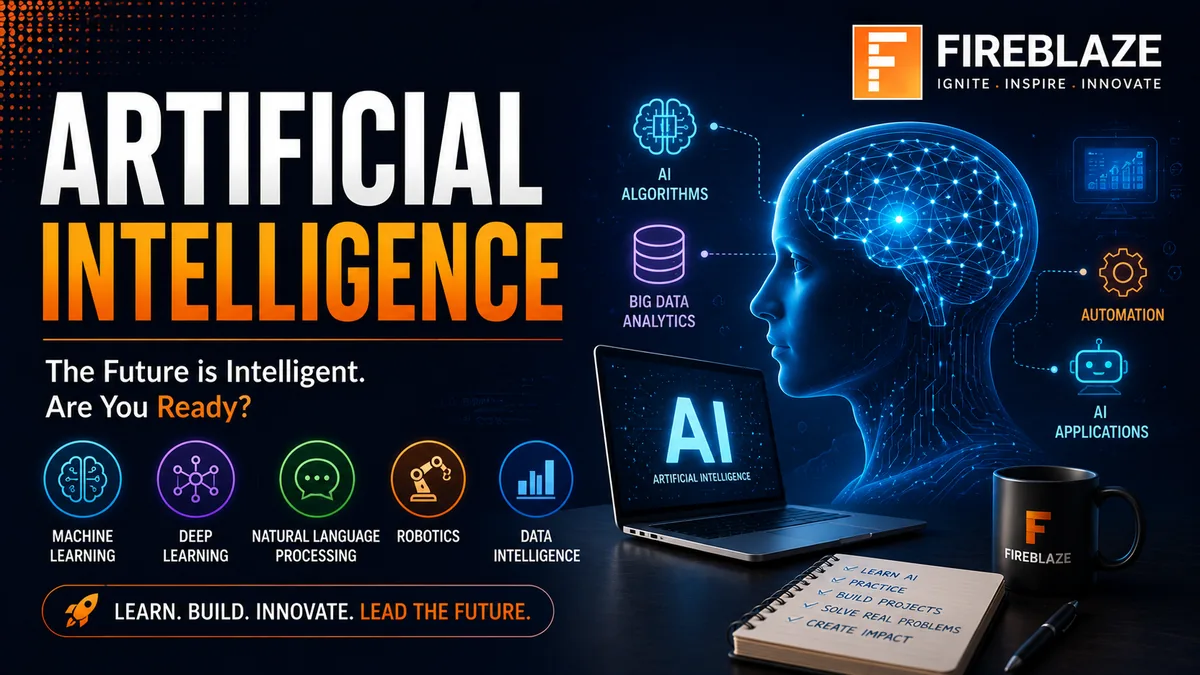
Artificial Intelligence is no longer a futuristic concept found only in science fiction movies. Today, AI powers many of the technologies we use daily, from virtual assistants and recommendation systems to self-driving vehicles and intelligent chatbots.
Organizations across industries are investing heavily in AI to improve efficiency, automate tasks, and create innovative products and services.
In this guide, you'll learn:
What Artificial Intelligence is
How AI works
Types of AI
Machine Learning and Deep Learning
Real-world applications
Benefits and challenges
Career opportunities
Future trends
What is Artificial Intelligence?
Artificial Intelligence (AI) is a branch of computer science that enables machines to simulate human intelligence.
In simple words:
Artificial Intelligence allows computers to learn, reason, make decisions, and solve problems like humans.
AI systems can:
Analyze data
Recognize patterns
Understand language
Make predictions
Learn from experience
Why is Artificial Intelligence Important?
Modern businesses generate enormous amounts of data.
AI helps organizations:
Automate repetitive tasks
Improve decision-making
Increase productivity
Enhance customer experiences
Reduce operational costs
As a result, AI has become one of the most valuable technologies in the digital era.
Examples of Artificial Intelligence in Daily Life
You interact with AI more often than you realize.
Examples include:
ChatGPT
AI-powered conversational assistant.
Google Search
Provides intelligent search results.
Netflix
Recommends movies and shows.
Amazon
Suggests products based on preferences.
Siri and Alexa
Understand voice commands and answer questions.
Google Maps
Optimizes routes and predicts traffic conditions.
How Does Artificial Intelligence Work?
AI systems learn from data.
The basic workflow is:
Data Collection
→ Data Processing
→ Model Training
→ Prediction
→ Continuous Learning
AI algorithms identify patterns and relationships within data to make intelligent decisions.
Types of Artificial Intelligence
AI can be classified into different categories.
Narrow AI (Weak AI)
Narrow AI is designed to perform specific tasks.
Examples:
Chatbots
Recommendation Systems
Voice Assistants
Spam Filters
Most AI systems today belong to this category.
General AI (Strong AI)
General AI refers to machines capable of performing any intellectual task that humans can perform.
Characteristics:
Human-level reasoning
Problem-solving abilities
Adaptability
General AI remains a research goal and has not yet been fully achieved.
Super AI
Super AI refers to hypothetical systems that surpass human intelligence in all areas.
Potential capabilities:
Advanced reasoning
Creativity
Autonomous decision-making
Currently, Super AI remains theoretical.
Core Technologies Behind AI
Several technologies power Artificial Intelligence.
Machine Learning
Machine Learning is a subset of AI that allows systems to learn from data without explicit programming.
Applications:
Fraud Detection
Recommendation Systems
Predictive Analytics
Deep Learning
Deep Learning is a specialized branch of Machine Learning based on neural networks.
Applications:
Image Recognition
Speech Recognition
Natural Language Processing
Natural Language Processing (NLP)
NLP enables computers to understand and generate human language.
Applications:
Chatbots
Language Translation
Sentiment Analysis
Virtual Assistants
Computer Vision
Computer Vision enables machines to interpret visual information.
Applications:
Face Recognition
Medical Imaging
Autonomous Vehicles
Security Systems
Robotics
AI-powered robots can perform tasks autonomously.
Applications:
Manufacturing
Warehousing
Healthcare
Logistics
Machine Learning Types
Machine Learning is typically divided into three categories.
Supervised Learning
Uses labeled data.
Examples:
House Price Prediction
Email Spam Detection
Algorithms:
Linear Regression
Decision Trees
Random Forest
Unsupervised Learning
Uses unlabeled data.
Examples:
Customer Segmentation
Market Basket Analysis
Algorithms:
K-Means Clustering
Hierarchical Clustering
Reinforcement Learning
AI learns through rewards and penalties.
Applications:
Robotics
Gaming
Autonomous Driving
What is Generative AI?
Generative AI is a branch of AI that creates new content.
Examples:
Text Generation
Image Generation
Video Creation
Code Generation
Popular tools include:
ChatGPT
Gemini
Claude
Midjourney
Generative AI is transforming how people create and consume content.
Real-World Applications of Artificial Intelligence
AI is transforming nearly every industry.
Healthcare
Applications:
Disease Prediction
Medical Imaging
Drug Discovery
Patient Monitoring
Banking and Finance
Applications:
Fraud Detection
Credit Scoring
Risk Analysis
Algorithmic Trading
Retail and E-Commerce
Applications:
Product Recommendations
Inventory Optimization
Customer Analytics
Manufacturing
Applications:
Predictive Maintenance
Quality Control
Process Automation
Transportation
Applications:
Self-Driving Cars
Traffic Management
Route Optimization
Education
Applications:
Personalized Learning
Intelligent Tutoring Systems
Automated Assessments
Benefits of Artificial Intelligence
Increased Efficiency
AI automates repetitive tasks and improves productivity.
Better Decision-Making
AI analyzes large volumes of data quickly.
Cost Reduction
Automation reduces operational expenses.
Improved Customer Experiences
AI enables personalized interactions and recommendations.
24/7 Availability
AI-powered systems can operate continuously without interruption.
Challenges of Artificial Intelligence
Despite its advantages, AI presents several challenges.
Data Privacy
AI systems often require large amounts of data.
Bias and Fairness
Poor-quality data can lead to biased outcomes.
Job Displacement Concerns
Automation may replace some traditional roles.
Security Risks
AI systems can become targets for cyberattacks.
Ethical Considerations
Responsible AI development is essential.
Artificial Intelligence vs Machine Learning
| Artificial Intelligence | Machine Learning |
|---|---|
| Broad field | Subset of AI |
| Mimics human intelligence | Learns from data |
| Includes reasoning and decision-making | Focuses on predictions |
Machine Learning is one of the technologies used to build AI systems.
Artificial Intelligence vs Data Science
| Artificial Intelligence | Data Science |
|---|---|
| Builds intelligent systems | Extracts insights from data |
| Focuses on automation | Focuses on analysis |
| Uses Machine Learning | Uses analytics and statistics |
Both fields are closely connected and often work together.
Popular AI Tools and Frameworks
Developers use various tools to build AI applications.
Examples include:
Python
TensorFlow
PyTorch
Scikit-Learn
OpenCV
Hugging Face
These tools simplify AI development and deployment.
Career Opportunities in Artificial Intelligence
The rapid growth of AI has created numerous career opportunities.
Popular roles include:
AI Engineer
Machine Learning Engineer
Data Scientist
NLP Engineer
Computer Vision Engineer
AI Research Scientist
AI professionals are in high demand worldwide.
Artificial Intelligence Interview Questions
What is Artificial Intelligence?
AI is the simulation of human intelligence by machines.
What is Machine Learning?
A subset of AI that enables systems to learn from data.
Difference Between AI and Deep Learning?
AI is the broader field, while Deep Learning is a subset of Machine Learning that uses neural networks.
What is NLP?
Natural Language Processing enables machines to understand and generate human language.
What is Computer Vision?
Computer Vision allows machines to interpret and analyze visual information.
Future of Artificial Intelligence
The future of AI is extremely promising.
Emerging trends include:
Generative AI
Autonomous Systems
AI-Powered Healthcare
Explainable AI
Edge AI
Human-AI Collaboration
Organizations worldwide are expected to increase AI adoption significantly in the coming years.
Why Students Should Learn AI
Artificial Intelligence is becoming a foundational technology across industries.
Learning AI helps students:
Build future-ready skills
Access high-paying career opportunities
Solve real-world problems
Contribute to technological innovation
AI knowledge is increasingly valuable in today's job market.
Final Thoughts
Artificial Intelligence is transforming how individuals, businesses, and societies operate. From intelligent assistants and recommendation systems to healthcare diagnostics and autonomous vehicles, AI is reshaping the future of technology.
Understanding AI concepts, technologies, applications, and challenges is essential for anyone interested in Data Science, Machine Learning, or emerging technologies. As AI continues to evolve, professionals who develop strong AI skills will be well-positioned to contribute to some of the most exciting innovations of the future.
Keep Reading
Related Articles
Learning Guides
Introduction to Computer Vision: A Beginner’s Guide
Discover the basics of Computer Vision, a rapidly growing field of Artificial Intelligence that enables machines to understand images and videos. Expl
All About PyCaret: Conversation with Mr. Moez Ali and Mr. Aniruddha Kalbande | EP-06
Explore PyCaret and its impact on machine learning development through an insightful conversation with PyCaret creator Moez Ali and AI expert Aniruddh
What is Data Mining? Complete Guide for Beginners
Learn what Data Mining is, how it works, key techniques, tools, applications, advantages, challenges, and its role in Data Science, Machine Learning,