 Fireblaze
AI & Careers
Agentic AI vs Generative AI: The Difference, With Real Examples
Agentic AI vs generative AI explained simply: one creates content, the other acts toward a goal. Side-by-side examples, a 4-question test, career skills.

Every AI tool now calls itself "agentic", your manager wants an "AI agent", and your course brochure promises "generative AI".
Most explanations online blur the two until they mean nothing.
This guide makes the difference concrete. You will see the same training-institute task done both ways, a simple test to spot products that are only relabelled chatbots, the reliability arithmetic most articles skip, and which skills each path needs if you want to work in AI.
Agentic AI vs generative AI is a comparison of output versus outcome. Generative AI creates content (text, images, code) in response to a prompt. Agentic AI uses a generative model as its reasoning engine, but also plans steps, calls tools such as email, databases or APIs, checks results and keeps going until a goal is reached.
Quick answer: agentic AI vs generative AI (November 2026)
- Generative AI, such as ChatGPT writing an email, produces one piece of content per prompt and stops.
- Agentic AI, such as a system that reads an enquiry, checks a batch calendar, books a slot and sends a confirmation, takes actions across several steps toward a goal.
- Most agentic systems run on a generative model (an LLM) plus tools, memory and a loop, so the two are layers, not rivals.
- Gartner predicts that over 40% of agentic AI projects will be cancelled by the end of 2027, mainly because of cost, unclear value or weak risk controls.
- Gartner also predicts that by 2028, 15% of day-to-day work decisions will be made autonomously through agentic AI.
Contents
- Generative AI in Plain Words
- Agentic AI in Plain Words
- Agentic AI vs Generative AI: Side-by-Side
- Same Task, Two Ways: A Nagpur Example
- AI Agents vs Agentic AI vs Generative AI
- The 4-Question Agent Test
- Why Agents Fail More Often: The Reliability Maths
- Which One Should a Business Use?
- Agentic AI vs Generative AI for Your Career
- FAQ
Generative AI in Plain Words
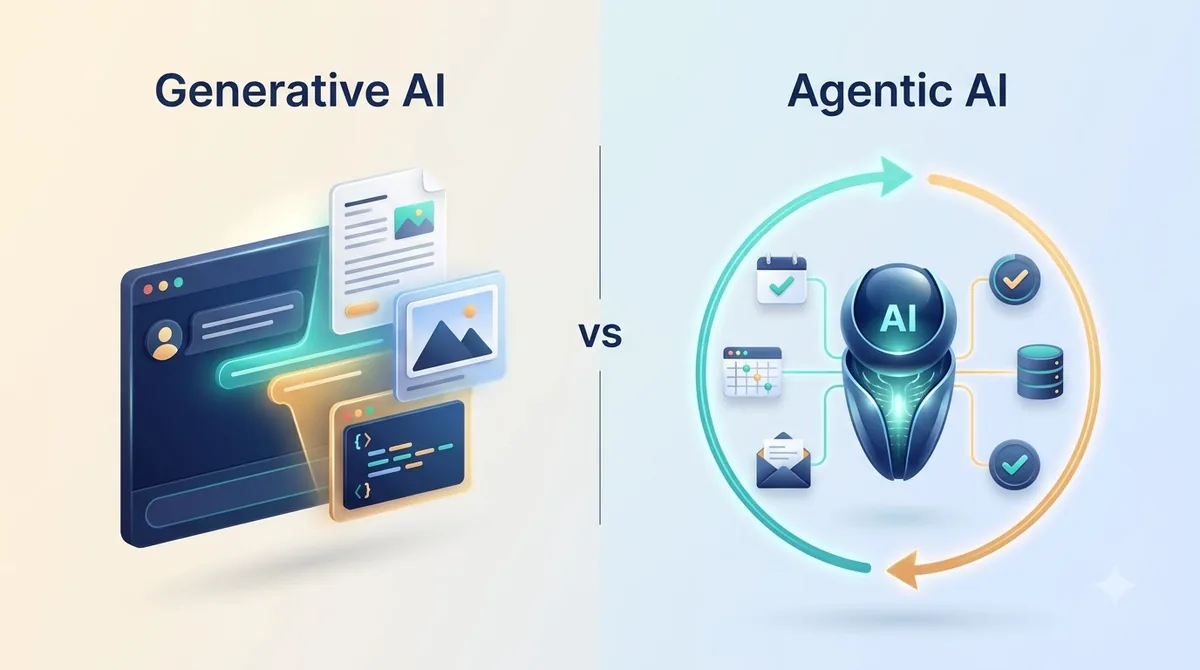
Generative AI is AI that creates new content, such as text, images, audio or code, by predicting what should come next based on patterns learned from large amounts of data. ChatGPT, Claude, Gemini, Midjourney and GitHub Copilot are all generative AI tools.
The core is a large language model (LLM) or an image model. You give it a prompt, it gives you an output, and then it waits.
Everyday generative AI examples:
- Writing a product description for an online store
- Summarising a 40-page PDF into five bullet points
- Translating a notice from English to Marathi
- Drafting Python code for a data-cleaning script
- Creating a poster image for a college fest
Generative AI is already mainstream. McKinsey's 2025 global survey found that 88% of respondents report regular AI use in at least one business function, up from 78% a year earlier.
The limit is simple: generative AI does not act on what it creates. You still copy the email, paste it into your mail app and click send.
Agentic AI in Plain Words
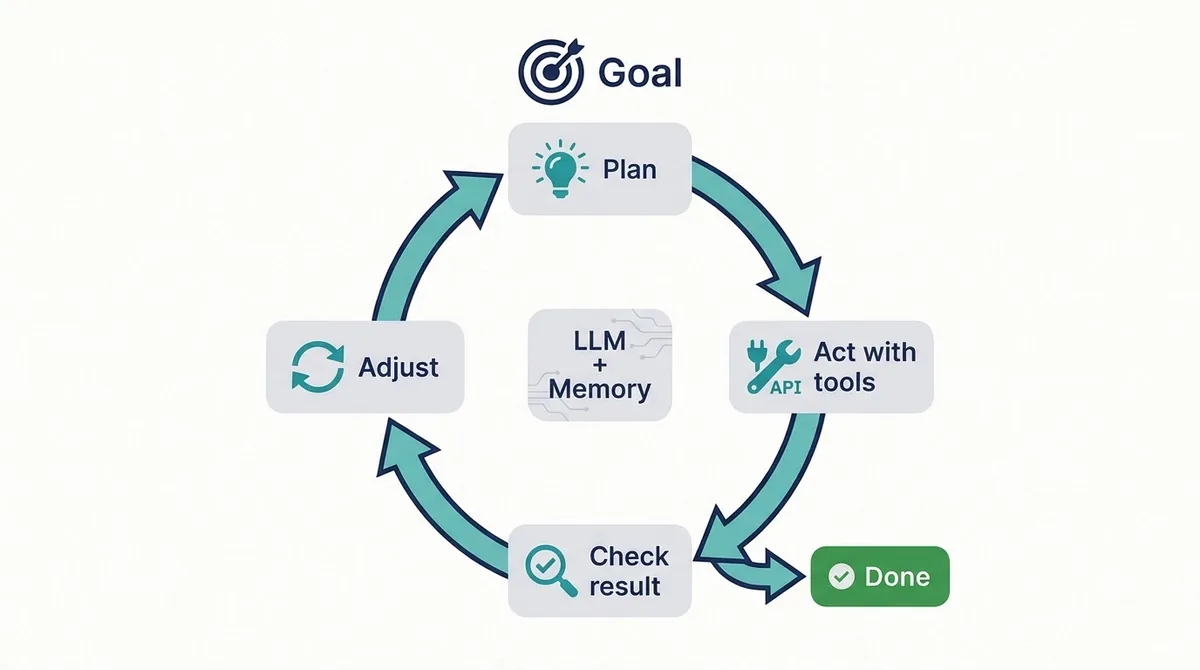
Agentic AI is a system that pursues a goal by deciding which steps to take, using tools to take them, checking the results and adjusting, with limited human input along the way. It usually has a generative model at its centre, plus tools, memory and a loop.
Anthropic, which builds the Claude models, describes the basic building block of agentic systems as an LLM enhanced with augmentations such as retrieval, tools and memory, in its Building Effective Agents guide.
The four parts that make AI "agentic":
| Part | What it does | Example |
|---|---|---|
| Goal | A target bigger than one reply | "Book a counselling call for every new enquiry today" |
| Tools | Actions the model can trigger | Read a Google Sheet, send a WhatsApp message, update the CRM |
| Memory | Context kept across steps | What has already been done, what the student said earlier |
| Loop | Plan, act, check, repeat | Retry if a slot is taken, ask a human if unsure |
Frameworks such as LangGraph, CrewAI and Anthropic's Model Context Protocol (MCP) help developers connect models to tools, but the underlying idea is the same in each.
Agentic AI vs Generative AI: Side-by-Side
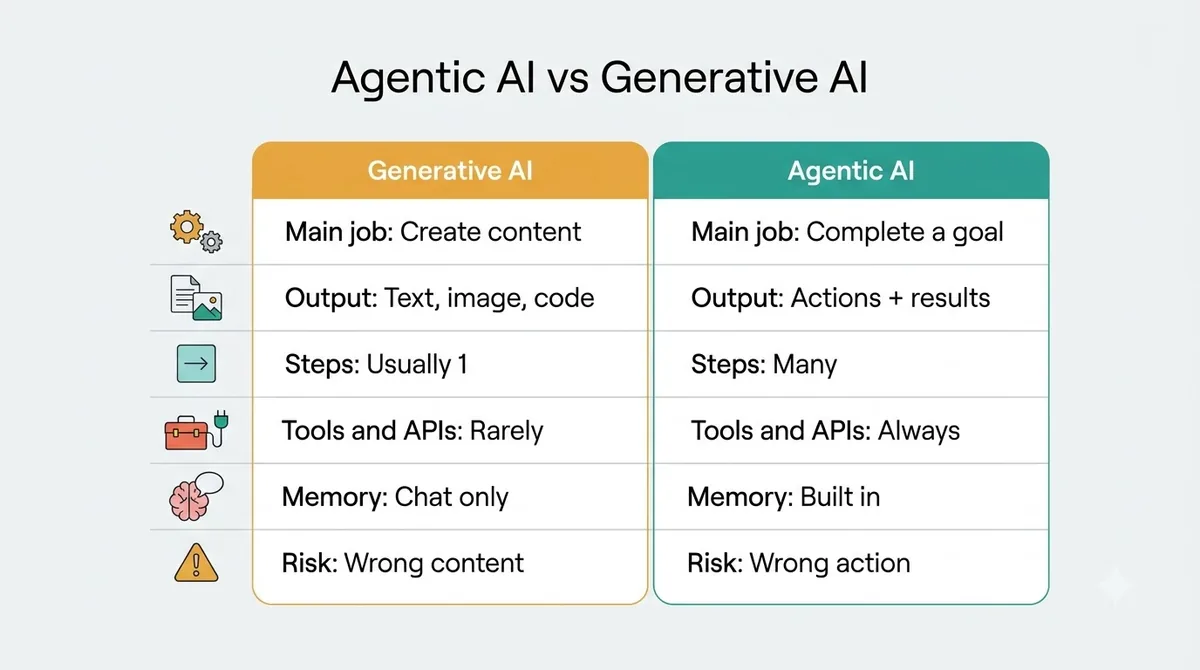
The difference between generative AI and agentic AI is that generative AI is reactive and produces content, while agentic AI is proactive and produces outcomes by taking actions.
| Generative AI | Agentic AI | |
|---|---|---|
| Main job | Create content | Complete a goal |
| Trigger | One prompt from a person | A goal, event or schedule |
| Output | Text, image, code, audio | Actions plus results (booked, sent, updated) |
| Steps per task | Usually one | Many, often decided by the model |
| Uses tools and APIs | Rarely | Usually |
| Memory across steps | Limited to the chat | Built in |
| Human role | Reviews every output | Sets goals, approves risky actions |
| Typical risk | Wrong or made-up content | Wrong action taken in a real system |
| Example | ChatGPT drafts a reply | A system that replies, books and logs the lead |
The gen AI vs agentic AI framing is slightly misleading, because agentic AI is not a replacement for generative AI. It is generative AI with the ability to act.
Same Task, Two Ways: A Nagpur Example
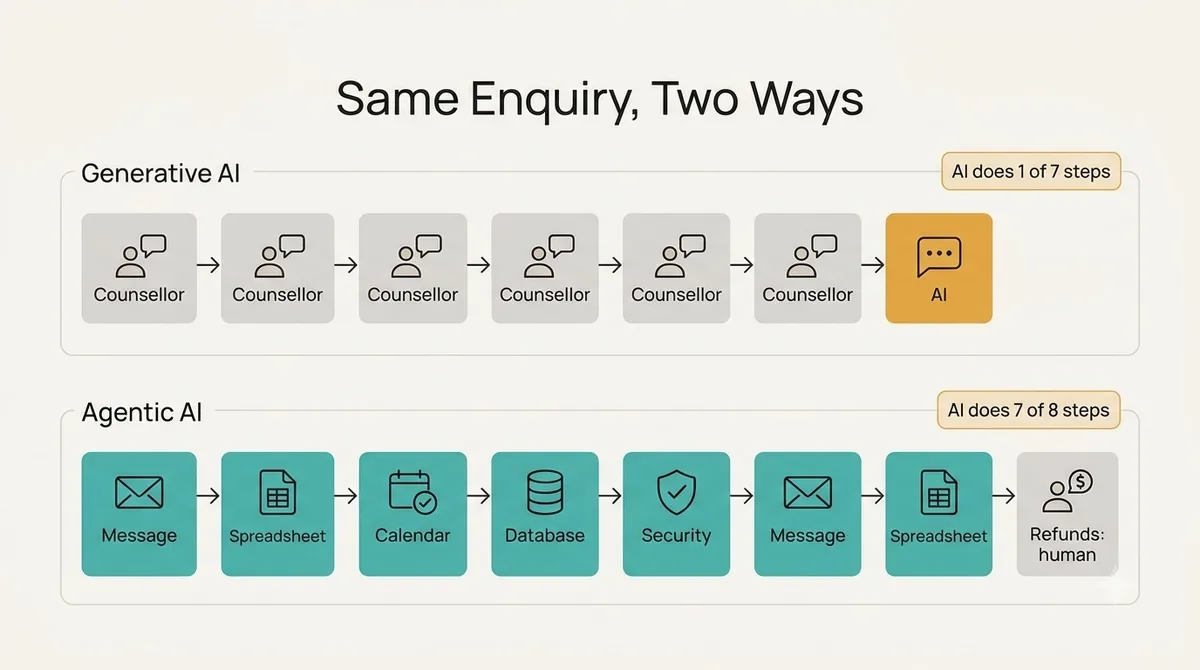
The clearest way to see agentic AI vs generative AI examples is to run one business task both ways and count who does the work. This is an illustrative flow for a training institute in Nagpur handling a new WhatsApp enquiry about a data analytics course.
With generative AI (ChatGPT or similar):
- Read the WhatsApp enquiry (counsellor)
- Open ChatGPT, paste the message, ask for a polite reply (counsellor)
- Generate the reply (generative AI)
- Check the batch-dates sheet for the next weekend batch (counsellor)
- Edit the reply with the right date and fee (counsellor)
- Send it on WhatsApp (counsellor)
- Add the lead to the CRM and set a follow-up reminder (counsellor)
AI handles one of seven steps.
With agentic AI:
| Step | Who does it |
|---|---|
| 1. Detect the new enquiry | Agent (WhatsApp Business API trigger) |
| 2. Classify intent: course, location, timing | Agent (LLM) |
| 3. Look up the next matching batch in the sheet | Agent (Google Sheets tool) |
| 4. Draft a reply with the correct date, fee and centre | Agent (LLM) |
| 5. Check the fee against the approved price list | Agent (validation rule) |
| 6. Send the reply and offer two counselling slots | Agent (WhatsApp tool) |
| 7. Create the CRM lead and book the slot the student picks | Agent (CRM and calendar tools) |
| 8. Escalate to a human if the student asks about refunds or discounts | Agent hands off to the counsellor |
AI handles seven of eight steps, and a person steps in only for sensitive questions.
Notice step 5. A well-built agent checks its own work against a trusted source before acting. That single guardrail is the difference between a useful agent and one that quotes the wrong fee to many students.
AI Agents vs Agentic AI vs Generative AI
Generative AI is the content-creating model. An AI agent is a single system that uses that model plus tools to complete tasks. Agentic AI is the broader approach, which can include several agents working together.
Anthropic groups these under "agentic systems" but separates two designs. In workflows, LLMs and tools are orchestrated through predefined code paths. In agents, the model directs its own process. Anthropic's guide notes that workflows give predictability for well-defined tasks, while agents suit problems that need flexibility and model-driven decisions.
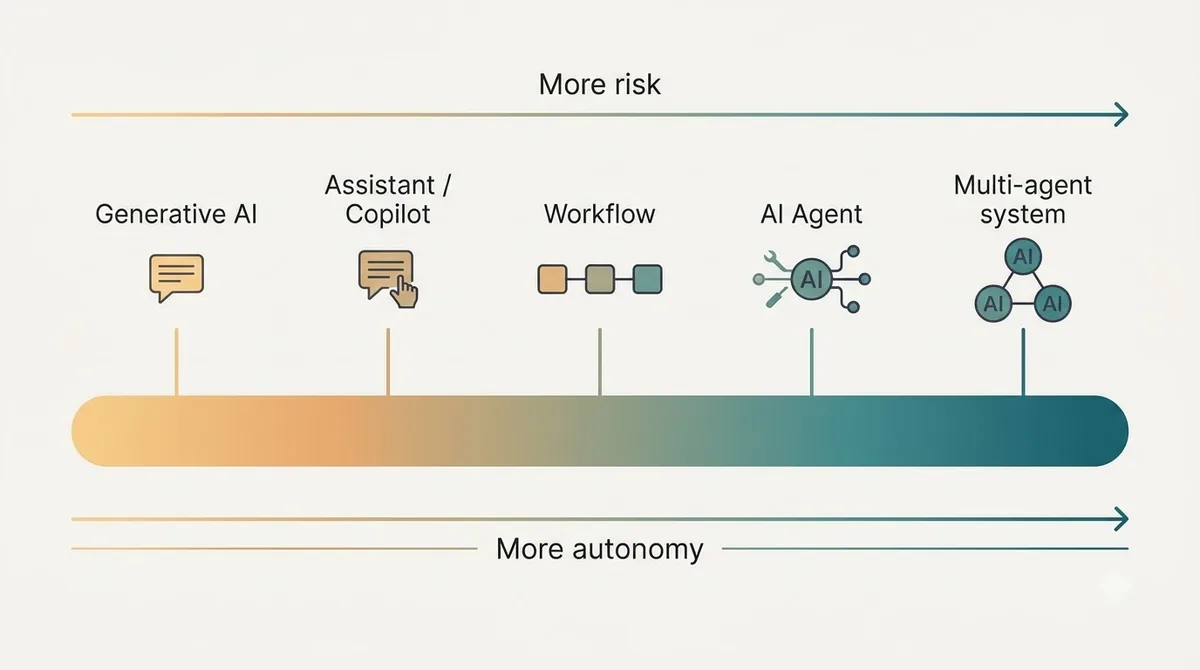
Here is the full spectrum, from least to most autonomous:
| Level | What it is | Example |
|---|---|---|
| 1. Generative AI | Model answers a prompt | ChatGPT writes a caption |
| 2. Assistant or copilot | Model inside an app suggests, you approve | Copilot suggests code, you accept it |
| 3. Workflow | Fixed steps, LLM fills some of them | Every form submission: summarise, then email the team |
| 4. AI agent | Model chooses steps and tools for one goal | A research agent searches, reads and writes a report |
| 5. Multi-agent system | Several agents split a larger goal | One agent qualifies leads, one books, one follows up |
Predictive AI (forecasting sales or churn) and RPA (rule-based bots that click through screens) sit outside this ladder. They can be parts of an agentic system, but neither is generative or agentic on its own.
The 4-Question Agent Test
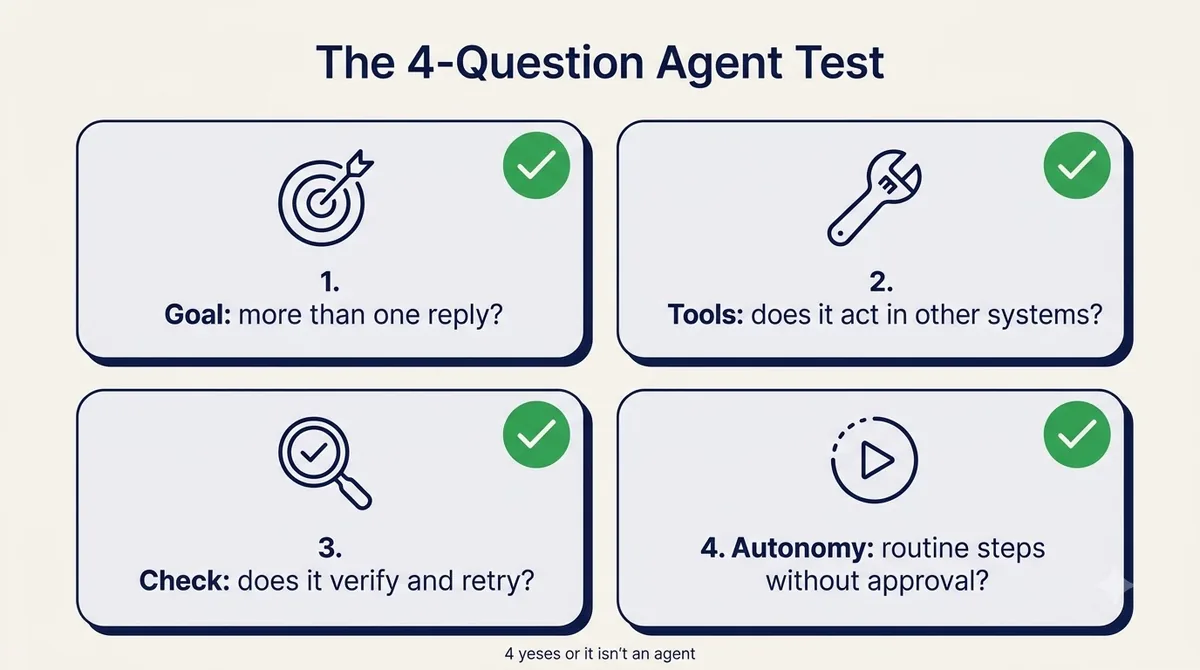
The 4-Question Agent Test is our quick check for whether a product is really agentic. It must have a goal beyond one reply, call tools, check its own results, and act without approval at every step. If the answer to any of the four is no, it is generative AI with a new label.
- Goal: does it work toward an outcome bigger than one response?
- Tools: can it take actions in other systems (send, book, update, search)?
- Check: does it look at the result and adjust or retry?
- Autonomy: can it complete routine steps without a person approving each one?
This matters because "agent" has become a sales word. Reuters, reporting on Gartner's research, described many vendors' products as "agent washing", rebranding assistants and chatbots without real agentic capabilities, and estimated that only a small fraction of the thousands of agentic AI vendors offer real agentic products.
| Product type | Goal | Tools | Check | Autonomy | Verdict |
|---|---|---|---|---|---|
| Chatbot answering FAQs | No | No | No | No | Generative AI |
| Chatbot that searches your documents (RAG) | No | Yes (search) | No | No | Generative AI with retrieval |
| Fixed "summarise and email" automation | Partly | Yes | No | Yes | Workflow |
| Enquiry agent from the Nagpur example | Yes | Yes | Yes | Yes | Agentic AI |
Why Agents Fail More Often: The Reliability Maths
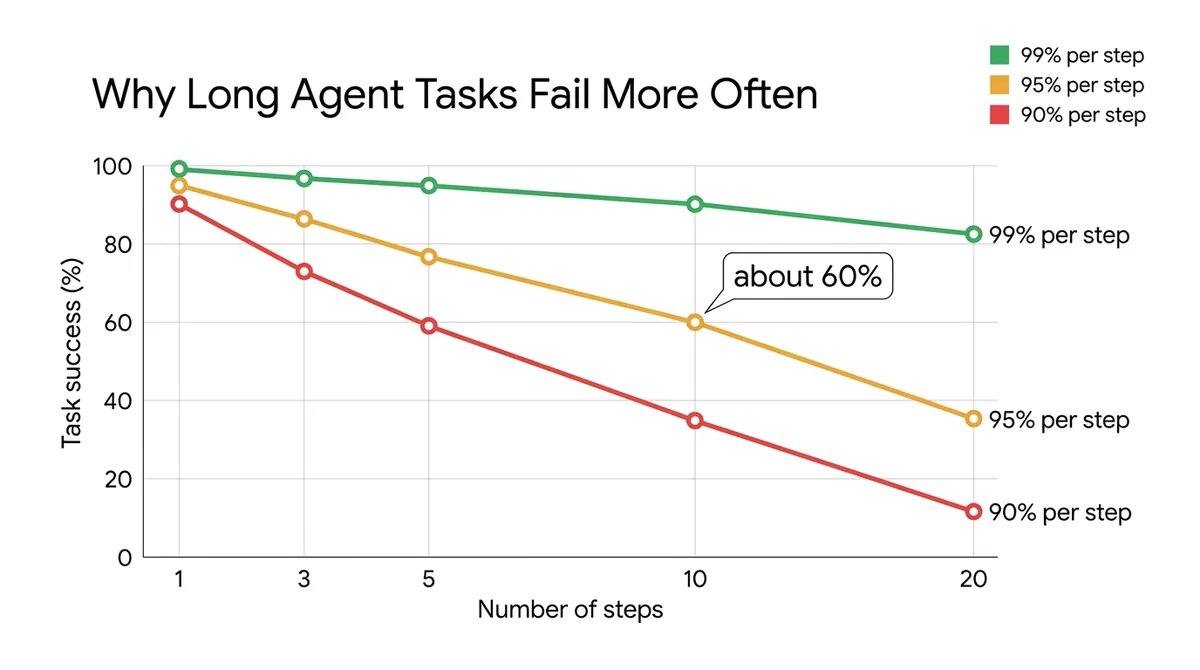
Agentic AI fails more often than generative AI because errors compound across steps. If each step succeeds 95% of the time, a 10-step task succeeds only about 60% of the time.
We calculated end-to-end success for tasks where every step is independent and must succeed:
| Per-step success | 1 step | 3 steps | 5 steps | 10 steps | 20 steps |
|---|---|---|---|---|---|
| 99% | 99% | 97% | 95.1% | 90.4% | 81.8% |
| 95% | 95% | 85.7% | 77.4% | 59.9% | 35.8% |
| 90% | 90% | 72.9% | 59% | 34.9% | 12.2% |
A generative AI tool that is right 95% of the time feels reliable. Chain ten of those steps into an agent and about four tasks in ten go wrong somewhere.
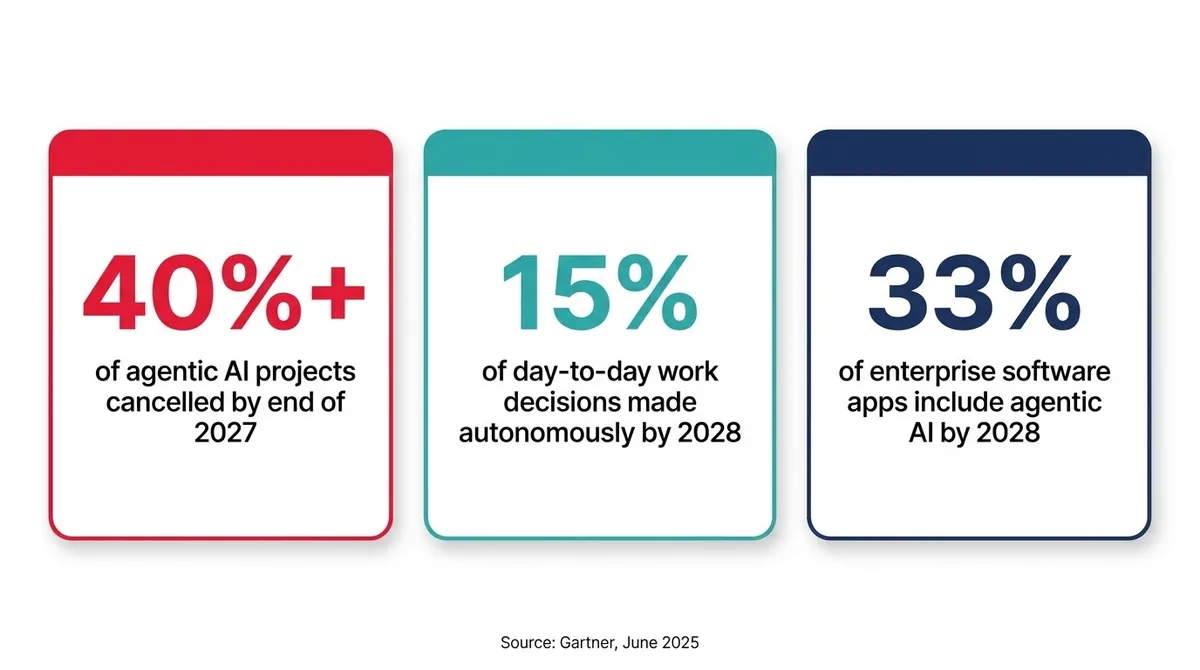
That is the practical reason behind Gartner's warning that over 40% of agentic AI projects will be cancelled by the end of 2027, due to escalating costs, unclear business value or inadequate risk controls.
How good teams manage the arithmetic:
- Fewer steps. Use a fixed workflow where the path is known, and reserve agents for genuinely variable tasks.
- Validation at each step. Check outputs against a trusted source, like the fee check in step 5 of the example above.
- Human in the loop for risky actions. Payments, refunds and anything legal wait for approval.
- Evaluation sets. Run 50 to 100 test cases after every change and track the success rate.
Gartner still expects growth. It predicts that by 2028, 15% of day-to-day work decisions will be made autonomously and 33% of enterprise software applications will include agentic AI.
Which One Should a Business Use?
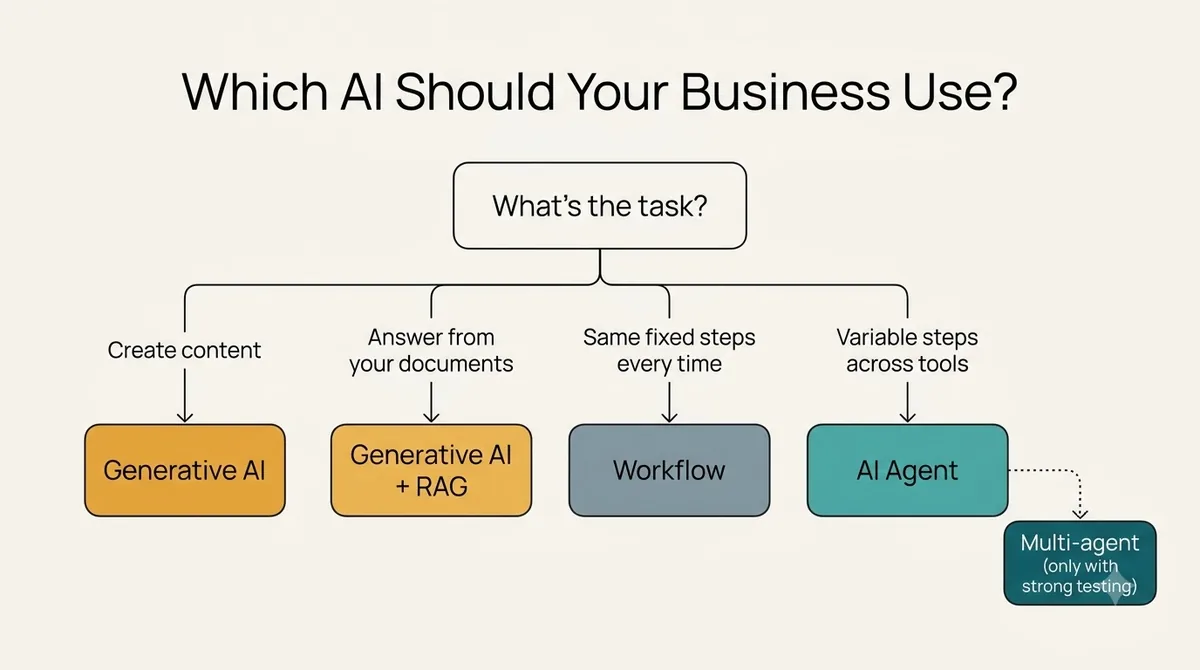
Use generative AI when a person needs help creating content. Use agentic AI only when a repeatable, multi-step process with clear rules costs real staff time. Most small and mid-sized businesses should start with generative AI and simple workflows.
Gartner's own advice is to pursue agentic AI where it delivers clear value or return on investment.
| Situation | Best fit | Why |
|---|---|---|
| Writing posts, emails, reports | Generative AI | One output, and a human reviews it |
| Answering questions from your own documents | Generative AI with RAG | Needs knowledge, not actions |
| The same five steps for every form or invoice | Workflow | Predictable path, cheaper and safer |
| Lead handling, ticket triage, scheduling across tools | AI agent | Variable inputs, several systems |
| Complex operations with many roles | Multi-agent system | Only with strong evaluation and guardrails |
Adoption data supports a cautious start. McKinsey's 2025 survey found that 62% of organisations are at least experimenting with AI agents, yet no more than 10% report scaling agents in any single business function.
Agentic AI vs Generative AI for Your Career
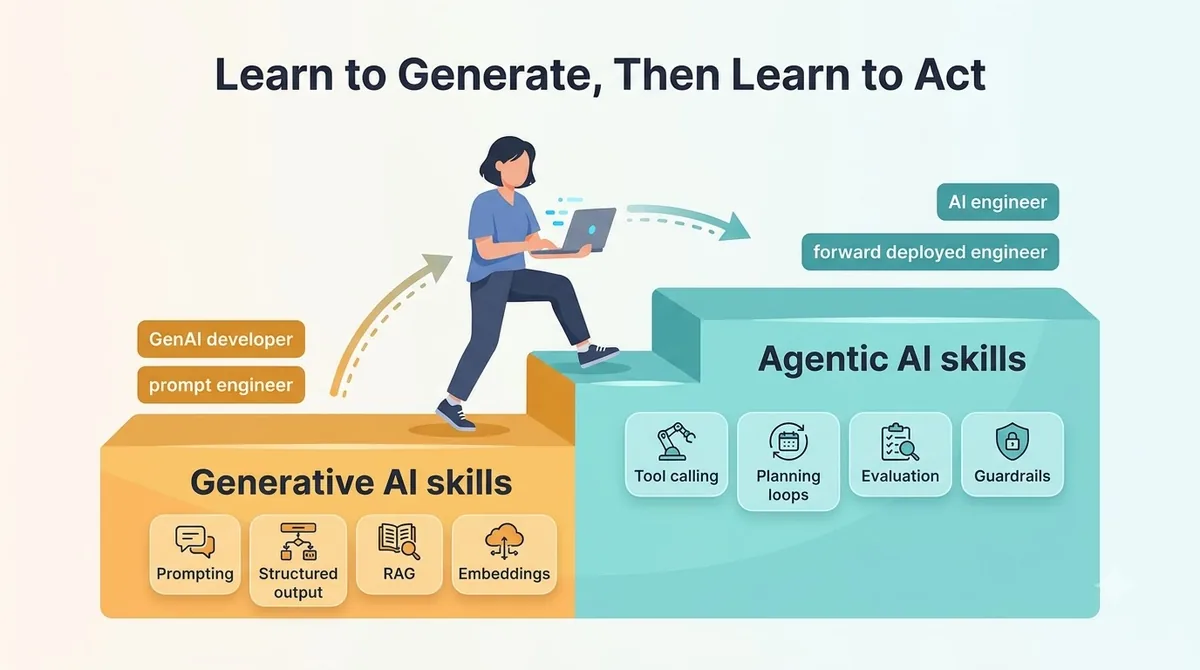
Generative AI skills (prompting, RAG and content workflows) are the entry point. Agentic AI skills (tool calling, orchestration, evaluation and guardrails) build on them, and AI engineer roles increasingly ask for them.
| Skill area | Generative AI work | Agentic AI work |
|---|---|---|
| Core | Prompt design, structured output | Tool and function calling, planning loops |
| Knowledge | RAG, embeddings, vector databases | The same, plus memory across steps |
| Frameworks | LLM APIs, LangChain | LangGraph, CrewAI, MCP |
| Quality | Checking outputs by hand | Evaluation sets, step validation, logging |
| Safety | Content filters | Guardrails, permissions, human approval rules |
| Typical roles | Prompt engineer, GenAI developer, content and marketing roles | AI engineer, agent developer, forward deployed engineer |
Non-technical learners can do a lot with generative AI alone, especially in marketing, HR and operations. Developers who want AI engineering roles should learn generative AI first, then agents. Our AI engineer roadmap sets out that order month by month.
For pay expectations, see our AI engineer salary in Nagpur analysis.
If you are choosing a course, our guide on how to choose a generative AI course in Nagpur covers the first step.
Now It's Your Turn
You now know the real difference in agentic AI vs generative AI: one creates content, the other acts toward a goal, and the second is built on the first. You also have the 4-Question Agent Test to cut through "agent washing", and the reliability table to explain why agents need guardrails.
Try it today. Take one task you repeat every week, write down every step, and mark which ones a generative AI tool could help with and which an agent could fully handle.
If you want to build agents that ship, Fireblaze's Applied AI Forward Deployment Engineering program covers tool calling, evaluation and deployment for working IT professionals. The AI course in Nagpur covers the generative AI foundations. Both are our own programs. Not sure where to start? Book a free career counselling session.
FAQ
What is the difference between generative AI and agentic AI?
Generative AI creates content, such as text, images or code, in response to a prompt and then stops. Agentic AI pursues a goal over several steps by planning, using tools like APIs and databases, checking results and adjusting. Most agentic systems use a generative model as their reasoning engine.
Is ChatGPT generative AI or agentic AI?
ChatGPT is primarily generative AI: you prompt it and it produces a response. When it is given tools such as web search, code execution or connected apps, and allowed to take several steps toward a goal, it starts behaving agentically. The label depends on how it is set up, not on the brand.
What are some agentic AI vs generative AI examples?
A generative AI example is ChatGPT drafting a reply to a customer enquiry. An agentic AI example is a system that reads the enquiry, checks batch dates in a spreadsheet, sends the correct reply on WhatsApp, books a counselling slot and logs the lead in the CRM, escalating to a human only for refunds.
Is agentic AI better than generative AI?
Neither is better in general. Agentic AI is more powerful for multi-step processes, but it costs more, fails more often across long chains of steps and needs guardrails. Generative AI is cheaper and safer for content tasks. Gartner predicts that over 40% of agentic AI projects will be cancelled by 2027.
What is the difference between an AI agent and agentic AI?
An AI agent is one system that uses a model and tools to complete a task. Agentic AI is the broader approach of building AI that acts autonomously, which can include single agents, fixed workflows or several agents working together.
Should I learn generative AI or agentic AI first?
Learn generative AI first: prompting, structured outputs and RAG. Agentic AI builds directly on those skills by adding tool calling, planning loops and evaluation. Developers aiming for AI engineer roles usually need both.
Sources
- Anthropic: Building Effective Agents, December 2024
- McKinsey: The State of AI in 2025 (MGI), November 2025
- McKinsey: The State of AI in 2025 (Tech and AI), November 2025
- McKinsey: The State of AI (Operations), November 2025
- Outlook Business: Over 40% of agentic AI projects will be scrapped by 2027, says Gartner, 2025
- The Star (Reuters): Gartner on agentic AI projects and agent washing, June 2025
- SD Times: Gartner predictions on agentic AI, 2025
- Fireblaze AI School reliability calculation (independent-step compounding), November 2026