 Fireblaze
Career Roadmaps
AI Engineer Roadmap 2026: How to Become an AI Engineer in India (Even After 12th)
AI engineer roadmap for India in 2026: 3 routes (after 12th, after graduation, working pros), month-by-month skills, real costs, salaries and projects.

Every second career video now says "become an AI engineer". Very few tell you what to do on Monday morning, how long it really takes, or what it costs if you are starting from Nagpur rather than Bengaluru.
This AI engineer roadmap fixes that. You will get three routes (after 12th, after graduation, and for working professionals), a month-by-month skill plan, current college fees, 2026 hiring data and the three kinds of project that get interviews.
The AI engineer roadmap is the ordered set of skills, projects and milestones that takes you from no AI knowledge to a job building AI-powered software. In 2026 that means Python and SQL first, then machine learning basics, then LLM applications (RAG and agents), and finally deploying and evaluating what you build.
Quick answer: AI engineer roadmap in India (November 2026)
- Learn Python, SQL and Git first. This takes about 2 to 3 months at 10 to 12 hours a week.
- Add statistics and machine learning with scikit-learn next, roughly 2 months, before you touch LLMs.
- Build LLM applications with RAG, embeddings, a vector database and tool-calling agents over the following 2 to 3 months.
- Deploy every project with FastAPI and Docker, and measure it with an evaluation set. That is what separates AI engineers from tutorial followers.
- Published fresher pay for AI engineers in India ranges from about ₹6 to 15 LPA. Naukri JobSpeak recorded AI/ML hiring growth of 22% to 33% year on year in each month from April to August 2026. Roles in Nagpur usually pay less than that range.
Contents
- What Does an AI Engineer Actually Do?
- Pick Your Route: 3 Ways Into AI Engineering
- How to Become an AI Engineer After 12th
- The AI Engineer Roadmap: Month-by-Month Skills
- The Ship Test: 3 Projects That Get Interviews
- Is There Demand? What the 2026 Hiring Data Shows
- AI Engineer Salary in India: Realistic Numbers
- AI Engineer Roadmap for Working Professionals
- 7 Mistakes That Slow Most Beginners Down
- FAQ
What Does an AI Engineer Actually Do?
An AI engineer builds software that uses AI models, usually large language models (LLMs) from providers such as OpenAI, Anthropic or Google, or open models from Hugging Face, and makes it work reliably for real users. Most AI engineers do not train large models from scratch. They connect, customise, deploy and monitor them.
A typical week might include:
- Building a chatbot that answers questions from a company's PDFs (RAG)
- Writing an agent that reads emails and updates a CRM through APIs (tool calling)
- Testing which prompt or model gives better answers on 100 sample questions (evaluation)
- Packaging the app with FastAPI and Docker and putting it on a cloud server
- Tracking cost, speed and error rates once real users arrive
Here is how the role compares with its neighbours:
| Role | Main job | Core tools | Trains models? |
|---|---|---|---|
| AI engineer | Builds and ships AI-powered apps | Python, LLM APIs, RAG, agents, FastAPI, Docker | Rarely; mostly uses existing models |
| ML engineer | Trains and serves custom models | scikit-learn, PyTorch, MLOps pipelines | Yes |
| Data scientist | Finds insights and builds predictive models | SQL, statistics, Python, notebooks | Sometimes |
| Data analyst | Reports and dashboards for decisions | Excel, SQL, Power BI | No |
| Forward deployed engineer | Builds AI systems on-site with clients | AI engineering plus client delivery | Rarely |

Pick Your Route: 3 Ways Into AI Engineering
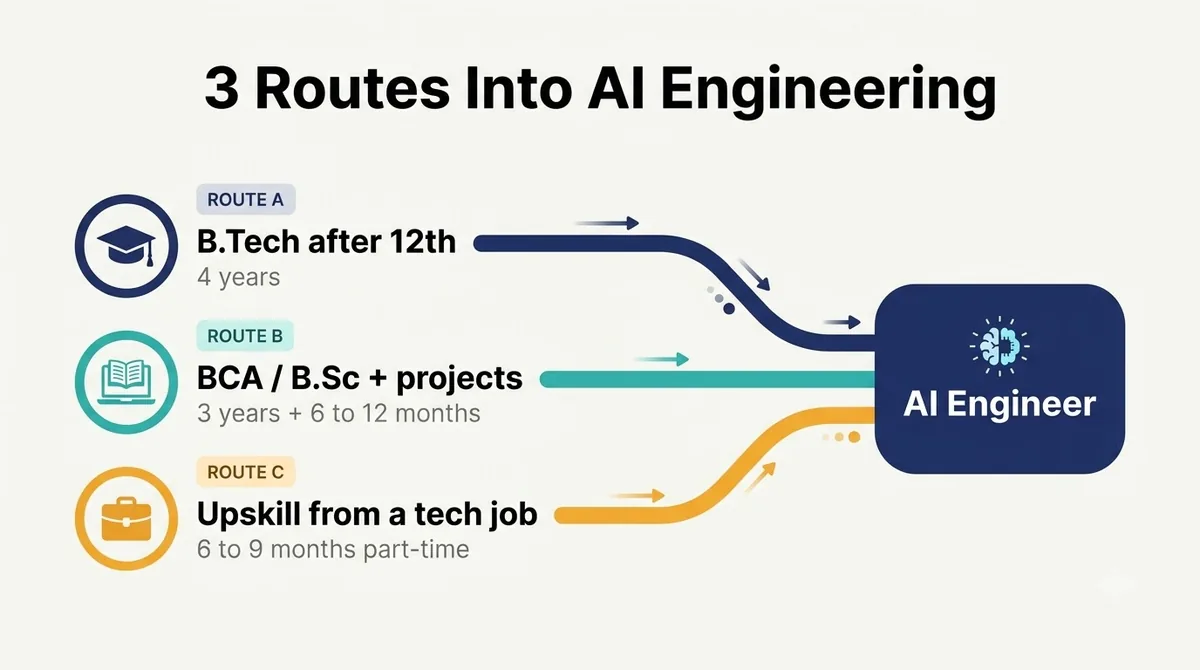
There are three realistic routes into AI engineering in India: a four-year engineering degree after 12th, a non-engineering degree plus self-built skills, or upskilling from an existing tech job. They differ mainly in time, cost and how employers screen you.
| Route | Who it fits | Time to first AI role | Typical cost | Main hurdle |
|---|---|---|---|---|
| A. B.Tech or BE in CSE, AI, AI & DS or AI & ML | 12th PCM students | 4 years | About ₹5.8 lakh (GHRCE B.Tech AI) to ₹12.7 lakh (Ramdeobaba BE CSE) total fees | Entrance rank in JEE Main or MHT CET |
| B. BCA, B.Sc (CS, Data Science, Maths) plus projects | Students without a JEE or CET rank, or PCB and commerce students with maths | 3 years plus 6 to 12 months of skills | Lower degree fees plus a course or self-study | Some employers filter by B.Tech; your portfolio has to make up the gap |
| C. Upskill from software, testing, data or IT support | Graduates already working | 6 to 9 months part-time | Free resources to about ₹1 lakh for a structured program | Time, while balancing work and learning |
Fees for route A come from Careers360 listings. GHRCE Nagpur lists about ₹5.78 lakh for its four-year B.Tech in Artificial Intelligence, and Ramdeobaba University lists about ₹12.65 lakh for BE Computer Science. Check each college's current fee notice before you decide.
None of the three routes is the right one for everyone. Route A gives the smoothest campus-placement path, route B gives the most freedom, and route C is the fastest if you already code for a living.
How to Become an AI Engineer After 12th
To become an AI engineer after 12th, take PCM, aim for JEE Main or MHT CET to get into a B.Tech in CSE, AI or AI and Data Science, and start Python and projects in your first year instead of waiting for the syllabus. Students without an engineering seat can still get there through BCA or B.Sc plus a strong portfolio.
Step 1: Subjects in 11th and 12th
Mathematics matters most. Statistics, probability and linear algebra sit underneath every model you will use. PCM keeps the B.Tech route open. PCB or commerce students with maths can still take route B.
Step 2: Entrance exams in Maharashtra
Engineering colleges in Nagpur admit students through JEE Main and MHT CET. Cut-offs change every year and vary by college and branch, so check the latest CAP round data before you plan around any number.
Step 3: Which branch to pick
CSE, CSE (AI and ML), AI and Data Science, and plain AI all lead to similar jobs. Recruiters look at your projects and problem-solving far more than the branch name. If you are choosing between a stronger college in CSE and a weaker college in "AI", the stronger college usually wins.
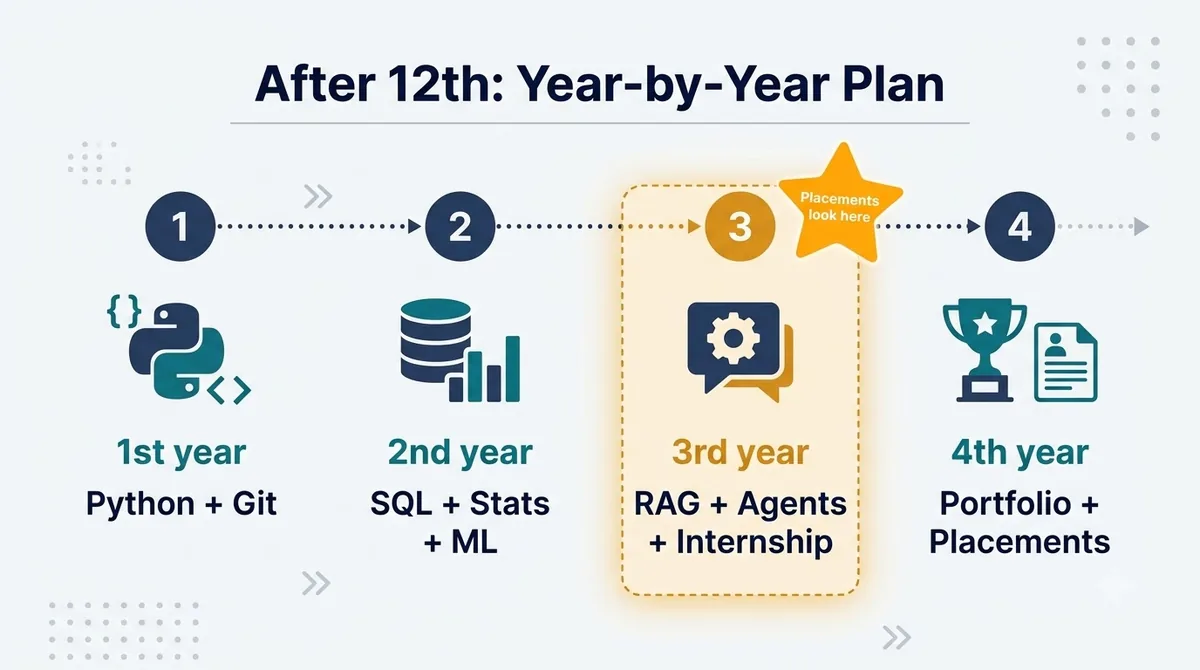
Step 4: A year-by-year plan for B.Tech students
| Year | Focus | Output by year end |
|---|---|---|
| 1st year | Python, Git, basic maths revision | 30 to 50 small Python programs on GitHub |
| 2nd year | DSA basics, SQL, statistics, first ML models | 2 ML notebooks with clean write-ups |
| 3rd year | LLM apps (RAG, agents, FastAPI, Docker) and one internship | 2 deployed AI projects |
| 4th year | Polish the portfolio, interview prep, placements | 3 Ship Test projects, resume, mock interviews |
Campus placements in India usually start in the final year, so your third-year projects are what recruiters see. If data science interests you as much as AI, our guide to data science after 12th in Nagpur compares that path.
The AI Engineer Roadmap: Month-by-Month Skills
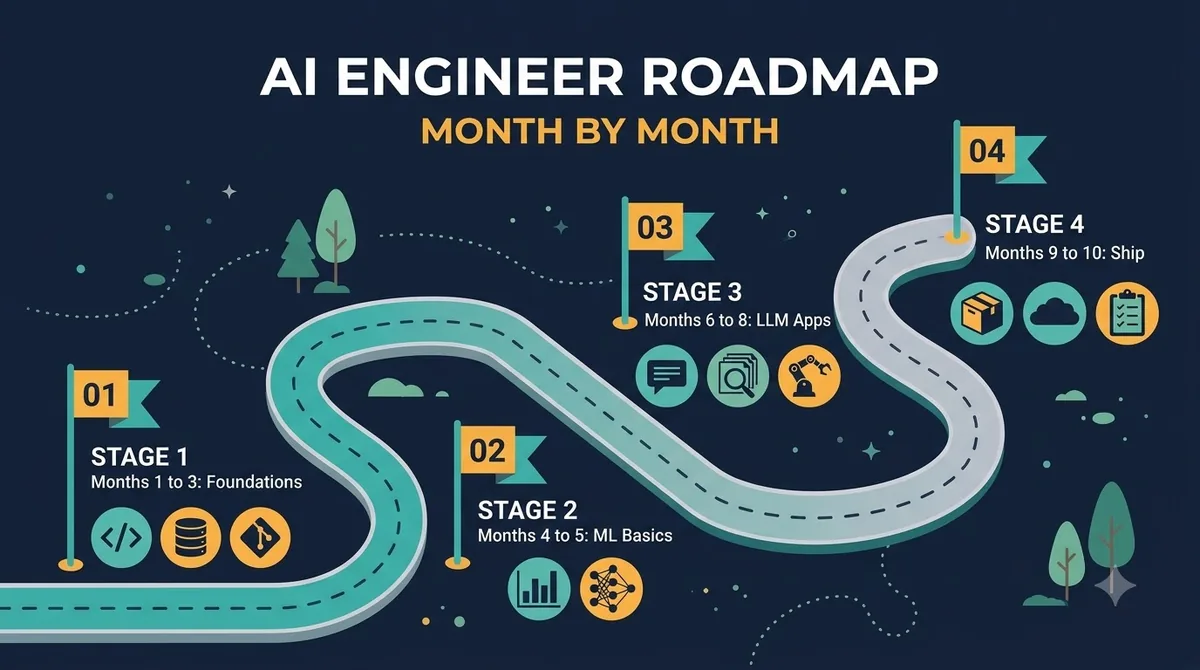
The core AI engineer roadmap takes about 9 to 10 months at 10 to 12 hours a week: 3 months of programming foundations, 2 months of machine learning, 3 months of LLM applications, and 1 to 2 months of deployment and portfolio. Students on a B.Tech can spread the same plan across two years.
Stage 1 (Months 1 to 3): Programming foundations
- Python: variables, loops, functions, classes, files, error handling, virtual environments
- Libraries: NumPy and pandas for data
- SQL: SELECT, JOIN, GROUP BY. Our SQL interview questions guide has practice queries.
- Git and GitHub: commit every day. Your GitHub is your second resume.
- APIs: calling a REST API with Python's requests library
Milestone: a small Python app that fetches data from a public API and saves it to a database.
Stage 2 (Months 4 and 5): Maths and machine learning
- Statistics and probability: mean, variance, distributions, correlation
- Linear algebra basics: vectors, matrices, dot products (this is what embeddings are built on)
- Machine learning with scikit-learn: regression, classification, train and test split, overfitting, metrics
- A light introduction to neural networks and PyTorch
Milestone: one end-to-end ML model with a short report on what worked and what did not.
Stage 3 (Months 6 to 8): LLM applications
- Prompt engineering: system prompts, few-shot examples, structured JSON output
- Embeddings and vector databases: turning text into vectors and searching them
- RAG (retrieval-augmented generation): chatbots that answer from your own documents
- AI agents and tool calling: letting a model call functions, search or update a system, using frameworks such as LangChain or LangGraph
- Hugging Face: running and comparing open models
Milestone: a RAG app over a real document set, plus an agent that completes a multi-step task.
Stage 4 (Months 9 and 10): Ship, measure, show
- FastAPI to turn your app into an API
- Docker to package it, and a cloud service to host it
- Evaluation: a fixed set of test questions with expected answers, scored before and after every change
- Basics of MLOps: logging, monitoring cost and latency, versioning prompts
Milestone: three deployed projects that pass the Ship Test (next section).
| Stage | Months | Skills | Milestone |
|---|---|---|---|
| 1. Foundations | 1 to 3 | Python, pandas, SQL, Git, APIs | API-to-database app |
| 2. ML basics | 4 to 5 | Statistics, linear algebra, scikit-learn | One ML model with a report |
| 3. LLM apps | 6 to 8 | Prompts, embeddings, RAG, agents | RAG app plus agent |
| 4. Ship | 9 to 10 | FastAPI, Docker, cloud, evaluation | 3 deployed projects |
The Ship Test: 3 Projects That Get Interviews
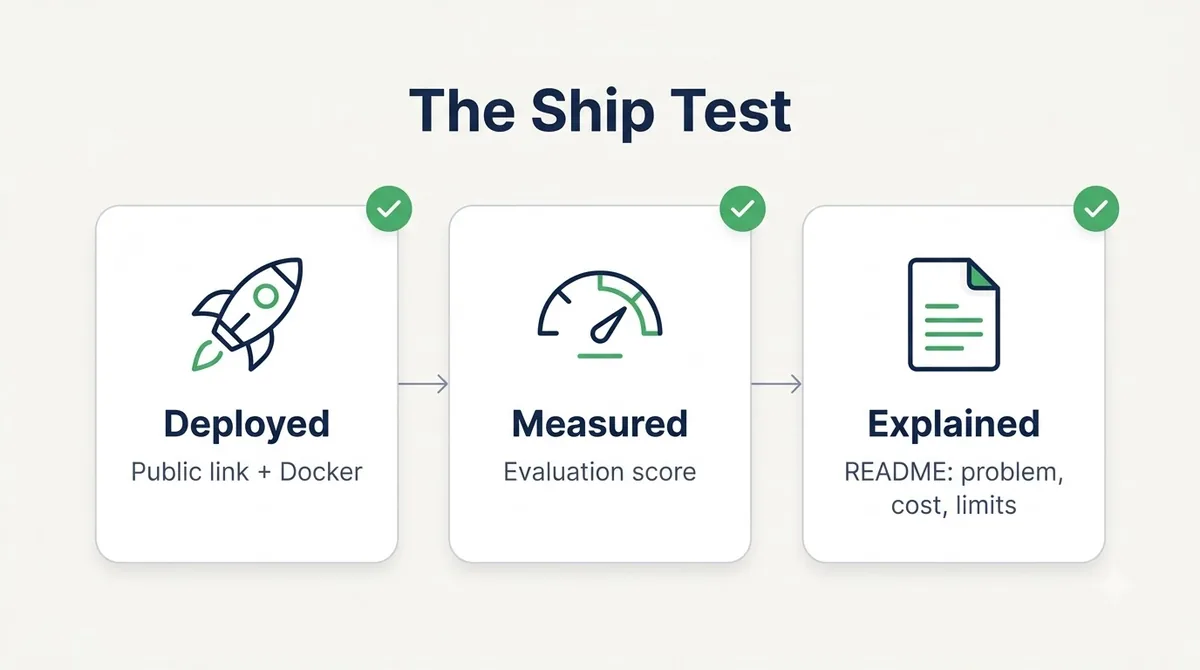
The Ship Test is our rule for portfolio projects. Each project must be deployed at a public link, measured with an evaluation set, and explained in a README that states the problem, the cost and what you would improve next. A project that fails any of the three reads as a tutorial, not engineering.
Three projects cover what interviewers usually ask about:
1. A RAG assistant on real local documents. For example, a chatbot that answers questions from university syllabus PDFs or government scheme documents. Show retrieval accuracy on 50 test questions and what changed when you adjusted the chunk size.
2. A tool-calling agent that finishes a business task. For example, an agent that reads a shop's daily sales sheet, flags low stock and drafts a message to the supplier. Show how often it completed the task correctly across 20 test runs.
3. A deployed, monitored AI API. For example, a FastAPI service that classifies customer complaints, packaged with Docker and hosted on a cloud free tier. Show average response time and cost per 1,000 requests.
| Ship Test check | What to show | Why it matters |
|---|---|---|
| Deployed | Public URL or demo video, plus a Dockerfile | Proves you can get past "works on my laptop" |
| Measured | Evaluation set with a score before and after changes | Proves you test instead of guessing |
| Explained | README: problem, approach, cost, limits, next steps | Proves you can communicate with a team |
Is There Demand? What the 2026 Hiring Data Shows
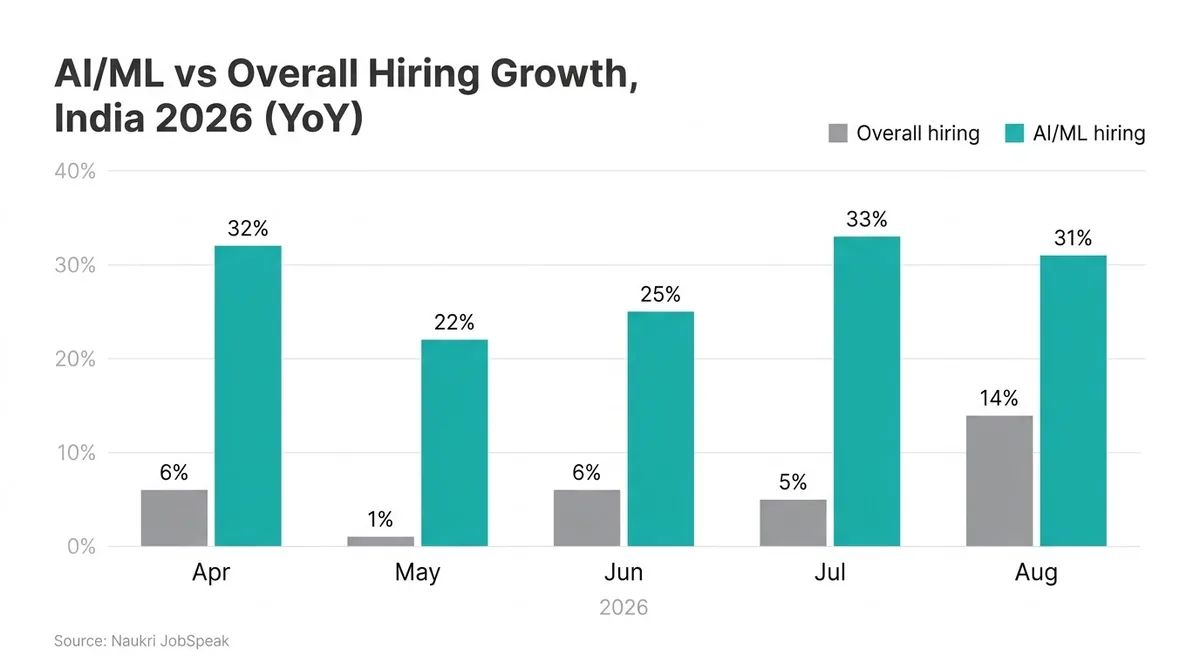
Yes. Naukri's JobSpeak index showed AI/ML job postings growing between 22% and 33% year on year in every month from April to August 2026, while overall white-collar hiring grew between 1% and 14% in the same months.
| Month (2026) | Overall white-collar hiring (YoY) | AI/ML hiring (YoY) | Source |
|---|---|---|---|
| April | +6% | +32% | Naukri JobSpeak, April 2026 |
| May | +1% | +22% | Naukri JobSpeak, May 2026 |
| June | +6% | +25% | Naukri JobSpeak, June 2026 |
| July | +5% | +33% | Naukri JobSpeak, July 2026 (summary by Sahi) |
| August | +14% | +31% | Naukri JobSpeak, August 2026 |
Two things in the data matter for beginners:
- AI hiring grew while overall IT hiring fell. TechRepublic, citing Naukri's JobSpeak report, reported that AI hiring in India's IT sector rose 16% year on year in June 2026, while overall IT job listings fell 3%.
- Demand is tilting toward experience. Naukri's April report showed AI/ML hiring up 53% for candidates with 13 to 16 years of experience, against 16% for freshers. Freshers need deployed projects to compete, which is why the Ship Test exists.
Naukri's index is based on job postings from one portal, so it shows direction, not the number of jobs filled. Our guide to remote data and AI jobs from Nagpur shows how people in Nagpur widen their search.
AI Engineer Salary in India: Realistic Numbers
Pay for AI engineers varies widely by source, experience and employer. Published estimates put freshers at roughly ₹6 to 15 LPA, and experienced AI engineers in the ₹10 to 20 LPA range.
| Level | Published range | Source |
|---|---|---|
| Junior AI engineer (0 to 2 years), India | About ₹6 to 14 LPA | SecondTalent, September 2026 |
| AI engineers in general, India | Most roles about ₹6 to 15 LPA | Amity Online |
| Working AI engineers, India | ₹10 to 20 LPA | Weekday, 2026 |
| Freshers in Nagpur | Most roles about ₹3 to 6 LPA | Our Nagpur salary analysis |
Treat these as ranges, not promises. Some 2026 reports quote about ₹60 lakh a year for senior generative AI specialists, but that is a ceiling for a small number of experts, not a starting salary.
Many freshers in Nagpur start locally and move to remote or global-capability-centre roles after a year or two, because those roles usually pay more than local services firms.

AI Engineer Roadmap for Working Professionals
Working professionals can often skip the first two or three months of the AI engineer roadmap and reach a portfolio in 6 to 9 months part-time, because Python, SQL, Git and APIs overlap with their current job.
| Current role | Already have | Focus on |
|---|---|---|
| Software developer (Java, .NET, JS) | Git, APIs, deployment | Python, ML basics, RAG, evaluation |
| Tester or QA | Test cases, automation thinking | Python, LLM evaluation (a natural fit), agents |
| Data analyst | SQL, Excel, Power BI | Python depth, ML, RAG, FastAPI |
| IT support or operations | Linux, cloud, monitoring | Python, LLM apps, Docker, MLOps basics |
Testers have a useful head start: evaluating LLM output is close to test design.
A useful next step for experienced engineers is the forward deployed engineer role, which combines AI engineering with client delivery. Fireblaze's Applied AI Forward Deployment Engineering program is built for IT professionals with 1 to 8 years of experience. It costs ₹99,000 for the online cohort or ₹1,29,999 for the Nagpur classroom cohort, both inclusive of 18% GST, as listed on the course page. (Disclosure: this is our own program.)
If you are comparing options, our AI course in Nagpur and Python course cover the early stages of this roadmap.

7 Mistakes That Slow Most Beginners Down
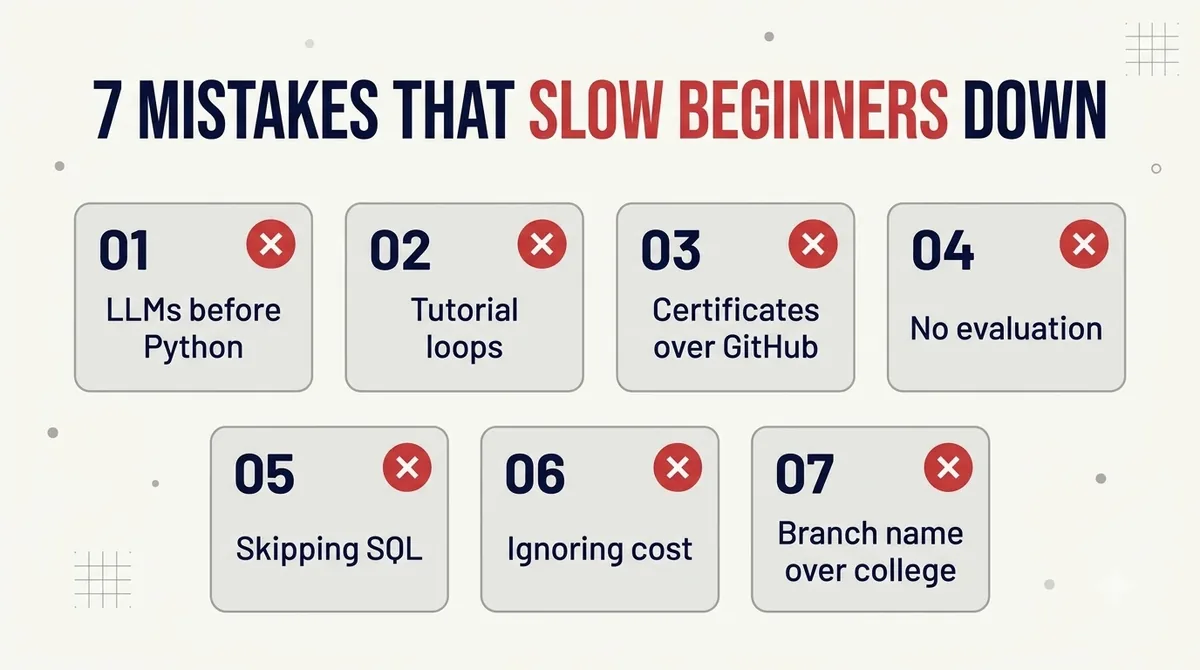
The most common mistakes are jumping to generative AI before learning Python, collecting certificates instead of projects, and never deploying anything.
- Starting with LLMs before Python. You will copy code you cannot debug.
- Tutorial loops. Watching a fifth course instead of building one project.
- Certificates over GitHub. Recruiters open your repositories, not your certificate folder.
- No evaluation. "It seems to work" is not a result. A score on 50 test questions is.
- Skipping SQL. Most company data lives in databases, and AI apps need it.
- Ignoring cost. An app that costs ₹5 per query will not survive real users.
- Choosing a college for the branch name. CSE at a stronger college beats "AI" at a weaker one.
Now It's Your Turn
You now have the full AI engineer roadmap: pick your route, follow the four stages, build three projects that pass the Ship Test, and use the hiring and salary data to set honest expectations.
Start small this week. Install Python, create a GitHub account and push your first program. Then open the month-by-month table and block 10 hours in your calendar.
If you would like trainers and project reviews along the way, Fireblaze's AI course in Nagpur and Python course cover the early stages, and Applied AI Forward Deployment Engineering covers the later ones for working professionals. Not sure which fits? Book a free career counselling session.
FAQ
What is the AI engineer roadmap for beginners?
The AI engineer roadmap for beginners has four stages: Python, SQL and Git (about 3 months), statistics and machine learning (about 2 months), LLM applications like RAG and agents (about 3 months), and deployment with evaluation (1 to 2 months). Build at least three deployed projects along the way.
What is the best path after 12th to become an AI engineer?
Take PCM in 11th and 12th, appear for JEE Main or MHT CET, and join a B.Tech in CSE, AI or AI and Data Science. Start Python and GitHub in your first year, and build deployed AI projects by third year, when campus placements begin. BCA or B.Sc plus a strong portfolio is the alternative route.
Can I become an AI engineer without JEE or a B.Tech?
Yes. A BCA, a B.Sc in Computer Science, Data Science or Maths, plus three deployed projects, can get you interviews, especially at startups and for remote roles. Some large employers still filter by B.Tech, so your portfolio and GitHub need to be stronger to make up for it.
How long does it take to become an AI engineer?
About 9 to 10 months of part-time study (10 to 12 hours a week) if you start from zero, or 6 to 9 months if you already code professionally. Through a B.Tech it takes four years, but you can be job-ready in AI by your third year.
What is the AI engineer salary for freshers in India?
Published estimates put fresher AI engineer pay in India at roughly ₹6 to 15 LPA. Roles in Nagpur usually pay less, around ₹3 to 6 LPA for freshers, according to our Nagpur salary analysis.
AI engineer kaise bane?
AI engineer banne ke liye pehle Python, SQL aur Git seekhiye, phir machine learning ke basics, aur uske baad LLM apps jaise RAG aur AI agents banaiye. 12th ke baad PCM ke saath JEE Main ya MHT CET dekar B.Tech CSE ya AI mein admission lijiye, aur teen deployed projects ka portfolio banaiye.
Is maths compulsory to become an AI engineer?
You need school-level maths plus basic statistics, probability and linear algebra. You do not need advanced calculus to build LLM applications, but you do need enough to understand embeddings, model metrics and why a model is wrong.
Sources
- Careers360: GHRCE Nagpur courses and fees
- Careers360: Ramdeobaba University courses and fees
- Naukri JobSpeak: April 2026
- Naukri JobSpeak: May 2026
- Naukri JobSpeak: June 2026
- Sahi: Naukri JobSpeak July 2026 summary
- Naukri JobSpeak: August 2026
- TechRepublic: AI jobs rise 16% in India's IT sector as overall listings fall, July 2026
- SecondTalent: AI engineer salary India, September 2026
- Amity Online: AI engineer salary in India
- Weekday: AI engineer salary in India 2026