 Fireblaze
 AI & Careers
Will AI Replace Data Analysts? An Honest Answer
AI is unlikely to replace data analysts, but it is already replacing parts of the job. Writing routine queries, generating first-draft charts and producing boilerplate summaries are increasingly automated. What is becoming more valuable is knowing which question to ask, judging whether an answer is credible, and communicating a recommendation to people who will act on it.
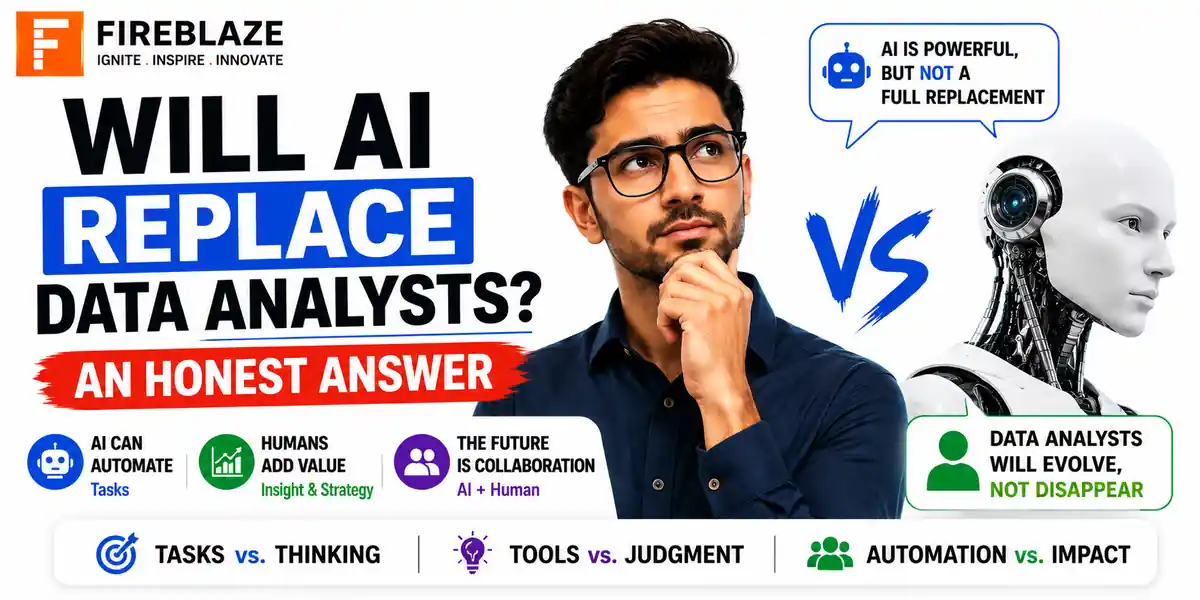
The honest position
It would be convenient for an institute to tell you that AI changes nothing and you should enrol anyway. That is not true, and anyone starting a data career deserves a straighter answer.
Large language models are genuinely good at the mechanical parts of analysis. They will write a SQL query from a description, explain an error message, draft a chart, and summarise a table. An analyst who spent most of their day on exactly those tasks has real cause to pay attention.
What AI does well right now
- Writing and debugging routine SQL and Python
- Explaining unfamiliar code or error messages
- Producing first drafts of documentation and summaries
- Suggesting approaches when you are stuck
- Speeding up repetitive cleaning and reformatting work
What it still does badly
- Knowing which question is worth asking in the first place
- Understanding the business context that makes a number meaningful
- Noticing that the data itself is wrong, which is extremely common
- Judging whether a result is plausible rather than merely well-formatted
- Persuading a manager to act, and being accountable for that recommendation
What is actually changing about the job
The realistic near-term picture is not fewer analysts, it is analysts who produce more. When routine query-writing gets faster, the constraint moves to interpretation and communication. Teams that previously asked three questions a week can ask thirty, and somebody still has to decide which answers to trust and what to do about them.
The people most exposed are those whose value was purely mechanical: taking a clear specification and turning it into a query. The people least exposed are those who talk to the business, question the data, and own recommendations.
What this means if you are starting out
Still learn SQL properly
Not because you will type every query by hand, but because you cannot evaluate a generated query you do not understand. Reviewing is a higher skill than writing, and it requires the same knowledge.
Use AI tools deliberately from day one
Treat them as a fast colleague who is sometimes confidently wrong. Verify everything. This is a skill in itself and employers now expect it.
Invest more in the business side
Domain understanding, asking sharper questions, and knowing what a plausible answer looks like are appreciating assets.
Practise communication seriously
This is the part that is not automating, and it is the part most technical candidates neglect.
Should you still start a data career?
Yes, in our view, but with a clear picture of what the job is becoming. The demand for people who can turn data into decisions has not fallen. What has fallen is the value of being a human query generator, and that was never a satisfying job anyway.
This is why AI tools are taught inside our programs rather than treated as a threat. The Post Graduate Program in Data Science & Analytics and the data analyst course in Nagpur both cover working with ChatGPT, Claude and Copilot as professional tools, including how to verify what they produce.
Watch
Why NOT to Become a Data Scientist
FAQ
Frequently Asked Questions
Will AI replace data analysts?
It is unlikely to replace the role, but it is already automating parts of it, particularly routine query writing, first-draft charts and boilerplate summaries. The parts that remain valuable are choosing the right question, judging whether an answer is credible, and communicating a recommendation.
Is it still worth learning SQL if AI can write queries?
Yes. You cannot evaluate a generated query you do not understand, and reviewing code is a higher skill than writing it. SQL remains the most tested skill in analyst interviews.
Which data skills are becoming more valuable because of AI?
Business domain understanding, data quality judgement, the ability to tell whether a result is plausible, and communication. These are the parts of the job that AI tools handle worst.
Do employers expect analysts to use AI tools?
Increasingly yes. Being able to use ChatGPT, Claude or Copilot productively and verify their output is becoming an expected part of the workflow rather than a differentiator.
Keep Reading
Related Articles
Career Roadmaps
How to Become a Data Analyst in India: A Step-by-Step Roadmap
The skills that actually get you hired, in the order worth learning them, and an honest view of how long it takes.
AI & Careers
Generative AI Skills Every Data Analyst Needs in 2026
Which AI skills employers actually expect from analysts now, and the verification habits that separate useful from dangerous.
Career Roadmaps
Data Analyst vs Data Scientist: Which Career Should You Choose?
Different jobs, not different levels. Here is what each actually does daily, and which is the more realistic first move.