 Fireblaze
 Career Roadmaps
How to Become a Data Analyst in India: A Step-by-Step Roadmap
To become a data analyst in India, learn Excel and SQL first, then a business intelligence tool such as Power BI, then Python for analysis. Build three or four portfolio projects on real datasets, practise explaining them aloud, and apply for analyst roles. Most people starting from zero need six to nine months of consistent effort. A degree in engineering is not required.
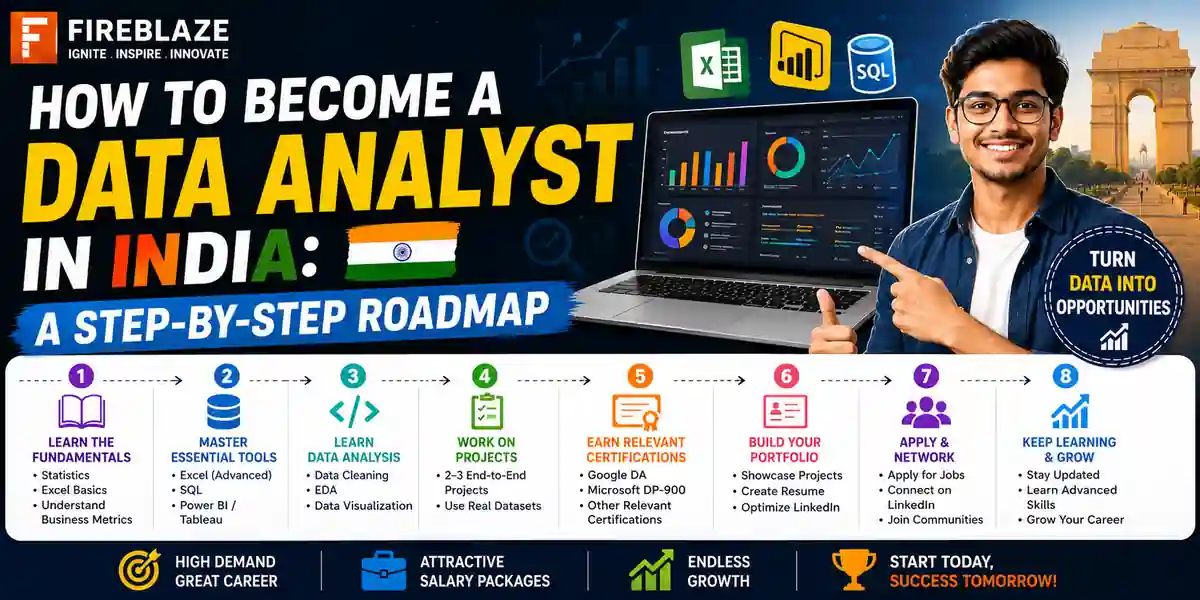
The short version
Data analyst is the highest-volume entry point into the Indian IT industry, and unlike most technology roles it is genuinely open to graduates from commerce, science and management backgrounds. What employers test is narrow and predictable: can you get data out of a database, can you make sense of it, and can you explain what you found to somebody who is not technical.
Everything below is ordered deliberately. Learning these skills out of order is the single most common reason people spend a year studying and still cannot clear an interview.
Step 1: Excel, properly
Almost every Indian business runs on spreadsheets, and a large share of analyst work still happens in them. More importantly, Excel teaches you to think about data structure before you have to fight a programming language at the same time.
- Formulas, lookups and conditional logic
- Pivot tables, which are the fastest way to understand grouping and aggregation
- Cleaning messy data: duplicates, inconsistent text, dates stored as text
- Basic charting and when each chart type is the wrong choice
Give this three to four weeks. You are not aiming to become an Excel expert, you are aiming to stop being slow in it.
Step 2: SQL, which is the skill that gets interviews
If you learn only one thing from this article, learn this: SQL appears in more Indian data analyst job descriptions than any other skill. It is also the most commonly tested skill in analyst interviews, usually as a live query exercise.
- SELECT, WHERE, ORDER BY, and the habit of reading a schema before writing anything
- GROUP BY and aggregate functions
- JOINs, which are where most beginners quietly get stuck
- Subqueries and common table expressions
- Window functions, which separate a junior candidate from a competent one
Give this six to eight weeks and practise on a real database rather than exercises with five rows. The difficulty of real SQL comes from messy, large data, not from syntax.
Step 3: A business intelligence tool
Power BI or Tableau. In the Indian job market Power BI appears in more listings, largely because of Microsoft ecosystem adoption, but the underlying skills transfer between them in a week or two.
The part that matters is not the tool. It is data modelling: understanding how tables relate, and building measures that stay correct when somebody filters the dashboard in a way you did not anticipate. Anyone can drag a chart onto a canvas. Very few beginners can build a model that does not break.
Step 4: Python for analysis
Python enters after you already think in data, not before. Learn it as an analyst rather than as a software engineer: you need Pandas for wrangling, a plotting library for visualisation, and enough language fundamentals to automate a repetitive task.
Step 5: Statistics, enough of it
You need descriptive statistics, distributions, correlation, and a working understanding of hypothesis testing and A/B tests. More than that is useful for data science roles and largely irrelevant for your first analyst job. The interview question that actually gets asked is some version of "this number moved, is it real or is it noise".
Step 6: Projects, which are what you are really selling
Interviews test projects. A candidate with three defensible projects beats a candidate with six certificates almost every time, because a certificate proves attendance and a project proves capability.
Pick real, messy data
Government open data portals, Kaggle, or a dataset from a small business you know. Clean data teaches you nothing about the job.
Answer a business question
Not "analysis of sales data" but "which three products should this retailer stop stocking, and what does that save".
Build the full path
From raw data to cleaned model to dashboard to a written recommendation. The recommendation is the part most people skip and the part interviewers care about.
Practise defending it
Say it out loud. Expect to be asked why you chose that method, what you would do differently, and what the data cannot tell you.
Step 7: Communication, which decides your offer
Analysts present to managers. Two candidates with identical technical skill routinely receive very different offers because one can explain a finding in plain language and one cannot. Practise group discussions, mock interviews and explaining a chart to somebody outside the field.
How long does this take?
Starting from zero, with consistent daily effort, six to nine months is realistic. People who already work with data in a spreadsheet-heavy role often move faster. People studying alongside a full-time degree usually take longer, and that is fine.
Be sceptical of any claim that you can become job-ready in four weeks. You can learn the syntax in four weeks. You cannot build judgement in four weeks, and judgement is what the interview probes.
Do you need a course?
No. Everything above is learnable independently, and plenty of people do exactly that. What a structured program buys you is sequence, feedback and accountability: someone telling you what to learn next, reviewing your actual work, and noticing when you stop showing up. If you have started and abandoned self-study before, that is the honest argument for a program rather than any claim about content quality.
Fireblaze AI School teaches this exact sequence in its data analyst course in Nagpur, and covers it in more depth alongside machine learning in the Post Graduate Program in Data Science & Analytics. Both run as classroom batches in Nagpur and as live online batches across Maharashtra.
Watch
How to Become a Data Scientist
FAQ
Frequently Asked Questions
Can I become a data analyst without a degree in computer science?
Yes. Data analytics is one of the most background-agnostic roles in IT. Commerce, science, management and engineering graduates all work as analysts. Employers test SQL, business intelligence tools and how you reason about data, not which degree you hold.
How long does it take to become a data analyst in India?
Starting from zero with consistent effort, six to nine months is realistic. That covers Excel, SQL, a business intelligence tool, Python for analysis, basic statistics and three or four portfolio projects.
Which skill should I learn first?
Excel, then SQL. SQL is the single most requested skill in Indian data analyst job descriptions and the most commonly tested in interviews. Learning Python before SQL is a very common and costly ordering mistake.
Do I need to know machine learning to be a data analyst?
No. Machine learning matters for data scientist roles. For analyst roles, SQL, business intelligence and clear communication matter far more. Learn machine learning after you have an analyst job, or if you are specifically targeting data science.
Keep Reading
Related Articles
Career Roadmaps
Data Analyst vs Data Scientist: Which Career Should You Choose?
Different jobs, not different levels. Here is what each actually does daily, and which is the more realistic first move.
Learning Guides
Python vs SQL: Which Should You Learn First for Data?
One of these gets you interviews faster than the other. The order you learn them in changes how quickly you become employable.
Salary & Outcomes
Data Analyst Salary Guide for Nagpur and Pune Freshers
What actually moves a fresher offer, and why the same skills earn differently across company types.