 Fireblaze
 Learning Guides
What is a Data Pipeline? Architecture, Benefits and Applications
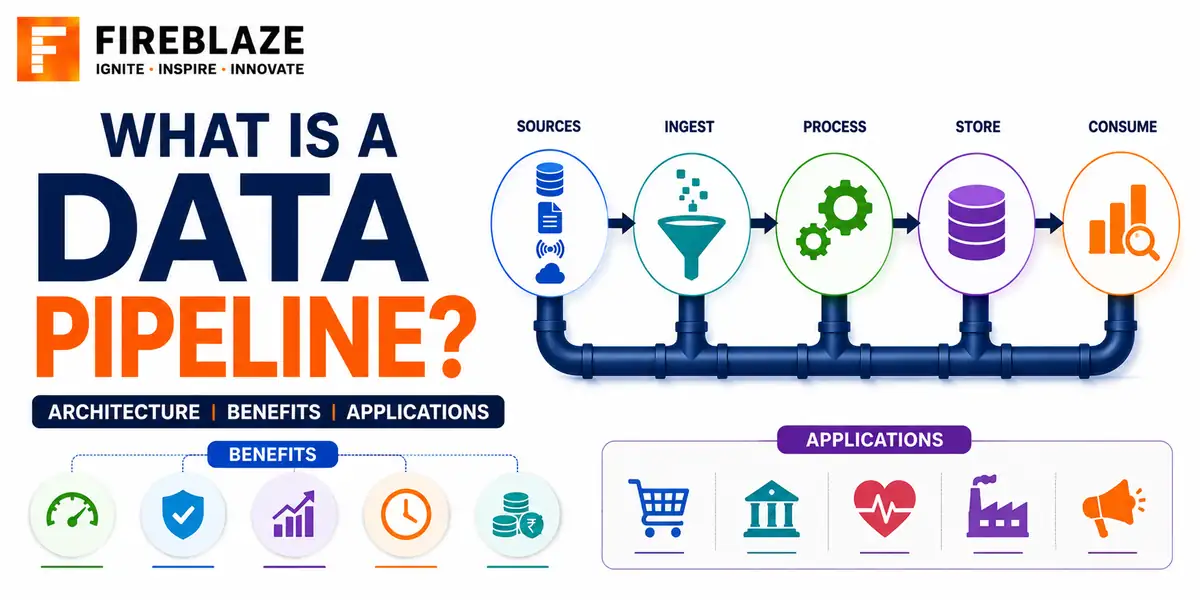
Quick answer: Learn what a data pipeline is, the typical ETL and ELT architecture, key components, and why reliable data pipelines matter for analytics and Machine Learning.
What is a Data Pipeline?
A data pipeline is a series of automated steps that move data from one or more source systems to a destination, typically a data warehouse or data lake, transforming it along the way so it is ready for analysis, reporting, or feeding into a Machine Learning model.
ETL vs ELT Architecture
| ETL | ELT |
|---|---|
| Extract, Transform, Load | Extract, Load, Transform |
| Data is transformed before loading | Raw data is loaded first, transformed inside the warehouse |
| Traditional approach, often for smaller data volumes | Common with modern cloud warehouses with cheap storage and strong compute |
Typical Stages of a Data Pipeline
1. Extraction
Pulling data from source systems, such as application databases, third-party APIs, or log files.
2. Transformation
Cleaning, reshaping and validating the data, including tasks like deduplication, type conversion, and joining data from multiple sources into a consistent structure.
3. Loading
Writing the transformed data into its destination, typically a data warehouse for structured analytics or a data lake for more varied, less structured data.
4. Orchestration and Scheduling
Tools like Apache Airflow schedule and monitor when each pipeline step runs, and handle dependencies between steps, such as ensuring a transformation only runs after extraction has completed successfully.
Batch vs Streaming Pipelines
A batch pipeline processes data in scheduled chunks, such as once every hour or once a day, suitable when near-real-time freshness is not required. A streaming pipeline processes data continuously as it arrives, needed for use cases like real-time fraud detection where even a short delay has real cost.
Key Components of a Modern Data Pipeline
Source connectors: for databases, APIs, files and event streams
Transformation logic: often written in SQL, Python, or a dedicated transformation tool
Orchestration: scheduling and dependency management
Data quality checks: automated validation at each stage
Monitoring and alerting: to catch failures quickly before they silently corrupt downstream analysis
Why Pipeline Reliability Matters So Much
A dashboard or Machine Learning model is only as trustworthy as the data feeding it. A silent pipeline failure, such as a source system quietly changing its data format, can produce confidently wrong numbers that look completely normal, which is often more damaging than an obvious, visible failure that gets noticed and fixed quickly.
Benefits of a Well-Built Data Pipeline
Consistent, repeatable data processing instead of manual, error-prone steps
Faster availability of fresh data for decision making
A single source of truth that multiple teams can rely on
Scalability as data volume grows over time
Common Tools in the Data Pipeline Ecosystem
| Tool | Purpose |
|---|---|
| Apache Airflow | Orchestration and scheduling |
| dbt | SQL-based transformation inside the warehouse |
| Apache Kafka | Real-time data streaming |
| Snowflake / BigQuery | Cloud data warehousing |
Common Interview Questions
What is the difference between ETL and ELT?
ETL transforms data before loading it into the destination. ELT loads raw data first and transforms it afterward inside the destination system, an approach that suits modern cloud warehouses with cheap storage and strong compute.
What is the difference between a batch and a streaming pipeline?
A batch pipeline processes data in scheduled chunks, suitable when near-real-time freshness is not required. A streaming pipeline processes data continuously as it arrives, needed when even a short delay carries real cost.
FAQ
Frequently Asked Questions
What is a data pipeline?
A series of automated steps that move data from source systems to a destination, transforming it along the way so it is ready for analysis or Machine Learning.
What is the difference between ETL and ELT?
ETL transforms data before loading it into the destination. ELT loads raw data first and transforms it afterward inside the destination system, common with modern cloud warehouses.
What is the difference between a batch and a streaming data pipeline?
A batch pipeline processes data in scheduled chunks. A streaming pipeline processes data continuously as it arrives, needed for use cases like real-time fraud detection.
Why does data pipeline reliability matter so much?
A dashboard or model is only as trustworthy as the data feeding it, and a silent pipeline failure can produce confidently wrong numbers that look completely normal.
Keep Reading
Related Articles
Learning Guides
INNER JOIN in SQL with Examples: Complete Beginner's Guide
Learn INNER JOIN in SQL with practical examples, syntax, interview questions, and real-world use cases. A complete beginner-friendly SQL JOI
Learning Guides
OUTER JOIN in SQL: Complete Guide with Examples for Beginners
Master OUTER JOIN in SQL with practical examples and real-world scenarios. Learn LEFT JOIN, RIGHT JOIN, FULL OUTER JOIN, syntax, use cases,
Learning Guides
Multi-Row Functions in SQL: Complete Guide with Examples
Learn multi-row (aggregate) functions in SQL including SUM, AVG, COUNT, MIN, MAX, GROUP BY and HAVING, with practical examples, NULL handlin