 Fireblaze
 Learning Guides
Best Machine Learning Books for Beginners (2026 Guide)
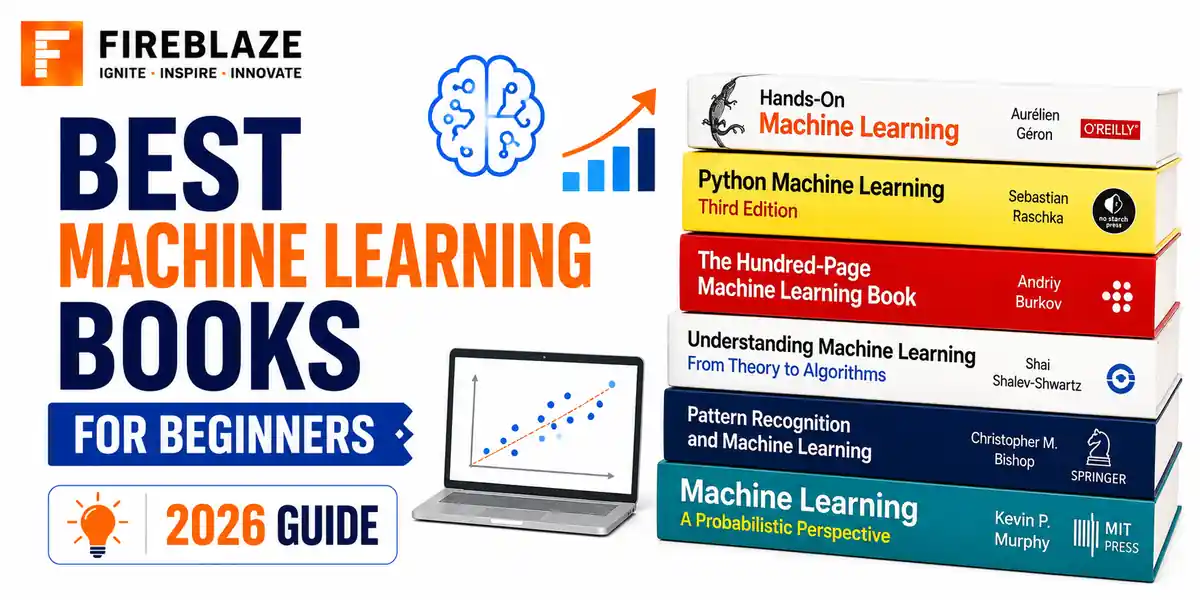
Quick answer: A curated list of well regarded Machine Learning books for beginners and practitioners, covering foundational theory, practical Python implementation, and deep learning.
Why Books Still Matter Alongside Online Courses
Online courses are excellent for guided, hands-on learning, but well written books often provide a depth of explanation and a more complete, structured foundation that shorter video content cannot always match, particularly for genuinely understanding the theory behind the tools.
Books for Absolute Beginners
"Python Machine Learning" by Sebastian Raschka
A widely recommended starting point that balances theory with practical Python implementation using Scikit-Learn, covering the core algorithms a beginner needs before moving to more advanced material.
"An Introduction to Statistical Learning" by James, Witten, Hastie and Tibshirani
A rigorous but genuinely accessible introduction to statistical learning theory, widely used in university courses, with a companion R version and the concepts translating well to Python practice.
Books for Practical, Hands-On Implementation
"Hands-On Machine Learning with Scikit-Learn, Keras, and TensorFlow" by Aurélien Géron
A consistently well regarded, practical guide covering both classical Machine Learning and deep learning with genuinely runnable code examples, often recommended as a natural second book after the fundamentals.
Books for Deeper Statistical and Mathematical Theory
"The Elements of Statistical Learning" by Hastie, Tibshirani and Friedman
A more advanced, mathematically rigorous companion to the introductory statistical learning book above, better suited once you already have a solid foundation and want genuine depth.
Books Focused on Deep Learning
"Deep Learning" by Goodfellow, Bengio and Courville
Often considered the definitive deep learning textbook, covering the mathematical foundations in real depth, though it demands a solid grounding in linear algebra and calculus to get full value from it.
Books for Project-Based Learning
"Python for Data Analysis" by Wes McKinney
Written by the creator of Pandas, this is a genuinely authoritative, practical reference for data manipulation, an essential skill underlying nearly every Machine Learning project.
How to Choose Where to Start
If you are new to both Python and Machine Learning, start with a practical, code-first book like "Python Machine Learning" or "Hands-On Machine Learning." If you already code comfortably and want the statistical theory first, "An Introduction to Statistical Learning" is the better entry point.
Books Alone Are Not Enough
Reading builds understanding, but genuine skill comes from applying what you read to real projects with real, messy data. Treat any book as a companion to hands-on practice, not a substitute for it.
Common Interview Questions
What is a good first Machine Learning book for someone comfortable with Python?
"Python Machine Learning" by Sebastian Raschka or "Hands-On Machine Learning" by Aurélien Géron, both of which combine theory with genuinely practical, runnable code examples.
Is reading books alone enough to become job-ready in Machine Learning?
No. Books build conceptual understanding, but genuine skill and interview readiness come from applying that understanding to real projects with real, messy data.
FAQ
Frequently Asked Questions
What is a good Machine Learning book for absolute beginners?
'Python Machine Learning' by Sebastian Raschka is a widely recommended starting point, balancing theory with practical Python implementation using Scikit-Learn.
What book is considered the definitive deep learning textbook?
'Deep Learning' by Goodfellow, Bengio and Courville, though it demands a solid grounding in linear algebra and calculus to get full value from it.
Is reading Machine Learning books enough to get job-ready?
No. Books build conceptual understanding, but genuine skill and interview readiness come from applying that understanding to real projects with real, messy data.
Should I read the theory book or the practical implementation book first?
If you already code comfortably, start with the theory in 'An Introduction to Statistical Learning'. If you want a code-first approach, start with 'Hands-On Machine Learning' or 'Python Machine Learning' instead.
Keep Reading
Related Articles
Learning Guides
INNER JOIN in SQL with Examples: Complete Beginner's Guide
Learn INNER JOIN in SQL with practical examples, syntax, interview questions, and real-world use cases. A complete beginner-friendly SQL JOI
Learning Guides
OUTER JOIN in SQL: Complete Guide with Examples for Beginners
Master OUTER JOIN in SQL with practical examples and real-world scenarios. Learn LEFT JOIN, RIGHT JOIN, FULL OUTER JOIN, syntax, use cases,
Learning Guides
Multi-Row Functions in SQL: Complete Guide with Examples
Learn multi-row (aggregate) functions in SQL including SUM, AVG, COUNT, MIN, MAX, GROUP BY and HAVING, with practical examples, NULL handlin