 Fireblaze
 Aerospace & Defence AI
The 2026 GNSS-Jamming Crisis: What's Actually Happening Over the Baltic and Middle East

A market and policy read on why "GPS interference" quietly became one of 2026's biggest infrastructure stories: and where the money is already moving.
1. What Happened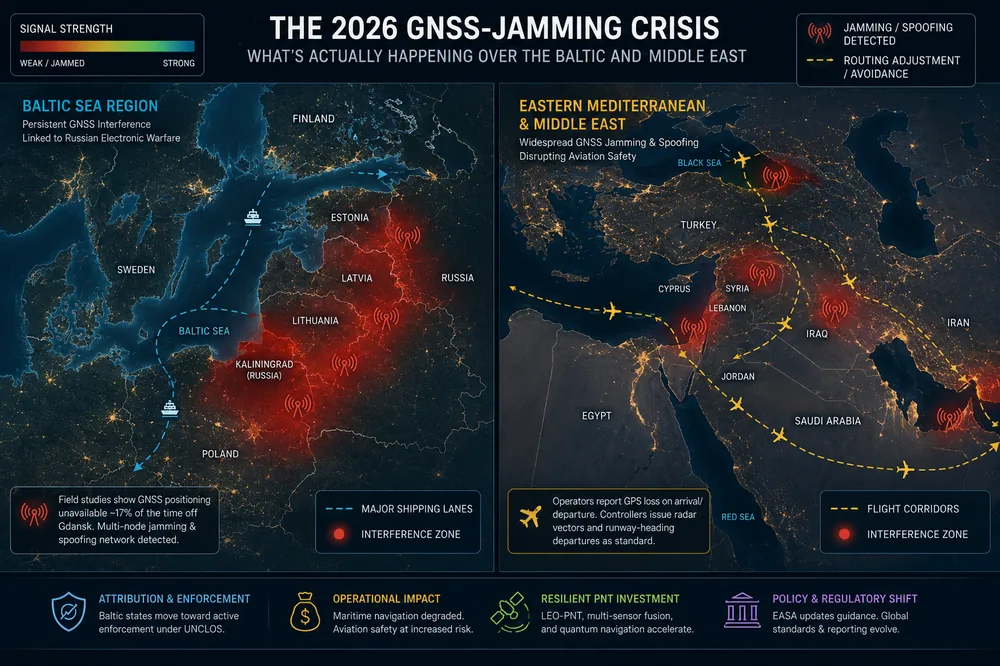
In January 2026, fourteen Baltic and North Sea coastal states plus Iceland issued a joint open letter declaring they would no longer tolerate Russian-linked GNSS jamming and spoofing degrading maritime safety, signaling a shift toward active enforcement under international maritime law. Simultaneously, EASA (European Union Aviation Safety Agency) revised its aviation guidance in July 2026, citing a persistent spike in jamming and spoofing across the Mediterranean, Black Sea, Middle East, Baltic Sea, and Arctic since 2022.
2. Why It Matters
Two separate regional crises have converged into a single infrastructure story, and the distinction between them matters for anyone tracking where defense-AI investment is headed next.
The Baltic problem is attributable and escalating toward enforcement. A GPSPATRON/Gdynia Maritime University field study using a sensor-equipped research vessel found that GNSS positioning was unavailable off Gdansk roughly 17% of the time during a late June–July measurement window, and documented a distributed, multi-node interference network with jamming and spoofing components that switch on and off in synchronization: evidence, the researchers concluded, of a coordinated electronic warfare system rather than isolated incidents. A separate shore-based study by the same partnership logged 84 hours of interference over a multi-month campaign, with October alone producing six major jamming incidents totaling 29 hours. This is no longer a "signal degradation" story; it's an attribution story, and the January 2026 joint letter from 14 nations: explicitly naming the Russian Federation and invoking Exclusive Economic Zone enforcement authority under UNCLOS: reads as a genuine policy inflection point rather than another diplomatic statement.
The Middle East problem is more diffuse but operationally heavier. EASA's Conflict Zone Information Bulletins through 2026 have repeatedly flagged jamming and spoofing across the Beirut, Baghdad, and Riyadh flight information regions, with operator reports describing complete GPS loss on arrival or departure and air traffic controllers now routinely issuing runway-heading departures and radar vectors to compensate. The FAA's own updated GNSS Interference Resource Guide points to the December 2024 crash of Azerbaijan Airlines Flight 8243: which experienced jamming followed by spoofing before a missile strike, killing 38 people: as the case that changed the regulatory conversation from "nuisance" to "safety-of-life risk" in the space of one incident report.
For the defense-AI industry specifically, three implications stand out:
- The jamming-vs-spoofing distinction is becoming a procurement distinction. EASA has explicitly stated that spoofing poses greater operational risk than jamming, because spoofing degrades silently while jamming is immediately obvious to a flight crew. This is starting to bifurcate vendor roadmaps: detection tooling for jamming is comparatively mature, while spoofing-resilient multi-sensor fusion and cross-constellation verification are where new capital is concentrating.
- Commercial LEO (Low Earth Orbit) PNT is displacing government-built constellations as the preferred near-term fix. The U.S. Space Force's Resilient GPS (R-GPS) program: originally intended to fund new government-owned small satellites: was cancelled in early 2026 in favor of embracing existing commercial PNT solutions, a decision multiple industry commentators have called validation of the LEO-PNT commercial thesis over traditional acquisition cycles.
- Capital is already flowing at meaningful scale. Xona Space Systems raised a Series B of $92 million in mid-2025 (including a $20 million SpaceWERX STRATFI award), bringing its total funding past $150 million, and has since closed an additional raise reported at $170 million to fund its roughly 300-satellite Pulsar constellation. Advanced Navigation separately closed a $110 million Series C in March 2026 explicitly framed around building PNT resilience beyond GPS. On the policy side, the FY2025 Senate NDAA markup included $217.7 million in RDT&E funding for PNT resiliency, and DARPA's Robust Quantum Sensors (RoQS) program has begun funding non-space-based, jam-immune quantum inertial navigation prototypes, with at least one awardee reporting $24.4 million across two contracts.
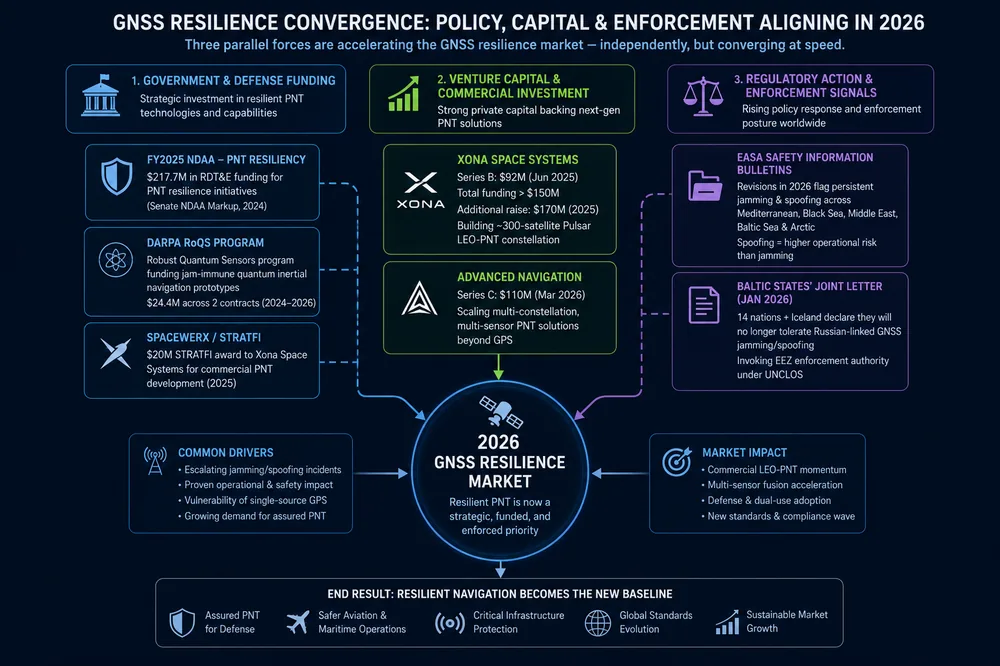
Taken together, this isn't a story about GPS getting marginally worse: it's a story about a two-decade-old single-point-of-failure finally generating enough documented harm, in enough jurisdictions, to unlock institutional capital and enforcement authority simultaneously. That combination: proven harm plus available capital plus a policy mechanism (EEZ enforcement, EASA guidance revisions, NDAA line items): is what separates a genuine market inflection from a recurring news cycle.
3. What to Watch Next
- Whether Baltic/North Sea EEZ enforcement actually materializes into boarding, inspection, or interference-source interdiction actions, or remains declaratory: the gap between the January letter's rhetoric and operational follow-through will signal how seriously coastal states intend to escalate.
- ICAO's response at its next Assembly, given EASA and IATA have already pushed for standardized global RFI (Radio Frequency Interference) incident reporting, NOTAM (Notice to Airmen) coding, and export/licensing restrictions on jamming devices: global standardization here would meaningfully change vendor requirements overnight.
- Further consolidation or fundraising among LEO-PNT players (Xona, TrustPoint, and adjacent signals-of-opportunity approaches using existing broadband constellations like Starlink or Iridium) now that the R-GPS cancellation has functionally endorsed commercial-first procurement.
- Whether EFB (Electronic Flight Bag)-based detection tools, which both FAA and EASA now formally recommend as near-term mitigation, become a mandated rather than optional layer: this would be a fast, low-cost win for avionics and software vendors serving commercial airlines.
- Quantum inertial sensing's transition out of the lab, as DARPA's RoQS program moves toward operational prototypes: the real test is whether these systems survive vibration and noise in an actual aircraft or helicopter cabin, not a laboratory bench.
4. Anchor Data Point
A single field study over one Baltic measurement window found GNSS positioning unavailable roughly 17% of the time off Gdansk: and that jamming/spoofing pattern was traced to a synchronized, multi-node interference network, not a scattered set of isolated incidents. (GPSPATRON / Gdynia Maritime University, 2025–2026 field campaign)
Keep Reading
Related Articles
Aerospace & Defence AI
IBM–NASA Prithvi: The Open Foundation Model Transforming Earth Observation
Discover how IBM and NASA's Prithvi foundation model family is reshaping Earth observation with open-source geospatial AI. Learn about Prithvi-EO, Pri
How GPS/GNSS Spoofing and Jamming Actually Work: A Practical Primer
GPS and other GNSS systems rely on extremely weak satellite signals, making them vulnerable to jamming and spoofing attacks. This practical primer exp
Kinetic vs. Directed Energy: Inside the AI Deciding How to Defeat a Drone Swarm
Once a hostile drone is confirmed, someone: or something: has to decide how to stop it. This article compares kinetic interceptors, high-energy lasers