 Fireblaze
 Learning Guides
Polynomial Regression in Python: Complete Guide
Quick answer: Learn polynomial regression including when to use it over linear regression, implementing it in Python with Scikit-Learn, and how to avoid overfitting with high-degree polynomials.
What is Polynomial Regression?
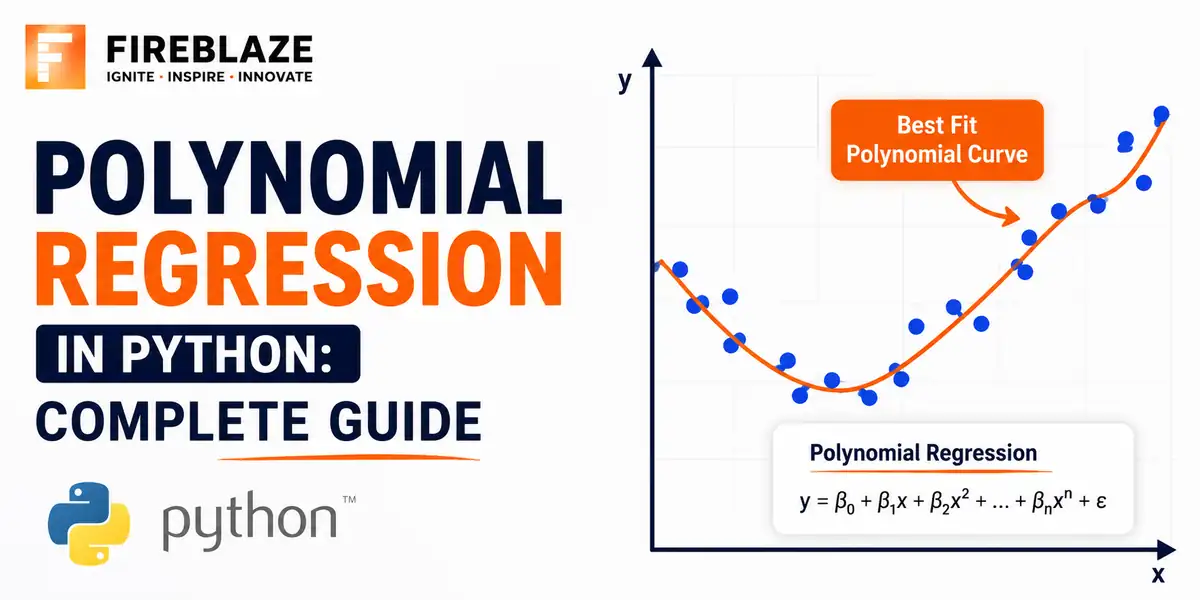
Polynomial regression models a non-linear relationship between a feature and a target by adding polynomial terms, such as x squared and x cubed, allowing a curved line to fit the data instead of a straight one, while still using the same linear regression machinery underneath.
When Plain Linear Regression Fails
If the true relationship between a feature and the target genuinely curves, a straight line will systematically underfit, missing the pattern at both extremes of the data. Polynomial regression addresses this by transforming the feature before fitting a standard linear model to the transformed features.
The Polynomial Regression Equation
y = b0 + b1*x + b2*x² + b3*x³ + ... + bn*xⁿ
Implementing Polynomial Regression in Python
from sklearn.preprocessing import PolynomialFeatures
from sklearn.linear_model import LinearRegression
import numpy as np

X = np.array([[1], [2], [3], [4], [5]])
y = np.array([2, 8, 18, 32, 50])

poly = PolynomialFeatures(degree=2)
X_poly = poly.fit_transform(X)   # creates columns for x and x²

model = LinearRegression()
model.fit(X_poly, y)

prediction = model.predict(poly.transform([[6]]))
PolynomialFeatures transforms the original feature into multiple polynomial terms, then an ordinary LinearRegression model is fit on those transformed features, which is why polynomial regression is technically still considered a form of linear regression, linear in its coefficients even though the resulting curve is not a straight line.
Choosing the Right Degree
A degree that is too low underfits a genuinely curved relationship. A degree that is too high overfits, producing a wildly oscillating curve that memorises the training points rather than capturing a genuine pattern. The right degree is typically chosen using cross validation across a few candidate degrees.
from sklearn.model_selection import cross_val_score

for degree in [1, 2, 3, 4]:
    poly = PolynomialFeatures(degree=degree)
    X_poly = poly.fit_transform(X)
    scores = cross_val_score(LinearRegression(), X_poly, y, cv=5)
    print(f"Degree {degree}: {scores.mean():.3f}")
The Overfitting Risk with High Degrees
As the polynomial degree increases, the model gains enough flexibility to pass through every single training point exactly, which usually means it has stopped learning a genuine pattern and started memorising noise. This is a classic, very visible example of overfitting.
Common Interview Questions
Is polynomial regression a type of linear regression?
Yes, technically. It is linear in its coefficients, even though the resulting relationship between the original feature and the target is a curve, since the polynomial terms are simply additional transformed features fed into an otherwise standard linear model.
How do you decide the right polynomial degree to use?
Through cross validation, comparing performance across a few candidate degrees and choosing the one that generalises best to validation data, rather than the one that fits the training data most closely.
FAQ
Frequently Asked Questions
What is polynomial regression?
A technique that models a non-linear relationship by adding polynomial terms of a feature, such as x squared, allowing a curved fit while still using linear regression's underlying machinery.
Is polynomial regression considered linear or non-linear?
It is technically a form of linear regression, since it is linear in its coefficients, even though the resulting curve fitting the original feature is not a straight line.
How do you choose the right degree for polynomial regression?
Using cross validation, testing a few candidate degrees and selecting the one that performs best on validation data rather than the one that fits training data most closely.
What happens if the polynomial degree is set too high?
The model becomes flexible enough to pass through nearly every training point, which usually means it is overfitting to noise rather than capturing a genuine underlying pattern.
Keep Reading
Related Articles
Learning Guides
INNER JOIN in SQL with Examples: Complete Beginner's Guide
Learn INNER JOIN in SQL with practical examples, syntax, interview questions, and real-world use cases. A complete beginner-friendly SQL JOI
Learning Guides
OUTER JOIN in SQL: Complete Guide with Examples for Beginners
Master OUTER JOIN in SQL with practical examples and real-world scenarios. Learn LEFT JOIN, RIGHT JOIN, FULL OUTER JOIN, syntax, use cases,
Learning Guides
Multi-Row Functions in SQL: Complete Guide with Examples
Learn multi-row (aggregate) functions in SQL including SUM, AVG, COUNT, MIN, MAX, GROUP BY and HAVING, with practical examples, NULL handlin