 Fireblaze
 Learning Guides
Parts of Speech Tagging Using NLP: Complete Guide
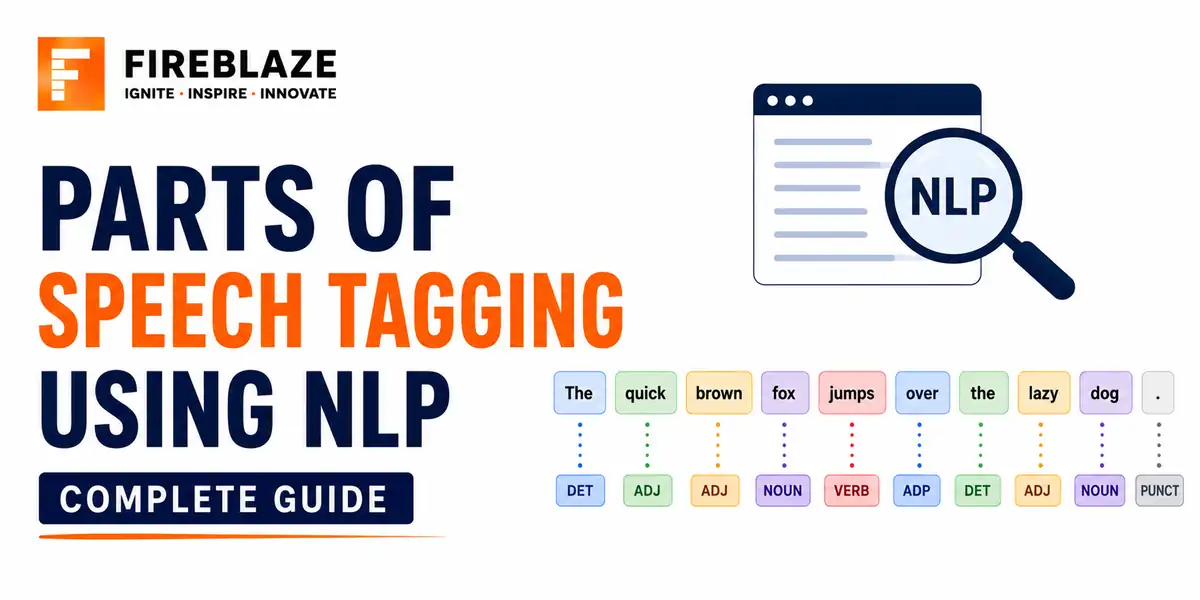
Quick answer: Learn Parts of Speech (POS) tagging in Natural Language Processing, how it works, and how to implement it in Python using NLTK and spaCy.
What is Parts of Speech Tagging?
Parts of Speech (POS) tagging assigns a grammatical category, such as noun, verb or adjective, to each word in a sentence, forming the foundation for many higher level NLP tasks like parsing, named entity recognition and information extraction.
Why POS Tagging Matters
The same word can serve different grammatical roles depending on context. Knowing a word's part of speech helps disambiguate meaning and is a necessary input for tasks that need to understand sentence structure, not just individual words.
"I will book a flight."   -- "book" is a VERB
"I read a good book."      -- "book" is a NOUN
POS Tagging with NLTK
import nltk
nltk.download('punkt')
nltk.download('averaged_perceptron_tagger')

text = "Fireblaze AI School trains students in data science."
tokens = nltk.word_tokenize(text)
tags = nltk.pos_tag(tokens)

print(tags)
# [('Fireblaze', 'NNP'), ('AI', 'NNP'), ('School', 'NNP'), ('trains', 'VBZ'), ...]
POS Tagging with spaCy
import spacy

nlp = spacy.load('en_core_web_sm')
doc = nlp("Fireblaze AI School trains students in data science.")

for token in doc:
    print(token.text, token.pos_)
spaCy tends to be faster and more convenient for production use, while NLTK is often preferred for teaching and detailed linguistic experimentation.
Common POS Tags
| Tag | Meaning |
|---|---|
| NN / NNP | Noun / Proper noun |
| VB / VBZ | Verb (base form / third person singular) |
| JJ | Adjective |
| RB | Adverb |
| PRP | Pronoun |
How Modern POS Taggers Actually Work
Modern taggers use statistical or neural models trained on large, human-annotated text corpora, learning patterns of which tags typically follow which other tags, rather than relying on a fixed dictionary of word-to-tag mappings, which would fail on ambiguous words entirely.
Practical Use Cases
Extracting only nouns and proper nouns as candidate keywords from a document
Filtering adjectives to analyse sentiment-bearing language in reviews
Serving as a preprocessing step before named entity recognition or dependency parsing
Common Interview Questions
Why is POS tagging harder than it looks?
Many words are ambiguous and change grammatical role depending on context, such as "book" being either a noun or a verb, so accurate tagging requires considering surrounding words, not just the word in isolation.
What is the difference between NLTK and spaCy for POS tagging?
NLTK is often used for teaching and detailed experimentation with different tagging approaches. spaCy is generally faster and better suited to production pipelines, with a simpler, more opinionated API.
FAQ
Frequently Asked Questions
What is Parts of Speech tagging in NLP?
It assigns a grammatical category, such as noun, verb or adjective, to each word in a sentence, forming a foundation for higher level NLP tasks.
Why is POS tagging considered a hard problem?
Many words are ambiguous and can serve different grammatical roles depending on context, so accurate tagging requires understanding surrounding words, not the word in isolation.
What is the difference between NLTK and spaCy for POS tagging?
NLTK is commonly used for teaching and detailed experimentation. spaCy is generally faster and better suited to production pipelines with a simpler API.
Keep Reading
Related Articles
Learning Guides
INNER JOIN in SQL with Examples: Complete Beginner's Guide
Learn INNER JOIN in SQL with practical examples, syntax, interview questions, and real-world use cases. A complete beginner-friendly SQL JOI
Learning Guides
OUTER JOIN in SQL: Complete Guide with Examples for Beginners
Master OUTER JOIN in SQL with practical examples and real-world scenarios. Learn LEFT JOIN, RIGHT JOIN, FULL OUTER JOIN, syntax, use cases,
Learning Guides
Multi-Row Functions in SQL: Complete Guide with Examples
Learn multi-row (aggregate) functions in SQL including SUM, AVG, COUNT, MIN, MAX, GROUP BY and HAVING, with practical examples, NULL handlin