 Fireblaze
 Learning Guides
Overfitting and Underfitting in Machine Learning Explained
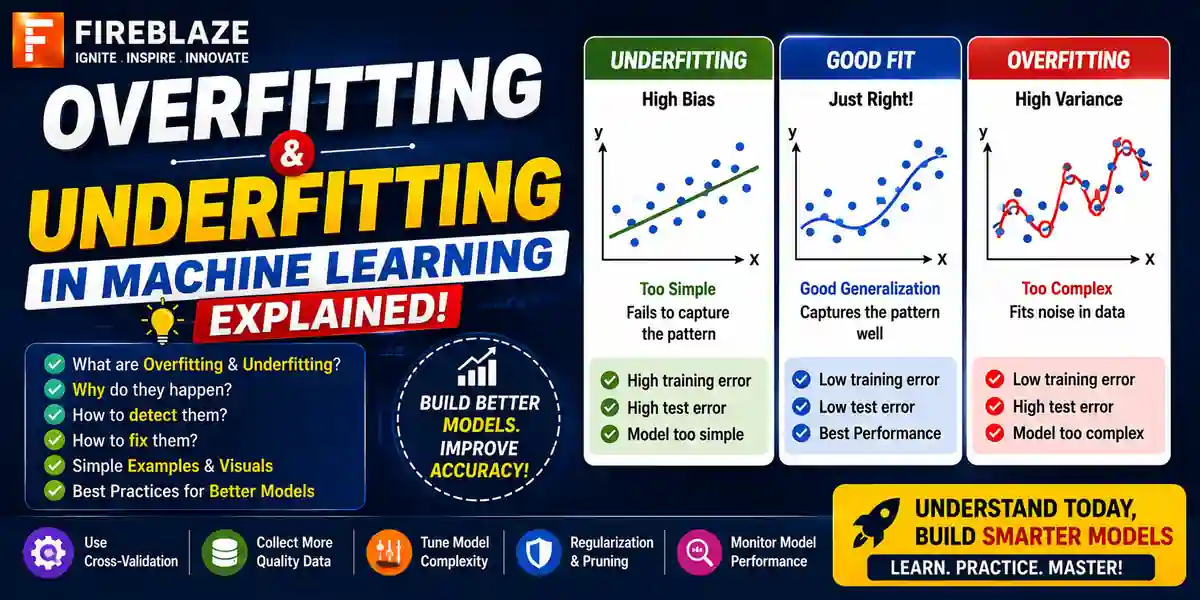
Quick answer: Learn the difference between overfitting and underfitting, how to detect each with a bias-variance perspective, and the standard techniques to fix them.
What is Overfitting?
Overfitting occurs when a model learns the training data too specifically, including its noise and random quirks, rather than the genuine underlying pattern. An overfit model performs very well on training data but poorly on new, unseen data.
What is Underfitting?
Underfitting occurs when a model is too simple to capture the genuine underlying pattern in the data at all, performing poorly on both training data and new data.
The Bias-Variance Perspective
| Underfitting | Overfitting |
|---|---|
| High bias, low variance | Low bias, high variance |
| Too simple a model | Too complex a model |
| Poor performance on training AND test data | Great training performance, poor test performance |
Bias is the error from overly simplistic assumptions. Variance is the error from excessive sensitivity to the specific training data. Good model building looks for the sweet spot balancing both.
How to Detect Overfitting and Underfitting
from sklearn.model_selection import train_test_split

X_train, X_test, y_train, y_test = train_test_split(X, y, test_size=0.2, random_state=42)

model.fit(X_train, y_train)
train_score = model.score(X_train, y_train)
test_score = model.score(X_test, y_test)

print(f"Training score: {train_score:.3f}, Test score: {test_score:.3f}")
A large gap where training score is much higher than test score signals overfitting. Both scores being low together signals underfitting.
How to Fix Overfitting
Gather more training data
Simplify the model, using fewer features or a less complex algorithm
Apply regularisation (L1 or L2 penalty) to constrain model complexity
Use cross validation to get a more reliable performance estimate
For tree-based models, limit tree depth or the number of leaf nodes
Use dropout for neural networks
How to Fix Underfitting
Use a more complex model
Add more relevant features through feature engineering
Reduce regularisation strength if it is currently too aggressive
Train for longer, or with more iterations, in the case of iterative algorithms
Using Learning Curves to Diagnose
Plotting training and validation error against training set size reveals the pattern clearly. If both curves converge to a high error, that indicates underfitting. If there is a persistent large gap between a low training error and a high validation error, that indicates overfitting.
Why Cross Validation Helps
A single train-test split can give a misleadingly optimistic or pessimistic result by chance. K-Fold Cross Validation trains and tests across multiple different splits, giving a more reliable estimate of how the model actually generalises.
Common Interview Questions
How would you tell overfitting apart from underfitting just from the numbers?
Overfitting shows a large gap between a high training score and a much lower test score. Underfitting shows both scores being low, close to each other.
What is regularisation and how does it help with overfitting?
Regularisation adds a penalty term that discourages overly complex models, such as very large coefficients in a linear model, encouraging the model to find a simpler pattern that generalises better.
FAQ
Frequently Asked Questions
What is the difference between overfitting and underfitting?
Overfitting is when a model learns training data too specifically, including its noise, performing well on training data but poorly on new data. Underfitting is when a model is too simple to capture the real pattern, performing poorly on both.
How do you detect overfitting?
Compare training score to test score. A large gap where training performance is much higher than test performance signals overfitting.
What are common ways to fix overfitting?
Gathering more data, simplifying the model, applying regularisation, using cross validation, and limiting complexity such as tree depth for tree-based models.
What is the bias-variance tradeoff?
Bias is error from an overly simple model, causing underfitting. Variance is error from excessive sensitivity to training data, causing overfitting. Good models balance both.
Keep Reading
Related Articles
Learning Guides
INNER JOIN in SQL with Examples: Complete Beginner's Guide
Learn INNER JOIN in SQL with practical examples, syntax, interview questions, and real-world use cases. A complete beginner-friendly SQL JOI
Learning Guides
OUTER JOIN in SQL: Complete Guide with Examples for Beginners
Master OUTER JOIN in SQL with practical examples and real-world scenarios. Learn LEFT JOIN, RIGHT JOIN, FULL OUTER JOIN, syntax, use cases,
Learning Guides
Multi-Row Functions in SQL: Complete Guide with Examples
Learn multi-row (aggregate) functions in SQL including SUM, AVG, COUNT, MIN, MAX, GROUP BY and HAVING, with practical examples, NULL handlin