 Fireblaze
 Learning Guides
Keras vs TensorFlow: What's the Difference
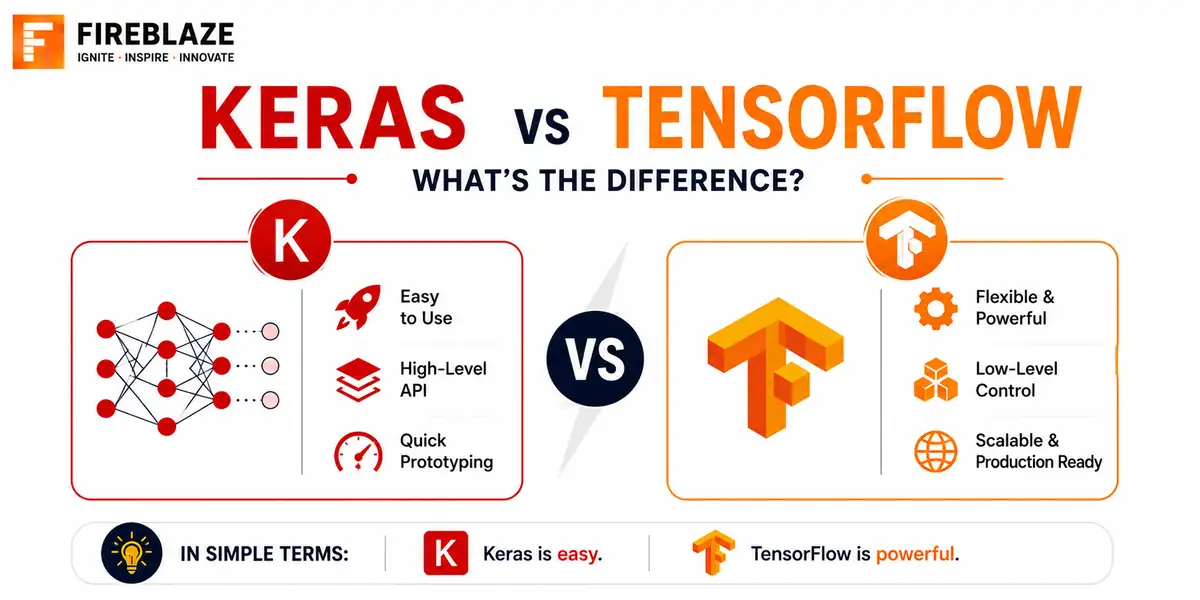
Quick answer: Understand the relationship between Keras and TensorFlow, when to use each, and how they compare to PyTorch for building deep learning models.
The Short Answer
Keras is not a competitor to TensorFlow. Keras is a high-level API that is now built directly into TensorFlow, providing a simpler, more readable way to build neural networks on top of TensorFlow's underlying computation engine.
A Bit of History
Keras began as an independent, framework-agnostic library that could run on top of several backends, including TensorFlow and Theano. Since TensorFlow 2.0, Keras has been tightly integrated as TensorFlow's official high-level API, which is why most current usage is simply "TensorFlow with Keras" rather than a separate choice between the two.
Building a Model with Keras (Inside TensorFlow)
from tensorflow import keras
from tensorflow.keras import layers

model = keras.Sequential([
    layers.Dense(64, activation='relu', input_shape=(10,)),
    layers.Dense(32, activation='relu'),
    layers.Dense(1, activation='sigmoid')
])

model.compile(optimizer='adam', loss='binary_crossentropy', metrics=['accuracy'])
model.fit(X_train, y_train, epochs=10)
This is genuinely TensorFlow code, using Keras's simpler syntax for defining the layers rather than TensorFlow's lower-level operations directly.
What TensorFlow Provides Beyond Keras
TensorFlow offers lower-level control for custom operations, strong production deployment tooling through TensorFlow Serving and TensorFlow Lite, and distributed training support, which Keras's simpler interface abstracts away for most standard use cases.
Keras/TensorFlow vs PyTorch
| Keras / TensorFlow | PyTorch |
|---|---|
| Historically stronger production deployment tooling | Historically favoured in research for flexibility |
| Higher-level, more concise syntax by default | More explicit, "Pythonic" style, popular for custom architectures |
The practical gap between the two ecosystems has narrowed considerably in recent years, and either is a reasonable choice for most projects today.
When You Would Skip Keras and Use TensorFlow Directly
For highly custom training loops, novel layer types, or specialised research architectures, working with TensorFlow's lower-level API directly gives more control than Keras's higher-level abstractions provide.
Common Interview Questions
Is Keras a separate library from TensorFlow?
Not anymore in practice. Since TensorFlow 2.0, Keras is TensorFlow's official built-in high-level API, so writing Keras code today is writing TensorFlow code.
Why would someone use TensorFlow's lower-level API instead of Keras?
For highly custom training loops or novel architectures that Keras's higher-level, more opinionated interface does not easily accommodate.
FAQ
Frequently Asked Questions
Is Keras different from TensorFlow?
Not really anymore. Keras is TensorFlow's official built-in high-level API since TensorFlow 2.0, providing a simpler syntax for building models on top of TensorFlow's engine.
Should a beginner learn Keras or TensorFlow first?
Start with Keras's high-level API within TensorFlow, since it is more readable and beginner-friendly, and move to TensorFlow's lower-level operations only when a project genuinely needs that level of control.
How does Keras/TensorFlow compare to PyTorch?
TensorFlow has historically had stronger production deployment tooling, while PyTorch is favoured in research for its flexible, explicit style, though the practical gap between them has narrowed considerably.
Keep Reading
Related Articles
Learning Guides
INNER JOIN in SQL with Examples: Complete Beginner's Guide
Learn INNER JOIN in SQL with practical examples, syntax, interview questions, and real-world use cases. A complete beginner-friendly SQL JOI
Learning Guides
OUTER JOIN in SQL: Complete Guide with Examples for Beginners
Master OUTER JOIN in SQL with practical examples and real-world scenarios. Learn LEFT JOIN, RIGHT JOIN, FULL OUTER JOIN, syntax, use cases,
Learning Guides
Multi-Row Functions in SQL: Complete Guide with Examples
Learn multi-row (aggregate) functions in SQL including SUM, AVG, COUNT, MIN, MAX, GROUP BY and HAVING, with practical examples, NULL handlin