 Fireblaze
 Learning Guides
Inheritance in Python: Complete Guide with Examples
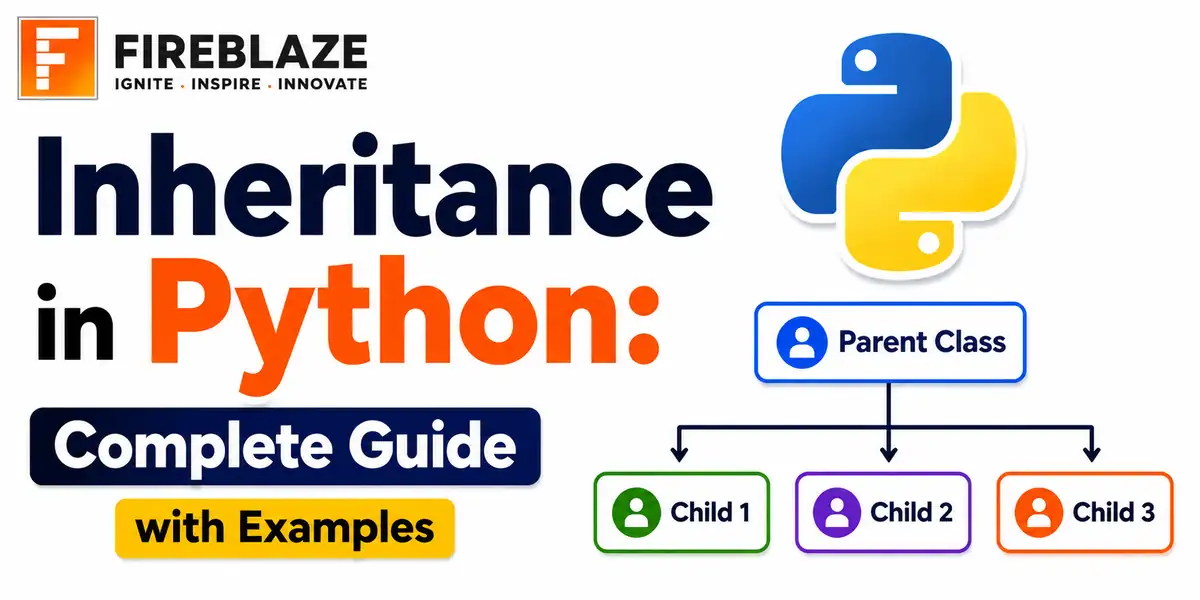
Quick answer: Learn Python inheritance including parent and child classes, method overriding, the super() function, and multiple inheritance, with examples.
What is Inheritance?
Inheritance lets a class, called the child or subclass, reuse and extend the attributes and methods of another class, called the parent or superclass, avoiding repeated code across related classes.
class Animal:
    def __init__(self, name):
        self.name = name

    def speak(self):
        return "Some generic sound"

class Dog(Animal):
    def speak(self):
        return "Woof"

class Cat(Animal):
    def speak(self):
        return "Meow"

d = Dog("Rex")
c = Cat("Whiskers")
print(d.name, d.speak())   # Rex Woof
print(c.name, c.speak())   # Whiskers Meow
Both Dog and Cat automatically inherit the __init__ method and the name attribute from Animal, without needing to redefine them.
Method Overriding
A child class can redefine a method it inherits, replacing the parent's version with its own, as seen with speak() above. This is called method overriding.
Using super()
super() lets a child class call a method from its parent class, commonly used inside an overridden __init__ to still run the parent's setup logic.
class Employee:
    def __init__(self, name, salary):
        self.name = name
        self.salary = salary

class Manager(Employee):
    def __init__(self, name, salary, team_size):
        super().__init__(name, salary)   # runs Employee's __init__ first
        self.team_size = team_size

m = Manager("Rohan", 80000, 5)
print(m.name, m.salary, m.team_size)
Checking Inheritance
print(isinstance(d, Animal))    # True, Dog is a subclass of Animal
print(issubclass(Dog, Animal))  # True
Multiple Inheritance
Python allows a class to inherit from more than one parent class, though it should be used carefully to avoid confusing method resolution when parents define the same method.
class Swimmer:
    def swim(self):
        return "Swimming"

class Runner:
    def run(self):
        return "Running"

class Triathlete(Swimmer, Runner):
    pass

t = Triathlete()
print(t.swim(), t.run())
Common Interview Questions
What is the difference between inheritance and method overriding?
Inheritance is the mechanism of a class acquiring attributes and methods from another class. Method overriding is when a child class provides its own specific implementation of a method it inherited.
Why would you use super() instead of skipping the parent's __init__ entirely?
Skipping it means you would need to manually reinitialise every attribute the parent normally sets up, duplicating logic and risking it going out of sync if the parent class changes later.
FAQ
Frequently Asked Questions
What is inheritance in Python used for?
It lets a class reuse and extend the attributes and methods of another class, avoiding repeated code across related classes.
What is method overriding?
When a child class defines its own version of a method it inherited from a parent class, replacing the parent's behaviour for that class.
What does super() do in Python?
It lets a child class call a method, most commonly __init__, from its parent class, so the parent's setup logic still runs.
Does Python support multiple inheritance?
Yes, a class can inherit from more than one parent class, though it should be used carefully when parent classes define overlapping methods.
Keep Reading
Related Articles
Learning Guides
INNER JOIN in SQL with Examples: Complete Beginner's Guide
Learn INNER JOIN in SQL with practical examples, syntax, interview questions, and real-world use cases. A complete beginner-friendly SQL JOI
Learning Guides
OUTER JOIN in SQL: Complete Guide with Examples for Beginners
Master OUTER JOIN in SQL with practical examples and real-world scenarios. Learn LEFT JOIN, RIGHT JOIN, FULL OUTER JOIN, syntax, use cases,
Learning Guides
Multi-Row Functions in SQL: Complete Guide with Examples
Learn multi-row (aggregate) functions in SQL including SUM, AVG, COUNT, MIN, MAX, GROUP BY and HAVING, with practical examples, NULL handlin