 Fireblaze
 Career Roadmaps
Essential Skills for Data Scientists: A Complete Career Guide for 2026
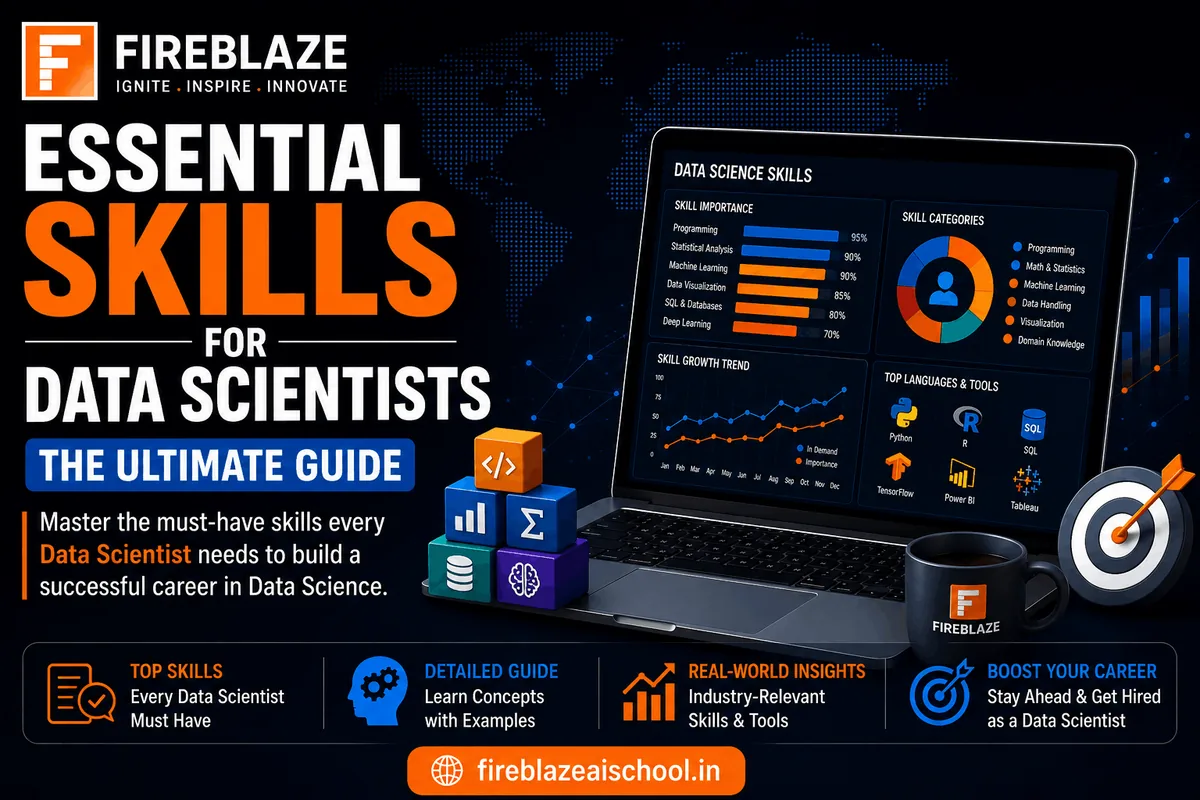
Data Science has become one of the most sought-after career paths in today's digital economy. Organizations across industries rely on data scientists to extract valuable insights, build predictive models, and drive business decisions.
However, becoming a successful Data Scientist requires much more than learning a programming language or building a few projects.
Modern data scientists need a combination of technical expertise, analytical thinking, business understanding, and communication skills.
In this guide, we'll explore the essential skills every aspiring Data Scientist should develop to succeed in 2026 and beyond.
What Does a Data Scientist Do?
A Data Scientist collects, analyzes, and interprets large volumes of data to solve business problems and support decision-making.
Their responsibilities often include:
Data Collection
Data Cleaning
Exploratory Data Analysis
Machine Learning Model Development
Data Visualization
Business Reporting
Predictive Analytics
To perform these tasks effectively, a diverse skill set is required.
1. Programming Skills
Programming forms the foundation of Data Science.
The most widely used languages include:
Python
Python is the most popular programming language for Data Science because of its simplicity and powerful libraries.
Popular Python libraries:
Pandas
NumPy
Matplotlib
Seaborn
Scikit-Learn
TensorFlow
PyTorch
Example:
import pandas as pd

data = pd.read_csv("sales_data.csv")

print(data.head())
R Programming
R is widely used for statistical computing and advanced analytics.
Many research institutions and statisticians prefer R for data analysis tasks.
2. SQL and Database Management
Data is stored in databases, making SQL one of the most important skills for Data Scientists.
SQL helps professionals:
Retrieve data
Filter records
Join multiple tables
Perform aggregations
Create reports
Example:
SELECT customer_name,
SUM(total_sales)
FROM sales
GROUP BY customer_name;
Without SQL knowledge, working with real-world datasets becomes difficult.
3. Statistics and Probability
Statistics is the backbone of Data Science.
Understanding statistical concepts helps professionals:
Analyze data accurately
Validate findings
Build reliable models
Key topics include:
Descriptive Statistics
Mean
Median
Mode
Standard Deviation
Inferential Statistics
Hypothesis Testing
Confidence Intervals
Sampling Techniques
Probability
Probability helps estimate the likelihood of future events.
These concepts are essential for predictive modeling and machine learning.
4. Data Cleaning and Data Wrangling
Real-world data is rarely clean.
Data Scientists spend a significant amount of time:
Removing duplicates
Handling missing values
Correcting inconsistencies
Standardizing formats
Example:
df.dropna(inplace=True)

df.drop_duplicates(inplace=True)
Clean data leads to more accurate analysis and better model performance.
5. Data Visualization
Data visualization transforms complex datasets into understandable insights.
Popular visualization tools include:
Power BI
Tableau
Matplotlib
Seaborn
Plotly
Effective visualizations help stakeholders understand trends and patterns quickly.
Common charts:
Bar Charts
Line Charts
Scatter Plots
Heatmaps
Dashboards
6. Machine Learning
Machine Learning enables systems to learn patterns from data and make predictions.
Important machine learning concepts include:
Supervised Learning
Examples:
Linear Regression
Logistic Regression
Decision Trees
Unsupervised Learning
Examples:
K-Means Clustering
Hierarchical Clustering
Ensemble Learning
Examples:
Random Forest
XGBoost
Machine Learning is one of the most valuable skills for modern Data Scientists.
7. Deep Learning and Artificial Intelligence
As AI adoption grows, Data Scientists increasingly work with deep learning models.
Important concepts include:
Neural Networks
Convolutional Neural Networks (CNNs)
Recurrent Neural Networks (RNNs)
Transformers
Generative AI
Popular frameworks:
TensorFlow
PyTorch
Keras
AI skills can significantly enhance career opportunities.
8. Business Understanding
Technical skills alone are not enough.
Successful Data Scientists understand:
Business objectives
Industry challenges
Customer behavior
Revenue drivers
This enables them to deliver actionable insights rather than just technical reports.
9. Problem-Solving Skills
Data Science is fundamentally about solving problems.
Professionals must:
Identify business challenges
Analyze available data
Develop solutions
Evaluate outcomes
Strong analytical thinking is highly valued by employers.
10. Communication Skills
One of the most overlooked skills in Data Science is communication.
Data Scientists often present findings to:
Managers
Clients
Executives
Non-technical stakeholders
Being able to explain complex concepts in simple language is essential.
11. Big Data Technologies
Many organizations work with massive datasets.
Knowledge of big data tools can be beneficial.
Popular technologies include:
Hadoop
Spark
Hive
Kafka
These tools help process and analyze large-scale data efficiently.
12. Cloud Computing
Modern data infrastructure increasingly relies on cloud platforms.
Popular cloud providers include:
AWS
Microsoft Azure
Google Cloud Platform (GCP)
Cloud skills improve scalability and deployment capabilities.
13. Version Control and Collaboration
Data Scientists often work in teams.
Version control systems help manage projects efficiently.
The most widely used tool is:
Git
Benefits include:
Code tracking
Collaboration
Rollback capabilities
Project management
GitHub is commonly used for portfolio development and team collaboration.
14. Feature Engineering
Feature Engineering involves creating meaningful variables from raw data.
Examples:
Customer Age Groups
Monthly Revenue Metrics
Purchase Frequency Scores
High-quality features often improve machine learning performance significantly.
15. Model Evaluation
Building a model is only part of the process.
Data Scientists must evaluate performance using metrics such as:
Classification Metrics
Accuracy
Precision
Recall
F1 Score
Regression Metrics
MAE
MSE
RMSE
R² Score
Proper evaluation ensures reliable predictions.
Soft Skills Every Data Scientist Needs
Technical expertise should be supported by strong soft skills.
Important soft skills include:
Critical Thinking
Making decisions based on evidence and logic.
Curiosity
Continuously exploring new tools, techniques, and ideas.
Adaptability
Technology evolves rapidly, requiring continuous learning.
Teamwork
Collaborating with engineers, analysts, and business stakeholders.
Career Roadmap for Aspiring Data Scientists
A recommended learning path:
Learn Python
Master SQL
Study Statistics
Learn Data Visualization
Build Machine Learning Projects
Explore Deep Learning
Learn Cloud Technologies
Create a Strong Portfolio
Practice Business Case Studies
Prepare for Interviews
Following this roadmap can significantly improve career readiness.
Why These Skills Matter in 2026
Organizations are increasingly investing in Artificial Intelligence, Machine Learning, and Data-Driven Decision Making.
As a result, companies seek professionals who can:
Analyze data effectively
Build predictive models
Communicate insights
Drive business outcomes
Developing these essential skills will help aspiring Data Scientists remain competitive in a rapidly evolving job market.
Final Thoughts
Data Science is one of the most exciting and rewarding careers in technology. However, success requires a combination of programming, statistics, machine learning, business understanding, and communication skills.
Rather than focusing on a single tool or technology, aspiring Data Scientists should aim to build a strong foundation across multiple domains.
By mastering these essential skills, you'll be well-positioned to solve real-world problems, contribute to business success, and build a successful career in Data Science.
Keep Reading
Related Articles
Career Roadmaps
How to Become an AI Engineer in India: Complete Roadmap (2026) AI Engineer Roadmap
Artificial Intelligence is transforming industries and creating thousands of career opportunities across India. Becoming an AI Engineer in 2026 requir
Why Companies Prefer Full Stack Developers Over Specialized Roles Today
A Full Stack Developer is a professional capable of working across the entire technology stack: from the front-end user interface to the back-end serv
How to Become a Data Analyst in Nagpur in 2026: Complete Career Roadmap
Want to become a Data Analyst in Nagpur? This complete guide covers the skills, tools, salary expectations, career roadmap, and training required to s