 Fireblaze
 Learning Guides
How Tesla Uses AI and Computer Vision in Its Vehicles
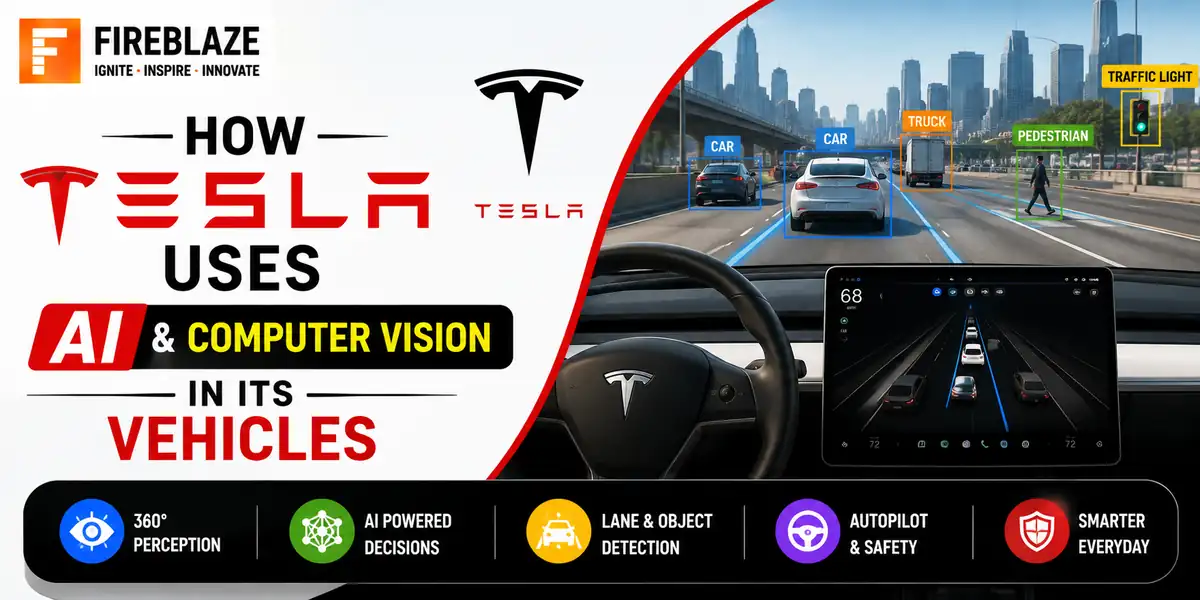
Quick answer: An overview of how Tesla applies AI and computer vision for its Autopilot and Full Self-Driving features, including camera based perception and neural networks.
Tesla's Camera-Based Approach
Tesla's Autopilot and Full Self-Driving systems rely primarily on a camera based approach to perception, using multiple cameras positioned around the vehicle to build an understanding of the surrounding environment, rather than depending on LiDAR, the laser based sensor technology some competitors favour.
Why a Camera-Centric Approach
Tesla's publicly stated reasoning is that humans drive safely using vision alone, so a system trained to interpret camera data comprehensively should, in principle, be able to do the same, while also keeping the sensor suite simpler and cheaper to manufacture at scale. This approach remains a genuinely debated topic in the autonomous vehicle industry, with other companies favouring LiDAR for its more direct depth measurement.
Neural Networks for Perception
Camera footage is processed through Convolutional Neural Networks trained to detect and classify objects such as other vehicles, pedestrians, lane markings and traffic signs, and to estimate distances and predict the movement of nearby objects.
Occupancy Networks
More recent Tesla approaches use what the company calls occupancy networks, which predict which regions of 3D space around the vehicle are occupied by something, rather than only trying to classify specific predefined object categories, intended to help the system react appropriately to unusual objects it may not have a specific label for.
Training on Real-World Fleet Data
A significant part of Tesla's approach involves collecting driving data from its large deployed customer fleet, then using specific difficult or unusual scenarios encountered by real drivers to further train and refine its perception models, an approach to gathering diverse real-world training data that is hard for competitors without a comparable fleet size to replicate.
Genuine Technical Challenges
Handling rare edge cases that are, by definition, underrepresented in training data
Maintaining reliable performance in poor weather or unusual lighting conditions where camera vision is inherently more limited than radar or LiDAR
Achieving the extremely high reliability bar that full autonomous driving safety genuinely requires
A Broader Lesson for Data Science Learners
Tesla's approach illustrates several concepts covered elsewhere in this Learning Guides series in a real, high-stakes setting: Convolutional Neural Networks for perception, the importance of diverse real-world training data over purely synthetic data, and the genuine difficulty of building models that must perform reliably rather than just accurately on average.
Common Interview Questions
Why does Tesla rely primarily on cameras rather than LiDAR?
Tesla's stated reasoning is that human drivers manage safely using vision alone, and a comprehensive vision based system can achieve similar or better results while keeping the sensor suite simpler, though this remains a genuinely debated engineering choice in the industry.
What is a key challenge in training perception models for autonomous driving?
Rare edge cases are, by their nature, underrepresented in training data, yet handling them correctly is essential for real-world safety, making data diversity and collection strategy as important as model architecture itself.
FAQ
Frequently Asked Questions
Does Tesla use LiDAR in its self-driving approach?
No. Tesla's Autopilot and Full Self-Driving systems rely primarily on a camera-based approach, unlike some competitors who use LiDAR for direct depth measurement.
What kind of neural networks does Tesla use for perception?
Convolutional Neural Networks process camera footage to detect and classify objects like vehicles and pedestrians, and more recent approaches use occupancy networks to predict which regions of space are occupied.
Why is real-world fleet data important to Tesla's approach?
It allows the company to identify rare, difficult driving scenarios encountered by actual drivers and use them to further train and refine perception models, a form of diverse data collection that is hard to replicate without a comparable fleet size.
Keep Reading
Related Articles
Learning Guides
INNER JOIN in SQL with Examples: Complete Beginner's Guide
Learn INNER JOIN in SQL with practical examples, syntax, interview questions, and real-world use cases. A complete beginner-friendly SQL JOI
Learning Guides
OUTER JOIN in SQL: Complete Guide with Examples for Beginners
Master OUTER JOIN in SQL with practical examples and real-world scenarios. Learn LEFT JOIN, RIGHT JOIN, FULL OUTER JOIN, syntax, use cases,
Learning Guides
Multi-Row Functions in SQL: Complete Guide with Examples
Learn multi-row (aggregate) functions in SQL including SUM, AVG, COUNT, MIN, MAX, GROUP BY and HAVING, with practical examples, NULL handlin