 Fireblaze
 Aerospace & Defence AI
From Static Optimization to Multi-Agent RL: The Next Frontier in Autonomous Climate Response
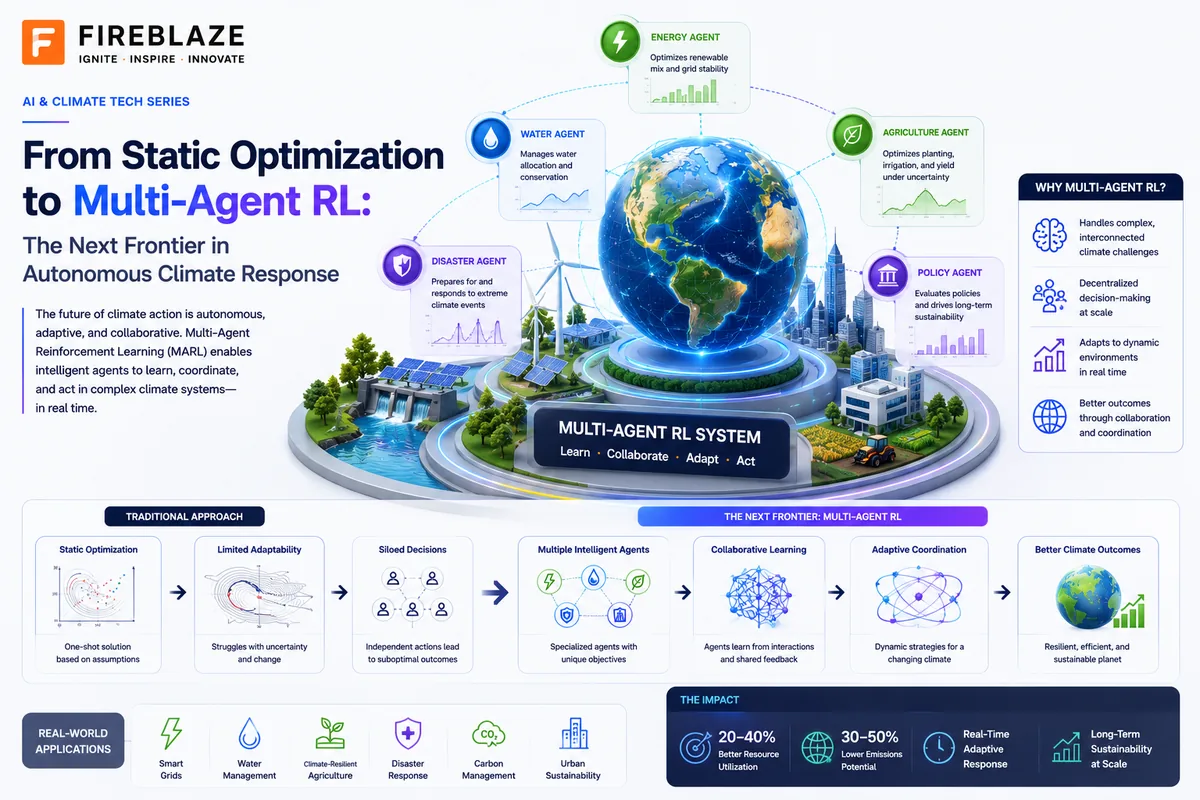
A market-trend piece on why the optimization tools that work well for a Tuesday-morning maintenance schedule: the OR-Tools-style solvers covered in our predictive maintenance series: start to break down the moment the problem is a flood, a wildfire, or a hurricane with dozens of interacting decision-makers and information that keeps changing mid-response.
1. Hook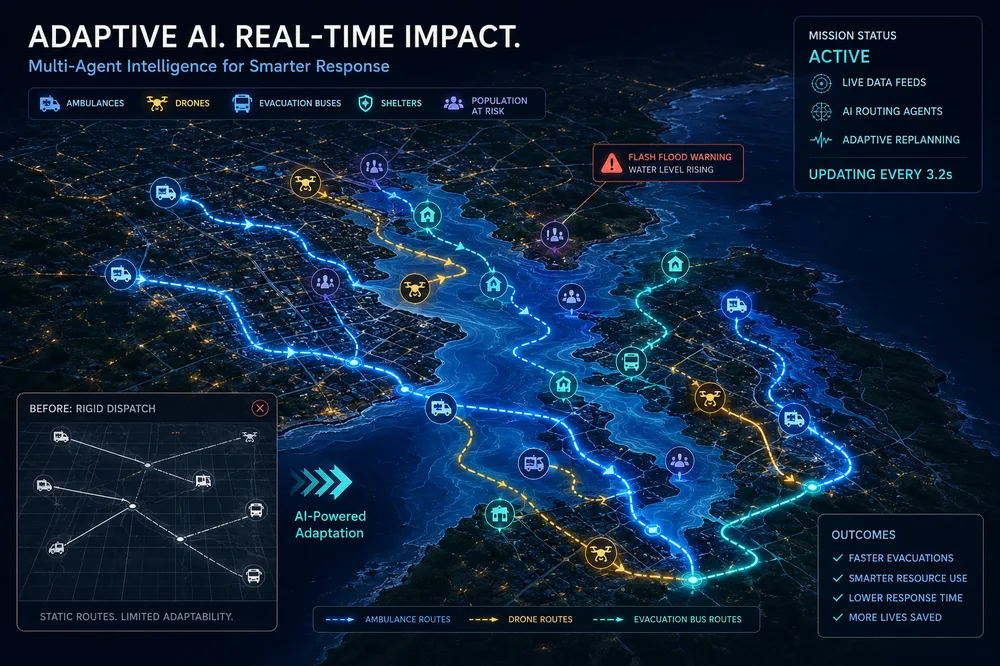
Our companion piece on autonomous maintenance decision layers covered a static optimizer: an OR-Tools-style solver that takes a snapshot of the world (which parts are available, which technicians are free, which aircraft need attention) and computes a single, provably good schedule. That works well when the problem holds still long enough to solve it. A disaster response scenario does not hold still: the flood extent changes hour to hour, road closures appear mid-evacuation, drone battery life runs out, and dozens of agents: ambulances, shelters, UAVs, relief trucks: are all making decisions simultaneously, each with only a partial view of what's happening elsewhere. Solve a mixed-integer program for that snapshot and by the time the solution is deployed, the snapshot is already stale. This is the specific, structural reason a fast-growing body of 2024–2026 research has moved from single-shot static optimization toward multi-agent reinforcement learning (MARL): systems of agents that learn coordinated policies for acting continuously under uncertainty, rather than solving the problem once and hoping the world doesn't change too much before the plan finishes executing.
2. Core Explanation
2.1 Why Static Optimization Breaks Down Specifically Here
It's worth being precise about why a MILP/OR-Tools-style solver: genuinely the right tool for many scheduling problems: runs into trouble in dynamic disaster response, rather than treating "it's more complex" as a sufficient explanation
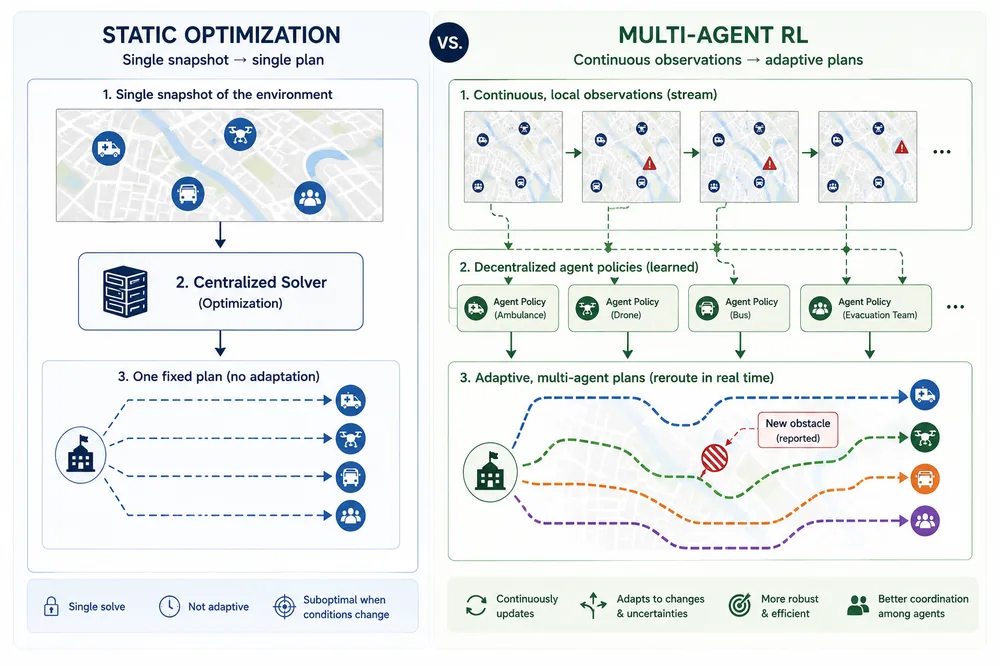
- The single-solve assumption. A static optimizer takes one snapshot of the world, computes one optimal (or near-optimal) plan, and hands it off for execution. Disaster response conditions: flood extent, road passability, casualty locations, resource depletion: change on a timescale often shorter than the time it takes to re-solve a large mixed-integer program from scratch, which forces a choice between stale plans or constant, expensive re-optimization.
- The full-information assumption. Classical optimization formulations generally assume the decision-maker has (or can be given) complete, accurate state information. Real disaster response is a partially observable problem: a flood-response drone knows what its own sensors see, not what every other agent's sensors see, and building a single global optimizer that ingests and reconciles all of that in real time is a substantial engineering problem in its own right, separate from the optimization itself.
- The single-decision-maker assumption. Even stochastic and robust optimization variants: which do explicitly model uncertainty, and are a real improvement over deterministic MILP: still typically compute one plan for one central coordinator to hand down. Real disaster response usually involves many semi-autonomous actors (multiple agencies, multiple vehicle fleets, multiple shelters) whose actions need to be coordinated without every actor waiting on a single central solver for every decision.
None of this means static and stochastic optimization are obsolete: Section 2.5 covers exactly where they remain the right tool. It means the specific combination of continuously changing conditions plus many semi-autonomous decision-makers plus partial observability is the precise gap multi-agent RL research has been built to fill.
2.2 What Multi-Agent Reinforcement Learning Actually Is
Multi-agent reinforcement learning extends the standard reinforcement learning idea: an agent learns a policy that maps observations to actions by trial and error, guided by a reward signal: to settings with multiple agents learning simultaneously, each with its own (possibly partial) view of a shared environment. The formal setting most disaster-response MARL research uses is a Decentralized Partially Observable Markov Decision Process (Dec-POMDP): multiple agents, a shared environment state that no single agent fully observes, and a joint reward that depends on everyone's combined actions.
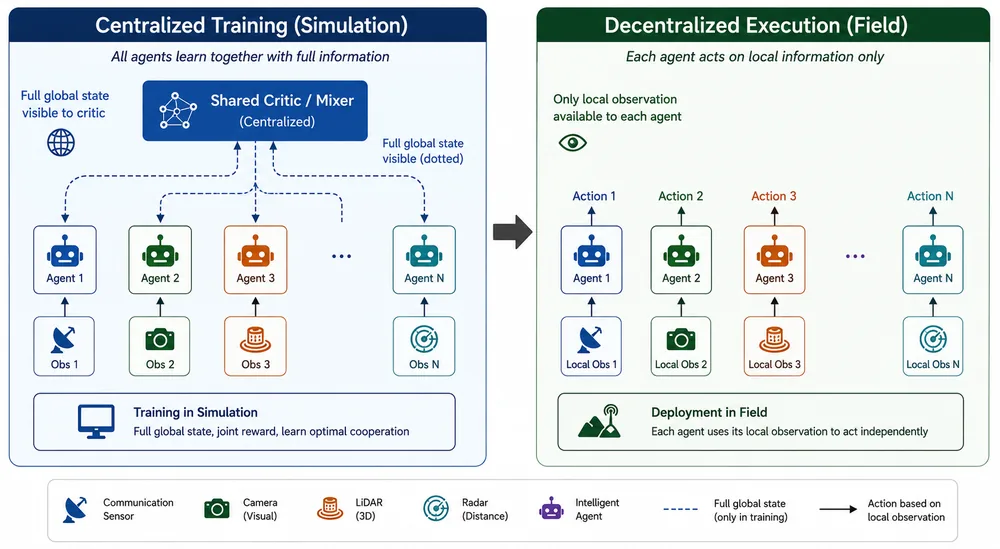
The design pattern that makes this tractable, used across nearly all the specific architectures discussed below, is Centralized Training with Decentralized Execution (CTDE): during training (in simulation, where the full global state is available), the learning algorithm can use complete information: every agent's observations, actions, and the true global state: to compute better gradient updates. Once training is complete, each agent's policy runs using only its own local observations, which is exactly what's needed operationally: a field agent making a real-time decision can't wait for a global coordinator to assemble a complete picture before acting, but it can run a policy that was trained with the benefit of that complete picture.
2.3 The Three Algorithm Families Actually Used
Disaster-response and resource-allocation MARL research converges on a small number of named algorithm families, each solving the CTDE coordination problem differently
- Value decomposition (QMIX, VDN, QPLEX) trains a joint action-value function but factors it into per-agent components during centralized training, under a mathematical constraint: the Individual-Global-Max (IGM) condition: ensuring that each agent independently maximizing its own local value also maximizes the team's joint value. QMIX in particular has become a widely used baseline for exactly this reason: it lets agents act on purely local value estimates at execution time while still being trained toward a coordinated joint objective.
- Centralized-critic actor-critic (MADDPG) gives each agent its own actor (policy) network but trains a centralized critic that can see all agents' observations and actions during training: useful specifically for continuous action spaces (e.g., a drone's exact flight vector or a pump's exact flow rate), where value-decomposition methods are less naturally suited.
- Multi-agent policy-gradient (MAPPO) extends Proximal Policy Optimization: one of the most widely used single-agent RL algorithms, valued for its training stability: into the CTDE setting, and has increasingly become a strong default choice across recent comparative studies for its combination of stability and coordination quality, though which of the three families wins tends to be genuinely task-dependent rather than universal.
| Algorithm Family | Core Mechanism | Best Suited For | Named Examples |
|---|---|---|---|
| Value decomposition | Factor a joint Q-function into per-agent components under the IGM condition | Discrete action spaces (e.g., which zone to evacuate first) | QMIX, VDN, QPLEX |
| Centralized-critic actor-critic | Per-agent actor, shared centralized critic seeing all agents during training | Continuous action spaces (e.g., exact routing/flow-rate control) | MADDPG |
| Multi-agent policy gradient | PPO extended to CTDE, generally strong training stability | General-purpose; increasingly a default baseline | MAPPO |
2.4 Where This Is Already Being Applied
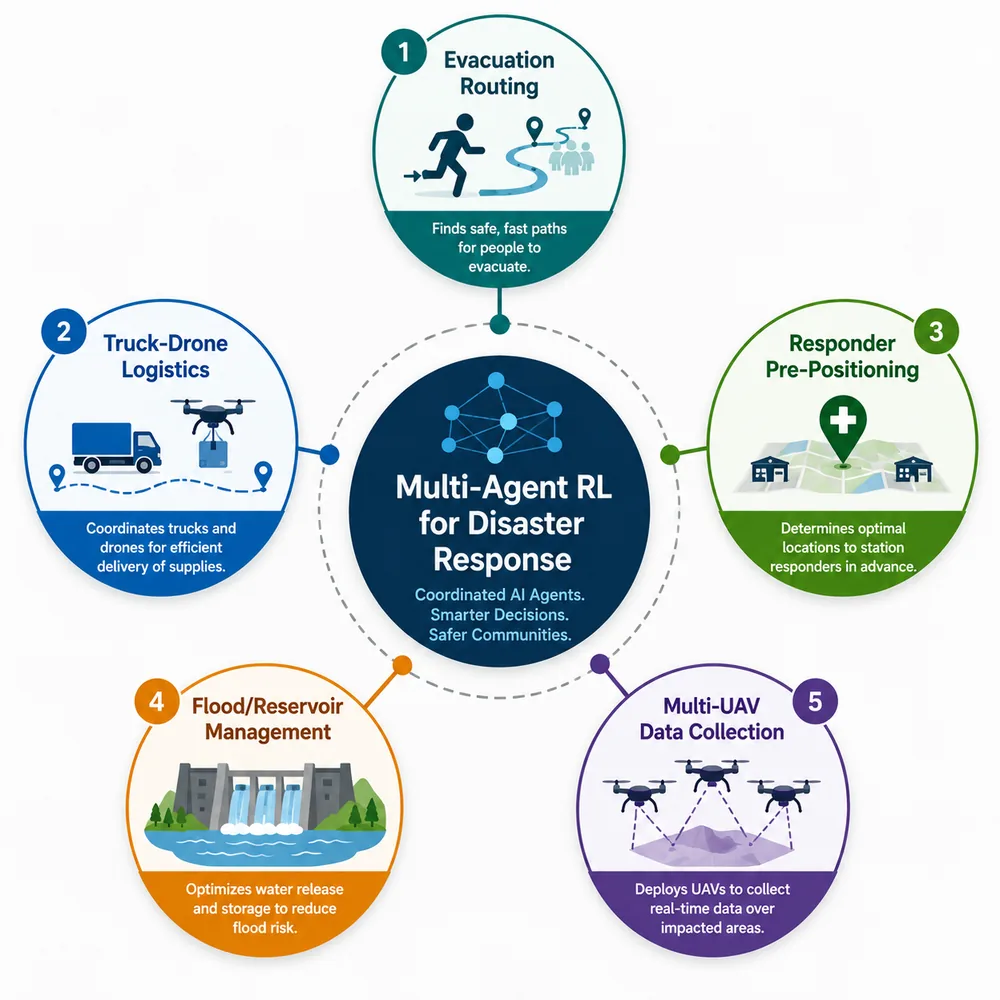
This isn't a purely theoretical research direction: a specific, fast-growing applied literature has emerged across 2024–2026 targeting exactly the disaster-response and climate-risk problems relevant to a hybrid Earth-system decision layer
- Evacuation routing. Comparative studies have found multi-agent actor-critic methods (A3C-family algorithms) outperforming single-agent Deep Q-Networks in evacuation scenarios specifically on scalability and robustness under varying conditions, and a GRU-integrated MAPPO variant (GRU-MAPPO) has been developed specifically for building-scale multi-agent evacuation, using the GRU component to help agents reason about recent history rather than react to only the current instant. Separately, researchers have combined agent-based tsunami evacuation simulation with Q-learning to generate evacuation paths, reporting meaningful improvements over traditional shortest-path routing algorithms: the classical approach most static evacuation-planning tools still rely on.
- Truck-and-drone disaster logistics under uncertainty. Recent work has applied multi-agent deep RL to coordinate trucks and drones for emergency response, explicitly modeling uncertain travel times and demand via distributionally robust optimization layered underneath the RL policy: validated on a case study built around the 2025 Myanmar M7.9 earthquake, with reported superiority over deterministic, classical stochastic, and robust-optimization-only benchmarks.
- Emergency responder stationing. Hierarchical multi-agent RL has been applied to the problem of where to pre-position emergency responders across a city before incidents occur: a genuinely different problem from post-incident routing, evaluated against real historical incident data from multiple U.S. cities.
- Flood and reservoir management. A notable 2025 architecture (MARLIN) combines multi-agent RL with large language model guidance for reservoir and flood-response management, explicitly incorporating a "murmuration intelligence" coordination pattern (inspired by starling flock behavior) alongside LLM-based reasoning: an early example of the agentic-LLM-plus-RL hybrid pattern this CoE's decision-intelligence work is also converging toward.
- Multi-UAV disaster data collection. Deep RL has been applied specifically to schedule multiple UAVs collecting disaster data under time-varying value constraints: relevant directly to any EarthMind-Agent-style system that needs to prioritize which sensing platforms to task first as a disaster unfolds.
2.5 Where Static and Stochastic Optimization Still Win
It would overstate the case to frame this as MARL simply replacing optimization outright, and the more recent comparative literature is careful not to make that claim. Static and stochastic optimization retain clear advantages in several situations directly relevant to a climate digital twin's design choices
- When the problem genuinely is closer to a single snapshot: pre-positioning inventory before a hurricane season based on historical risk, for instance: a well-specified stochastic or robust MILP can still be the more reliable, more explainable, and computationally cheaper choice.
- When solution guarantees matter more than adaptivity. A MILP solver can certify a provably optimal (or bounded-suboptimal) solution to a well-specified problem; a trained RL policy offers no such formal guarantee, and its behavior on scenarios far outside its training distribution is genuinely harder to characterize in advance: a limitation this piece's Section 2.6 covers directly.
- When training data or simulation fidelity is limited. MARL policies are only as good as the environment they were trained in; a disaster simulator that doesn't capture a region's actual road network, population distribution, or hazard dynamics accurately will produce a policy that's confidently wrong in the field: a sim-to-real gap that a classical optimizer, working directly off real input data at solve time, doesn't have in the same form.
| Dimension | Static/Stochastic Optimization | Multi-Agent RL |
|---|---|---|
| Best fit | Well-specified, slower-changing problems with a clear objective | Fast-changing, partially observable, many-decision-maker problems |
| Solution guarantee | Can be provably optimal or bounded-suboptimal | No formal guarantee; behavior is empirical |
| Adaptivity mid-execution | Requires re-solving (costly at scale) | Native: a trained policy reacts to new local observations continuously |
| Explainability | High: a solver's objective and constraints are directly inspectable | Lower by default: policy behavior is learned, not explicitly specified (see Section 2.6) |
| Data/simulation dependency | Needs accurate input data at solve time | Needs an accurate training environment, which is a harder, upfront engineering problem |
| Coordination across many agents | Requires a central solver with full problem visibility | Native via CTDE: agents act independently at execution time |
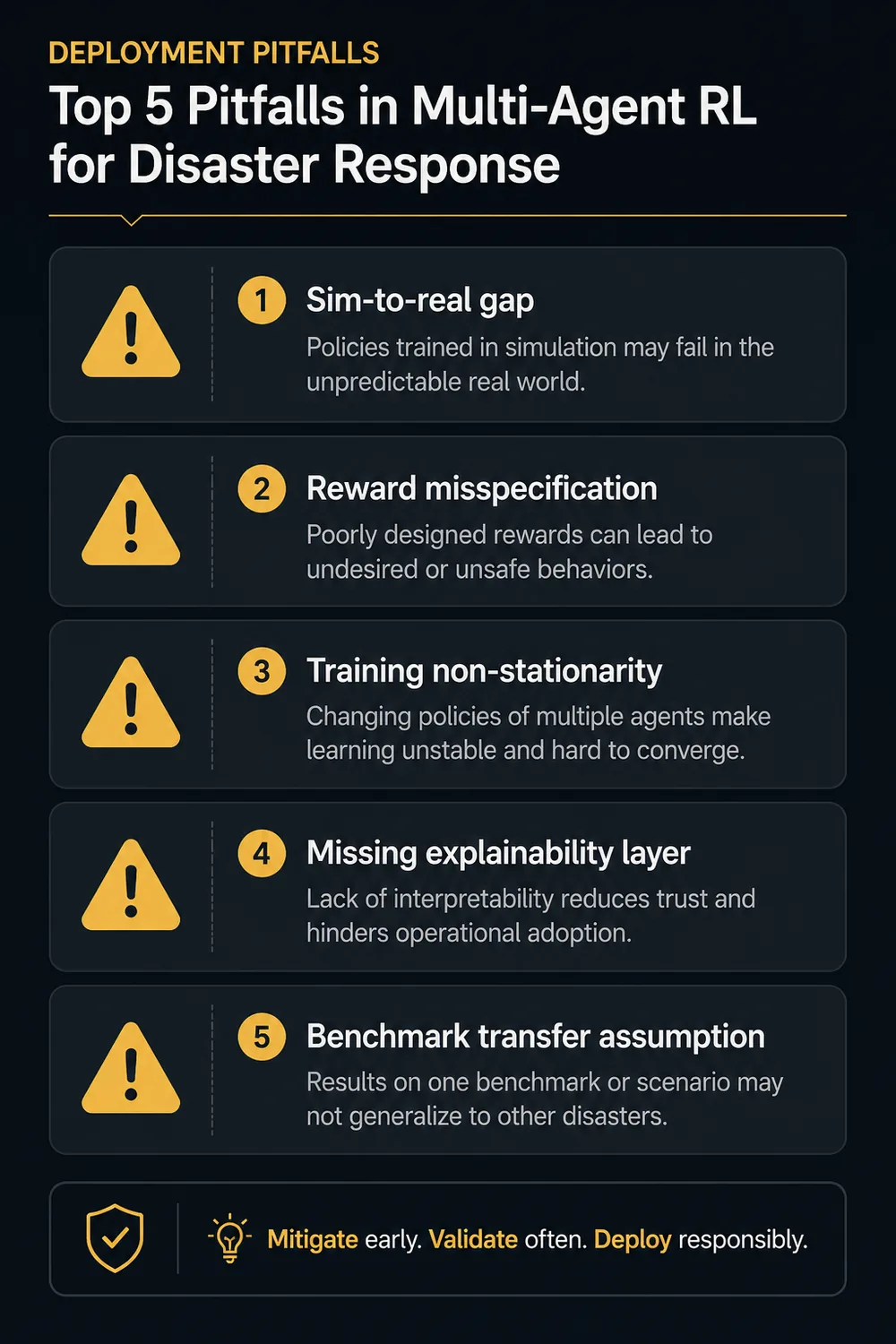
2.6 Common Pitfalls
- Treating "learns under uncertainty" as "doesn't need good simulation." A MARL policy's real-world reliability is bounded by how well its training simulator captures the actual disaster dynamics it will face: the sim-to-real gap is arguably the single biggest practical obstacle to fielding these systems, more than the algorithm choice among QMIX, MADDPG, or MAPPO.
- Underestimating the reward-design problem. In single-agent RL, reward shaping is already hard; in multi-agent settings, a poorly designed joint reward can produce agents that each individually perform well on a proxy metric while the overall team outcome is poor: a version of Goodhart's Law that shows up repeatedly in applied MARL research.
- Ignoring non-stationarity during training. Because every agent is learning and changing its policy simultaneously, each individual agent's environment is technically non-stationary: from any one agent's perspective, the "rules" keep shifting as its teammates' policies evolve, which is a well-documented source of training instability that CTDE architectures mitigate but don't eliminate.
- Deploying a trained policy without an explainability layer. Echoing this CoE's earlier piece on the actionability gap in AI-driven decisions: a MARL policy that recommends "route ambulance 3 to zone B" without a traceable justification is a harder sell to an incident commander than a MILP solution whose constraints and objective are directly inspectable: recent work explicitly pairing rule-based bottlenecks or language-model explanation layers with RL policies (echoing the MARLIN pattern above) is a direct response to this gap, not an optional add-on.
- Assuming published benchmark improvements transfer to a new domain. Every specific performance claim in Section 2.4 was measured on a specific simulated environment, city, or historical dataset; transferring an architecture that worked well for building evacuation to, say, wildfire-driven regional evacuation requires re-validating on the new domain's actual dynamics, not assuming the reported gains carry over.
3. Worked Example / Analogy
Picture the difference between an air traffic control tower that issues one complete flight plan to every aircraft at 6 a.m. based on that morning's weather forecast, versus a tower that continuously exchanges short radio updates with every pilot throughout the day, adjusting routes as thunderstorms actually develop, other aircraft actually move, and runways actually close. The 6 a.m. plan (the static optimizer) is precise, provably conflict-free at the moment it was issued, and easy to audit: but if a storm cell forms over the planned route at 11 a.m., every affected aircraft is flying a plan that's now wrong until someone notices and manually re-issues a new one. The continuous-update tower (the multi-agent RL system) never had a single, perfectly optimal master plan to point to: instead, each pilot and the tower are constantly exchanging local information and adjusting, so that by 11 a.m. the traffic has already smoothly rerouted around the storm without anyone needing to stop and recompute the whole day's plan from scratch. Neither approach is strictly better in every scenario: the 6 a.m. plan is exactly what you want for a calm, predictable Tuesday with only a handful of flights, and the continuous-update approach is what you want the moment conditions start changing faster than a human (or a solver) can keep re-planning from scratch, which is precisely the shape of the disaster-response problem this piece has been describing.
4. Application to Defense & Aerospace
For a Defense & Aerospace AI Center of Excellence, and directly relevant to the autonomous-decision-intelligence layer of a hybrid Earth-system digital twin, multi-agent RL is best understood as the natural successor architecture for exactly the coordination problems that outgrow a single, centrally-solved optimization: disaster-response logistics, multi-platform sensor tasking during an unfolding event, and dynamic resource allocation across dispersed units all share the defining structural features covered in Section 2.1: many semi-autonomous decision-makers, partial observability, and conditions that change faster than a full re-solve can keep up with. The CTDE paradigm specifically maps well onto military and disaster-response command structures already in use, where a centralized planning function has more complete information than any single field unit, but field units still need to act on local information without waiting on constant central coordination: which is precisely the split CTDE was designed around. Section 2.5 and 2.6's caveats deserve equal weight in this context, though: a MARL policy trained on an imperfect simulation of a specific theater or region carries real risk if fielded without extensive validation, and any deployed system should pair its RL-driven recommendations with an explainability layer that lets a human commander understand why a given allocation was recommended, not just accept it on trust: directly consistent with this CoE's broader position, developed in our explainable AI series, that a prediction or recommendation is not the same thing as an actionable, accountable decision.
5. Quick-Reference Glossary
| Term | Meaning |
|---|---|
| Multi-agent reinforcement learning (MARL) | Reinforcement learning extended to settings with multiple simultaneously learning agents sharing an environment |
| Dec-POMDP | Decentralized Partially Observable Markov Decision Process: the formal model most disaster-response MARL research uses: multiple agents, a shared but only partially observed state, and a joint reward |
| Centralized Training, Decentralized Execution (CTDE) | The dominant MARL design pattern: full information is used during training in simulation, but each agent acts on only its own local observations at deployment |
| QMIX / VDN / QPLEX | Value-decomposition MARL algorithms that factor a joint action-value function into per-agent components under the Individual-Global-Max (IGM) condition |
| MADDPG | Multi-Agent Deep Deterministic Policy Gradient: a centralized-critic actor-critic method suited to continuous action spaces |
| MAPPO | Multi-Agent Proximal Policy Optimization: a CTDE extension of the widely used single-agent PPO algorithm |
| Sim-to-real gap | The performance drop that occurs when a policy trained in simulation is deployed in the real world, driven by inaccuracies in the training environment |
| Non-stationarity (in MARL) | The fact that, from any one agent's perspective, the environment appears to keep changing because other agents are simultaneously learning and updating their own policies |
Keep Reading
Related Articles
Aerospace & Defence AI
IBM–NASA Prithvi: The Open Foundation Model Transforming Earth Observation
Discover how IBM and NASA's Prithvi foundation model family is reshaping Earth observation with open-source geospatial AI. Learn about Prithvi-EO, Pri
How GPS/GNSS Spoofing and Jamming Actually Work: A Practical Primer
GPS and other GNSS systems rely on extremely weak satellite signals, making them vulnerable to jamming and spoofing attacks. This practical primer exp
Kinetic vs. Directed Energy: Inside the AI Deciding How to Defeat a Drone Swarm
Once a hostile drone is confirmed, someone: or something: has to decide how to stop it. This article compares kinetic interceptors, high-energy lasers