 Fireblaze
 Learning Guides
Data Science vs Big Data vs Data Analytics: What's the Difference
Quick answer: Understand the difference between Data Science, Big Data and Data Analytics as fields, what each actually involves, and which career path might suit you.
Why These Terms Get Confused
Data Science, Big Data and Data Analytics are often used loosely and interchangeably in job postings and casual conversation, but they refer to genuinely different, if overlapping, areas of work.
Data Analytics
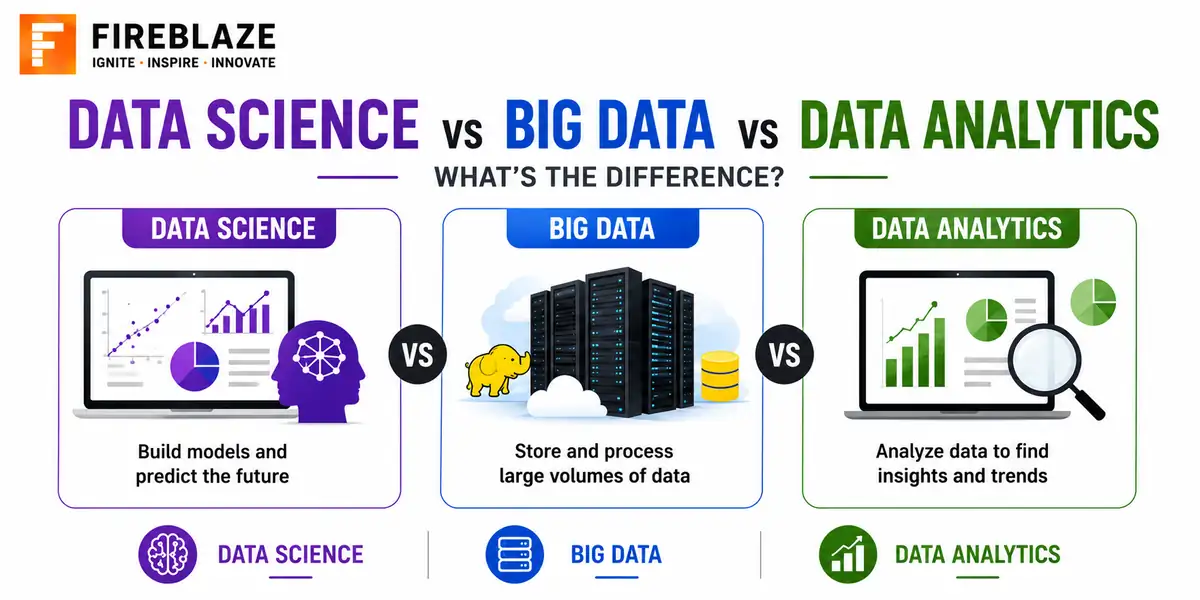
Data Analytics focuses on examining existing data to answer specific questions and inform decisions, typically using SQL, Excel, Power BI or Tableau, and statistical analysis. It usually looks backward and to the present: what happened, and why.
Data Science
Data Science is a broader field that includes analytics but extends into building predictive models using Machine Learning, working with more varied and often unstructured data, and typically requires stronger programming and statistical modelling skills. It looks forward as well as backward: what is likely to happen next.
Big Data
Big Data refers to the technology and infrastructure for storing, processing and managing datasets too large or fast-moving for traditional single-machine tools to handle efficiently, commonly described through the "3 Vs": Volume, Velocity and Variety. Big Data is more about the infrastructure and engineering, using tools like Hadoop and Spark, than the analysis itself.
How the Three Fields Relate
Big Data provides the infrastructure and pipelines that make very large-scale data available. Data Analytics and Data Science are the disciplines that then extract insight and build models from that data, whether it sits on a single laptop or a massive distributed cluster.
| Field | Core focus | Common tools |
|---|---|---|
| Data Analytics | Answering specific business questions from existing data | SQL, Excel, Power BI, Tableau |
| Data Science | Building predictive models and extracting deeper patterns | Python, R, Scikit-Learn, statistics |
| Big Data | Storing and processing very large or fast-moving data | Hadoop, Spark, distributed databases |
Which Path Might Suit You
If you enjoy answering concrete business questions with clear, immediate impact, Data Analytics is a natural entry point with strong demand. If you enjoy building predictive models and are comfortable with programming and statistics, Data Science is the deeper technical path. If you are drawn to distributed systems and infrastructure engineering rather than analysis itself, Big Data engineering roles are worth exploring.
Overlap in Practice
In practice, many roles blend elements of all three, and job titles do not always use these terms precisely. What matters more than the title is understanding the actual day-to-day responsibilities described in a specific job posting.
Common Interview Questions
What is the key difference between Data Analytics and Data Science?
Data Analytics focuses on answering specific questions from existing data, often looking backward at what happened. Data Science extends into building predictive models using Machine Learning, often looking forward at what is likely to happen next.
Is Big Data the same field as Data Science?
No. Big Data refers to the technology and infrastructure for handling very large or fast-moving datasets. Data Science is the analytical discipline that can be applied to data of any size, including data that fits easily on a single machine.
FAQ
Frequently Asked Questions
What is the difference between Data Analytics and Data Science?
Data Analytics focuses on answering specific business questions from existing data. Data Science extends into building predictive models using Machine Learning and typically requires stronger programming skills.
Is Big Data a subset of Data Science?
Not exactly. Big Data refers to the infrastructure and technology for handling very large or fast-moving datasets, while Data Science is the analytical discipline applied to data of any size.
Which field should a beginner start with: Data Analytics or Data Science?
Data Analytics is generally a more accessible entry point, using tools like SQL and Excel, and many analysts later progress into Data Science as they build programming and statistical modelling skills.
What are the '3 Vs' of Big Data?
Volume (the amount of data), Velocity (the speed at which it is generated) and Variety (the range of data types and formats).
Keep Reading
Related Articles
Learning Guides
INNER JOIN in SQL with Examples: Complete Beginner's Guide
Learn INNER JOIN in SQL with practical examples, syntax, interview questions, and real-world use cases. A complete beginner-friendly SQL JOI
Learning Guides
OUTER JOIN in SQL: Complete Guide with Examples for Beginners
Master OUTER JOIN in SQL with practical examples and real-world scenarios. Learn LEFT JOIN, RIGHT JOIN, FULL OUTER JOIN, syntax, use cases,
Learning Guides
Multi-Row Functions in SQL: Complete Guide with Examples
Learn multi-row (aggregate) functions in SQL including SUM, AVG, COUNT, MIN, MAX, GROUP BY and HAVING, with practical examples, NULL handlin