 Fireblaze
 Learning Guides
Chi-Square Test vs ANOVA: When to Use Each
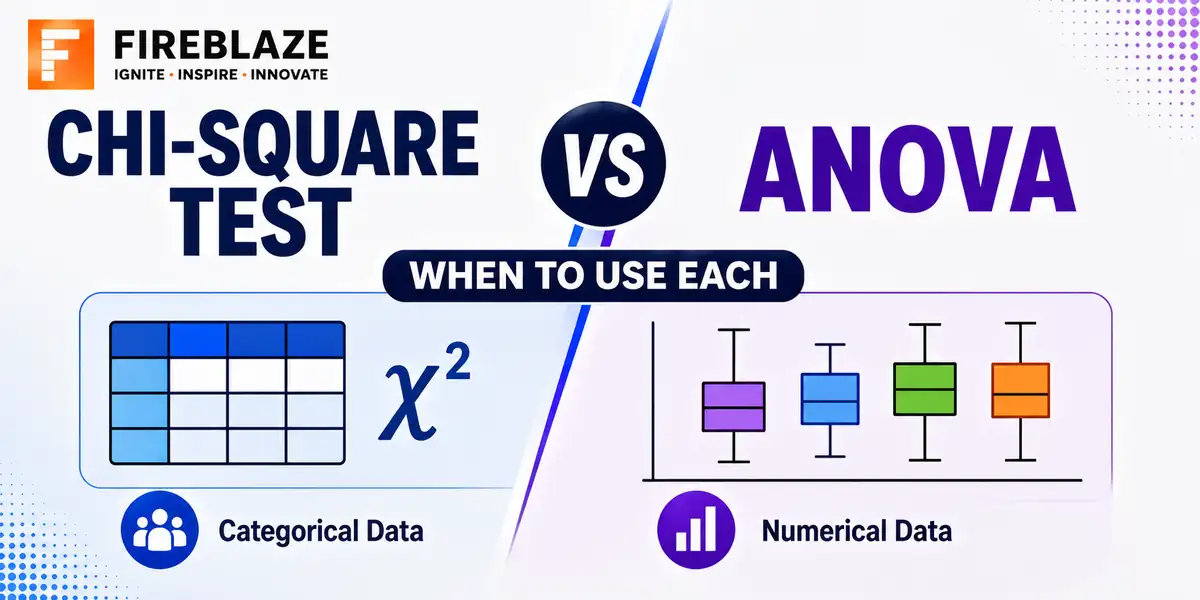
Quick answer: Learn the Chi-Square test for categorical data, how it differs from ANOVA, and when to use each statistical test, with Python examples.
Chi-Square and ANOVA Solve Different Problems
Both are hypothesis tests, but they apply to fundamentally different types of data. Chi-Square tests relationships between categorical variables. ANOVA compares the means of a continuous variable across three or more groups.
What is the Chi-Square Test?
The Chi-Square test checks whether there is a statistically significant association between two categorical variables, by comparing observed frequencies in a contingency table against the frequencies you would expect if the variables were genuinely independent.
import pandas as pd
from scipy.stats import chi2_contingency

data = pd.DataFrame({
    'Program':  ['PGP', 'PGP', 'FullStack', 'FullStack'],
    'Placed':   ['Yes', 'No', 'Yes', 'No'],
    'Count':    [45, 5, 38, 12]
})

contingency_table = data.pivot_table(index='Program', columns='Placed', values='Count')
chi2, p_value, dof, expected = chi2_contingency(contingency_table)

print(f"Chi-square: {chi2:.2f}, p-value: {p_value:.4f}")
A low p-value here would suggest program choice and placement outcome are genuinely associated, rather than independent of each other.
A Quick Reminder: What ANOVA Tests
from scipy import stats

pgp_scores = [78, 82, 85, 90, 76]
fullstack_scores = [65, 70, 72, 68, 74]
analytics_scores = [88, 91, 85, 93, 89]

f_stat, p_value = stats.f_oneway(pgp_scores, fullstack_scores, analytics_scores)
Key Differences
| Chi-Square | ANOVA |
|---|---|
| Tests association between categorical variables | Tests whether means of a continuous variable differ across groups |
| Uses a contingency table of frequencies | Uses actual numeric values within each group |
| Test statistic: Chi-square | Test statistic: F-statistic |
Choosing the Right Test: A Simple Rule
Ask what type your outcome variable is. If it is categorical, such as pass or fail, use Chi-Square. If it is continuous, such as an exam score, and you are comparing across three or more groups, use ANOVA. If comparing exactly two groups on a continuous outcome, use a t-test instead.
A Second Use of Chi-Square: Goodness of Fit
Beyond testing association between two categorical variables, Chi-Square can also test whether a single categorical variable's observed distribution matches an expected distribution, such as checking whether website traffic is evenly split across four regions as expected.
Common Interview Questions
How do you decide between Chi-Square and ANOVA for a given problem?
Look at the outcome variable's type. Chi-Square applies when both variables of interest are categorical. ANOVA applies when the outcome is continuous and you are comparing means across three or more groups.
What does a significant Chi-Square result actually mean?
It means the two categorical variables are unlikely to be independent, suggesting a genuine association exists between them, though it does not by itself indicate the strength or direction of that association.
FAQ
Frequently Asked Questions
What is the difference between Chi-Square and ANOVA?
Chi-Square tests whether an association exists between two categorical variables. ANOVA tests whether the mean of a continuous variable differs across three or more groups.
When would you use a Chi-Square test?
When both variables of interest are categorical, such as testing whether program choice is associated with placement outcome.
Can Chi-Square be used with a continuous variable?
Not directly. A continuous variable typically needs to be binned into categories first if you want to test its association with another categorical variable using Chi-Square.
What does a significant Chi-Square result mean?
It suggests the two categorical variables are unlikely to be independent, indicating a genuine association, though not the strength or direction of that association.
Keep Reading
Related Articles
Learning Guides
INNER JOIN in SQL with Examples: Complete Beginner's Guide
Learn INNER JOIN in SQL with practical examples, syntax, interview questions, and real-world use cases. A complete beginner-friendly SQL JOI
Learning Guides
OUTER JOIN in SQL: Complete Guide with Examples for Beginners
Master OUTER JOIN in SQL with practical examples and real-world scenarios. Learn LEFT JOIN, RIGHT JOIN, FULL OUTER JOIN, syntax, use cases,
Learning Guides
Multi-Row Functions in SQL: Complete Guide with Examples
Learn multi-row (aggregate) functions in SQL including SUM, AVG, COUNT, MIN, MAX, GROUP BY and HAVING, with practical examples, NULL handlin