 Fireblaze
 Learning Guides
A Beginner's Guide to Learning Power BI
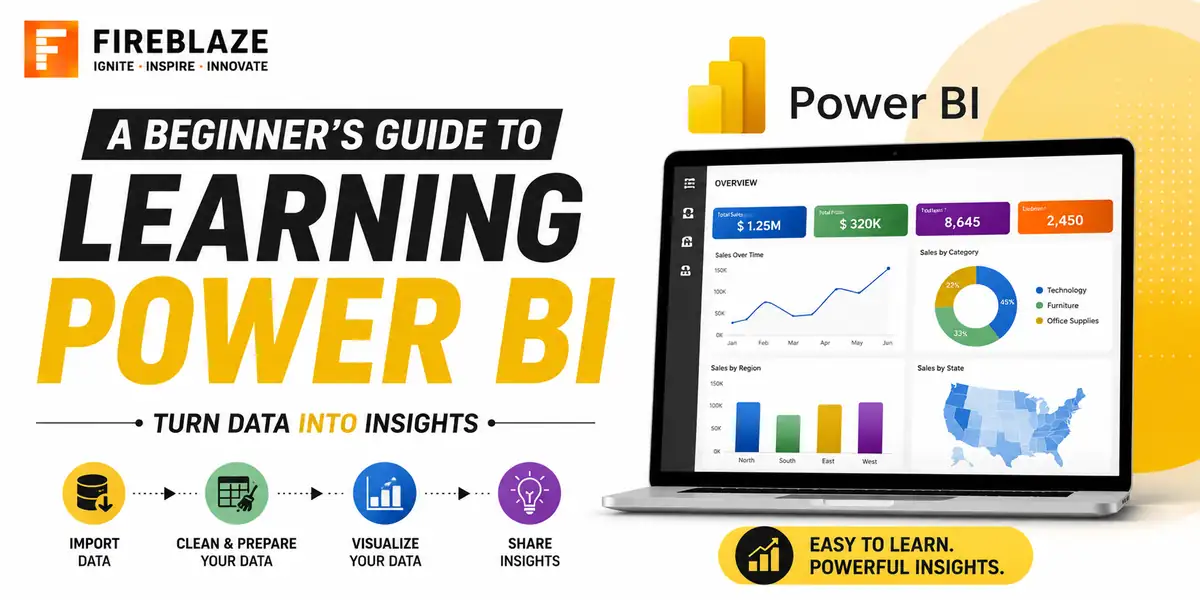
Quick answer: A beginner-friendly roadmap to learning Power BI, covering data import, Power Query, DAX formulas, visualisations, and how to structure your learning.
What is Power BI?
Power BI is Microsoft's business intelligence and data visualisation tool, used to connect to data sources, transform and model data, and build interactive reports and dashboards.
The Core Components of Power BI
| Component | Purpose |
|---|---|
| Power Query | Importing and cleaning data before analysis |
| Data Model | Defining relationships between different tables |
| DAX | Writing formulas for calculated columns and measures |
| Report View | Building the actual visual dashboards |
Step 1: Connecting to Data
Power BI can connect to a wide range of sources, including Excel files, SQL databases, and cloud services, through Get Data in the Home ribbon.
Step 2: Cleaning Data with Power Query
Power Query provides a visual interface for cleaning data before it reaches your report, including removing duplicate rows, splitting columns, changing data types, and filtering out unwanted rows, without writing code.
Step 3: Building the Data Model
When working with multiple tables, defining relationships between them, such as linking a Sales table to a Products table through a shared product ID, is essential for accurate cross-table analysis.
Step 4: Learning DAX Basics
Total Sales = SUM(Sales[Amount])

Sales Last Year = CALCULATE(
    SUM(Sales[Amount]),
    SAMEPERIODLASTYEAR(Calendar[Date])
)
DAX, short for Data Analysis Expressions, is Power BI's formula language for creating calculated columns and measures. Start with simple aggregations like SUM and AVERAGE before moving to more advanced time intelligence functions.
Step 5: Building Visualisations
Drag fields onto the report canvas to build charts, tables and cards, then add slicers to let report viewers filter the data interactively themselves.
Step 6: Publishing and Sharing
Reports can be published to the Power BI Service, Microsoft's cloud platform, for sharing with colleagues, scheduling automatic data refreshes, and building organisation-wide dashboards.
A Realistic Learning Path
Learn to import and clean data with Power Query
Build simple visuals: bar charts, line charts, tables
Learn basic DAX: SUM, AVERAGE, COUNT, simple CALCULATE expressions
Learn data modelling and relationships between tables
Progress to more advanced DAX, particularly time intelligence functions
Practise building a complete dashboard from a real, messy dataset end to end
Common Interview Questions
What is DAX used for in Power BI?
DAX, Data Analysis Expressions, is Power BI's formula language, used to create calculated columns and measures that go beyond simply visualising raw data.
What is Power Query used for?
It provides a visual, code-free interface for importing and cleaning data before it reaches your report, including tasks like removing duplicates and changing data types.
FAQ
Frequently Asked Questions
What is Power BI used for?
It is Microsoft's business intelligence tool, used to connect to data sources, clean and model data, and build interactive reports and dashboards.
What is DAX in Power BI?
Data Analysis Expressions, Power BI's formula language for creating calculated columns and measures beyond what raw data alone can show.
What should a beginner learn first in Power BI?
Start with importing and cleaning data using Power Query, then build simple visuals, before progressing to DAX formulas and data modelling with relationships between tables.
Is coding required to learn Power BI?
Basic use, including data cleaning with Power Query and building visuals, requires no coding. DAX formulas are needed for more advanced calculations, which is a formula language rather than general-purpose coding.
Keep Reading
Related Articles
Learning Guides
INNER JOIN in SQL with Examples: Complete Beginner's Guide
Learn INNER JOIN in SQL with practical examples, syntax, interview questions, and real-world use cases. A complete beginner-friendly SQL JOI
Learning Guides
OUTER JOIN in SQL: Complete Guide with Examples for Beginners
Master OUTER JOIN in SQL with practical examples and real-world scenarios. Learn LEFT JOIN, RIGHT JOIN, FULL OUTER JOIN, syntax, use cases,
Learning Guides
Multi-Row Functions in SQL: Complete Guide with Examples
Learn multi-row (aggregate) functions in SQL including SUM, AVG, COUNT, MIN, MAX, GROUP BY and HAVING, with practical examples, NULL handlin