 Fireblaze
 Learning Guides
Autoencoders in Deep Learning Explained
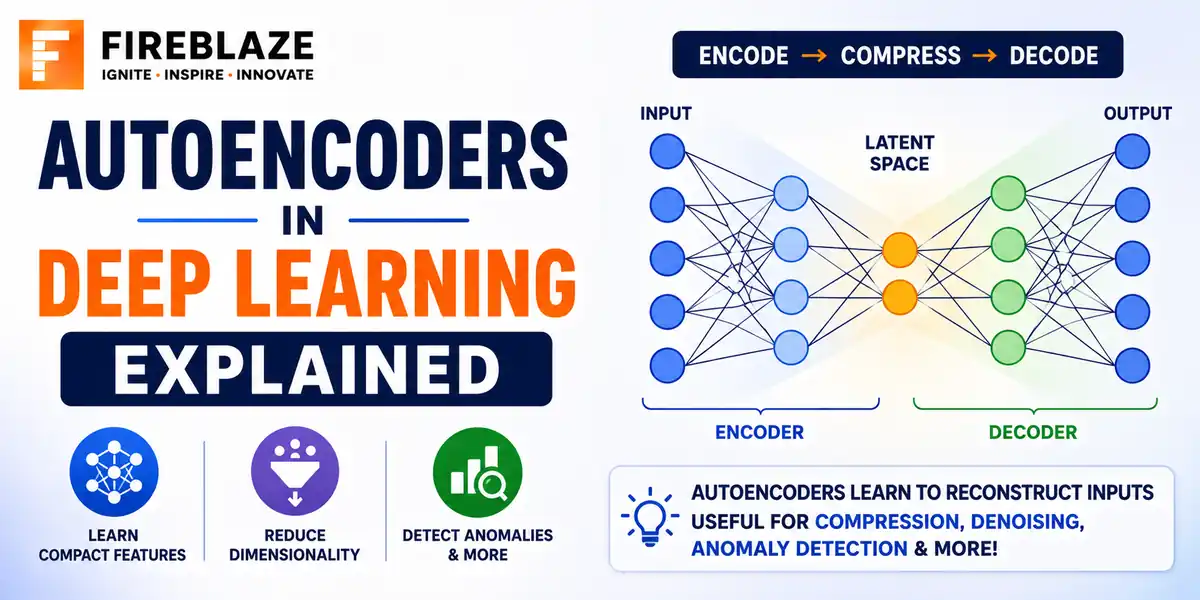
Quick answer: Learn what autoencoders are, how the encoder-decoder architecture works, their use in dimensionality reduction and anomaly detection, with a simple example.
What is an Autoencoder?
An autoencoder is a type of neural network trained to reconstruct its own input, forcing it to learn a compressed, meaningful representation of the data in the process. It is a form of unsupervised learning, since it needs no labels beyond the input data itself.
The Encoder-Decoder Architecture
An autoencoder has two parts. The encoder compresses the input into a smaller representation, called the latent space or bottleneck. The decoder then reconstructs the original input from that compressed representation.
Input -> Encoder -> Compressed representation (bottleneck) -> Decoder -> Reconstructed output
A Simple Autoencoder in Keras
from tensorflow import keras
from tensorflow.keras import layers

input_dim = 784   # e.g. a flattened 28x28 image
encoding_dim = 32  # compressed representation size

input_layer = keras.Input(shape=(input_dim,))
encoded = layers.Dense(encoding_dim, activation='relu')(input_layer)
decoded = layers.Dense(input_dim, activation='sigmoid')(encoded)

autoencoder = keras.Model(input_layer, decoded)
autoencoder.compile(optimizer='adam', loss='binary_crossentropy')
autoencoder.fit(X_train, X_train, epochs=20, batch_size=256)
Notice that the model is trained with X_train as both the input AND the target, since the whole point is reconstructing the input itself.
Why the Bottleneck Forces Useful Learning
Because the compressed representation has far fewer dimensions than the original input, the network cannot simply copy the input through unchanged. It is forced to learn which features are genuinely most important for reconstruction, discarding redundant or less informative details.
Use Case: Dimensionality Reduction
The trained encoder alone can compress high-dimensional data into a much smaller, dense representation, similar in spirit to PCA but capable of learning non-linear relationships that PCA cannot capture.
Use Case: Anomaly Detection
An autoencoder trained only on normal data learns to reconstruct normal patterns well. When it encounters an anomalous input, reconstruction error tends to be much higher, since the model never learned to compress that unusual pattern effectively. This makes autoencoders useful for fraud detection and equipment failure detection.
reconstructions = autoencoder.predict(X_test)
reconstruction_error = np.mean(np.square(X_test - reconstructions), axis=1)

threshold = np.percentile(reconstruction_error, 95)
anomalies = X_test[reconstruction_error > threshold]
Use Case: Denoising
A denoising autoencoder is deliberately trained on noisy input paired with a clean target output, teaching it to remove noise, useful for cleaning up corrupted images or sensor data.
Common Interview Questions
How does an autoencoder learn without labelled data?
It uses the input data itself as the target, training the network to reconstruct its own input, which counts as a form of self-supervision rather than requiring separate labels.
Why can autoencoders be used for anomaly detection?
An autoencoder trained only on normal data reconstructs normal patterns well but struggles with anomalous ones it never learned to compress, so an unusually high reconstruction error signals a likely anomaly.
FAQ
Frequently Asked Questions
What is an autoencoder in deep learning?
A neural network trained to reconstruct its own input, forcing it to learn a compressed, meaningful representation of the data through an encoder-decoder architecture.
How is an autoencoder trained without labelled data?
The input data itself serves as the target output, so the network learns to reconstruct its input, which is a form of unsupervised or self-supervised learning.
How are autoencoders used for anomaly detection?
An autoencoder trained only on normal data reconstructs normal patterns well but poorly reconstructs anomalies, so an unusually high reconstruction error signals a likely anomaly.
What is the bottleneck in an autoencoder?
The compressed, lower-dimensional representation between the encoder and decoder, which forces the network to learn only the most important features of the data.
Keep Reading
Related Articles
Learning Guides
INNER JOIN in SQL with Examples: Complete Beginner's Guide
Learn INNER JOIN in SQL with practical examples, syntax, interview questions, and real-world use cases. A complete beginner-friendly SQL JOI
Learning Guides
OUTER JOIN in SQL: Complete Guide with Examples for Beginners
Master OUTER JOIN in SQL with practical examples and real-world scenarios. Learn LEFT JOIN, RIGHT JOIN, FULL OUTER JOIN, syntax, use cases,
Learning Guides
Multi-Row Functions in SQL: Complete Guide with Examples
Learn multi-row (aggregate) functions in SQL including SUM, AVG, COUNT, MIN, MAX, GROUP BY and HAVING, with practical examples, NULL handlin