 Fireblaze
 Aerospace & Defence AI
The $433M-to-$1.1B Market: Why the Pentagon Is Racing to Fund Counter-Drone AI
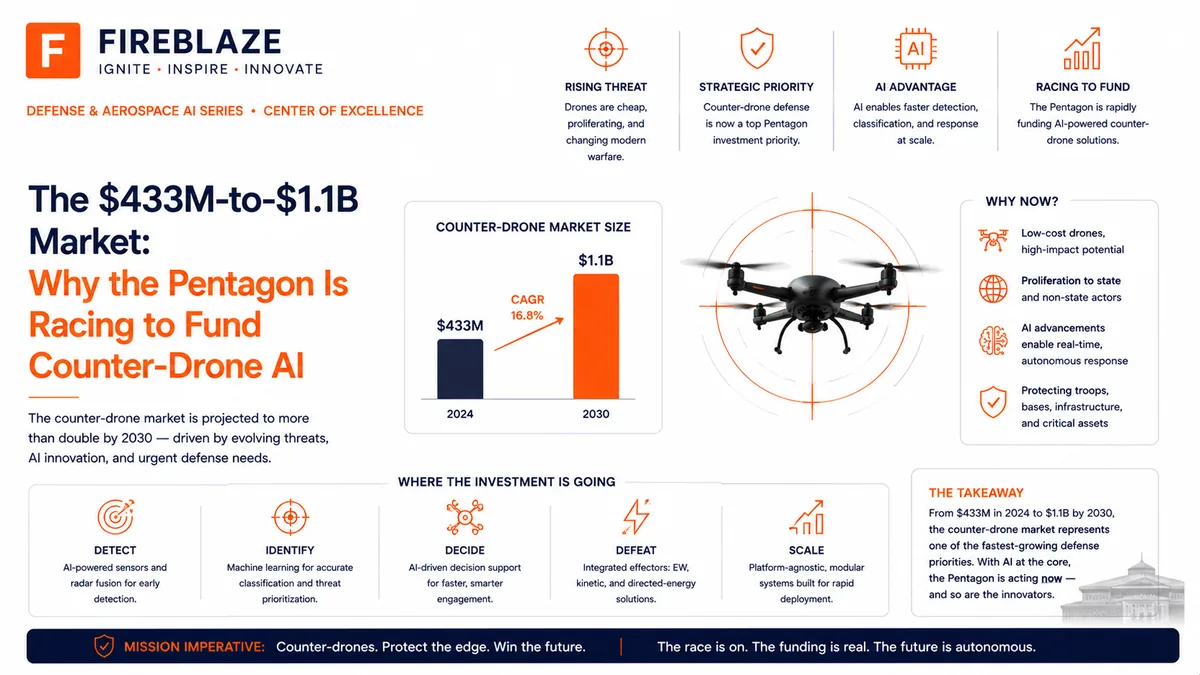
The Number That Explains Everything
The U.S. counter-UAS market is forecast to grow from roughly $433 million in 2025 to $1.1 billion by 2035. Zoom out globally, and the picture is even steeper: the worldwide counter-drone market is projected to climb from about $4 billion in 2026 to more than $20 billion by the early 2030s: a compound annual growth rate north of 25%. Behind those numbers is a simple, uncomfortable fact driving nearly every defense budget conversation in 2026: cheap drones have become one of the most dangerous, hardest-to-stop threats on the modern battlefield, and almost nobody was fully ready for it.
Why the Money Is Moving So Fast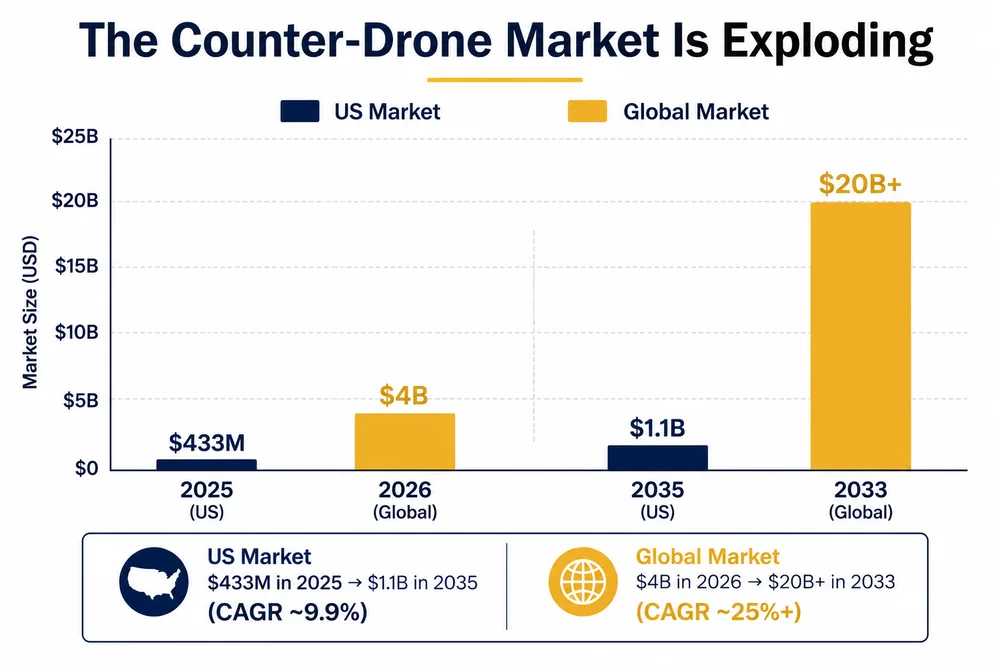
This isn't a slow, steady defense-budget increase: it's a scramble. Three forces are converging at once:
1. The threat scaled faster than the defense. A drone that costs a few hundred dollars can force a defender to spend a $2 million interceptor missile to stop it. That math doesn't just favor the attacker: it makes traditional air defense financially unsustainable the moment an adversary sends dozens of drones at once, a tactic already proven in Ukraine and in Houthi attacks on shipping in the Red Sea.
2. The FY27 defense budget reflects the shift. The U.S. Department of War's FY27 budget allocates $54.6 billion toward the broader "DAWG" (Drone and Autonomous Warfare Group) category: a figure that is reshaping procurement scale across every counter-UAS vendor in the market.
3. No single technology solves the problem alone. The market isn't consolidating around one winning approach: it's splitting into four distinct technology categories, each addressing a different part of the threat:
| Technology Category | What It Does | Example Vendors |
|---|---|---|
| RF Detection & Jamming | Detects and jams a drone's radio control signal | DroneShield, D-Fend Solutions |
| Radar-Based Detection | Covers medium/high-altitude threats RF can't reliably see | Fortem Technologies, Hidden Level |
| Electro-Optical / Infrared | Visual identification and engagement authorization | Teledyne FLIR, L3Harris |
| Kinetic & Directed Energy | Physically or electronically disables the drone | Epirus, Anduril, CHAOS Industries |
Follow the Contracts, Not the Headlines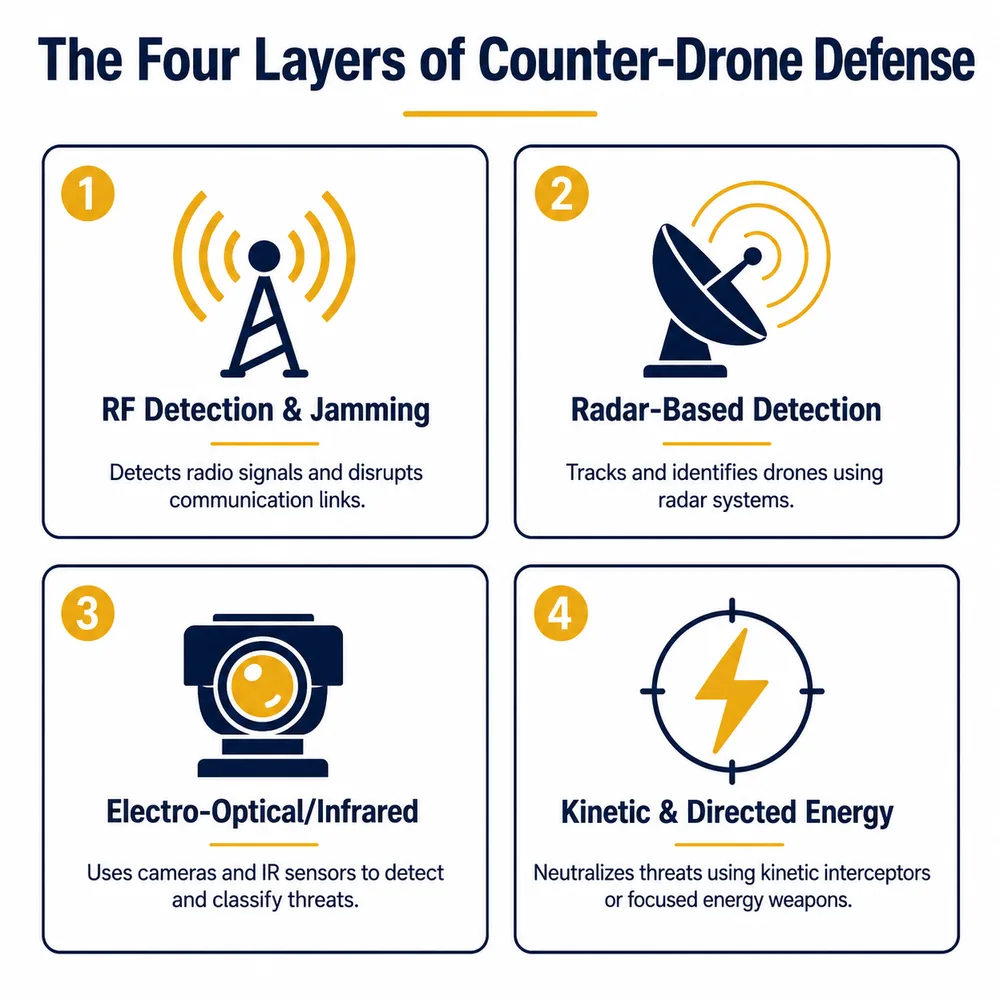
The clearest evidence of urgency isn't in press releases: it's in how fast contract values are climbing:
- DroneShield received a $24.9 million contract in June 2026 from the Department of War's Joint Interagency Task Force 401 (JIATF-401) for mobile and fixed-site counter-drone systems
- Anduril signed a $20 billion, 10-year Army enterprise contract in March 2026, with counter-UAS operations as an explicit early focus area
- Epirus has accumulated over $120 million in Army contracts since 2023 for its Leonidas directed-energy system
- The Missile Defense Agency's SHIELD contract vehicle carries a program ceiling of $151 billion, with over 2,300 companies awarded competitive-range positions across three tranches
The Regional Picture
North America and the Middle East are currently the two fastest-moving procurement markets. The Middle East and Africa counter-drone market alone is forecast to grow at roughly 27.7% CAGR through 2030, with Gulf states like the UAE and Saudi Arabia near 28.5%: driven by programs like Saudi Arabia's Red Sands integrated experimentation effort and a proposed $2 billion sale of Anduril's Roadrunner and Anvil interceptor systems to Kuwait.
Why This Matters Beyond the Dollar Figures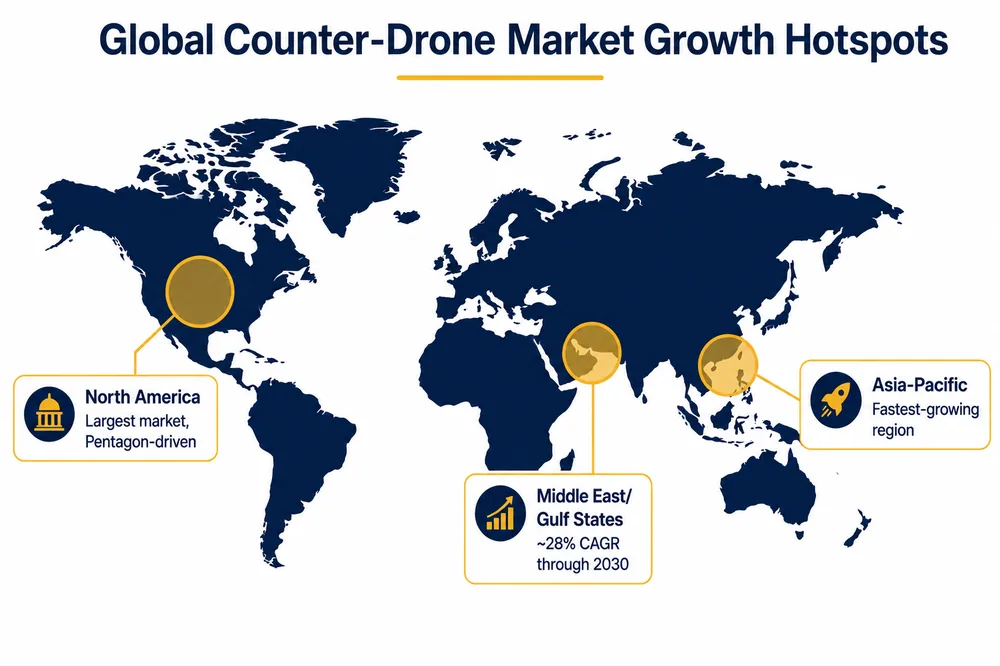
Market-size numbers are easy to skim past, but the underlying signal is significant: counter-drone defense has moved from a niche procurement category to one of the fastest-growing segments in all of defense technology, and it's happening because the threat itself proved impossible to ignore: not because of a slow-moving five-year modernization plan. Every dollar figure in this piece reflects urgency, not routine budgeting.
Sources
The Business Research Company (Counter-Drone Systems Market Report); Drone Intelligence (US Counter-UAS Market Forecast, Counter-Drone Middle East Forecast, Counter-Drone Companies directory); Coherent Market Insights (Counter Drone Market Size Report); MarketsandMarkets (Global C-UAS market projections). Market-size figures vary across research firms and are presented as directional estimates, consistent with sourcing conventions elsewhere in this series.
Keep Reading
Related Articles
Aerospace & Defence AI
The Neural Data Assimilation Shift: Why AI Emulators Are Replacing Decades-Old 4D-Var Systems
Explore how neural data assimilation is transforming weather forecasting by replacing compute-intensive 4D-Var systems with AI models like NVIDIA's HealDA. Lear
Conformal Prediction for Climate Risk: Statistically-Guaranteed Confidence Without Bayesian Assumptions
Discover how conformal prediction adds statistically guaranteed uncertainty estimates to climate AI models. Learn how distribution-free prediction intervals, co
Underwater Acoustic Target Recognition Explained: From Spectrograms to Classification
Underwater Acoustic Target Recognition (UATR) is the machine learning problem of turning a raw hydrophone recording into an answer: whale, trawler, or submarine