 Fireblaze
 Learning Guides
Text-to-Speech Conversion Using NLP: Complete Guide
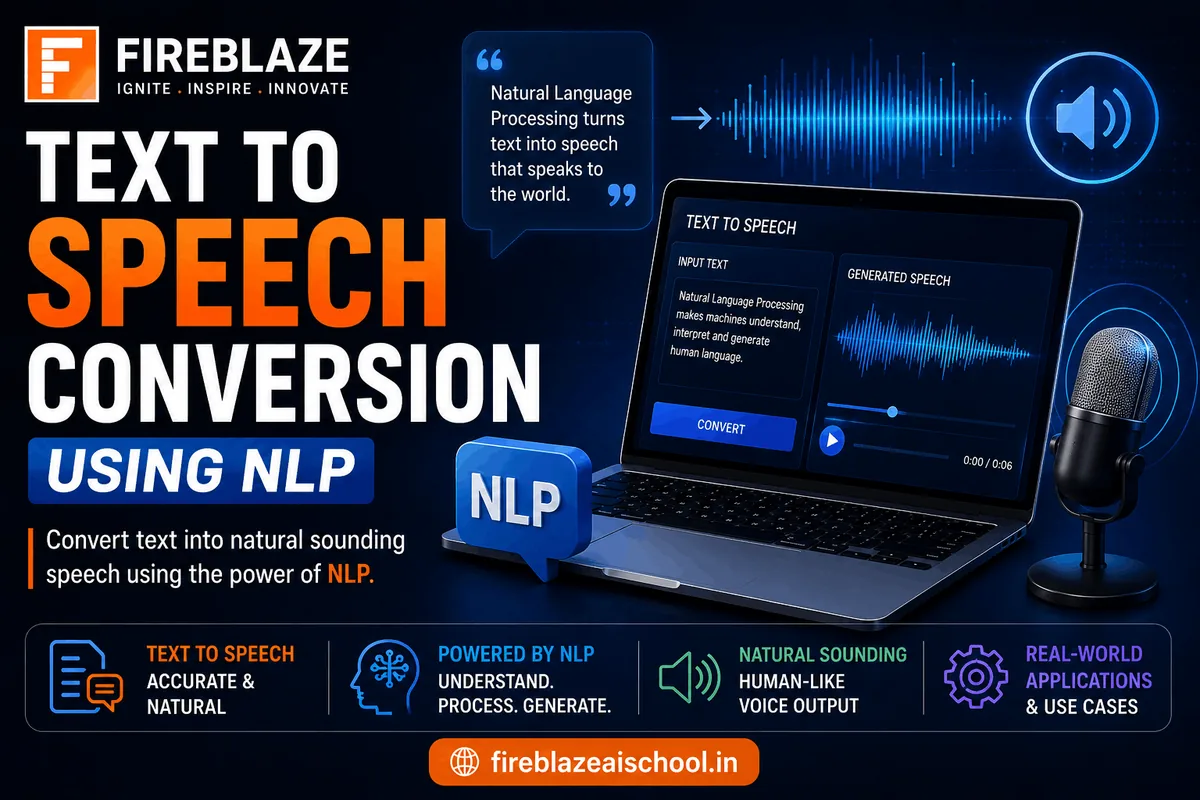
Text-to-Speech (TTS) technology has become an essential part of modern Artificial Intelligence systems. From virtual assistants and navigation systems to audiobooks and accessibility tools, Text-to-Speech enables machines to convert written text into natural-sounding speech.
With advancements in Natural Language Processing (NLP) and Deep Learning, modern TTS systems can generate highly realistic voices that closely resemble human speech.
In this article, you'll learn how Text-to-Speech Conversion works using NLP, its underlying technologies, applications, challenges, and future opportunities.
What is Text-to-Speech (TTS)?
Text-to-Speech (TTS) is a technology that converts written text into spoken audio.
For example:
Input Text
Welcome to Fireblaze AI School.
Generated Speech
The system converts the text into human-like speech that can be played through speakers or headphones.
TTS helps machines communicate naturally with users.
What is NLP in Text-to-Speech?
Natural Language Processing (NLP) enables computers to understand and process human language.
In Text-to-Speech systems, NLP helps machines:
Understand sentence structure
Interpret punctuation
Determine pronunciation
Apply proper intonation
Generate natural speech patterns
Without NLP, generated speech would sound robotic and unnatural.
Why is Text-to-Speech Important?
Text-to-Speech technology is widely used because it improves accessibility and user experience.
Benefits include:
Accessibility for visually impaired users
Hands-free interaction
Language learning support
Voice-enabled applications
Customer service automation
TTS has become a key component of modern AI-powered products.
How Text-to-Speech Conversion Works
The process typically involves several stages.
Step 1: Text Analysis
The system first analyzes the input text.
Example:
Artificial Intelligence is transforming education.
The NLP engine identifies:
Words
Punctuation
Sentence structure
Grammar
This helps prepare the text for speech generation.
Step 2: Text Normalization
Text normalization converts abbreviations, numbers, and symbols into spoken forms.
Examples:
Dr. → Doctor
2026 → Two Thousand Twenty-Six
₹500 → Five Hundred Rupees
This ensures accurate pronunciation.
Step 3: Phonetic Analysis
The system converts words into phonemes.
Phonemes are the smallest units of sound in a language.
Example:
Cat
Phonetic representation:
K-A-T
This stage determines how words should be spoken.
Step 4: Prosody Generation
Prosody refers to speech characteristics such as:
Pitch
Rhythm
Stress
Intonation
Example:
Question:
How are you?
Statement:
I am fine.
Both require different speech patterns.
Prosody helps make speech sound natural and expressive.
Step 5: Speech Synthesis
The final stage generates audio from processed text.
The system creates a waveform that can be played as human speech.
Modern TTS systems use Deep Learning models to generate highly realistic voices.
Traditional Text-to-Speech Approaches
Earlier TTS systems relied on predefined speech recordings.
Concatenative Synthesis
Uses recorded speech segments joined together.
Advantages:
Natural sounding
Limitations:
Limited flexibility
Large storage requirements
Formant Synthesis
Generates speech using mathematical models.
Advantages:
Lightweight
Limitations:
Robotic sounding voice
These approaches have largely been replaced by Deep Learning techniques.
Deep Learning in Text-to-Speech
Modern TTS systems use neural networks to generate natural speech.
Advantages:
Human-like voices
Better pronunciation
Improved prosody
Multilingual support
Deep Learning has dramatically improved speech quality.
Popular Deep Learning Models for TTS
Tacotron
Tacotron converts text into spectrograms that are later transformed into audio.
Benefits:
Natural pronunciation
High-quality speech generation
Tacotron 2
Improved version of Tacotron.
Features:
Better voice quality
More natural intonation
Higher accuracy
WaveNet
Developed by DeepMind.
Advantages:
Extremely realistic voices
Human-like speech synthesis
WaveNet significantly improved the quality of AI-generated speech.
FastSpeech
Designed for faster speech generation.
Benefits:
Faster inference
Stable performance
High-quality output
Text-to-Speech Using Python
Developers can build TTS applications using Python libraries.
Using pyttsx3
Install:
pip install pyttsx3
Example:
import pyttsx3

engine = pyttsx3.init()

engine.say("Welcome to Fireblaze AI School")

engine.runAndWait()
This converts text into speech locally.
Using gTTS
Install:
pip install gtts
Example:
from gtts import gTTS

text = "Artificial Intelligence is changing the world."

tts = gTTS(text=text, lang='en')

tts.save("speech.mp3")
This generates an MP3 audio file from text.
Real-World Applications of Text-to-Speech
Virtual Assistants
Examples:
Siri
Google Assistant
Alexa
TTS enables voice-based interactions.
Accessibility Solutions
Helps visually impaired individuals access digital content.
Audiobooks
Converts written books into spoken audio.
E-Learning Platforms
Provides voice-based learning experiences.
Customer Support Systems
AI-powered voice bots use TTS to communicate with customers.
Navigation Systems
GPS applications provide spoken directions using TTS technology.
Challenges in Text-to-Speech Systems
Despite significant progress, some challenges remain.
Pronunciation Accuracy
Words with multiple pronunciations can create ambiguity.
Example:
Read
Can be pronounced differently depending on context.
Emotional Expression
Generating realistic emotions remains challenging.
Examples:
Happiness
Sadness
Excitement
Multilingual Support
Supporting multiple languages requires extensive training data.
Context Understanding
The system must understand sentence meaning to generate proper intonation.
Future of Text-to-Speech Technology
Emerging trends include:
Emotion-Aware Speech Synthesis
Real-Time Voice Generation
Personalized AI Voices
Voice Cloning
Multilingual Speech Models
AI Narrators
Large Language Models and Generative AI are further enhancing TTS quality and realism.
Career Opportunities in NLP and Speech AI
Professionals skilled in NLP and Speech Technologies can pursue roles such as:
NLP Engineer
AI Engineer
Machine Learning Engineer
Speech Recognition Engineer
Data Scientist
Research Scientist
The demand for speech AI professionals continues to grow across industries.
Why Learn Text-to-Speech in AI?
Text-to-Speech combines several advanced technologies:
Natural Language Processing
Deep Learning
Speech Processing
Neural Networks
Generative AI
Learning TTS helps build strong foundations in AI and opens opportunities in cutting-edge NLP applications.
Final Thoughts
Text-to-Speech Conversion using NLP has transformed how humans interact with machines. Modern Deep Learning models can generate highly realistic speech, making AI systems more accessible, engaging, and effective.
As Artificial Intelligence continues to evolve, Text-to-Speech technology will play an increasingly important role in communication, education, healthcare, customer service, and accessibility solutions. Understanding TTS is a valuable step toward mastering NLP and building a successful career in Artificial Intelligence.
Suggested Internal Links
What is Natural Language Processing (NLP)
Language Translation Using Deep Learning
Sentence Segmentation Using NLP
Speech Recognition in AI
Artificial Intelligence Course
Data Science Career Roadmap
Focus Keyword
Text-to-Speech Conversion Using NLP
Secondary Keywords
Text to Speech NLP
NLP Speech Synthesis
Deep Learning Text to Speech
Speech Generation Using AI
Natural Language Processing Applications
AI Voice Generation
Keep Reading
Related Articles
Learning Guides
Language Translation Using Deep Learning: A Complete Guide
Discover how Deep Learning powers modern language translation systems. Learn Neural Machine Translation, Transformer models, Seq2Seq architecture, applications,
Python 3.9: Features, Improvements, and Complete Beginner's Guide
Python 3.9 introduced several powerful enhancements that improve developer productivity, code readability, and application performance. From dictionary merge op
Data Science Learning Hub: Tutorials, Interview Questions, Projects & Career Resources
Explore Data Science tutorials, Machine Learning guides, Python and SQL resources, interview questions, projects, career roadmaps, analytics concepts, and AI le