 Fireblaze
 Interview Preparation
Target Data Science Interview Questions and Answers
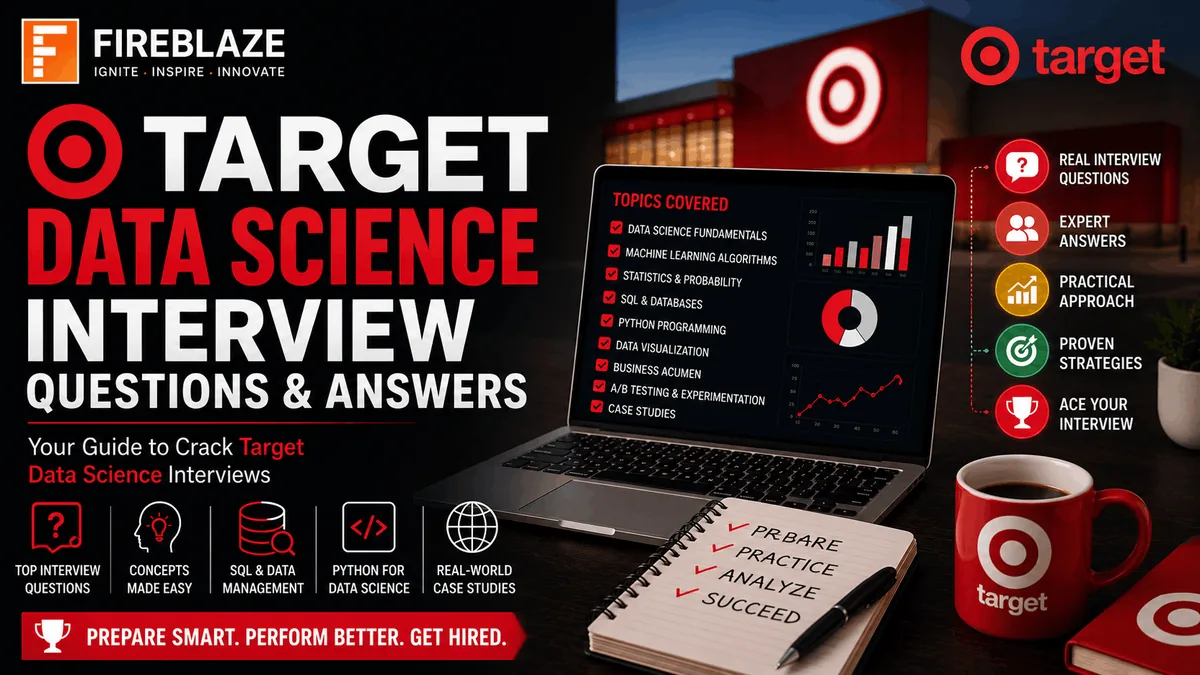
Target is one of the largest retail corporations in the world, serving millions of customers through physical stores and digital commerce platforms. Data Science plays a crucial role in helping Target optimize inventory, personalize customer experiences, forecast demand, improve supply chains, and drive business growth.
Data Scientists at Target work on machine learning models, customer analytics, recommendation systems, pricing optimization, forecasting, and business intelligence projects.
If you're preparing for a Target Data Science interview, you should have a strong understanding of machine learning, SQL, Python, statistics, retail analytics, and business problem-solving.
In this guide, we'll cover the most frequently asked Target Data Science interview questions and answers.
1. What is Data Science?
Answer
Data Science is the process of extracting meaningful insights from structured and unstructured data using:
Statistics
Mathematics
Programming
Machine Learning
Artificial Intelligence
Data Visualization
The goal is to solve business problems and support data-driven decision-making.
2. How Does Target Use Data Science?
Answer
Target uses Data Science for:
Demand Forecasting
Inventory Optimization
Customer Segmentation
Personalized Recommendations
Pricing Analytics
Supply Chain Optimization
Marketing Analytics
Data Science helps improve customer experiences while maximizing business performance.
3. What is Machine Learning?
Answer
Machine Learning is a subset of Artificial Intelligence that enables systems to learn patterns from historical data and make predictions without explicit programming.
Applications at Target include:
Product Recommendations
Customer Behavior Prediction
Demand Forecasting
Fraud Detection
Inventory Management
4. What Are the Different Types of Machine Learning?
Answer
Supervised Learning
Uses labeled datasets.
Examples:
Linear Regression
Logistic Regression
Random Forest
Unsupervised Learning
Uses unlabeled datasets.
Examples:
K-Means Clustering
Hierarchical Clustering
Reinforcement Learning
Learns through rewards and penalties.
Examples:
Dynamic Pricing
Inventory Optimization
Supply Chain Decision Systems
5. What is Overfitting?
Answer
Overfitting occurs when a model performs extremely well on training data but poorly on unseen data.
Symptoms:
High Training Accuracy
Poor Test Accuracy
Solutions:
Cross Validation
Regularization
More Training Data
Feature Selection
6. What is Underfitting?
Answer
Underfitting occurs when a model is too simple to capture important patterns in data.
Symptoms:
Poor Training Performance
Poor Testing Performance
Solutions:
Increase Model Complexity
Improve Features
Use Better Algorithms
7. What is the Difference Between Classification and Regression?
Classification
Predicts categories.
Examples:
Customer Will Buy or Not
Fraudulent or Legitimate Transaction
Algorithms:
Logistic Regression
Random Forest
Decision Trees
Regression
Predicts numerical values.
Examples:
Sales Forecasting
Revenue Prediction
Inventory Demand Estimation
Algorithms:
Linear Regression
Polynomial Regression
8. Why is SQL Important for Data Scientists?
Answer
SQL is used to retrieve, manipulate, and analyze data stored in relational databases.
Applications include:
Customer Analytics
Sales Reporting
Inventory Analysis
Business Intelligence
Dashboard Development
SQL remains one of the most important technical skills assessed in Data Science interviews.
9. Explain Different Types of SQL Joins.
INNER JOIN
Returns matching records from both tables.
LEFT JOIN
Returns all records from the left table and matching records from the right table.
RIGHT JOIN
Returns all records from the right table and matching records from the left table.
FULL OUTER JOIN
Returns all records from both tables.
Example:
SELECT c.customer_name,
o.order_amount
FROM customers c
LEFT JOIN orders o
ON c.customer_id = o.customer_id;
10. What is Customer Segmentation?
Answer
Customer Segmentation involves dividing customers into groups based on common characteristics.
Examples:
Age
Purchase History
Spending Patterns
Product Preferences
Geographic Location
Customer segmentation helps businesses create personalized marketing strategies.
11. What is a Recommendation System?
Answer
A Recommendation System suggests products or services based on customer behavior and preferences.
Examples:
"Customers also bought"
Personalized product suggestions
Similar product recommendations
Algorithms commonly used include:
Collaborative Filtering
Content-Based Filtering
Hybrid Recommendation Models
Recommendation systems significantly improve customer engagement and sales.
12. What is Demand Forecasting?
Answer
Demand Forecasting predicts future product demand using historical sales data and machine learning models.
Benefits include:
Better Inventory Management
Reduced Stockouts
Improved Supply Chain Planning
Higher Customer Satisfaction
Demand forecasting is a critical retail analytics function.
13. What Python Libraries Are Commonly Used in Data Science?
Answer
Popular libraries include:
NumPy
Numerical computing.
Pandas
Data manipulation and analysis.
Matplotlib
Data visualization.
Seaborn
Statistical visualization.
Scikit-Learn
Machine learning development.
TensorFlow
Deep learning applications.
PyTorch
Neural network development.
14. What is a Confusion Matrix?
Answer
A Confusion Matrix evaluates classification models.
Components include:
True Positive (TP)
True Negative (TN)
False Positive (FP)
False Negative (FN)
It helps calculate:
Accuracy
Precision
Recall
F1 Score
15. What is Precision and Recall?
Precision
Measures how many predicted positive cases are actually positive.
Formula:
Precision = TP / (TP + FP)
Recall
Measures how many actual positive cases are correctly identified.
Formula:
Recall = TP / (TP + FN)
These metrics are important for fraud detection and customer prediction models.
Real-World Applications of Data Science at Target
Personalized Product Recommendations
Improving customer shopping experiences.
Inventory Optimization
Maintaining optimal stock levels.
Customer Analytics
Understanding customer purchasing behavior.
Demand Forecasting
Predicting future sales trends.
Pricing Analytics
Optimizing product pricing strategies.
Common Target Data Science Case Study Questions
How would you predict customer churn?
Approach:
Analyze customer behavior
Identify churn indicators
Build predictive models
Recommend retention strategies
How would you forecast inventory demand?
Approach:
Analyze historical sales data
Identify seasonal trends
Build forecasting models
Validate predictions
How would you improve product recommendations?
Approach:
Analyze customer purchase history
Build recommendation models
Evaluate recommendation accuracy
Optimize personalization strategies
Tips to Crack a Target Data Science Interview
Master SQL
Practice:
Joins
Aggregations
Window Functions
Subqueries
Learn Retail Analytics
Understand:
Customer Segmentation
Inventory Analytics
Demand Forecasting
Pricing Optimization
Strengthen Statistics
Focus on:
Probability
Correlation
Hypothesis Testing
Regression Analysis
Learn Machine Learning
Master:
Classification
Regression
Clustering
Recommendation Systems
Build Real Projects
Examples:
Customer Churn Prediction
Product Recommendation Engine
Demand Forecasting Model
Retail Analytics Dashboard
Career Opportunities
Popular roles include:
Data Scientist
Machine Learning Engineer
Retail Analytics Specialist
Business Intelligence Analyst
AI Engineer
Product Data Scientist
The growth of digital retail and AI-powered commerce continues to create strong demand for Data Science professionals.
Final Thoughts
Target Data Science interviews typically focus on machine learning, SQL, Python, statistics, recommendation systems, retail analytics, demand forecasting, and business problem-solving. Building strong technical skills and understanding retail business applications can significantly improve your interview performance.
Whether you're a fresher or an experienced professional, mastering Data Science concepts and retail analytics techniques can help you build a successful career in analytics, Artificial Intelligence, and e-commerce.
Suggested Internal Links
Data Science Interview Questions
Machine Learning Interview Questions
SQL Interview Questions
Recommendation Systems Explained
Retail Analytics Guide
Data Science Career Roadmap
Focus Keyword
Target Data Science Interview Questions and Answers
Secondary Keywords
Target Interview Questions
Retail Data Science Interview Questions
Machine Learning Interview Questions
SQL Interview Questions
Demand Forecasting Interview Questions
Recommendation System Interview Questions
Keep Reading
Related Articles
Interview Preparation
The Coca-Cola Company Data Science Interview Questions and Answers (2026 Guide)
The Coca-Cola Company is one of the world's largest beverage companies, leveraging Data Science, Artificial Intelligence, Machine Learning, Predictive
Huawei Technologies Data Science Interview Questions and Answers (2026 Guide)
Huawei Technologies is a global leader in telecommunications, cloud computing, artificial intelligence, networking, and digital transformation solutio
Convergytics Data Analytics Interview Questions and Answers
Explore the most commonly asked Convergytics Data Analytics interview questions and answers covering SQL, Python, statistics, customer analytics, mark