 Fireblaze
 Interview Preparation
Swiss Re Data Science Interview Questions and Answers (2026 Guide)
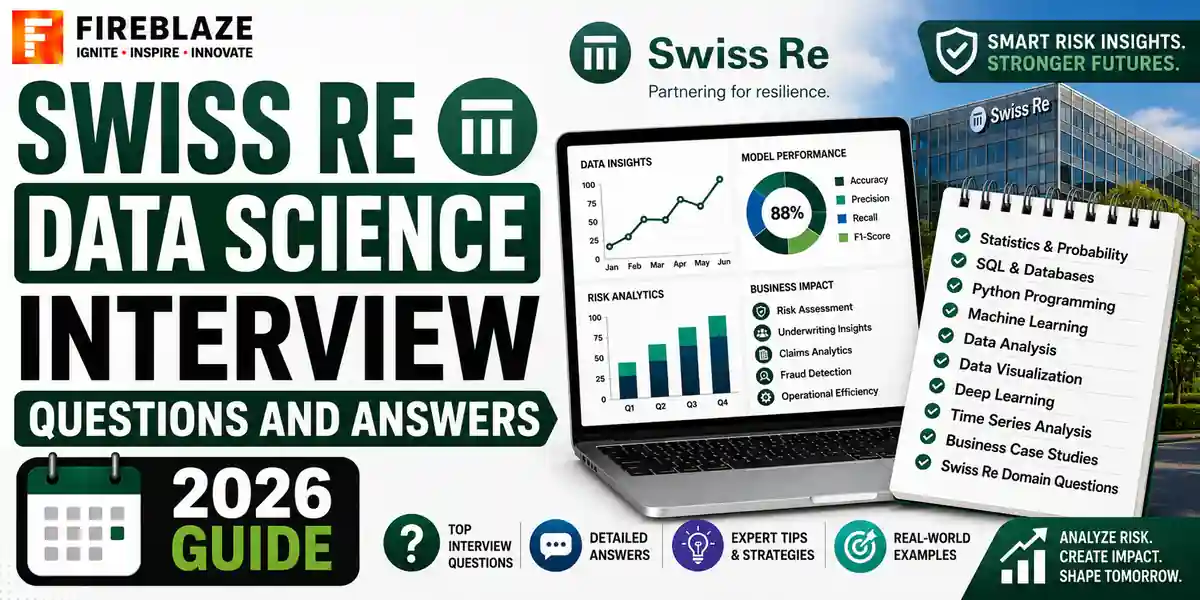
Quick answer: Swiss Re Data Science and Analytics interviews generally test SQL, Python, statistics and Machine Learning fundamentals alongside a company or domain specific case discussion. This guide covers the likely process, core technical questions, and how to prepare.
Data Science and Analytics now sit at the centre of how large organisations make decisions. Companies use SQL, Python, statistics and Machine Learning to understand customers, reduce risk, forecast demand and improve day to day operations.
Swiss Re is one of the world's largest reinsurance companies, providing risk transfer and insurance solutions to insurers and large corporations globally.
If you are preparing for a Swiss Re Data Science or Data Analytics interview, understanding the likely structure of the process and the topics that commonly come up will help you prepare with far more focus.
About Swiss Re
Swiss Re works across areas such as:
Reinsurance and risk transfer
Life and health insurance solutions
Property and casualty risk
Catastrophe and climate risk modelling
Corporate solutions
Data and analytics teams typically support work such as:
Catastrophe and natural disaster risk modelling
Actuarial pricing models
Climate risk analytics
Claims analytics
Portfolio risk aggregation
Roles that commonly open up in this space include:
Data Scientist
Actuarial Analyst
Data Analyst
Catastrophe Modeller
Machine Learning Engineer
Interview Process
Hiring processes vary by role, team and experience level. A data role at a company of this size generally moves through several stages.
1. Online Assessment
Often covers:
Aptitude and logical reasoning
SQL queries
Python programming
Statistics fundamentals
2. Technical Interview
Topics commonly covered include:
SQL joins, aggregations and window functions
Python and Pandas for data manipulation
Statistics and probability
Machine Learning fundamentals
Data visualisation and reporting
Case or Business Round
You may be asked to reason through an open ended business problem, explain your approach, and justify the metrics you would track.
Managerial and HR Round
Focus areas usually include project experience, communication, stakeholder management, and how you handle ambiguity.
SQL Interview Questions
What is the difference between WHERE and HAVING?
| WHERE | HAVING |
|---|---|
| Filters individual rows | Filters grouped results |
| Applied before GROUP BY | Applied after GROUP BY |
| Cannot use aggregate functions | Can use aggregate functions |
What is the difference between INNER JOIN and LEFT JOIN?
INNER JOIN returns only the rows that match in both tables. LEFT JOIN returns every row from the left table, and fills unmatched columns from the right table with NULL.
SELECT c.customer_id,
       c.name,
       o.order_id
FROM customers c
LEFT JOIN orders o
  ON c.customer_id = o.customer_id;
How do you find duplicate records in a table?
SELECT email, COUNT(*) AS record_count
FROM customers
GROUP BY email
HAVING COUNT(*) > 1;
What are window functions?
Window functions perform a calculation across a set of rows while still returning every individual row. They are widely used for ranking, running totals and period on period comparisons.
SELECT region,
       sales_amount,
       RANK() OVER (
         PARTITION BY region
         ORDER BY sales_amount DESC
       ) AS sales_rank
FROM regional_sales;
What is a Common Table Expression?
A Common Table Expression, written with the WITH clause, creates a named temporary result set that exists only for the duration of the query. It makes long queries far easier to read and debug.
WITH monthly_totals AS (
  SELECT customer_id,
         SUM(amount) AS total_spend
  FROM transactions
  GROUP BY customer_id
)
SELECT *
FROM monthly_totals
WHERE total_spend > 10000;
Python Interview Questions
Why is Python widely used for data work?
Python combines readable syntax with a mature ecosystem of libraries. Commonly used ones include:
Pandas for data manipulation
NumPy for numerical computing
Scikit-Learn for Machine Learning
Matplotlib and Seaborn for visualisation
What is the difference between a list and a tuple?
| List | Tuple |
|---|---|
| Mutable, can be changed | Immutable, cannot be changed |
| Written with square brackets | Written with parentheses |
| Slightly slower | Slightly faster and hashable |
How do you handle missing values in Pandas?
import pandas as pd

# Inspect how much is missing
df.isnull().sum()

# Drop rows where a critical field is missing
df = df.dropna(subset=['customer_id'])

# Fill numeric gaps with the median
df['income'] = df['income'].fillna(df['income'].median())
The right choice depends on why the data is missing and how much of it is missing. Removing rows is safe only when the missing share is small and not systematic.
What is the difference between merge, join and concat?
merge combines DataFrames on key columns, similar to a SQL join. join combines on the index by default. concat stacks DataFrames along an axis without matching keys.
Statistics Interview Questions
What is the difference between mean, median and mode?
The mean is the arithmetic average, the median is the middle value in sorted data, and the mode is the most frequent value. The median is preferred when the data contains outliers, because it is not pulled by extreme values.
What is standard deviation?
Standard deviation measures how far values typically fall from the mean. A low value means the data is tightly clustered, a high value means it is spread out.
What is a p-value?
A p-value is the probability of observing a result at least as extreme as the one measured, assuming the null hypothesis is true. A small p-value gives evidence against the null hypothesis. It does not tell you the size of the effect or that the result matters commercially.
What is the Central Limit Theorem?
The Central Limit Theorem states that the distribution of sample means approaches a normal distribution as sample size increases, regardless of the shape of the population distribution. It is the reason so many statistical tests work on large samples.
What is the difference between Type I and Type II error?
| Type I error | Type II error |
|---|---|
| False positive | False negative |
| Rejecting a true null hypothesis | Failing to reject a false null hypothesis |
Machine Learning Interview Questions
What is the difference between supervised and unsupervised learning?
| Supervised learning | Unsupervised learning |
|---|---|
| Uses labelled data | Uses unlabelled data |
| Predicts a known target | Discovers structure and patterns |
| Regression, classification | Clustering, dimensionality reduction |
What is overfitting and how do you prevent it?
Overfitting happens when a model learns noise in the training data and fails to generalise to new data. Common remedies include cross validation, regularisation, simplifying the model, pruning features, and gathering more representative data.
Explain precision and recall
Precision is the share of predicted positives that are actually positive. Recall is the share of actual positives that the model successfully identified. There is usually a trade off between them, and which one matters more depends entirely on the cost of each type of mistake.
Why is accuracy a poor metric for imbalanced data?
If only one percent of cases are positive, a model that predicts negative every single time is ninety nine percent accurate and completely useless. Precision, recall, F1 score and ROC AUC give a far more honest picture.
What is cross validation?
Cross validation splits the data into several folds, trains on some and validates on the rest, then rotates. K-Fold Cross Validation is the most common form. It gives a more reliable estimate of performance than a single train and test split.
Insurance and Catastrophe Risk Analytics Questions
What is catastrophe modelling?
Catastrophe models simulate potential natural disaster events, such as hurricanes or earthquakes, and estimate the resulting financial losses across a portfolio of insured properties, informing how much risk a reinsurer can safely take on.
Why is tail risk especially important in reinsurance?
Reinsurers exist specifically to absorb extreme, low probability, high severity events. A model that fits the average case well but underestimates the tail can be dangerously misleading for exactly the events the business is designed to cover.
How is climate change affecting risk modelling in this industry?
Historical loss data increasingly understates future risk in a changing climate, since past frequency and severity of weather events may not represent future conditions. This pushes risk models to incorporate forward looking climate projections rather than relying purely on historical patterns.
Case Study Questions
Estimating a reinsurer's exposure to a major earthquake in a specific region
Combine geophysical hazard modelling with the actual concentration of insured properties in that region, since exposure depends as much on what is insured where as on the hazard itself.
Pricing a reinsurance contract for a new, poorly understood risk type
With limited historical data, combine expert judgement, analogous risks, and scenario based modelling, and price in a meaningful margin for the genuine uncertainty rather than presenting false statistical precision.
HR and Behavioural Questions
Tell me about yourself
A clear structure works well: your education, your technical skills, one or two projects you can defend in depth, any work experience, and what you are looking for next. Keep it under two minutes.
Why Swiss Re?
A strong answer references the long time horizon and genuine complexity of reinsurance risk modelling, including climate and catastrophe risk, and your interest in problems where getting the tail risk estimate right matters more than the average case.
Describe a project you are proud of
Use a simple arc: the business problem, the data you had, what you built, how you evaluated it, and what changed as a result. Interviewers are far more interested in your reasoning than in the algorithm you picked.
Tell me about a time a project did not work
Answer honestly. Describe what went wrong, what you learned, and what you would do differently. A candidate who can discuss failure clearly usually reads as more experienced, not less.
Preparation Tips
Build genuine SQL fluency
Practise joins, aggregations, subqueries, window functions and CTEs until you can write them without hesitation. SQL is the single most commonly tested skill in data interviews.
Get comfortable with Pandas
Focus on merging, grouping, reshaping, handling missing values and cleaning messy real world data rather than memorising the entire library.
Revise the statistics that actually come up
Hypothesis testing, distributions, correlation, sampling and experiment design appear far more often than advanced theory.
Prepare two projects properly
Two projects you can discuss deeply beat six you can only describe superficially. Be ready to explain your choices and the limitations of your work.
Practise explaining technical work to non technical people
Almost every data role sits between a technical system and a business decision. The ability to translate between them is repeatedly tested.
Final Thoughts
Interviews at Swiss Re reward candidates who combine solid technical foundations with clear business reasoning. Strong SQL, practical Python, dependable statistics, and the ability to explain your thinking usually matter more than knowing an unusually advanced algorithm.
Prepare systematically, build projects you can genuinely defend, and practise speaking about your work out loud. That combination is what separates candidates who pass from candidates who freeze.
FAQ
Frequently Asked Questions
What is the Swiss Re Data Science interview process like?
It typically includes an online assessment, a technical round covering SQL, Python and statistics, a domain or case discussion, and a managerial or HR round. Exact steps vary by role, team and experience level, and not every candidate goes through every stage.
What topics should I prepare for a Swiss Re interview?
Focus on SQL joins and aggregations, Python and Pandas for data manipulation, core statistics such as hypothesis testing and probability, and Machine Learning fundamentals like overfitting and model evaluation, alongside enough business context to reason through a case question.
What data roles does Swiss Re commonly hire for?
Common roles include Data Scientist, Actuarial Analyst, Data Analyst, Catastrophe Modeller and Machine Learning Engineer. Exact openings vary over time and by location.
How should I prepare for a Swiss Re Data Science interview?
Build genuine SQL fluency, get comfortable with Pandas on messy real world data, revise the statistics that actually come up in interviews, and prepare two projects you can discuss in real depth rather than several you can only describe superficially.
Keep Reading
Related Articles
Interview Preparation
ABB Data Science Interview Questions and Answers (2026 Guide)
Prepare for ABB Data Science interviews with SQL, Python, Statistics, Machine Learning, Industrial Analytics, Predictive Maintenance, and re
Interview Preparation
Cognizant Data Analytics Interview Questions and Answers
Explore the most frequently asked Cognizant Data Analytics interview questions and answers covering SQL, Python, statistics, Power BI, busin
Interview Preparation
Tredence Interview Data Science and Analytics Questions and Answers (2026 Guide)
Tredence is a leading Data Science, Analytics, Artificial Intelligence, and Business Intelligence company that helps enterprises solve compl