 Fireblaze
 Interview Preparation
Procter and Gamble Data Science Interview Questions and Answers
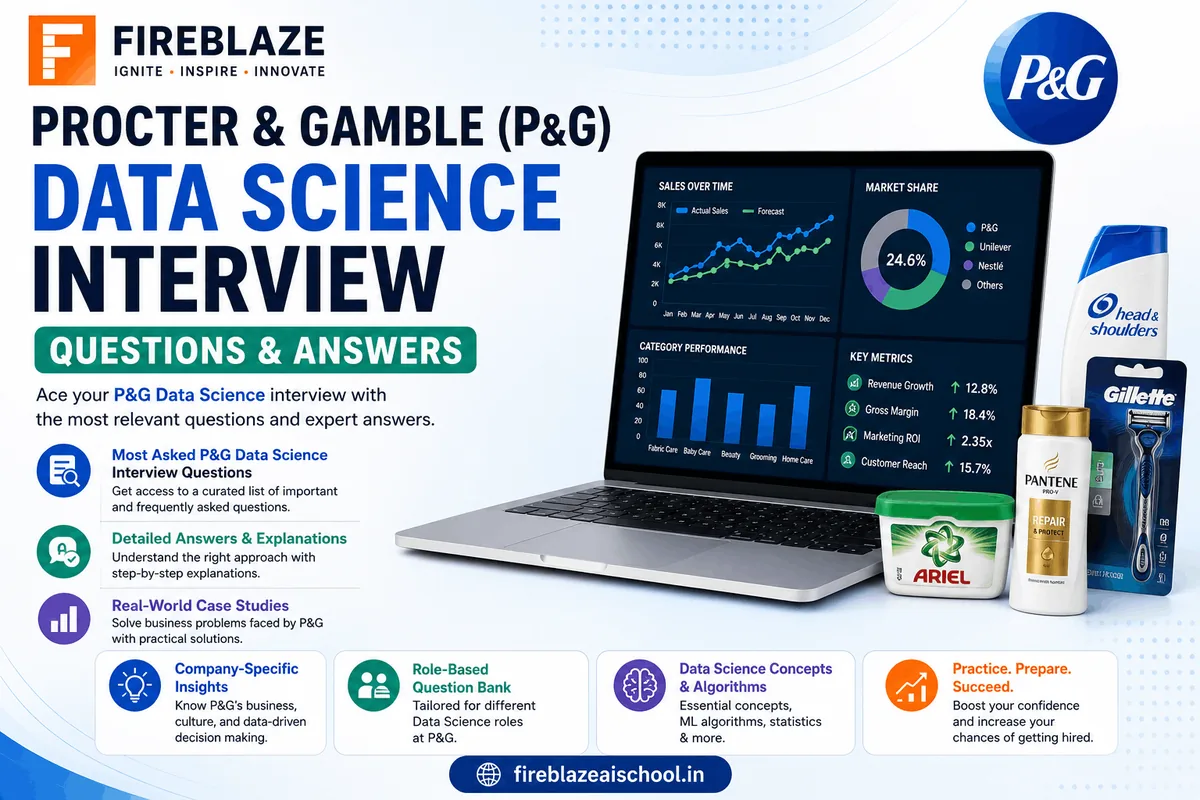
Data Science plays a crucial role in helping global organizations make informed decisions, optimize operations, and improve customer experiences. Companies like Procter and Gamble (P&G) leverage data science to analyze consumer behavior, optimize supply chains, forecast demand, and drive business growth.
If you're preparing for a Data Science interview at Procter and Gamble, understanding the commonly asked technical and business-focused questions can help you perform confidently.
In this article, we'll explore frequently asked Procter and Gamble Data Science interview questions and answers that can strengthen your interview preparation.
1. What is Data Science?
Answer
Data Science is the process of extracting meaningful insights from data using:
Statistics
Mathematics
Programming
Machine Learning
Data Visualization
Business Intelligence
The goal is to solve business problems and support decision-making through data-driven insights.
2. Why is Data Science Important for Businesses?
Answer
Data Science helps organizations:
Understand customer behavior
Improve decision-making
Forecast future trends
Optimize operations
Reduce business risks
Increase profitability
Companies use Data Science to gain a competitive advantage through data-driven strategies.
3. What is Machine Learning?
Answer
Machine Learning is a branch of Artificial Intelligence that enables systems to learn patterns from historical data and make predictions without being explicitly programmed.
Common applications include:
Customer Segmentation
Demand Forecasting
Fraud Detection
Product Recommendations
Sales Predictions
4. What are the Different Types of Machine Learning?
Answer
Supervised Learning
Uses labeled data for training.
Examples:
Linear Regression
Logistic Regression
Decision Trees
Unsupervised Learning
Uses unlabeled data to discover hidden patterns.
Examples:
K-Means Clustering
Hierarchical Clustering
Reinforcement Learning
Models learn through rewards and penalties.
Examples:
Robotics
Autonomous Systems
AI Gaming Applications
5. What is Overfitting?
Answer
Overfitting occurs when a model performs extremely well on training data but fails to generalize on new data.
Symptoms include:
High Training Accuracy
Low Test Accuracy
Solutions:
Cross Validation
Regularization
Feature Selection
Increasing Training Data
6. What is Underfitting?
Answer
Underfitting occurs when a model is too simple to learn the underlying patterns within data.
Symptoms include:
Poor Training Performance
Poor Testing Performance
Solutions:
Increase Model Complexity
Add Relevant Features
Train for More Iterations
7. Explain the Difference Between Classification and Regression.
Classification
Predicts categorical outcomes.
Examples:
Customer Churn Prediction
Product Purchase Prediction
Spam Detection
Algorithms:
Logistic Regression
Random Forest
Support Vector Machines
Regression
Predicts continuous numerical values.
Examples:
Sales Forecasting
Revenue Prediction
Demand Estimation
Algorithms:
Linear Regression
Decision Tree Regression
8. What is Logistic Regression?
Answer
Logistic Regression is a supervised machine learning algorithm used for classification problems.
It predicts probabilities between 0 and 1 and is commonly used in:
Customer Retention Analysis
Credit Risk Modeling
Fraud Detection
Marketing Analytics
9. What is a Confusion Matrix?
Answer
A Confusion Matrix evaluates the performance of classification models.
It contains:
True Positive (TP)
True Negative (TN)
False Positive (FP)
False Negative (FN)
It helps calculate:
Accuracy
Precision
Recall
F1 Score
10. What is Precision and Recall?
Precision
Measures the proportion of predicted positives that are actually positive.
Formula:
Precision = TP / (TP + FP)
Recall
Measures the proportion of actual positives correctly identified.
Formula:
Recall = TP / (TP + FN)
Recall is particularly important when missing a positive case is costly.
11. What is Feature Engineering?
Answer
Feature Engineering is the process of creating or transforming variables to improve model performance.
Examples include:
Creating Customer Age Groups
Purchase Frequency Metrics
Seasonal Features
Customer Loyalty Scores
Feature Engineering often has a significant impact on predictive accuracy.
12. What is Data Preprocessing?
Answer
Data preprocessing prepares raw data before model training.
Tasks include:
Handling Missing Values
Removing Duplicates
Encoding Categorical Variables
Feature Scaling
Outlier Detection
Clean and well-structured data improves model performance.
13. What is the Difference Between Mean, Median, and Mode?
Mean
Average value of a dataset.
Median
Middle value after sorting the dataset.
Mode
Most frequently occurring value.
Example:
4, 6, 6, 8, 10
Mean = 6.8
Median = 6
Mode = 6
14. Why is SQL Important for Data Scientists?
Answer
SQL is essential because most business data is stored in relational databases.
Data Scientists use SQL for:
Data Extraction
Data Cleaning
Data Aggregation
Feature Generation
Reporting
Strong SQL skills are frequently tested during Data Science interviews.
15. What Python Libraries Are Commonly Used in Data Science?
Answer
Popular libraries include:
NumPy
Numerical computing.
Pandas
Data manipulation and analysis.
Matplotlib
Data visualization.
Seaborn
Statistical visualization.
Scikit-Learn
Machine learning development.
TensorFlow
Deep learning applications.
PyTorch
Neural network and AI development.
Real-World Data Science Applications at Consumer Goods Companies
Organizations like Procter and Gamble use Data Science for:
Demand Forecasting
Predicting product demand across markets.
Customer Analytics
Understanding customer preferences and buying behavior.
Supply Chain Optimization
Improving inventory management and logistics.
Marketing Analytics
Measuring campaign effectiveness and ROI.
Product Innovation
Using consumer insights to improve products and services.
Tips to Crack a Data Science Interview
Strengthen Statistics Fundamentals
Focus on:
Probability
Distributions
Hypothesis Testing
Correlation
Master Machine Learning Concepts
Learn:
Regression
Classification
Clustering
Evaluation Metrics
Improve SQL Skills
Practice:
Joins
Subqueries
Aggregations
Window Functions
Build Practical Projects
Examples:
Customer Churn Prediction
Sales Forecasting
Demand Prediction
Recommendation Systems
Develop Strong Python Skills
Focus on:
Pandas
NumPy
Scikit-Learn
Data Visualization Libraries
Career Opportunities in Data Science
Popular roles include:
Data Scientist
Machine Learning Engineer
Business Analyst
Data Analyst
AI Engineer
Research Scientist
As businesses continue to embrace AI and analytics, skilled Data Science professionals remain in high demand across industries.
Final Thoughts
Procter and Gamble Data Science interviews often assess candidates on machine learning, statistics, SQL, Python, and business problem-solving skills. Developing strong technical foundations and building practical projects can significantly improve your interview performance.
Whether you're a student, fresher, or experienced professional, mastering Data Science concepts and gaining hands-on experience will help you build a successful career in the field.
Suggested Internal Links
Data Science Interview Questions
Machine Learning Interview Questions
SQL Interview Questions
Python Interview Questions
Statistics for Data Science
Artificial Intelligence Course
Focus Keyword
Procter and Gamble Data Science Interview Questions and Answers
Secondary Keywords
P&G Data Science Interview Questions
Data Science Interview Questions
Machine Learning Interview Questions
SQL for Data Science
Data Scientist Interview Preparation
Data Science Career Guide
Keep Reading
Related Articles
Interview Preparation
The Coca-Cola Company Data Science Interview Questions and Answers (2026 Guide)
The Coca-Cola Company is one of the world's largest beverage companies, leveraging Data Science, Artificial Intelligence, Machine Learning, Predictive
Huawei Technologies Data Science Interview Questions and Answers (2026 Guide)
Huawei Technologies is a global leader in telecommunications, cloud computing, artificial intelligence, networking, and digital transformation solutio
Convergytics Data Analytics Interview Questions and Answers
Explore the most commonly asked Convergytics Data Analytics interview questions and answers covering SQL, Python, statistics, customer analytics, mark