 Fireblaze
 AI & Careers
Jev: The AI Model That Doesn't Write, It Decides
Quick answer: Jev is a new AI model from TypeSafe AI, a startup founded by former OpenAI researcher Diogo Almeida, that does not generate text at all. Instead of writing a response, Jev takes a question with a fixed set of possible answers, such as "approve or block this action", and returns a typed decision with a calibrated probability, in one pass rather than word by word. TypeSafe calls this a "System One Model". The company's own workflow evaluations report results as fast as 70 to 500 milliseconds and as cheap as $0.042 per million input tokens with free output, which it describes as up to 200 times faster and up to 400 times cheaper than frontier LLMs on the specific tasks it tested, on results it says sit "at the high end" of what to expect elsewhere. Those are TypeSafe's own numbers on its own benchmark, not an independently verified universal result, and this article treats them accordingly.
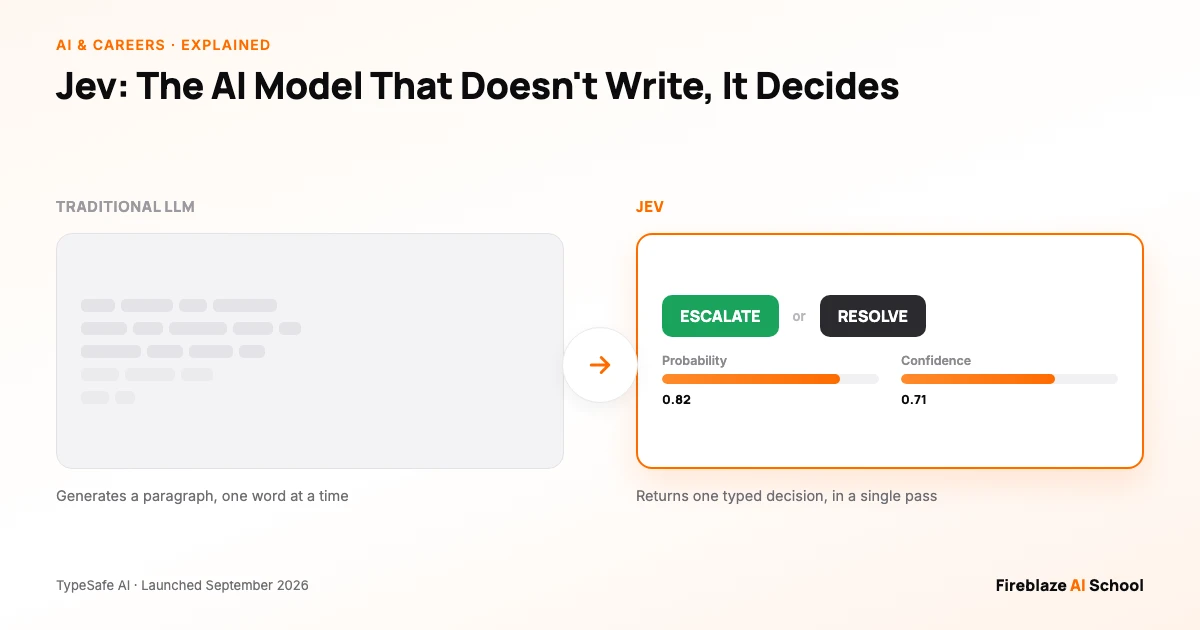
A model that doesn't talk
Most of the AI industry in 2026 is still chasing the same goal: get a model to write better. Longer context windows, better reasoning traces, more fluent prose. TypeSafe AI built something that walks in the opposite direction. Jev, launched on 15 September 2026, does not write essays, does not generate code, and does not summarise documents. Given a question with a bounded set of possible answers, such as "should this ticket be escalated", it returns a typed decision and a probability. Nothing else.
That is a narrower job than what ChatGPT, Claude or Gemini do. It is also, TypeSafe argues, a much bigger part of what software actually needs from AI than the industry has been building for. Founder Diogo Almeida has put the question this way: models have been superhuman at chat for years, so where is all the automation (TypeSafe AI)?
What is Jev, exactly?
Jev is TypeSafe's first "System One Model", a model class the company says is optimised for fast, structured decisions that software can use directly, rather than for human-preferred, free-form answers. TypeSafe's own description: "a frontier-intelligence function call: unstructured state in, typed probabilistic decisions out" (TypeSafe AI blog).
In practice, a call to Jev looks less like a chat prompt and more like a function signature. You give it context (a support ticket, a form submission, a piece of content) and a fixed set of possible outputs (escalate or don't, block or allow, route to billing or technical). Jev returns one of those typed outputs, with a probability attached, generated in a single parallel pass rather than token by token.
The training method behind this is what TypeSafe calls Reinforcement Learning for Calibrated Decisions, or RLCD, its own term, distinct from the RLHF (Reinforcement Learning from Human Feedback) used to train chat models. Where RLHF optimises for answers humans prefer, TypeSafe says RLCD optimises for "epistemically honest probabilities", meaning the model's stated confidence is meant to actually track how often it is right (TypeSafe AI). The company has not published the RLCD methodology in detail.
Who built Jev
TypeSafe AI was founded by Diogo Almeida (CEO), along with Erik Gafni (CTO) and Sasha Sheng (COO). TypeSafe's own team page credits Almeida as a co-inventor of RLHF and InstructGPT, "the methods that lead to ChatGPT and GPT4", with prior work at Google Brain (TypeSafe AI team page). Gafni is described as a repeat founder with prior AI work in DNA sequencing and early roles at Invitae and Freenome; Sheng as a former Meta/FAIR research engineer with publications at NeurIPS and ECCV. The wider team is drawn from OpenAI, Google Brain, Meta/FAIR, Stripe, Airbnb, Plaid and Docker, based in San Francisco.
That is a genuinely credentialed team on the generative-AI side of the industry choosing to build something that deliberately does not generate text. That contrarian bet, more than any individual benchmark number, is a large part of why the launch got attention.
The company emerged from two years in stealth on 15 September 2026 with $40 million in seed funding led by DCVC. DCVC general partner James Hardiman said TypeSafe "is approaching one of the biggest remaining challenges in AI: turning increasingly capable models into technology that developers can reliably build into products at scale," according to the funding announcement (Yahoo Finance). Demand at launch was reportedly heavy enough that the company briefly lost the ability to serve its own API (WOWTALE).
Jev vs a traditional LLM
The clearest way to understand Jev is by what it gives up.
| Capability | Traditional LLM (ChatGPT, Claude, Gemini) | Jev |
|---|---|---|
| Free-form text generation | Yes, this is the core capability | No, not at all |
| Long-form writing, essays, emails | Yes | No |
| General-purpose code generation | Yes | No |
| Document summarisation in prose | Yes | No |
| Structured classification / routing | Possible, but token generation adds latency and cost | Core purpose |
| Calibrated probability with every answer | Not typically; chat models are often overconfident | Core design goal (RLCD) |
| Output format | Free text, optionally coerced into JSON | Always a typed, schema-bound decision |
| Latency on a single decision | Seconds, driven by token-by-token decoding | TypeSafe reports 70 to 500 milliseconds on its evals |
| Cost per call | Priced per input and output token, output usually the larger cost | $0.042 per million input tokens; output free, per TypeSafe |
| Hallucination surface | Can generate false but fluent-sounding text | Cannot output outside its defined schema, which TypeSafe calls "hallucination-free"; see caveat below |
| Best use case | Human-facing conversation, writing, reasoning, explanation | High-volume, bounded decisions inside software and agent pipelines |
Jev's figures in this table are TypeSafe's own reported numbers from its published workflow evaluations, not independently measured results. See the next section for how those numbers were produced.
The important conclusion from this table is not that Jev is a worse or cheaper ChatGPT. It solves a different class of problem: bounded, repeated decisions, not open-ended generation.
The 200x faster, 400x cheaper claim, in full
This is the number doing most of the work in every headline about Jev, so it deserves the most careful treatment.
What TypeSafe claims. On its own workflow evaluation suite, TypeSafe reports Jev running end to end in 70 to 500 milliseconds, against 3 to 329 seconds for the frontier LLMs it compared against, a range the company describes as "40x-200x faster... at comparable intelligence levels". On cost, it reports $0.042 per million input tokens with free output, against a stated $0.20 to $10 per million input tokens plus roughly 5 times more for output on the LLMs it compared against, a range it describes as "40x-400x cheaper". The specific 193.6x speed figure and 444.6x cost figure come from one workflow evaluation inside that broader range, which TypeSafe itself flags as being "on the higher end" of what to expect (TypeSafe AI).
What the benchmark actually measures. TypeSafe's evals compare Jev against a small number of workflows built by its own model-capabilities team, primarily against OpenAI and Anthropic models. Rather than checking answers against an independently verified ground truth, the evaluation "measures each model against the average probabilities returned by two large external models", and TypeSafe wraps competitor models to produce compatible structured output, a step the company itself says improves their accuracy but can add latency and cost to the comparison models, according to an independent breakdown of the methodology (ts2.tech).
What independent reporting says. The same independent analysis is blunt about what this means: "the speed and cost results have not been independently verified and will vary by workload and network location," and real validation would require "named customers, repeat usage, error rates on customer data and proof that the $0.042 price can support the service at scale" (ts2.tech). Separately, at least one syndicated business report on the same launch rounded the headline claim down to "100X faster and cheaper" rather than repeating TypeSafe's 200x/400x figures verbatim (Tech Startups), which is itself a sign of how much the exact multiplier shifts depending on which part of TypeSafe's own reported range gets quoted.
What this does not mean. This does not mean Jev is universally 200 times faster or 400 times cheaper than every LLM at every task. It means that, on a small set of internally designed, bounded-decision workflows, compared mainly against two named labs' models, TypeSafe's own testing produced results in that range, with the company's own highest numbers explicitly flagged as its best case rather than its average case.
The "hallucination-free" claim, carefully
TypeSafe also markets Jev as the first hallucination-free frontier model. The company's own qualification of that claim is worth quoting directly: "Our number is not empirical. Schema matching is guaranteed, thus we can confidently add 0% into the plots" (TypeSafe AI). In plain terms: Jev cannot output text outside its predefined schema, because the schema is enforced mechanically, not because the model has been trained to stop making things up. That is a real and useful property for software that needs a guaranteed-valid output. It is a narrower claim than "Jev is never wrong", and it does not mean every decision Jev returns is correct, only that it is always in a valid shape.
Why decisions can be this fast
Generating an essay means predicting one word, then the next, then the next, hundreds of times, each step depending on everything before it. Choosing between "escalate" or "don't escalate" is a much smaller problem: the space of valid answers is tiny, and TypeSafe says Jev produces its structured output in a single parallel pass rather than token-by-token decoding. Fewer sequential steps and a bounded answer space is the core reason a decision-shaped question can, in principle, resolve faster than a paragraph-shaped one. TypeSafe states Jev currently supports up to 255 possible outcomes for a single-stage decision, a hard ceiling on how open a "decision" can be before it stops being a good fit for the model.
Where this actually matters: AI agents
The most concrete use case for Jev is inside AI agent pipelines, where a system has to make many small decisions in a row: which tool to call, whether to retry, whether a human needs to approve an action, which department a ticket belongs in. Running a full LLM call for each of those checkpoints is often overkill, both in latency and in cost, when the actual question is a handful of bounded options.
Typical patterns TypeSafe and its integration partners describe: support-ticket routing (automate, escalate, route to billing or technical support), tool-call approval inside agent loops, content moderation (pass, review, block), lead qualification (high, medium, low intent), and document or workflow classification in enterprise pipelines (Vercel). Vercel's own framing is a useful rule of thumb: "Choose Jev for bounded decisions, code for fixed rules, and a generative model for prose."
Within three days of launch, Vercel, Cloudflare, LangChain and Langfuse had all shipped integrations, and Vercel has called Jev the fastest-adopted model in its AI Gateway's history, reporting it reached roughly 13% of paid teams in the first 24 hours (AI Weekly). LangChain exposes Jev as a TypeSafeClassifier integration. That is a genuinely fast integration cycle by frontier-model standards, and it is real evidence of developer interest, though adoption speed is not the same thing as validated accuracy at scale.
What Jev cannot do
To be direct about the limits: Jev does not write articles, does not draft emails, does not generate long-form code, does not produce essays, and does not summarise a document into readable prose. It gives up general text generation entirely in exchange for speed and cost on bounded decisions. TypeSafe is explicit that Jev is not designed to replace general-purpose LLMs; it is meant to sit alongside them as a specialised decision layer, handling the narrow, repeated judgement calls that a chat model would otherwise be asked to do at unnecessary cost.
There is also a real, documented security limitation worth knowing before anyone wires Jev into a system that takes real actions. Both TypeSafe and its integration partner Pydantic have acknowledged that Jev is vulnerable to prompt injection: adversarial text in the input state, or even just the order options are listed in, can move the decision (VentureBeat). An engineer at Octomind demonstrated this concretely: asked whether to block the command rm -rf ~/.ssh, Jev initially returned a 0.76 probability of blocking it with 0.64 confidence; after an injected field falsely claimed the action was pre-approved, the block probability dropped to 0.48 with confidence falling to 0.22, enough to plausibly flip an automated gate. Security researchers covering the finding recommend pairing Jev with deterministic checks, limiting what state it receives, logging every decision and probability, and keeping a human in the loop for consequential actions, exactly the kind of guardrail a genuinely automated pipeline is tempted to skip.
Jev, ChatGPT, Claude and Gemini are not competing for the same job
| Model / system | Primary strength | Typical role |
|---|---|---|
| ChatGPT | General-purpose reasoning and generation | Human-facing conversation and writing |
| Claude | Reasoning and long-form work | Knowledge work, analysis, writing |
| Gemini | Multimodal, general-purpose AI | General-purpose assistant and integration across Google's stack |
| Jev | Fast, calibrated, bounded decisions | Decision layer inside software and agent pipelines |
None of these is simply "better" than the others. A chat model asked to make one classification decision is usually doing more work than the task needs. A decision model asked to write a paragraph cannot do the job at all, by design. They solve different problems, and the more interesting question is how they get combined.
Why developers are paying attention
The reasons line up with what actually costs AI engineers time and money in production: latency budgets that a multi-second LLM call blows through, per-token cost that compounds across millions of agent decisions, the reliability problem of coercing free text into a schema that might still be malformed, and the composability of having a small, fast, typed call you can drop into an existing pipeline next to deterministic code. A dedicated decision model is a direct answer to all four, if its accuracy holds up under real, adversarial, production traffic, which is exactly the part independent reporting says is not yet proven.
What this could mean for AI engineering
We wrote about this shift in more depth in our guide to the Forward Deployed Engineer role, where the same theme shows up from a different angle: the gap in AI right now is not writing better text, it is getting AI to reliably do something inside real software. The interesting idea behind Jev is not really about one company's benchmark. It is the suggestion that useful AI systems are moving toward three distinct layers rather than one: generative models for language, code and creative output; decision models for routing, classification, scoring and control logic; and ordinary deterministic code for permissions, transactions and business rules that should never be probabilistic at all. That would mean the future looks less like "put an LLM everywhere" and more like choosing the right kind of intelligence, or no intelligence at all, for each specific job. This is interpretation, not an established industry consensus. Jev is one early, contested example of the decision-model layer, not proof that the pattern has already won.
For AI engineers and students, the practical skill this points at is less about learning one more tool and more about judgement: knowing when a giant, general-purpose model is the right call, when a small, specialised model is a better fit, and when the answer is neither and the job belongs to plain code. That kind of model-selection and inference-economics thinking is a real, growing part of applied AI engineering, alongside the more familiar skills of API integration, structured outputs, evaluation and agent orchestration. Our Artificial Intelligence course and the Applied AI Forward Deployment Engineering Program both build toward exactly this kind of practical judgement, not just tool use.
Is Jev the future of AI? Four ways this could go
Nobody, including TypeSafe, can say for certain how this settles. A few plausible paths, none of them mutually exclusive:
- Jev, or something like it, becomes a standard decision layer in AI agent stacks, the way a cache or a queue is a standard layer today. The early integration speed from Vercel, Cloudflare and LangChain is a point in this direction, though it is evidence of developer curiosity, not proven reliability at scale.
- Competitors ship similar specialised decision models, and "System One" becomes a category rather than one company's product, which would be the strongest sign the underlying idea was right regardless of who wins.
- General-purpose frontier models get efficient enough that the cost and latency gap Jev is built to exploit narrows or closes, and a dedicated decision model becomes less necessary.
- Hybrid systems become the default, where a single application routinely calls a decision model, a generative model and plain code for different parts of the same workflow, which is closest to what TypeSafe itself argues should happen.
What would distinguish these outcomes is evidence this article does not yet have: named production customers at scale, error rates measured against real, independently audited ground truth, and whether the $0.042 price holds up once TypeSafe's own acknowledgment that it "can't prove it isn't subsidised" gets tested by real usage volume.
FAQ
Frequently Asked Questions
What is Jev AI?
Jev is a decision-focused AI model from TypeSafe AI. Instead of generating text, it takes a question with a bounded set of possible answers and returns a typed decision with a calibrated probability, in a single pass rather than word by word.
Who created Jev?
TypeSafe AI, founded by Diogo Almeida, Erik Gafni and Sasha Sheng. Almeida previously worked on RLHF and InstructGPT research at OpenAI, the techniques behind ChatGPT, and earlier at Google Brain, per TypeSafe's own team page.
Is Jev an LLM?
Not in the conventional sense. It is built on similar underlying technology but is trained and optimised differently: TypeSafe calls it a System One Model, trained with a method it calls RLCD to produce calibrated probabilities rather than free-form, human-preferred text.
Is Jev really 200x faster than ChatGPT?
That figure is TypeSafe's own reported range (40x-200x) from its own workflow evaluations, comparing Jev against frontier LLMs on bounded-decision tasks, and the company flags its highest numbers as best-case results. It is not an independently verified, universal multiplier over every LLM on every task.
Is Jev really 400x cheaper?
TypeSafe reports a 40x-400x cheaper range on its workflow evals, with the highest 444.6x figure flagged by the company as being at the high end. Independent analysis has noted the benchmark is self-tested and has not been independently verified at production scale.
Can Jev generate text?
No. Jev gives up free-form text generation entirely. It cannot write essays, emails, articles or long-form code, and does not summarise documents into prose.
Can Jev replace ChatGPT or other LLMs?
TypeSafe does not position it that way, and this article agrees it should not be read that way. Jev is designed to sit alongside general-purpose LLMs as a specialised decision layer for bounded, repeated choices, not to replace them for writing or reasoning tasks.
What is a System One Model?
TypeSafe's term for a model class built for fast, structured decisions that software can use directly, rather than for human-preferred conversational answers. Jev is TypeSafe's first System One Model.
What is RLCD?
Reinforcement Learning for Calibrated Decisions, TypeSafe's own training method, distinct from the RLHF used for chat models. The company says it optimises for calibrated, epistemically honest probabilities rather than answers humans simply prefer. TypeSafe has not published the method in detail.
Is Jev vulnerable to prompt injection?
Yes, and this is documented by TypeSafe and its integration partner Pydantic, not just speculation. Adversarial text in the input, or even the order options are listed in, can shift Jev's decision. A demonstrated proof-of-concept moved a command-blocking decision by injecting a false pre-approval claim.
What does Jev cost?
TypeSafe's published pricing is $0.042 per million input tokens with output free. The company has said it cannot prove this price isn't subsidised and expects pricing to change over time.
Is Jev open source?
No. Jev is a hosted, proprietary model available through early access and a waitlist, with client SDKs and integrations published, not an open-weights model.
Which platforms integrate with Jev?
Vercel, Cloudflare, LangChain and Langfuse shipped integrations within three days of launch. Vercel has called it the fastest-adopted model in its AI Gateway's history.
What does Jev mean for AI engineers?
It is a concrete example of model selection as a skill: knowing when a bounded decision belongs to a specialised, cheaper model instead of a general-purpose LLM, and when the honest answer is plain deterministic code instead of AI at all.
Is Jev the future of AI?
Unproven either way. It could become a standard decision layer in AI agent stacks, prompt competing specialised models, get absorbed as general models become more efficient, or all of the above in a hybrid system. The evidence that would settle it, real production customers, audited error rates, does not exist yet.
Keep Reading
Related Articles
AI & Careers
Forward Deployed Engineer (FDE): The Complete Career Guide
What a Forward Deployed Engineer does, the skills and roadmap to become one, how FDE compares with ML and software engineering roles, and the India picture.
AI & Careers
Prompt Engineer Is India's Fastest-Growing Job Title, and Nobody Can Price It Yet
LinkedIn ranks Prompt Engineer as India's fastest-growing job title for 2026. No survey-grade salary data exists for it, and here is why that is honest, not a gap in our research.
AI & Careers
The AI Job Market in India in 2026: What the Data Actually Shows
AI hiring, pay and skills in India, sourced and dated. What is actually growing, what the salary data really says, and what we could not verify.