 Fireblaze
 Learning Guides
Introduction to NLP (Natural Language Processing): Complete Beginner’s Guide
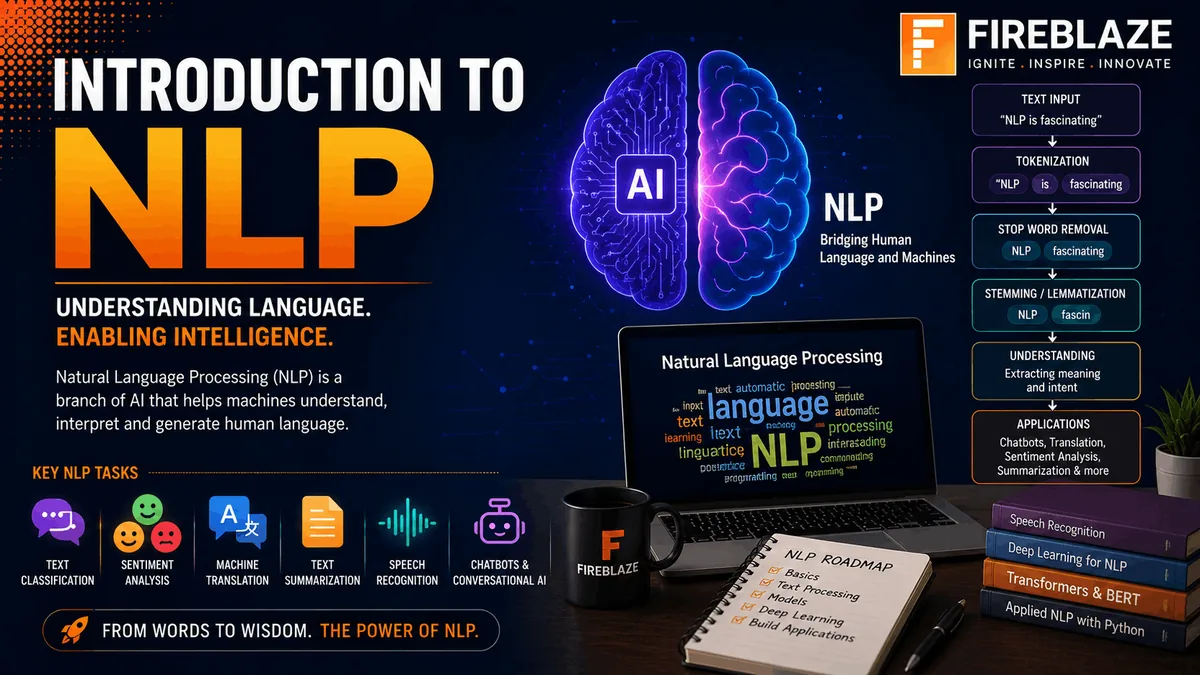
Language is one of the most powerful ways humans communicate. Every day, people send messages, write emails, search on Google, post on social media, and interact with virtual assistants using natural language.
But how do computers understand human language?
The answer lies in:
Natural Language Processing (NLP)
NLP is one of the most exciting fields within Artificial Intelligence and Machine Learning. It allows computers to understand, interpret, process, and generate human language in a meaningful way.
Today, NLP powers technologies such as:
ChatGPT
Google Translate
Siri
Alexa
Customer Support Chatbots
Speech Recognition Systems
Sentiment Analysis Tools
In this guide, you'll learn everything you need to know about Natural Language Processing.
What is Natural Language Processing (NLP)?
Natural Language Processing (NLP) is a branch of Artificial Intelligence (AI) that enables computers to understand, analyze, interpret, and generate human language.
In simple words:
NLP helps computers communicate with humans using natural language.
Natural language includes:
English
Hindi
Spanish
French
Arabic
Any language used by humans
Why is NLP Important?
Humans naturally communicate through language.
However, computers understand:
Binary Data (0s and 1s)
NLP acts as a bridge between human communication and machine understanding.
Benefits include:
Automated communication
Better customer experiences
Faster information retrieval
Intelligent virtual assistants
Improved business insights
Examples of NLP in Daily Life
You interact with NLP more often than you realize.
Examples include:
Google Search
Understanding search queries.
ChatGPT
Generating human-like responses.
Google Translate
Translating text between languages.
Siri and Alexa
Understanding voice commands.
Gmail
Smart email suggestions and spam filtering.
Netflix and Amazon
Recommendation systems using text analysis.
How NLP Works
NLP involves multiple stages of processing text and language data.
The basic workflow is:
Text Input
→ Preprocessing
→ Feature Extraction
→ Model Building
→ Output Generation
NLP Pipeline
A typical NLP system follows these steps.
Step 1: Text Collection
Data is gathered from sources such as:
Websites
Social Media
Emails
Documents
Customer Reviews
Step 2: Text Cleaning
Raw text often contains:
Special characters
Punctuation
HTML tags
Extra spaces
Example:
"Hello!!! Welcome to NLP :)"
After cleaning:
"Hello Welcome to NLP"
Step 3: Tokenization
Tokenization breaks text into smaller units called tokens.
Example:
"I love NLP"
Tokens:
["I", "love", "NLP"]
Step 4: Stop Word Removal
Common words such as:
is
are
the
and
of
are often removed.
Example:
"The cat is sleeping"
Becomes:
["cat", "sleeping"]
Step 5: Stemming
Stemming reduces words to their root form.
Examples:
playing → play
played → play
player → play
Step 6: Lemmatization
Lemmatization converts words into meaningful dictionary forms.
Examples:
running → run
better → good
Lemmatization is generally more accurate than stemming.
Key NLP Techniques
Several techniques are used depending on the application.
Text Classification
Text classification assigns predefined categories to text.
Examples:
Spam Detection
News Categorization
Topic Classification
Sentiment Analysis
Sentiment Analysis determines emotional tone.
Examples:
Positive
Negative
Neutral
Applications:
Product Reviews
Customer Feedback
Social Media Monitoring
Named Entity Recognition (NER)
NER identifies important entities within text.
Example:
Elon Musk founded SpaceX.
Entities:
Person → Elon Musk
Organization → SpaceX
Part-of-Speech Tagging
Identifies grammatical roles of words.
Example:
John is running.
Tags:
John → Noun
Running → Verb
Machine Translation
Automatically translates text between languages.
Examples:
Google Translate
Microsoft Translator
Text Summarization
Creates shorter versions of large documents.
Applications:
News Summaries
Research Papers
Business Reports
Question Answering Systems
Answers questions using textual knowledge.
Examples:
ChatGPT
Virtual Assistants
Search Engines
NLP and Machine Learning
Modern NLP heavily relies on Machine Learning.
Traditional NLP methods used:
Rules
Dictionaries
Grammar-based systems
Modern NLP uses:
Machine Learning
Deep Learning
Neural Networks
This significantly improves performance.
NLP and Deep Learning
Deep Learning revolutionized NLP.
Popular architectures include:
RNN (Recurrent Neural Networks)
Used for sequential data.
LSTM (Long Short-Term Memory)
Improves long-term memory handling.
Transformers
Modern NLP architecture.
Used in:
ChatGPT
Gemini
Claude
BERT
What is BERT?
BERT stands for:
Bidirectional Encoder Representations from Transformers
Developed by Google.
Benefits:
Better language understanding
Improved search results
Enhanced contextual learning
What are Large Language Models (LLMs)?
Large Language Models are advanced NLP systems trained on massive amounts of text.
Examples:
ChatGPT
Gemini
Claude
Llama
Capabilities:
Content Generation
Translation
Coding Assistance
Summarization
Question Answering
Popular NLP Libraries
Several tools simplify NLP development.
NLTK
Natural Language Toolkit.
Used for:
Text Processing
Tokenization
Stemming
SpaCy
Popular for production NLP systems.
Benefits:
Fast
Efficient
Industry-ready
TextBlob
Beginner-friendly NLP library.
Applications:
Sentiment Analysis
Text Processing
Transformers
Developed by Hugging Face.
Used for:
BERT
GPT Models
Modern NLP Applications
Real-World Applications of NLP
NLP is used across many industries.
Healthcare
Applications:
Medical Document Analysis
Clinical Text Processing
Disease Prediction
Banking
Applications:
Fraud Detection
Customer Support
Financial Document Analysis
E-Commerce
Applications:
Product Recommendations
Review Analysis
Customer Feedback Monitoring
Education
Applications:
Automated Grading
Intelligent Tutoring Systems
Language Learning
Customer Service
Applications:
Chatbots
Virtual Assistants
Automated Responses
Challenges in NLP
Despite major advancements, NLP still faces challenges.
Ambiguity
Words can have multiple meanings.
Example:
Bank
Could mean:
Financial Institution
River Bank
Context Understanding
Humans understand context naturally.
Machines often struggle.
Sarcasm Detection
Example:
Great! Another meeting...
Humans recognize sarcasm easily.
Machines find it difficult.
Multiple Languages
Supporting different languages increases complexity.
NLP Interview Questions
What is NLP?
NLP is a branch of Artificial Intelligence that enables computers to understand and process human language.
What is Tokenization?
Tokenization breaks text into smaller units called tokens.
Difference Between Stemming and Lemmatization?
| Stemming | Lemmatization |
|---|---|
| Faster | More accurate |
| Root form approximation | Dictionary-based root word |
What is Sentiment Analysis?
A technique used to determine emotional tone in text.
What are Transformers?
Deep Learning architectures that power modern NLP systems like ChatGPT and BERT.
Career Opportunities in NLP
Growing demand has created roles such as:
NLP Engineer
Data Scientist
AI Engineer
Machine Learning Engineer
Research Scientist
Conversational AI Developer
Industries actively hiring NLP professionals include:
Technology
Healthcare
Finance
E-Commerce
Education
Future of NLP
The future of NLP is incredibly promising.
Advancements in:
Large Language Models
Generative AI
Conversational AI
Multilingual Systems
are transforming how humans interact with technology.
As AI continues to evolve, NLP will remain one of the most important and impactful areas of Artificial Intelligence.
Final Thoughts
Natural Language Processing is the technology that enables computers to understand and communicate using human language. From chatbots and virtual assistants to translation systems and Large Language Models, NLP powers many of the intelligent systems we use every day.
For aspiring Data Scientists, AI Engineers, and Machine Learning professionals, understanding NLP is essential. By learning NLP fundamentals, techniques, tools, and applications, you can build a strong foundation for working on some of the most exciting innovations in Artificial Intelligence.
Keep Reading
Related Articles
Learning Guides
Language Translation Using Deep Learning: A Complete Guide
Discover how Deep Learning powers modern language translation systems. Learn Neural Machine Translation, Transformer models, Seq2Seq architecture, applications,
Python 3.9: Features, Improvements, and Complete Beginner's Guide
Python 3.9 introduced several powerful enhancements that improve developer productivity, code readability, and application performance. From dictionary merge op
Data Science Learning Hub: Tutorials, Interview Questions, Projects & Career Resources
Explore Data Science tutorials, Machine Learning guides, Python and SQL resources, interview questions, projects, career roadmaps, analytics concepts, and AI le