 Fireblaze
 Interview Preparation
Ultimate Interview Guide: How to Crack Data Science, Data Analytics & AI Interviews in 2026
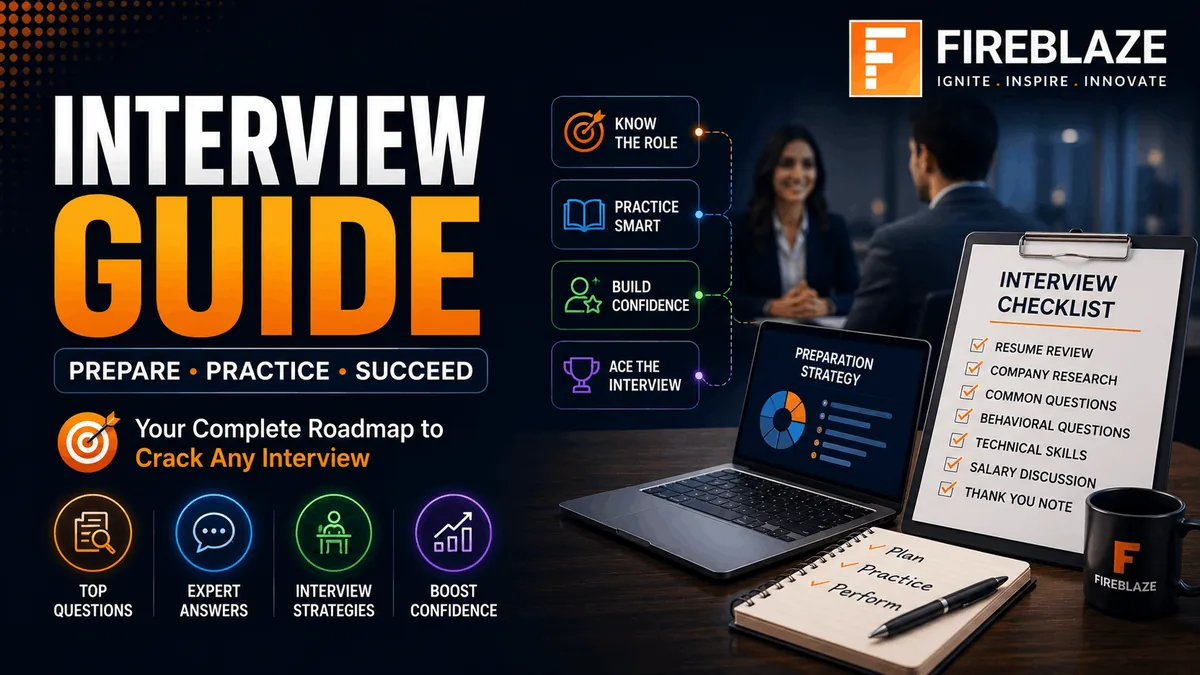
Landing a job in Data Science, Data Analytics, Artificial Intelligence, or Machine Learning requires more than technical knowledge. Companies are increasingly looking for candidates who can combine technical expertise with business problem-solving and communication skills.
Whether you're a fresher preparing for your first interview or a professional looking to advance your career, this comprehensive interview guide will help you prepare effectively.
In this guide, you'll learn:
How Data Science interviews are structured
Key technical topics to prepare
Common interview questions
Resume preparation tips
Project recommendations
HR interview strategies
Mistakes to avoid
Understanding the Interview Process
Most Data Science and Analytics interviews typically follow this structure:
1. Resume Screening
Recruiters evaluate:
Technical Skills
Projects
Internships
Certifications
Work Experience
Your resume creates the first impression.
2. Online Assessment
Companies often test:
SQL
Python
Statistics
Logical Reasoning
Aptitude
Strong fundamentals are essential.
3. Technical Interview
This round focuses on:
Data Analysis
Machine Learning
SQL Queries
Python Programming
Statistics
Business Case Studies
4. Project Discussion
Interviewers frequently ask:
Why did you choose this project?
What challenges did you face?
How did you evaluate performance?
What business value did the project create?
You should be able to explain every project on your resume.
5. Managerial Round
This evaluates:
Problem-Solving Ability
Team Collaboration
Communication Skills
Leadership Potential
6. HR Round
Topics include:
Career Goals
Salary Expectations
Strengths and Weaknesses
Company Fit
Technical Skills You Must Master
SQL
SQL is one of the most frequently tested skills.
Important topics:
Joins
Subqueries
Window Functions
Group By
CTEs
Aggregations
Example:
SELECT department,
AVG(salary)
FROM employees
GROUP BY department;
Python
Python is the most popular programming language in Data Science.
Important topics:
Data Types
Functions
Loops
Pandas
NumPy
File Handling
Exception Handling
Example:
import pandas as pd

df = pd.read_csv("data.csv")
Statistics
Core concepts:
Mean
Median
Mode
Standard Deviation
Hypothesis Testing
Correlation
Probability
Confidence Intervals
Interviewers frequently test statistical thinking.
Machine Learning
Important algorithms include:
Regression
Linear Regression
Logistic Regression
Classification
Decision Trees
Random Forest
XGBoost
Clustering
K-Means
Hierarchical Clustering
Model Evaluation
Accuracy
Precision
Recall
F1 Score
Common Interview Questions
What is the difference between Supervised and Unsupervised Learning?
Supervised Learning
Uses labeled data.
Examples:
Regression
Classification
Unsupervised Learning
Uses unlabeled data.
Examples:
Clustering
Association Rules
What is Overfitting?
Overfitting occurs when a model performs well on training data but poorly on unseen data.
Solutions:
Cross Validation
Regularization
More Data
What is Feature Engineering?
Feature Engineering involves creating meaningful variables from raw data to improve model performance.
What is the difference between INNER JOIN and LEFT JOIN?
INNER JOIN
Returns matching records only.
LEFT JOIN
Returns all records from the left table and matching records from the right table.
Project-Based Questions
Projects are often more important than certifications.
Interviewers may ask:
Why did you choose this project?
What business problem were you solving?
Why did you select a particular algorithm?
How did you measure success?
What improvements would you make?
Always focus on:
Problem
Approach
Results
Business Impact
Best Projects for Interview Preparation
Data Analytics Projects
Sales Dashboard
Customer Segmentation
Marketing Campaign Analysis
Data Science Projects
Loan Approval Prediction
Customer Churn Prediction
Fraud Detection System
AI Projects
Recommendation Engine
Chatbot
Image Classification System
Real-world projects strengthen your resume significantly.
Resume Preparation Tips
A strong resume should include:
Contact Information
LinkedIn
GitHub
Portfolio
Technical Skills
Python
SQL
Power BI
Machine Learning
Projects
Include measurable outcomes whenever possible.
Example:
Developed a customer churn prediction model achieving 89% accuracy.
Certifications
Examples:
Google Data Analytics
IBM Data Science
Microsoft Power BI
Scenario-Based Questions
Interviewers increasingly focus on business scenarios.
Example:
Customer Churn is Increasing. What Would You Do?
Steps:
Analyze historical customer behavior.
Identify churn indicators.
Segment customers.
Build predictive models.
Recommend retention strategies.
Revenue Suddenly Drops. How Would You Investigate?
Approach:
Verify data accuracy.
Analyze trends.
Identify affected segments.
Investigate operational changes.
Recommend corrective actions.
HR Interview Questions
Tell Me About Yourself
Structure:
Education
Skills
Projects
Experience
Career Goals
Keep it concise and relevant.
Why Should We Hire You?
Highlight:
Technical Skills
Problem-Solving Ability
Learning Mindset
Project Experience
What Are Your Strengths?
Examples:
Analytical Thinking
Quick Learning
Communication Skills
What Are Your Weaknesses?
Choose genuine but improvable areas.
Example:
I sometimes spend extra time optimizing solutions, but I have learned to balance perfection with deadlines.
Common Mistakes to Avoid
Memorizing Answers
Understand concepts rather than memorizing definitions.
Ignoring SQL
Many candidates underestimate SQL preparation.
Weak Project Knowledge
Be prepared to explain every project in detail.
Poor Communication
Practice explaining technical concepts in simple language.
Lack of Business Understanding
Companies value business impact, not just technical implementation.
Interview Preparation Roadmap
Week 1
SQL
Python Fundamentals
Week 2
Statistics
Probability
Week 3
Machine Learning
Model Evaluation
Week 4
Projects
Mock Interviews
Resume Refinement
Consistent preparation produces better results than last-minute studying.
Highest-Priority Topics for 2026
Focus on:
Python
SQL
Power BI
Machine Learning
Generative AI
Data Visualization
Business Analytics
A/B Testing
These skills are increasingly requested by employers.
Final Thoughts
Success in Data Science, Data Analytics, and AI interviews comes from a combination of technical knowledge, practical project experience, business understanding, and communication skills.
Rather than trying to memorize hundreds of interview questions, focus on building strong fundamentals, completing meaningful projects, and understanding how data can solve real-world business problems.
With consistent preparation and hands-on practice, you can confidently approach interviews and significantly improve your chances of securing your dream role in Data Science, Analytics, or Artificial Intelligence.
Keep Reading
Related Articles
Interview Preparation
The Coca-Cola Company Data Science Interview Questions and Answers (2026 Guide)
The Coca-Cola Company is one of the world's largest beverage companies, leveraging Data Science, Artificial Intelligence, Machine Learning, Predictive
Huawei Technologies Data Science Interview Questions and Answers (2026 Guide)
Huawei Technologies is a global leader in telecommunications, cloud computing, artificial intelligence, networking, and digital transformation solutio
Convergytics Data Analytics Interview Questions and Answers
Explore the most commonly asked Convergytics Data Analytics interview questions and answers covering SQL, Python, statistics, customer analytics, mark