 Fireblaze
 Learning Guides
Data Science in Healthcare: Applications and Use Cases
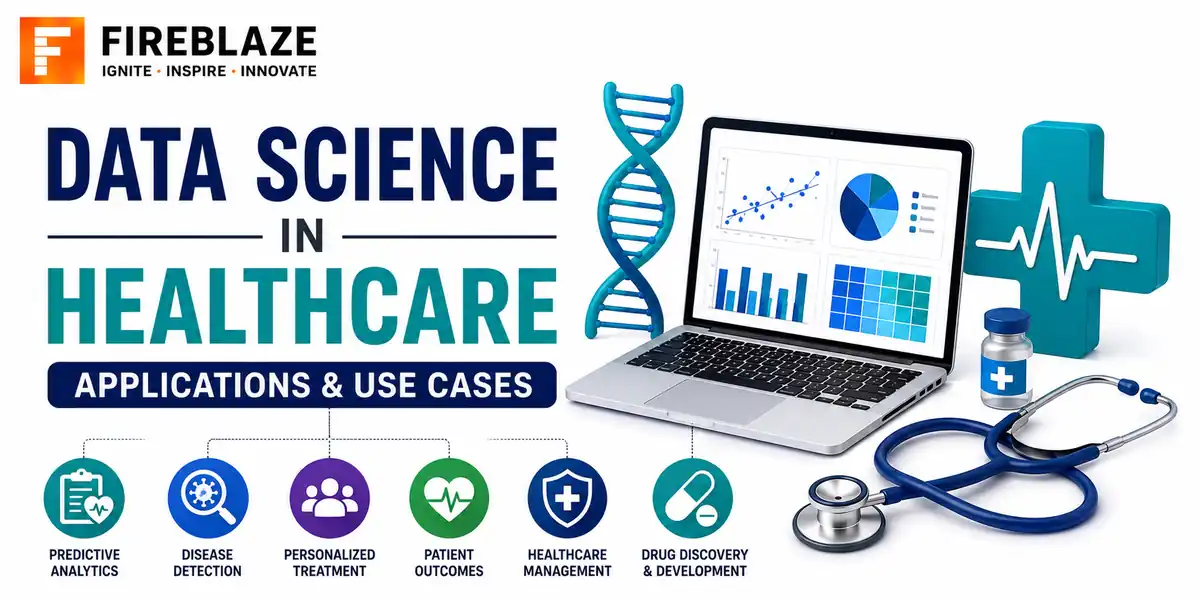
Quick answer: Learn how data science is applied in healthcare, including patient risk prediction, medical imaging, drug discovery, and the unique challenges of healthcare data.
Why Healthcare Data Science is Different
Healthcare data science carries unusually high stakes, since a model's error can directly affect patient safety, and it operates under strict privacy regulation, since patient health data is among the most sensitive data any organisation handles.
Patient Risk Prediction
Models predict which patients are at high risk of a costly hospital readmission or a specific adverse health event, using clinical history, demographics and prior utilisation data, allowing care teams to intervene proactively rather than reactively.
Medical Imaging and Diagnostics Support
Deep learning models, particularly Convolutional Neural Networks, can assist radiologists by highlighting regions of interest in scans such as X-rays and MRIs, though such tools are generally designed to support clinical judgement rather than replace it entirely.
Drug Discovery and Clinical Trials
Data science supports clinical trial design, analysing which patients are likely to respond to a specific treatment, and detecting safety signals in trial data as it accumulates, alongside genomics and bioinformatics analysis in early-stage drug research.
Pharmacovigilance
Ongoing monitoring of drug safety after a product reaches the market uses statistical methods to detect rare adverse events that a clinical trial's limited size and duration may not have surfaced.
Population Health Management
Risk adjustment models predict expected healthcare cost and utilisation based on a population's health conditions and demographics, supporting fair comparison and resource planning across different patient groups.
Why Data Privacy is Especially Strict Here
Patient health data is protected by strict regulations in most countries. Analysts typically work with de-identified or access-controlled data, and every model and dataset needs a clear audit trail of who accessed it and why, a stricter standard than most other industries require.
Why Explainability Matters in Clinical Settings
A clinician needs to understand and trust a model's reasoning before acting on its recommendation for an actual patient, which is why interpretable models or clear explanation techniques are often preferred over pure black box optimisation in clinical decision support.
Common Data Science Roles in Healthcare
Healthcare Data Analyst / Data Scientist
Biostatistician
Clinical Data Analyst
Bioinformatics Scientist
Common Interview Questions
Why is model explainability especially important in healthcare?
Clinicians need to understand and trust a model's reasoning before acting on it for a real patient, and regulatory and ethical standards in clinical settings generally require this level of transparency.
What is risk adjustment in healthcare analytics?
It predicts expected healthcare cost or utilisation based on a patient's health conditions and demographics, enabling fair comparison across populations with genuinely different underlying health needs.
FAQ
Frequently Asked Questions
What are the main applications of data science in healthcare?
Patient risk prediction, medical imaging support, drug discovery and clinical trial analysis, pharmacovigilance, and population health management.
Why is data privacy especially strict in healthcare analytics?
Patient health data is protected by strict regulations, so analysts typically work with de-identified or access-controlled data with a clear audit trail of access.
Why does explainability matter so much in clinical data science?
Clinicians need to understand and trust a model's reasoning before acting on it for a real patient, which pushes practitioners toward interpretable models or clear explanation techniques.
What is pharmacovigilance?
The ongoing monitoring of drug safety after a product reaches the market, using statistical methods to detect rare adverse events a clinical trial's limited size may not have surfaced.
Keep Reading
Related Articles
Learning Guides
INNER JOIN in SQL with Examples: Complete Beginner's Guide
Learn INNER JOIN in SQL with practical examples, syntax, interview questions, and real-world use cases. A complete beginner-friendly SQL JOI
Learning Guides
OUTER JOIN in SQL: Complete Guide with Examples for Beginners
Master OUTER JOIN in SQL with practical examples and real-world scenarios. Learn LEFT JOIN, RIGHT JOIN, FULL OUTER JOIN, syntax, use cases,
Learning Guides
Multi-Row Functions in SQL: Complete Guide with Examples
Learn multi-row (aggregate) functions in SQL including SUM, AVG, COUNT, MIN, MAX, GROUP BY and HAVING, with practical examples, NULL handlin