 Fireblaze
 Interview Preparation
Data Analytics Interview Questions and Answers at Gramener
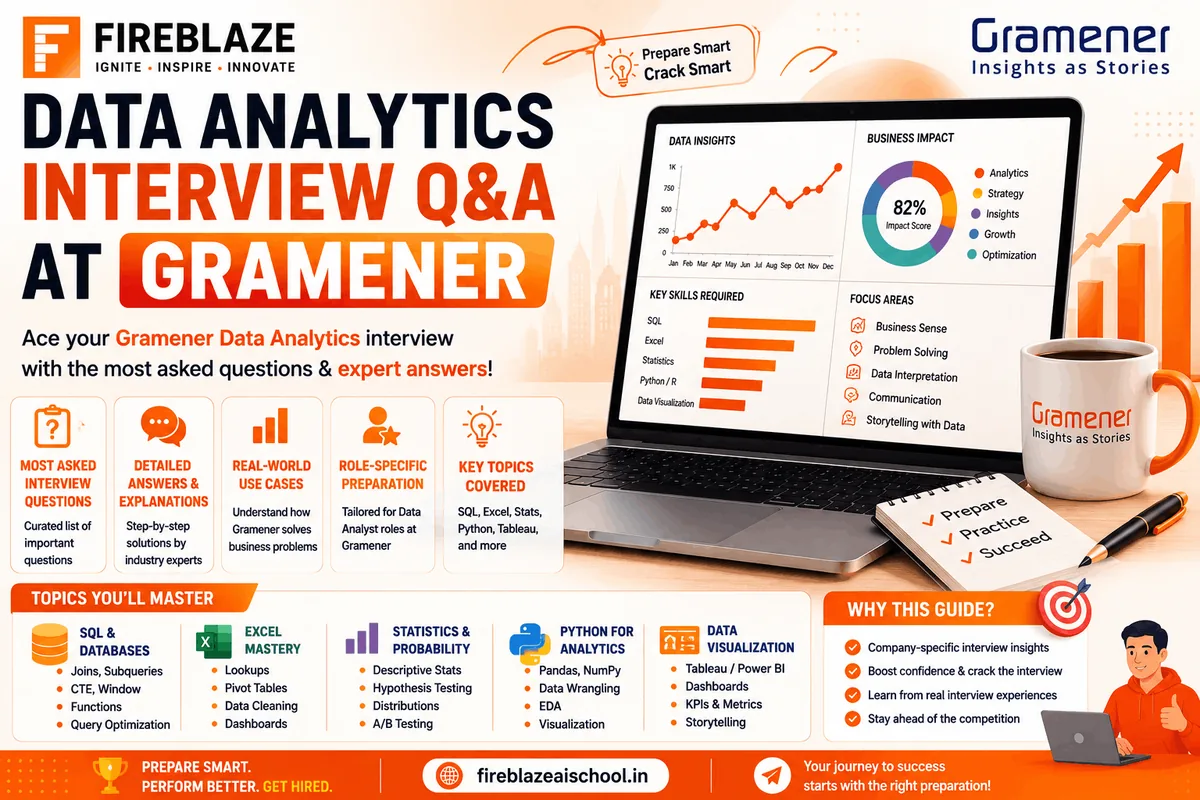
Data Analytics is one of the fastest-growing career domains, with organizations increasingly relying on data-driven decision-making. Companies like Gramener seek professionals who can analyze data, derive meaningful insights, and solve business problems effectively.
If you're preparing for a Data Analytics interview, understanding the commonly asked questions can help you gain confidence and improve your chances of success.
In this article, we'll explore some of the most important Data Analytics interview questions and answers that can help aspiring Data Analysts prepare for interviews at Gramener and similar organizations.
1. What is Data Analytics?
Answer
Data Analytics is the process of collecting, cleaning, transforming, and analyzing data to uncover patterns, trends, and insights that support decision-making.
The primary objective of Data Analytics is to convert raw data into actionable business insights.
Applications include:
Marketing Analytics
Sales Analysis
Customer Behavior Analysis
Financial Analysis
Healthcare Analytics
2. What are the Different Types of Data Analytics?
Answer
Data Analytics can be categorized into four major types:
Descriptive Analytics
Answers:
What happened?
Example:
Monthly sales reports and dashboard summaries.
Diagnostic Analytics
Answers:
Why did it happen?
Example:
Identifying reasons behind declining sales.
Predictive Analytics
Answers:
What is likely to happen?
Example:
Forecasting future demand using historical data.
Prescriptive Analytics
Answers:
What should be done?
Example:
Providing recommendations to improve business performance.
3. Why is SQL Important for Data Analysts?
Answer
SQL (Structured Query Language) is the foundation of Data Analytics because most business data is stored in relational databases.
Data Analysts use SQL for:
Data Extraction
Filtering Records
Data Aggregation
Report Generation
Dashboard Development
Strong SQL skills are often considered mandatory for analytics roles.
4. What is the Difference Between WHERE and HAVING Clauses?
Answer
| WHERE | HAVING |
|---|---|
| Filters rows before aggregation | Filters groups after aggregation |
| Cannot use aggregate functions | Can use aggregate functions |
Example:
SELECT department, COUNT(*)
FROM employees
GROUP BY department
HAVING COUNT(*) > 10;
The HAVING clause filters grouped results after aggregation.
5. Explain INNER JOIN and LEFT JOIN.
INNER JOIN
Returns only matching records from both tables.
LEFT JOIN
Returns all records from the left table and matching records from the right table.
Example:
A company may use INNER JOIN to find customers who placed orders and LEFT JOIN to identify customers who have never made a purchase.
6. What is Data Cleaning?
Answer
Data Cleaning is the process of identifying and correcting errors, inconsistencies, duplicates, and missing values within a dataset.
Common data cleaning activities include:
Removing duplicate records
Handling missing values
Standardizing formats
Correcting invalid entries
Removing irrelevant data
Data quality directly impacts analytical accuracy.
7. What is an Outlier?
Answer
An outlier is a data point that significantly differs from other observations in a dataset.
Example:
If most customer purchases range between ₹500 and ₹5,000 but one transaction is ₹5,00,000, that transaction may be considered an outlier.
Outliers may indicate:
Data Entry Errors
Fraudulent Activities
Rare Events
Valuable Business Insights
8. What is the Difference Between Mean, Median, and Mode?
Mean
The average value of a dataset.
Median
The middle value after sorting data.
Mode
The most frequently occurring value.
Example Dataset:
2, 4, 4, 6, 8
Mean = 4.8
Median = 4
Mode = 4
9. What is Correlation?
Answer
Correlation measures the strength and direction of a relationship between two variables.
Positive Correlation
Both variables increase together.
Example:
Study time and exam scores.
Negative Correlation
One variable increases while the other decreases.
Example:
Product price and demand.
No Correlation
No meaningful relationship exists between variables.
10. What is Normalization in Databases?
Answer
Normalization is a database design technique used to reduce redundancy and improve data consistency.
Benefits include:
Improved Data Integrity
Reduced Data Duplication
Easier Database Maintenance
Better Storage Efficiency
Common normal forms include:
First Normal Form (1NF)
Second Normal Form (2NF)
Third Normal Form (3NF)
11. What is ETL?
Answer
ETL stands for:
Extract
Collecting data from multiple sources.
Transform
Cleaning and converting data into a usable format.
Load
Storing processed data into a data warehouse or analytics platform.
ETL is a critical component of business intelligence systems.
12. What is Data Visualization?
Answer
Data Visualization refers to the graphical representation of data using charts, graphs, dashboards, and reports.
Popular tools include:
Power BI
Tableau
Excel
Looker Studio
Data visualization helps stakeholders understand complex information quickly.
13. What is a KPI?
Answer
KPI stands for Key Performance Indicator.
KPIs are measurable metrics used to evaluate business performance against specific objectives.
Examples:
Revenue Growth
Conversion Rate
Customer Retention Rate
Customer Acquisition Cost
Monthly Active Users
14. How Do You Handle Missing Data?
Answer
Common approaches include:
Removing Missing Records
Replacing with Mean Values
Replacing with Median Values
Forward Filling
Predictive Imputation
The choice depends on the dataset and business requirements.
15. What Tools Should Every Data Analyst Know?
Answer
A Data Analyst should ideally be familiar with:
SQL
Excel
Power BI
Tableau
Python
Statistics
Data Cleaning Techniques
Business Analytics Concepts
Practical project experience with these tools significantly improves employability.
Tips to Crack a Data Analytics Interview
Strengthen SQL Skills
Focus on:
Joins
Subqueries
Window Functions
CTEs
Aggregations
Build Real Projects
Work on:
Sales Dashboards
Customer Analytics
Business Reporting
Data Visualization Projects
Learn Statistics
Master concepts such as:
Probability
Correlation
Regression
Hypothesis Testing
Practice Business Case Studies
Interviewers often evaluate analytical thinking and problem-solving abilities.
Why Choose a Career in Data Analytics?
Data Analytics offers opportunities across multiple industries including:
Technology
Finance
Healthcare
E-commerce
Education
Consulting
Popular job roles include:
Data Analyst
Business Analyst
Reporting Analyst
Product Analyst
Business Intelligence Analyst
As organizations continue to embrace data-driven decision-making, the demand for skilled Data Analysts continues to grow.
Final Thoughts
Data Analytics interviews typically assess a combination of technical knowledge, business understanding, and analytical thinking. By mastering SQL, statistics, data visualization, and problem-solving techniques, candidates can significantly improve their chances of success.
Whether you're preparing for interviews at Gramener or any other analytics-focused company, continuous learning, hands-on projects, and strong fundamentals will help you stand out and build a successful career in Data Analytics.
Suggested Internal Links
Data Analytics Course
SQL Interview Questions
Power BI Interview Questions
Data Analyst Career Roadmap
Data Science Course
SQL Joins Explained
Focus Keyword
Data Analytics Interview Questions and Answers
Secondary Keywords
Gramener Data Analytics Interview Questions
Data Analyst Interview Questions
SQL Interview Questions
Data Analytics Interview Preparation
Data Analyst Career Guide
Data Analytics Jobs
Keep Reading
Related Articles
Interview Preparation
Affine Data Analysis Interview Questions and Answers (2026 Guide)
Prepare for Affine Data Analysis interviews with SQL, Python, Statistics, Machine Learning, Data Analytics, Case Studies, and real interview questions and answe
PayPal Data Analytics Interview Questions and Answers
Explore the most commonly asked PayPal Data Analytics interview questions and answers covering SQL, statistics, Python, product analytics, fraud detection, cust
ICICI Bank Top Data Analytics Interview Questions and Answers (2026 Guide)
Explore the most frequently asked ICICI Bank Data Analytics interview questions and answers covering SQL, Python, Statistics, Power BI, Banking Analytics, Machi