 Fireblaze
 Interview Preparation
Data Analyst Interview Questions for Freshers in India
A fresher data analyst interview in India usually runs across three or four rounds: an aptitude or screening stage, a technical round dominated by SQL and Excel, a case or scenario round testing business reasoning, and an HR round. Technical skill gets you through the first half, and communication decides the second.
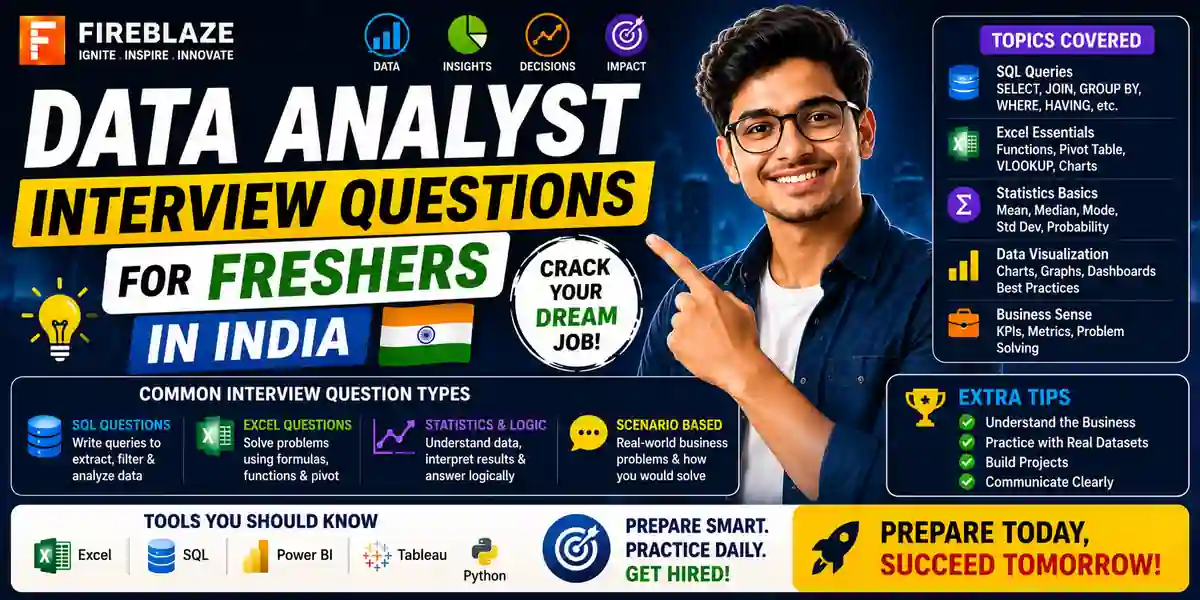
How the process typically runs
Screening
Resume shortlisting, sometimes an aptitude or online assessment. Keep your resume to one page with projects above education if your degree is not the selling point.
Technical round
SQL almost always, Excel frequently, Power BI or Python depending on the role. Usually live rather than take-home.
Case or scenario round
A business situation to reason through. This is the round freshers prepare for least and lose most often.
HR round
Motivation, stability, salary expectations and cultural fit. Rarely a formality, and offers do get withdrawn here.
Technical questions you should expect
What is the difference between a database and a data warehouse?
A database is optimised for transactions: many small reads and writes, current data. A warehouse is optimised for analysis: large scans, historical data, denormalised for query speed. Analysts usually query warehouses.
Explain normalisation in simple terms.
Organising data to reduce duplication, typically by splitting into related tables. Useful for transactional systems. Analytical models often deliberately denormalise for query performance, which is why star schemas exist.
What is the difference between inner join and left join?
Inner join returns only rows with a match in both tables. Left join returns all rows from the left table, with NULLs where the right side has no match. Use left join when the absence of a match is itself meaningful.
How do you handle missing data?
First find out why it is missing, because the reason determines the treatment. Options include dropping rows, imputing with a mean or median, imputing with a business rule, or treating missing as its own category. Whichever you choose, state it explicitly in your output. Silently dropping data is the answer that loses marks.
What is the difference between correlation and causation?
Correlation means two variables move together. Causation means one produces the other. Two correlated variables may both be driven by a third factor. Interviewers ask this to see whether you will overstate a finding.
How would you detect outliers?
Visually with a box plot or histogram, statistically with the interquartile range or z-scores, and contextually by asking whether the value is physically possible. The important follow-up is that not every outlier should be removed. Some are the most interesting data you have.
Case and scenario questions
These have no single right answer. The interviewer is watching your structure, your assumptions and whether you ask clarifying questions before diving in.
Our app's daily active users dropped 20% last week. How would you investigate?
Check the data pipeline first, because a tracking bug is a very common cause. Then segment: is the drop across all platforms, regions, versions and user cohorts, or concentrated? Compare against seasonality and any release or marketing change. Form a hypothesis, then test it. Say this structure out loud rather than listing random checks.
How would you measure whether a new feature is successful?
Start by asking what the feature was meant to achieve, because success is defined relative to intent. Then choose a primary metric, a guardrail metric to catch harm elsewhere, and a measurement window. Mention that an A/B test is preferable to a before-and-after comparison, and say why.
A manager asks for a report you think is the wrong thing to measure. What do you do?
Build what was asked, and alongside it show the metric you believe is more useful, with a short explanation. Refusing outright damages the relationship. Delivering silently wastes the opportunity. This question tests judgement, not technical skill.
HR questions, and what they are really asking
Why do you want to be a data analyst?
They are checking whether your interest is genuine or whether you followed a trend. Give a specific origin: a project, a problem you solved, a moment something clicked. Avoid saying it is a growing field, which every other candidate also says.
Why should we hire you with no experience?
Point to evidence rather than enthusiasm. A project you built end to end, a problem you solved without being told how, feedback you received. Enthusiasm is not differentiating because everybody claims it.
Where do you see yourself in five years?
The underlying question is whether you will leave in eight months. Describe growth within the analytics track rather than naming an unrelated ambition.
What are your salary expectations?
For a first role, state that you are focused on learning and would like to understand their band for the position. If pressed, give a range rather than a single number, based on the role and company type.
Questions you should ask them
Candidates who ask nothing read as uninterested. Three that consistently produce useful answers:
- What does a typical week look like for this role?
- Who will review my work, and how does feedback happen?
- What does success in the first six months look like?
Preparation checklist
- One page resume, projects above education, no skill listed that you cannot discuss for five minutes.
- Two projects you can walk through in depth, including limitations.
- SQL practice out loud, on unfamiliar schemas.
- Three case scenarios rehearsed for structure rather than answers.
- A specific, honest reason for wanting the role.
Mock interviews with recorded feedback, group discussions and communication training run from month one in our data analyst course in Nagpur and Post Graduate Program, because this is the part candidates neglect and interviewers weight heavily. See also our placement process.
Watch
AI Mock Interviews on the Fireblaze Recruitment Portal
FAQ
Frequently Asked Questions
How many rounds are there in a data analyst interview?
Usually three or four: screening or aptitude, a technical round dominated by SQL and Excel, a case or scenario round, and an HR round. Larger IT services companies often add an additional managerial round.
What should a fresher data analyst resume include?
One page, with projects placed above education if your degree is not the strongest selling point. List only tools you can discuss in depth, and describe each project by the business question it answered rather than the technology used.
Do freshers get asked machine learning questions?
Rarely for analyst roles. Expect SQL, Excel, business intelligence tools and reasoning about data. Machine learning questions belong to data scientist interviews.
What is the hardest round for freshers?
The case or scenario round, because it cannot be memorised. It tests whether you can structure an unfamiliar problem and state assumptions, which is a skill built by practice rather than study.
Keep Reading
Related Articles
Interview Preparation
SQL Interview Questions for Data Analysts (With Answers)
The questions that actually come up in analyst interviews, with answers and the reasoning interviewers are listening for.
Interview Preparation
Power BI Interview Questions and Answers for Analysts
Data modelling and DAX are where these interviews are won or lost. Here is what gets asked, and why.
Interview Preparation
IT Companies in Nagpur: Who Hires Freshers and How to Prepare
Different employers in Nagpur test very different things. Knowing which you are applying to changes how you prepare.