 Fireblaze
 Learning Guides
Beginner’s Guide to Scikit-Learn: Machine Learning Made Simple
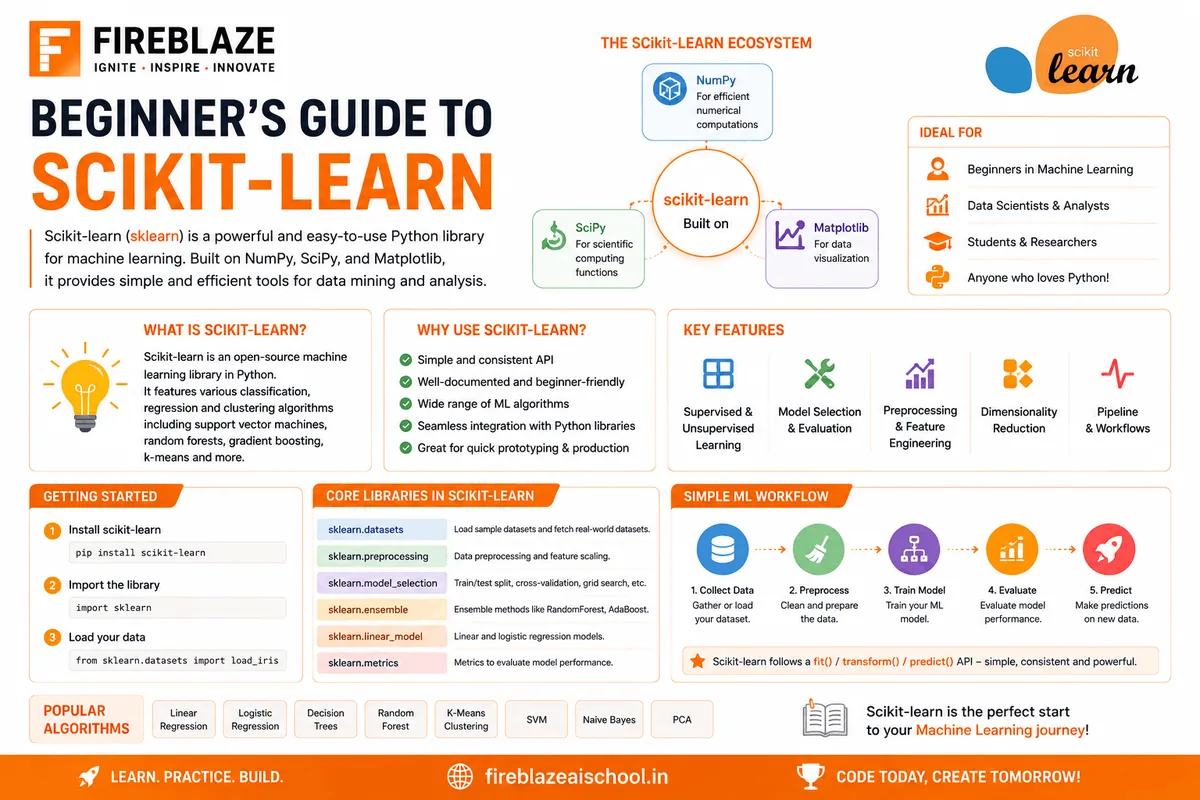
Machine Learning has become one of the most in-demand skills in Data Science, Artificial Intelligence, and Analytics. Whether you're predicting customer churn, detecting fraud, or building recommendation systems, machine learning plays a critical role in solving real-world problems.
One of the most popular Python libraries for Machine Learning is Scikit-Learn.
Scikit-Learn provides simple and efficient tools for data analysis, model building, and predictive analytics, making it the perfect library for beginners entering the world of Machine Learning.
In this guide, you'll learn:
What Scikit-Learn is
Why it is important
Installation and setup
Machine Learning workflow
Classification and Regression
Model Evaluation
Common Algorithms
Real-world applications
Interview Questions
What is Scikit-Learn?
Scikit-Learn is an open-source Machine Learning library built on top of:
NumPy
SciPy
Matplotlib
It provides easy-to-use tools for:
Classification
Regression
Clustering
Dimensionality Reduction
Model Evaluation
Data Preprocessing
Scikit-Learn is one of the most widely used libraries in the Data Science ecosystem.
Why Learn Scikit-Learn?
Scikit-Learn is beginner-friendly and production-ready.
Benefits include:
Easy to Learn
Simple APIs and clear documentation.
Wide Range of Algorithms
Supports most commonly used Machine Learning techniques.
Excellent Documentation
Ideal for learning and experimentation.
Industry Adoption
Used by Data Scientists and Machine Learning Engineers worldwide.
Installing Scikit-Learn
Install using pip:
pip install scikit-learn
Import the library:
import sklearn
You can verify installation:
print(sklearn.__version__)
Machine Learning Workflow in Scikit-Learn
A typical workflow includes:
Load Data
Preprocess Data
Split Dataset
Train Model
Evaluate Model
Make Predictions
This workflow applies to most Machine Learning projects.
Loading a Dataset
Scikit-Learn provides built-in datasets.
Example:
from sklearn.datasets import load_iris

iris = load_iris()

print(iris.data[:5])
The Iris dataset is commonly used for classification examples.
Splitting Data into Training and Testing Sets
Before training a model, data is usually split.
Example:
from sklearn.model_selection import train_test_split

X_train, X_test, y_train, y_test = train_test_split(
    X,
    y,
    test_size=0.2,
    random_state=42
)
Benefits:
Prevents overfitting
Measures real-world performance
Data Preprocessing
Machine Learning models require clean and structured data.
Common preprocessing steps:
Handling Missing Values
Feature Scaling
Encoding Categorical Variables
Feature Scaling
Example:
from sklearn.preprocessing import StandardScaler

scaler = StandardScaler()

X_scaled = scaler.fit_transform(X)
Feature scaling improves model performance.
Classification Using Scikit-Learn
Classification predicts categories.
Examples:
Spam Detection
Disease Prediction
Customer Churn Prediction
Logistic Regression Example
from sklearn.linear_model import LogisticRegression

model = LogisticRegression()

model.fit(X_train, y_train)

predictions = model.predict(X_test)
This trains a classification model.
Regression Using Scikit-Learn
Regression predicts continuous values.
Examples:
House Price Prediction
Sales Forecasting
Revenue Estimation
Linear Regression Example
from sklearn.linear_model import LinearRegression

model = LinearRegression()

model.fit(X_train, y_train)

predictions = model.predict(X_test)
Popular Machine Learning Algorithms
Scikit-Learn provides many algorithms.
Classification
Logistic Regression
Decision Tree
Random Forest
Support Vector Machine (SVM)
K-Nearest Neighbors (KNN)
Regression
Linear Regression
Ridge Regression
Lasso Regression
Clustering
K-Means
DBSCAN
Hierarchical Clustering
Decision Tree Example
from sklearn.tree import DecisionTreeClassifier

model = DecisionTreeClassifier()

model.fit(X_train, y_train)
Decision Trees are easy to interpret and visualize.
Random Forest Example
from sklearn.ensemble import RandomForestClassifier

model = RandomForestClassifier()

model.fit(X_train, y_train)
Random Forest combines multiple decision trees to improve accuracy.
Model Evaluation
Evaluating model performance is crucial.
Accuracy Score
from sklearn.metrics import accuracy_score

accuracy = accuracy_score(
    y_test,
    predictions
)
Confusion Matrix
from sklearn.metrics import confusion_matrix

cm = confusion_matrix(
    y_test,
    predictions
)
Used to evaluate classification models.
Classification Report
from sklearn.metrics import classification_report

print(
classification_report(
y_test,
predictions
))
Provides:
Precision
Recall
F1 Score
Cross Validation
Cross Validation improves reliability.
Example:
from sklearn.model_selection import cross_val_score

scores = cross_val_score(
    model,
    X,
    y,
    cv=5
)
Benefits:
Better model evaluation
Reduced overfitting risk
Hyperparameter Tuning
Hyperparameters affect model performance.
Example using GridSearchCV:
from sklearn.model_selection import GridSearchCV
Grid Search finds optimal parameter combinations.
Feature Selection
Feature Selection helps remove irrelevant variables.
Benefits:
Better accuracy
Faster training
Reduced complexity
Example:
from sklearn.feature_selection import SelectKBest
Clustering with K-Means
K-Means groups similar data points.
Example:
from sklearn.cluster import KMeans

kmeans = KMeans(n_clusters=3)

kmeans.fit(X)
Applications:
Customer Segmentation
Market Analysis
User Grouping
Real-World Applications of Scikit-Learn
Banking
Fraud Detection
Credit Risk Analysis
Healthcare
Disease Prediction
Medical Diagnostics
Retail
Customer Segmentation
Demand Forecasting
Marketing
Lead Scoring
Campaign Optimization
Finance
Stock Market Analysis
Revenue Prediction
Scikit-Learn Interview Questions
What is Scikit-Learn?
Scikit-Learn is a Python Machine Learning library used for predictive modeling and data analysis.
What are the Main Features of Scikit-Learn?
Classification
Regression
Clustering
Preprocessing
Model Evaluation
What is Train-Test Split?
A method of dividing data into training and testing sets.
Why is Feature Scaling Important?
Feature scaling ensures variables contribute equally to model training.
What is Cross Validation?
Cross Validation evaluates model performance across multiple data splits.
What is Overfitting?
Overfitting occurs when a model performs well on training data but poorly on unseen data.
Why Learn Scikit-Learn for Data Science?
Scikit-Learn is often the first Machine Learning library learned by Data Scientists.
It provides practical experience with:
Machine Learning Algorithms
Data Preprocessing
Model Evaluation
Predictive Analytics
Mastering Scikit-Learn creates a strong foundation for advanced Machine Learning and Artificial Intelligence development.
Career Opportunities After Learning Scikit-Learn
Professionals skilled in Scikit-Learn can pursue roles such as:
Data Analyst
Data Scientist
Machine Learning Engineer
AI Engineer
Business Analyst
Scikit-Learn remains one of the most requested Machine Learning skills in job descriptions worldwide.
Final Thoughts
Scikit-Learn is one of the most powerful and beginner-friendly Machine Learning libraries available in Python. It simplifies complex machine learning tasks and provides everything needed to build, evaluate, and deploy predictive models.
Whether you're starting your Data Science journey or preparing for Machine Learning interviews, mastering Scikit-Learn is a crucial step toward becoming a successful Data Scientist or AI professional.
Keep Reading
Related Articles
Learning Guides
Language Translation Using Deep Learning: A Complete Guide
Discover how Deep Learning powers modern language translation systems. Learn Neural Machine Translation, Transformer models, Seq2Seq architecture, applications,
Python 3.9: Features, Improvements, and Complete Beginner's Guide
Python 3.9 introduced several powerful enhancements that improve developer productivity, code readability, and application performance. From dictionary merge op
Data Science Learning Hub: Tutorials, Interview Questions, Projects & Career Resources
Explore Data Science tutorials, Machine Learning guides, Python and SQL resources, interview questions, projects, career roadmaps, analytics concepts, and AI le