 Fireblaze
 Career Roadmaps
Key Challenges and the Roadmap to Get Into Data Science with Mr. Vijay Pravin Maharajan (EP-04)
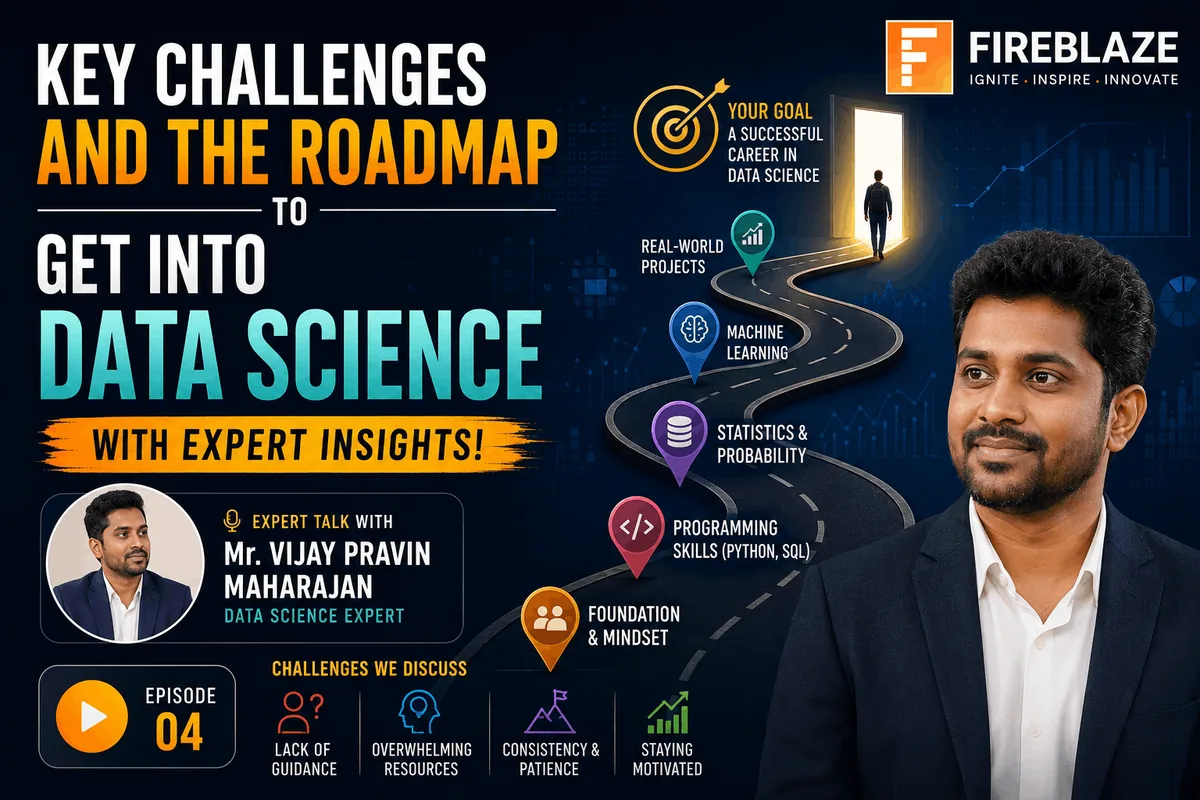
Data Science is one of the most exciting and rapidly growing career fields in the world today. Organizations across industries are leveraging data to make smarter decisions, automate processes, improve customer experiences, and drive innovation.
However, for beginners, entering the field of Data Science can feel overwhelming. With countless online courses, programming languages, frameworks, tools, and career advice available, many aspiring professionals struggle to determine where to start and what skills truly matter.
In this episode, Mr. Vijay Pravin Maharajan shares practical insights into the challenges faced by aspiring Data Scientists and provides a structured roadmap that can help learners navigate their journey successfully.
Why Data Science Is Growing Rapidly
The world generates massive amounts of data every second.
Examples include:
Social media interactions
Online purchases
Banking transactions
Healthcare records
IoT devices
Business operations
Organizations need professionals who can extract meaningful insights from this data.
This has created high demand for:
Data Scientists
Data Analysts
Machine Learning Engineers
AI Engineers
Business Analysts
Common Challenges Faced by Beginners
Many aspiring Data Scientists face similar obstacles.
1. Information Overload
One of the biggest challenges is deciding:
Which programming language to learn
Which tools are important
Which courses are worth taking
Which technologies to focus on
Many learners become stuck because they try to learn everything at once.
2. Lack of Clear Direction
Beginners often jump directly into Machine Learning without understanding the fundamentals.
Important foundational topics include:
Mathematics
Statistics
Programming
Data Analysis
Without strong fundamentals, advanced concepts become difficult to understand.
3. Tutorial Dependency
Many students spend months watching tutorials but never build real projects.
This creates:
Low confidence
Weak practical skills
Poor interview performance
Real learning begins when you start solving actual problems.
4. Fear of Mathematics
Many learners avoid Data Science because they believe advanced mathematics is mandatory.
While mathematics is important, beginners only need to focus on:
Basic Statistics
Probability
Linear Algebra fundamentals
Basic Calculus concepts
These can be learned gradually during the journey.
5. Lack of Practical Experience
Companies hire professionals who can apply knowledge to real-world problems.
Therefore:
Projects
Case studies
Internships
Competitions
play a crucial role in career growth.
The Complete Roadmap to Get Into Data Science
A structured roadmap helps learners avoid confusion and progress efficiently.
Step 1: Learn Python Programming
Python is the most widely used programming language in Data Science.
Key topics include:
Variables
Data Types
Loops
Functions
Lists
Dictionaries
Object-Oriented Programming
Why Python?
Beginner friendly
Large community
Powerful libraries
Industry standard
Step 2: Master Statistics
Statistics is the foundation of Data Science.
Important concepts include:
Descriptive Statistics
Mean
Median
Mode
Standard Deviation
Inferential Statistics
Hypothesis Testing
Confidence Intervals
Sampling Techniques
Probability
Probability Distributions
Conditional Probability
Bayes Theorem
Step 3: Learn Data Analysis
Data Analysis helps transform raw data into actionable insights.
Important skills:
Data Cleaning
Data Transformation
Exploratory Data Analysis (EDA)
Data Visualization
Popular tools:
Pandas
NumPy
Excel
Step 4: Learn Data Visualization
Visualization helps communicate insights effectively.
Popular libraries:
Matplotlib
Seaborn
Plotly
Popular tools:
Power BI
Tableau
Step 5: Learn SQL
SQL is one of the most important skills for Data Scientists.
Important topics:
SELECT Statements
Joins
Group By
Window Functions
Subqueries
CTEs
Most Data Science interviews include SQL questions.
Step 6: Understand Machine Learning
Once fundamentals are strong, learners can move to Machine Learning.
Supervised Learning
Examples:
Linear Regression
Logistic Regression
Decision Trees
Random Forest
Unsupervised Learning
Examples:
K-Means Clustering
Hierarchical Clustering
PCA
Model Evaluation
Important metrics:
Accuracy
Precision
Recall
F1 Score
ROC-AUC
Step 7: Build Real Projects
Projects are often more valuable than certificates.
Example projects:
Sales Prediction
Customer Churn Prediction
Movie Recommendation System
Fraud Detection
Stock Price Analysis
Projects help demonstrate:
Technical skills
Problem-solving ability
Business understanding
Step 8: Learn Deployment Basics
Many companies expect Data Scientists to understand how models are deployed.
Popular technologies:
Flask
FastAPI
Docker
Cloud Platforms
Step 9: Create a Strong Portfolio
A portfolio showcases your capabilities.
Include:
GitHub Projects
Case Studies
Dashboards
Research Work
A strong portfolio can significantly improve job opportunities.
Step 10: Prepare for Interviews
Focus on:
SQL
Python
Statistics
Machine Learning
Case Studies
Communication Skills
Practice regularly through mock interviews and coding challenges.
Skills Required to Become a Data Scientist
Technical Skills:
Python
SQL
Statistics
Machine Learning
Data Visualization
Business Skills:
Problem Solving
Communication
Critical Thinking
Domain Knowledge
Soft Skills:
Collaboration
Adaptability
Presentation Skills
Continuous Learning
Common Mistakes to Avoid
Learning Too Many Technologies at Once
Focus on one topic at a time.
Ignoring Fundamentals
Strong foundations lead to long-term success.
Collecting Certificates Without Practice
Projects matter more than certificates.
Avoiding Real Problems
Practical experience is essential.
Comparing Yourself with Others
Everyone learns at a different pace.
Focus on consistent progress.
How Long Does It Take to Learn Data Science?
The timeline depends on your background and dedication.
Approximate learning path:
| Stage | Duration |
|---|---|
| Python Basics | 1-2 Months |
| Statistics | 1-2 Months |
| SQL | 1 Month |
| Data Analysis | 1-2 Months |
| Machine Learning | 2-3 Months |
| Projects & Portfolio | Ongoing |
With consistent effort, many learners can become job-ready within 6–12 months.
Career Opportunities in Data Science
Popular roles include:
Data Scientist
Data Analyst
Machine Learning Engineer
AI Engineer
Business Analyst
Data Engineer
Analytics Consultant
These roles exist across industries such as:
Banking
Healthcare
Retail
Technology
Manufacturing
E-Commerce
Advice from Industry Experts
Successful professionals often emphasize:
Focus on fundamentals
Build projects consistently
Learn by doing
Stay curious
Keep improving communication skills
Data Science is a marathon, not a sprint.
Final Thoughts
Breaking into Data Science can seem challenging, but with the right roadmap, consistent effort, and practical learning approach, anyone can build a successful career in this field.
As highlighted by Mr. Vijay Pravin Maharajan, aspiring Data Scientists should focus on mastering fundamentals, gaining hands-on experience, building meaningful projects, and continuously learning from real-world problems.
The journey may take time, but persistence, discipline, and practical application will ultimately help you become a confident and industry-ready Data Science professional.
Keep Reading
Related Articles
Career Roadmaps
How to Make a Successful Career Transition into Data Science
Learn how to successfully transition into Data Science from any background. Discover the skills, roadmap, projects, tools, certifications, and career strategies
How to Become a Data Analyst in India: A Step-by-Step Roadmap
The skills that actually get you hired, in the order worth learning them, and an honest view of how long it takes.
Data Analyst vs Data Scientist: Which Career Should You Choose?
Different jobs, not different levels. Here is what each actually does daily, and which is the more realistic first move.