What Are Machine Learning Algorithms? Types and Applications Explained
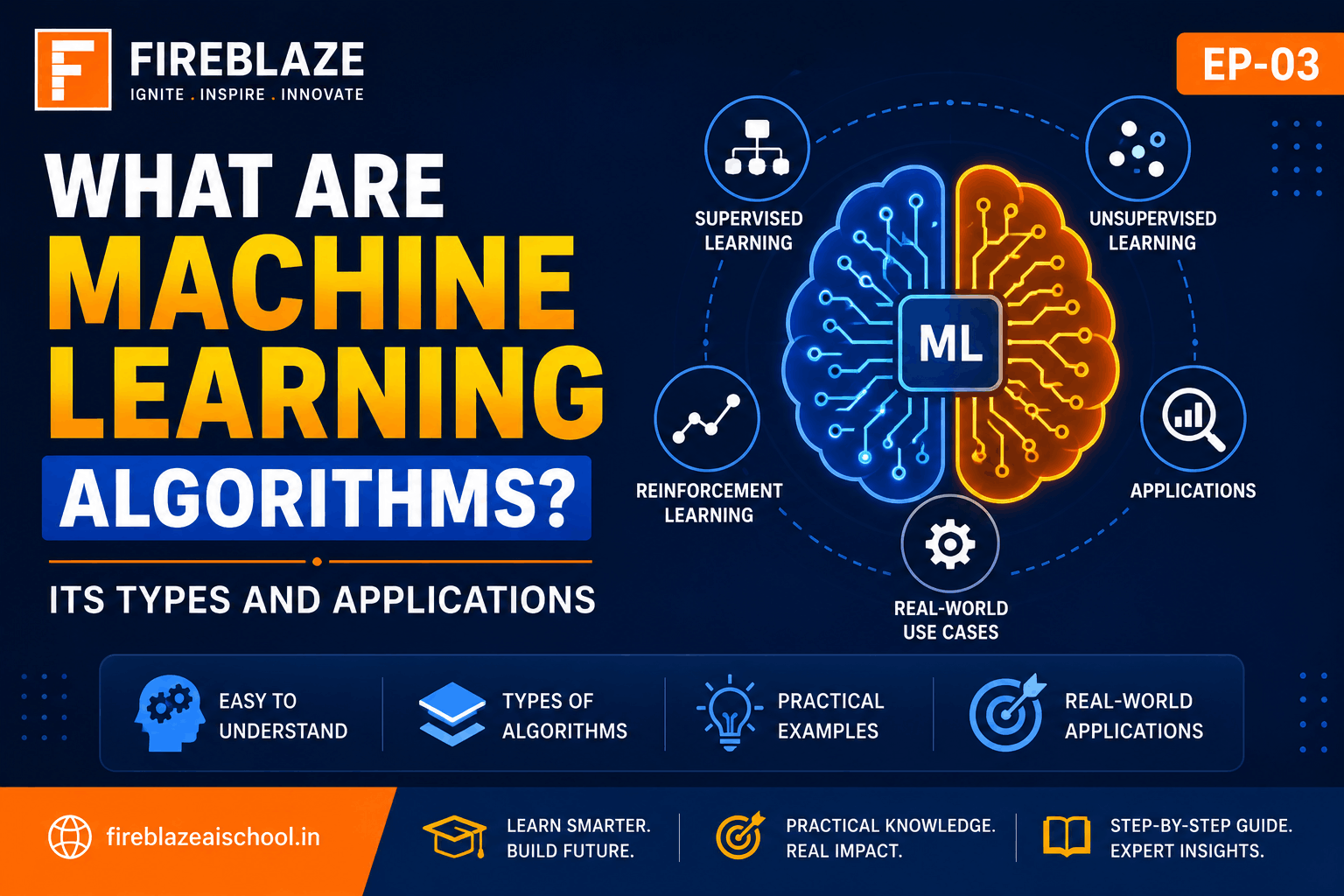
What Are Machine Learning Algorithms? Types and Applications
Machine Learning (ML) is one of the most transformative technologies in Artificial Intelligence. It enables computers to learn patterns from data and make predictions or decisions without being explicitly programmed.
At the core of every Machine Learning system are Machine Learning Algorithms. These algorithms help machines identify relationships in data, learn from experience, and improve performance over time.
In this article, we'll explore Machine Learning algorithms, their types, popular examples, and real-world applications.
What is a Machine Learning Algorithm?
A Machine Learning Algorithm is a mathematical and statistical model that learns patterns from data and uses those patterns to make predictions, classifications, or decisions.
Instead of following fixed instructions, Machine Learning algorithms improve automatically as they process more data.
Example:
A spam email filter learns from previous emails and predicts whether a new email is spam or not.
Why Are Machine Learning Algorithms Important?
Machine Learning algorithms help organizations:
Automate decision-making
Predict future outcomes
Identify hidden patterns
Improve customer experiences
Optimize business operations
Reduce manual effort
They are widely used in Artificial Intelligence applications across multiple industries.
Types of Machine Learning Algorithms
Machine Learning algorithms are generally classified into three major categories:
Supervised Learning
Unsupervised Learning
Reinforcement Learning
Let's understand each type.
1. Supervised Learning Algorithms
Supervised Learning uses labeled datasets where both input and output values are known.
The algorithm learns from historical examples and predicts future outcomes.
Example
Input:
House Size
Output:
House Price
The model learns the relationship between size and price.
Popular Supervised Learning Algorithms
Linear Regression
Used for predicting continuous numerical values.
Applications:
Sales Forecasting
Revenue Prediction
Price Estimation
Logistic Regression
Used for classification problems.
Applications:
Spam Detection
Disease Prediction
Customer Churn Prediction
Decision Trees
Uses a tree-like structure for decision-making.
Advantages:
Easy to understand
Easy to visualize
Random Forest
Combines multiple decision trees for improved accuracy.
Applications:
Fraud Detection
Credit Risk Analysis
Medical Diagnosis
Support Vector Machine (SVM)
Separates data into different classes using optimal boundaries.
Applications:
Image Classification
Face Recognition
Text Categorization
2. Unsupervised Learning Algorithms
Unsupervised Learning uses unlabeled datasets.
The algorithm identifies patterns and relationships without predefined outcomes.
Applications include:
Customer Segmentation
Market Basket Analysis
Anomaly Detection
Popular Unsupervised Learning Algorithms
K-Means Clustering
Groups similar data points into clusters.
Example:
Segmenting customers based on purchasing behavior.
Hierarchical Clustering
Creates nested groups of similar data points.
Applications:
Customer Segmentation
Biological Research
Principal Component Analysis (PCA)
Reduces data dimensions while preserving important information.
Benefits:
Faster Training
Reduced Complexity
Improved Visualization
Association Rule Learning
Identifies relationships between items.
Example:
Customers buying bread may also buy butter.
Used in recommendation systems and retail analytics.
3. Reinforcement Learning Algorithms
Reinforcement Learning trains models through rewards and penalties.
The algorithm learns by interacting with an environment and maximizing rewards.
Applications include:
Robotics
Self-Driving Cars
Gaming AI
Autonomous Systems
How Reinforcement Learning Works
Agent
The learner making decisions.
Environment
The system where actions occur.
Reward
Positive feedback for good actions.
Penalty
Negative feedback for poor actions.
Example
A self-driving car receives rewards for staying in the correct lane and penalties for unsafe actions.
Popular Machine Learning Algorithms Explained
Linear Regression
Predicts numerical values using a straight-line relationship.
Formula:
Y = mX + c
Applications:
Sales Forecasting
Demand Prediction
Logistic Regression
Predicts probabilities for classification tasks.
Output values range between:
0 and 1
Applications:
Fraud Detection
Medical Diagnosis
Decision Tree
Splits data based on decision rules.
Advantages:
Easy Interpretation
Handles Nonlinear Relationships
Random Forest
Builds multiple decision trees and combines results.
Advantages:
Higher Accuracy
Reduced Overfitting
K-Means Clustering
Partitions data into K groups.
Applications:
Customer Segmentation
Market Analysis
Naive Bayes
Based on Bayes' Theorem.
Applications:
Spam Filtering
Sentiment Analysis
Text Classification
Support Vector Machine (SVM)
Finds the best boundary between classes.
Applications:
Face Recognition
Image Classification
Text Analytics
Machine Learning Algorithms in Real Life
Healthcare
Applications:
Disease Prediction
Medical Imaging
Drug Discovery
Algorithms Used:
Random Forest
Logistic Regression
Neural Networks
Finance
Applications:
Fraud Detection
Credit Scoring
Risk Assessment
Algorithms Used:
Decision Trees
Random Forest
SVM
E-Commerce
Applications:
Product Recommendations
Customer Segmentation
Demand Forecasting
Algorithms Used:
K-Means
Collaborative Filtering
Association Rules
Social Media
Applications:
Content Recommendations
Sentiment Analysis
User Engagement Prediction
Algorithms Used:
Neural Networks
Naive Bayes
Deep Learning Models
Transportation
Applications:
Route Optimization
Autonomous Driving
Traffic Prediction
Algorithms Used:
Reinforcement Learning
Deep Learning
What Factors Affect Algorithm Selection?
Choosing the right algorithm depends on:
Type of Problem
Classification
Regression
Clustering
Dataset Size
Large datasets may require scalable algorithms.
Data Quality
Missing values and noise affect performance.
Interpretability
Some algorithms are easier to explain than others.
Accuracy Requirements
High-stakes applications require highly accurate models.
Advantages of Machine Learning Algorithms
Benefits include:
Automation
Faster Decision-Making
Pattern Recognition
Improved Accuracy
Scalability
Personalized Experiences
Machine Learning enables organizations to make smarter decisions using data.
Challenges of Machine Learning Algorithms
Despite their advantages, challenges include:
Overfitting
Model memorizes training data.
Underfitting
Model fails to learn patterns.
Data Quality Issues
Poor data leads to poor predictions.
Computational Requirements
Complex models require significant resources.
Bias and Fairness
Biased data may lead to biased outcomes.
Future of Machine Learning Algorithms
Emerging trends include:
Deep Learning
Generative AI
AutoML
Explainable AI (XAI)
Reinforcement Learning
Edge AI
Machine Learning continues to evolve and drive innovation across industries.
Career Opportunities in Machine Learning
Popular job roles include:
Machine Learning Engineer
Data Scientist
AI Engineer
Data Analyst
Research Scientist
Business Intelligence Analyst
Demand for Machine Learning professionals continues to grow worldwide.
Skills Required to Learn Machine Learning
Key skills include:
Programming
Python
R
Mathematics
Statistics
Probability
Linear Algebra
Data Analysis
SQL
Data Visualization
Machine Learning Libraries
Scikit-Learn
TensorFlow
PyTorch
Why Learn Machine Learning?
Machine Learning is one of the most valuable skills in modern technology.
Benefits include:
High Demand Career Opportunities
Strong Salary Potential
Exciting AI Applications
Global Industry Relevance
Learning Machine Learning opens doors to careers in Artificial Intelligence, Data Science, and Analytics.
Final Thoughts
Machine Learning algorithms are the foundation of modern Artificial Intelligence systems. Whether it's predicting customer behavior, detecting fraud, recommending products, or powering self-driving cars, these algorithms help organizations make intelligent decisions from data.
Understanding the different types of Machine Learning algorithms and their applications is essential for anyone pursuing a career in Data Science, Artificial Intelligence, or Machine Learning.
Suggested Internal Links
Introduction to Machine Learning
Introduction to Artificial Intelligence
Supervised vs Unsupervised Learning
Computer Vision Basics
Data Science Career Roadmap
Machine Learning Projects for Beginners
Focus Keyword
Machine Learning Algorithms
Secondary Keywords
Types of Machine Learning Algorithms
Supervised Learning Algorithms
Unsupervised Learning Algorithms
Reinforcement Learning
Machine Learning Applications
Machine Learning Tutorial