Text Lemmatization in NLP: A Complete Beginner's Guide
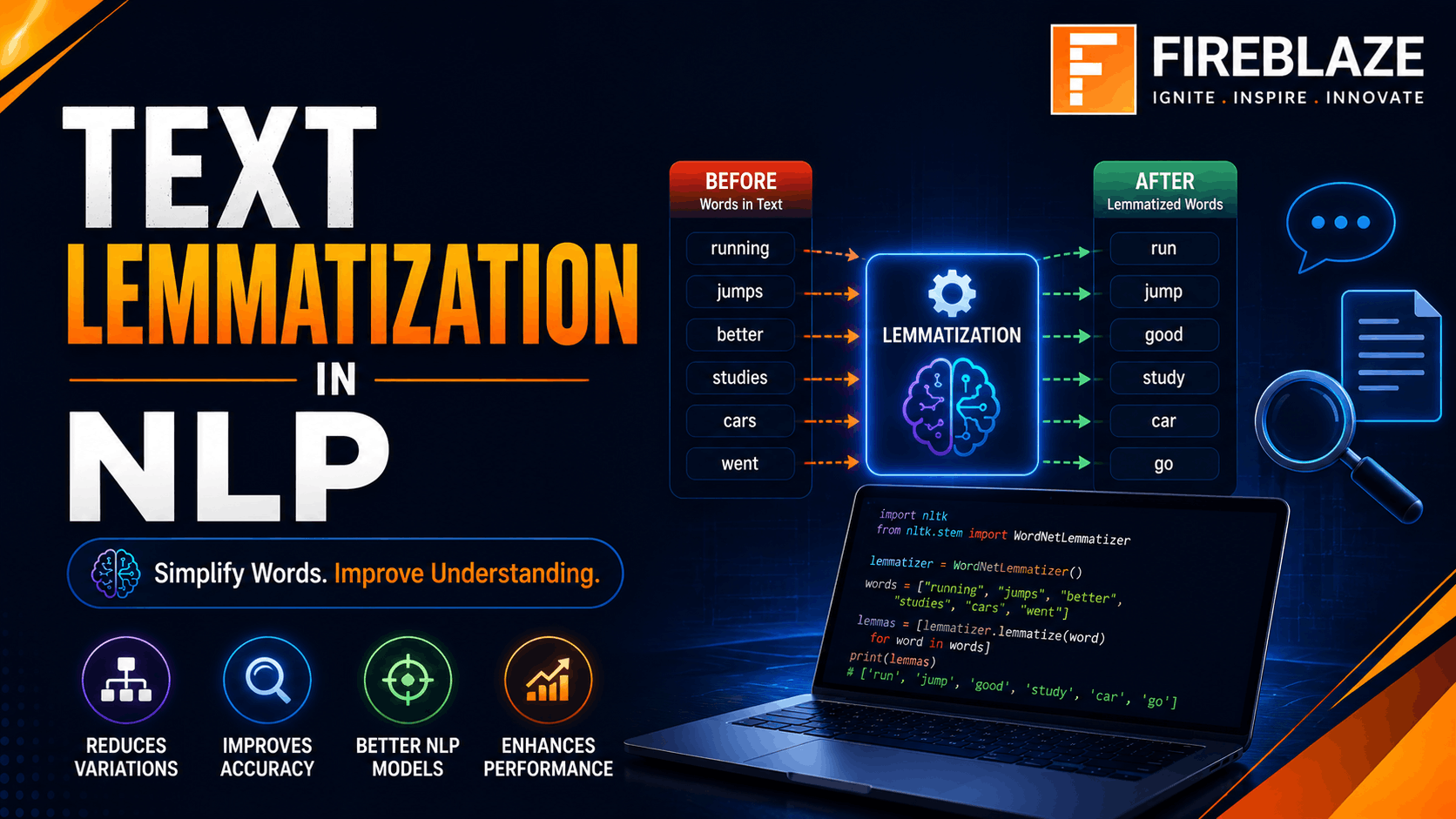
Text Lemmatization in NLP: A Complete Beginner's Guide
Natural Language Processing (NLP) enables computers to understand, process, and analyze human language. Before machines can interpret text effectively, the data must be cleaned and standardized.
One of the most important text preprocessing techniques in NLP is Lemmatization.
Lemmatization helps convert words into their meaningful root forms, improving the accuracy of machine learning and language models.
In this guide, you'll learn:
What Text Lemmatization is
Why it is important
How Lemmatization works
Lemmatization vs Stemming
Python implementation
Real-world applications
NLP interview questions
What is Text Lemmatization?
Text Lemmatization is the process of reducing a word to its base dictionary form, known as a lemma.
Unlike simple word chopping techniques, lemmatization considers the meaning and context of a word.
Examples:
| Original Word | Lemma |
|---|---|
| Running | Run |
| Ran | Run |
| Better | Good |
| Studies | Study |
| Cars | Car |
The resulting word is always a valid dictionary word.
Why is Lemmatization Important?
In NLP, the same concept may appear in different forms.
Example:
Run
Running
Runs
Ran
Although these words are different, they represent the same action.
Without lemmatization, machine learning models may treat them as separate words.
Benefits include:
Reduced vocabulary size
Better text understanding
Improved model accuracy
Enhanced search results
Better sentiment analysis
How Does Lemmatization Work?
Lemmatization uses:
Dictionary lookup
Morphological analysis
Part-of-speech (POS) tagging
to determine the correct root form.
Example:
The children are running in the park.
After lemmatization:
The child be run in the park.
The algorithm identifies the grammatical role of each word before converting it into its lemma.
Lemmatization vs Stemming
Many beginners confuse stemming and lemmatization.
| Stemming | Lemmatization |
|---|---|
| Removes word endings | Converts to dictionary form |
| Faster | More accurate |
| May create invalid words | Produces valid words |
| Rule-based | Context-aware |
Example:
| Word | Stemming | Lemmatization |
|---|---|---|
| Studies | Studi | Study |
| Running | Run | Run |
| Better | Better | Good |
Lemmatization generally provides more meaningful results.
Steps in Text Lemmatization
The process usually follows these steps:
Step 1: Text Input
The boys are playing football.
Step 2: Tokenization
["The", "boys", "are", "playing", "football"]
Step 3: POS Tagging
Identify grammatical roles:
Noun
Verb
Adjective
Adverb
Step 4: Lemmatization
["The", "boy", "be", "play", "football"]
The text becomes more standardized and easier to analyze.
Text Lemmatization Using Python
One of the most common NLP libraries for lemmatization is NLTK.
Install NLTK
pip install nltk
Import Required Libraries
import nltk
from nltk.stem import WordNetLemmatizer
Create Lemmatizer
lemmatizer = WordNetLemmatizer()
Example
print(lemmatizer.lemmatize("running"))
Output:
running
To get accurate results, POS information is often required.
Verb Example
print(
lemmatizer.lemmatize(
"running",
pos="v"
)
)
Output:
run
Lemmatization with SpaCy
SpaCy provides more advanced NLP capabilities.
Install SpaCy:
pip install spacy
Download language model:
python -m spacy download en_core_web_sm
Example:
import spacy

nlp = spacy.load("en_core_web_sm")

doc = nlp(
"The boys are playing football"
)

for token in doc:
    print(
        token.text,
        token.lemma_
    )
Output:
The -> the
boys -> boy
are -> be
playing -> play
football -> football
Advantages of Text Lemmatization
Improved Accuracy
Produces meaningful root words.
Better Search Results
Search engines can understand variations of the same word.
Reduced Vocabulary Size
Makes text processing more efficient.
Enhanced Machine Learning Performance
Improves feature quality in NLP models.
Context Awareness
Considers grammatical structure during transformation.
Real-World Applications
Search Engines
Search systems use lemmatization to improve query matching.
Example:
Searching:
running shoes
can also return results containing:
run shoes
Chatbots
Chatbots understand user intent more accurately through normalized text.
Sentiment Analysis
Lemmatization helps identify emotions and opinions more effectively.
Text Classification
Used in:
Spam Detection
Topic Classification
News Categorization
Information Retrieval
Improves document search and ranking systems.
Healthcare NLP
Used for analyzing:
Medical Reports
Patient Records
Clinical Notes
Challenges in Lemmatization
Requires Language Knowledge
The algorithm needs dictionaries and grammar rules.
Computationally Expensive
More complex than stemming.
Context Dependency
Incorrect POS tagging can lead to incorrect lemmas.
Example:
Saw
Could mean:
A tool
Past tense of "see"
Context determines the correct lemma.
Interview Questions on Lemmatization
What is Lemmatization?
Lemmatization is the process of converting words into their dictionary root forms while considering context and grammar.
What is a Lemma?
A lemma is the base form of a word found in a dictionary.
Example:
Running → Run
What is the Difference Between Stemming and Lemmatization?
Stemming removes suffixes mechanically, while lemmatization produces meaningful dictionary words.
Which Python Libraries Support Lemmatization?
Popular libraries include:
NLTK
SpaCy
Stanford NLP
Why is Lemmatization Important in NLP?
It improves text normalization, reduces vocabulary size, and enhances machine learning model performance.
Why Learn NLP in 2026?
Natural Language Processing powers many modern AI applications:
ChatGPT
Virtual Assistants
Chatbots
Search Engines
Recommendation Systems
Document Analysis
Understanding preprocessing techniques such as lemmatization helps build stronger foundations in AI, Machine Learning, and Generative AI.
As organizations increasingly adopt language-based AI solutions, NLP skills continue to be highly valuable in the job market.
Final Thoughts
Text Lemmatization is one of the most important preprocessing techniques in Natural Language Processing. By converting words into their meaningful root forms, it helps machines better understand human language and improves the performance of NLP models.
Whether you're building chatbots, performing sentiment analysis, creating search engines, or developing AI applications, mastering lemmatization is a crucial step in your NLP learning journey.