Social Distancing Detection Tool Using Deep Learning
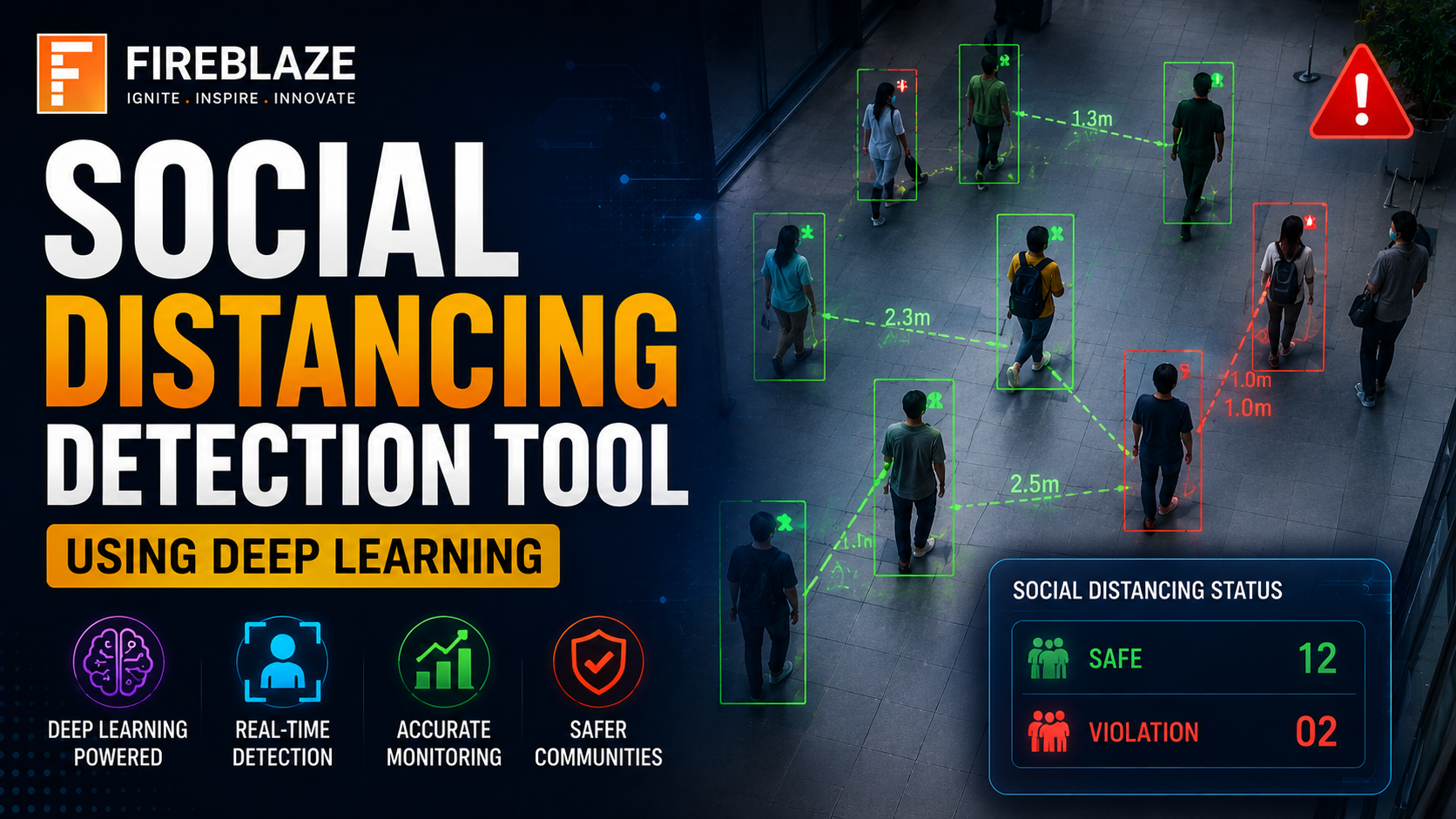
Social Distancing Detection Tool Using Deep Learning
The COVID-19 pandemic accelerated the adoption of Artificial Intelligence and Computer Vision technologies for public health and safety applications. One of the most impactful innovations was the Social Distancing Detection Tool, which uses Deep Learning and Computer Vision to monitor physical distancing between individuals in real time.
By analyzing video feeds from CCTV cameras and surveillance systems, these tools can identify people, calculate distances, and generate alerts whenever social distancing norms are violated.
In this guide, we'll explore how Social Distancing Detection works, the technologies behind it, implementation approaches, and real-world applications.
What is Social Distancing Detection?
Social Distancing Detection is a Computer Vision application that automatically detects individuals in a video stream and measures the distance between them.
The system:
Detects people in real time
Calculates distance between individuals
Identifies violations
Generates alerts or warnings
Provides visual monitoring dashboards
These systems help organizations maintain safety protocols in crowded environments.
Why Use Deep Learning for Social Distancing Detection?
Traditional surveillance systems require human monitoring.
Deep Learning enables:
Automated Monitoring
Real-Time Detection
Higher Accuracy
Scalability
Reduced Human Intervention
AI-powered monitoring systems can process multiple video feeds simultaneously.
Technologies Used
A typical Social Distancing Detection project involves:
Deep Learning
Used for object detection and recognition.
Computer Vision
Processes video frames and visual information.
OpenCV
Handles image and video processing.
Python
Primary programming language for implementation.
YOLO
Real-time object detection framework.
TensorFlow
Deep learning model development.
PyTorch
Model training and deployment.
How Social Distancing Detection Works
The process consists of multiple stages.
Step 1: Video Input
The system receives video feeds from:
CCTV Cameras
Security Cameras
IP Cameras
Drone Cameras
The video stream is processed frame by frame.
Step 2: Person Detection
Deep Learning models identify people within each frame.
Popular models include:
YOLO
You Only Look Once (YOLO) provides fast object detection.
SSD
Single Shot Detector performs real-time detection.
Faster R-CNN
Provides high accuracy for object detection tasks.
The model generates bounding boxes around detected individuals.
Step 3: Distance Calculation
After detecting people, the system calculates distances between bounding box centroids.
Methods include:
Euclidean Distance
Perspective Transformation
Bird's Eye View Mapping
The calculated distance determines whether social distancing rules are being followed.
Step 4: Violation Detection
If the distance between individuals falls below a predefined threshold:
Violation is detected
Alert is generated
Individuals are highlighted
Typically:
Green = Safe Distance
Red = Violation
This provides clear visual feedback.
Step 5: Monitoring Dashboard
Results can be displayed on dashboards showing:
Total People Detected
Violations Detected
Compliance Percentage
Real-Time Alerts
This helps authorities monitor large areas efficiently.
What is YOLO?
YOLO (You Only Look Once) is one of the most popular object detection algorithms.
Advantages:
Real-Time Detection
High Accuracy
Fast Processing
Efficient Deployment
YOLO is commonly used for:
Person Detection
Vehicle Detection
Face Detection
Security Monitoring
It is widely adopted in Social Distancing Detection systems.
What is OpenCV?
OpenCV is an open-source Computer Vision library.
Functions include:
Image Processing
Video Processing
Object Tracking
Face Detection
Motion Detection
OpenCV integrates seamlessly with Deep Learning frameworks.
Sample Workflow
A simplified workflow includes:
Video Feed
    ↓
Person Detection
    ↓
Distance Calculation
    ↓
Violation Detection
    ↓
Alert Generation
    ↓
Dashboard Monitoring
Key Components of the Project
Person Detection Module
Identifies people in video frames.
Distance Measurement Module
Calculates distances between detected individuals.
Alert System
Generates notifications when violations occur.
Visualization Module
Displays real-time monitoring results.
Reporting Dashboard
Provides analytics and insights.
Applications of Social Distancing Detection
Healthcare Facilities
Monitoring patient and visitor movement.
Airports
Managing crowd density and passenger safety.
Shopping Malls
Preventing overcrowding.
Railway Stations
Ensuring public safety in transit areas.
Educational Institutions
Monitoring compliance in classrooms and campuses.
Corporate Offices
Maintaining workplace safety standards.
Manufacturing Plants
Supporting industrial safety protocols.
Benefits of Social Distancing Detection Systems
Automated Monitoring
Reduces dependency on manual supervision.
Real-Time Alerts
Immediate identification of violations.
Scalability
Supports multiple camera feeds.
Increased Safety
Helps maintain health and safety standards.
Data Analytics
Provides valuable compliance insights.
Challenges in Social Distancing Detection
Despite its benefits, several challenges exist.
Camera Perspective Distortion
Distance calculations may vary based on camera angles.
Crowded Environments
Dense crowds increase detection complexity.
Occlusion
People blocking each other can affect detection accuracy.
Lighting Conditions
Poor lighting impacts object detection performance.
Real-Time Processing Requirements
High computational resources may be required.
Future of AI-Based Safety Monitoring
Modern AI systems are evolving to include:
Crowd Density Monitoring
Face Mask Detection
Occupancy Analytics
Smart Surveillance
Behavioral Analysis
Future systems will become more intelligent and autonomous.
Skills Required to Build This Project
Students interested in developing Social Distancing Detection systems should learn:
Python
Core programming language.
OpenCV
Computer Vision library.
Deep Learning
Neural networks and object detection.
TensorFlow or PyTorch
Model development frameworks.
Computer Vision Concepts
Image processing and video analytics.
Object Detection Models
YOLO, SSD, Faster R-CNN.
Career Opportunities
Learning Computer Vision and Deep Learning opens opportunities such as:
Computer Vision Engineer
AI Engineer
Machine Learning Engineer
Data Scientist
Robotics Engineer
Research Scientist
The demand for Computer Vision professionals continues to grow across industries.
Mini Project Ideas
After completing a Social Distancing Detection project, students can build:
Face Mask Detection System
Smart Attendance System
Vehicle Detection System
Crowd Monitoring Dashboard
Traffic Analytics Platform
Human Activity Recognition System
These projects strengthen practical AI and Computer Vision skills.
Final Thoughts
Social Distancing Detection using Deep Learning demonstrates the power of Artificial Intelligence in solving real-world challenges. By combining Computer Vision, Object Detection, Deep Learning, and real-time analytics, organizations can improve safety, automate monitoring, and gain actionable insights.
For students and aspiring AI professionals, building a Social Distancing Detection Tool is an excellent way to gain hands-on experience with Computer Vision, Deep Learning frameworks, and real-world AI applications.
Suggested Internal Links
Introduction to Computer Vision
Deep Learning Interview Questions
Object Detection Using YOLO
Face Mask Detection Project
Machine Learning Algorithms Explained
Artificial Intelligence Career Roadmap
Focus Keyword
Social Distancing Detection Tool Using Deep Learning
Secondary Keywords
Social Distancing Detection
Deep Learning Project
Computer Vision Project
YOLO Object Detection
OpenCV Tutorial
AI Surveillance System