Slingshot Aerospace and TALOS: The AI Agent Training America's Space Force to Fight in Orbit
1. Who is Slingshot Aerospace?
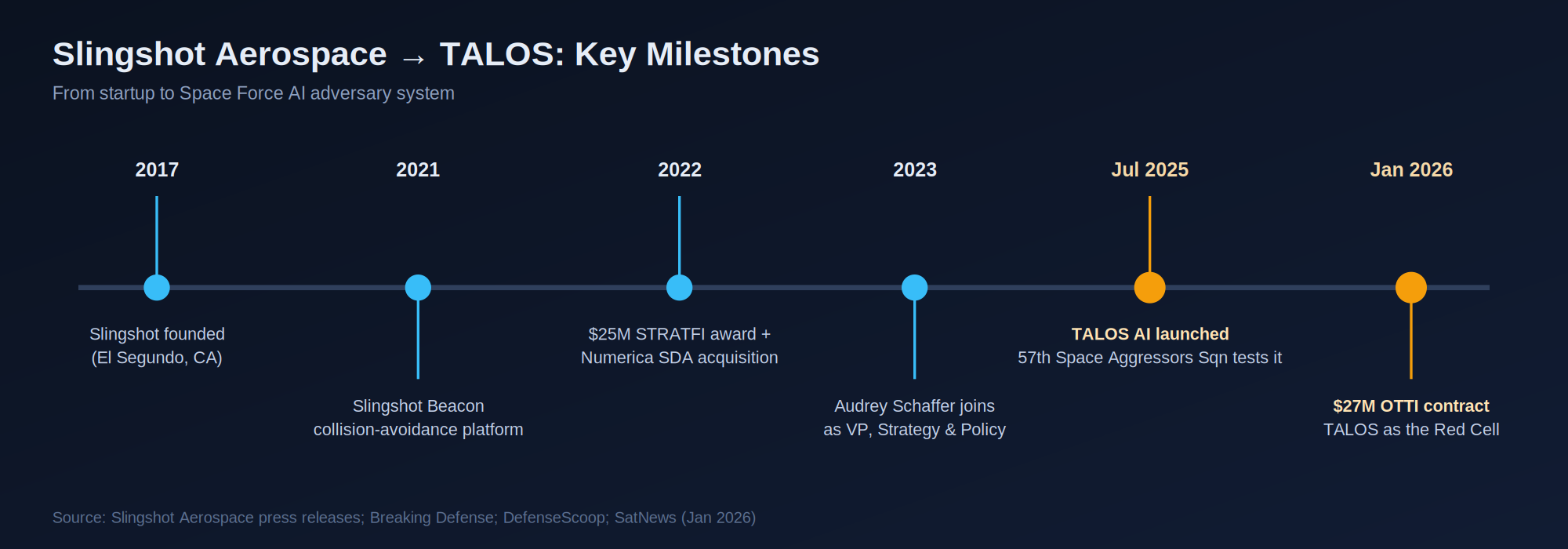
Slingshot Aerospace was started in 2017 by Melanie Stricklan, David Godwin, and Thomas Ashman. Its main office is in El Segundo, California, with more offices in Windsor, Colorado and Austin, Texas. So far, the company has raised about $120 million from investors like ATX Venture Partners, TAcc+, and Gaingels.
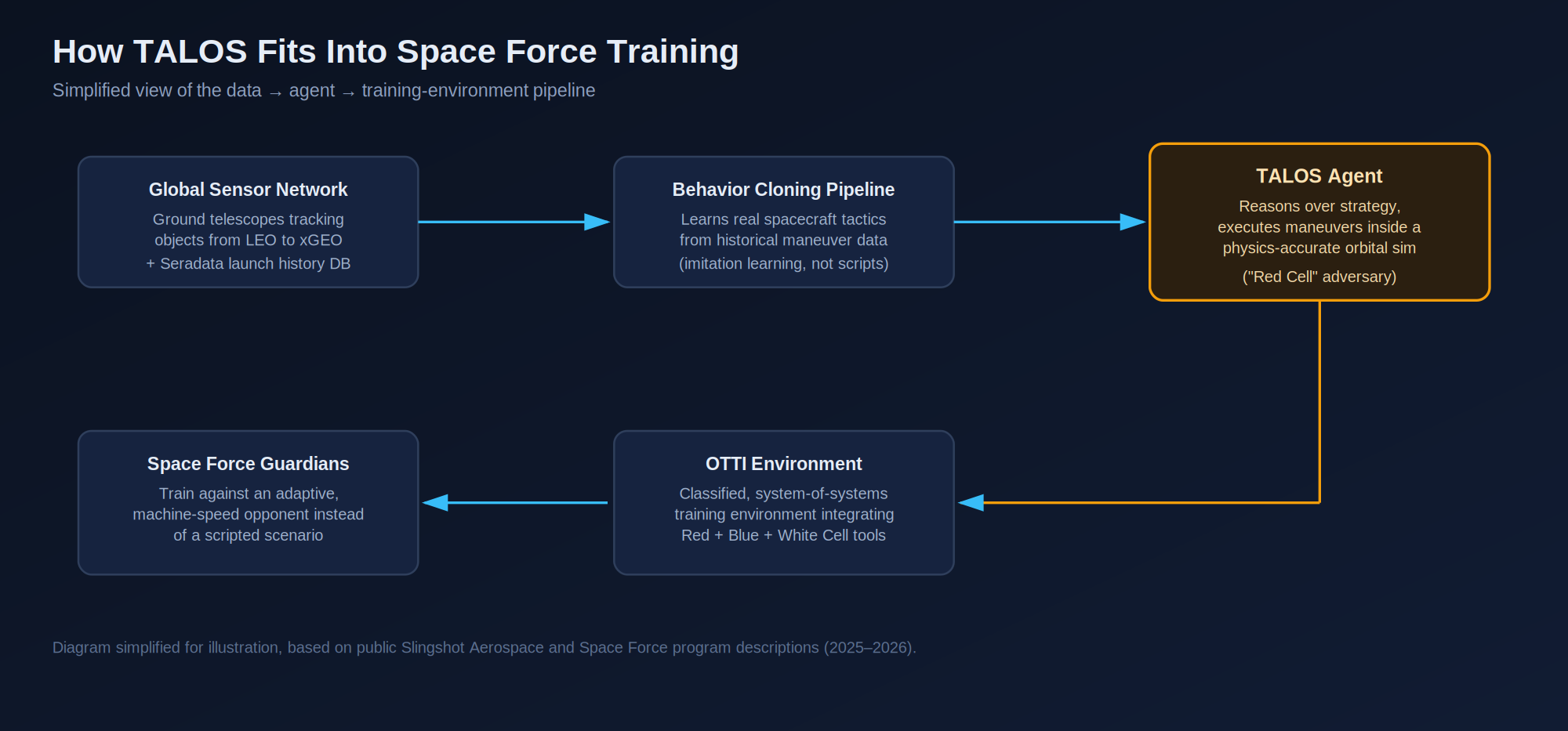
What does Slingshot actually do? It collects space-tracking data from many different sources and puts it all together into one clear picture. This includes its own network of ground telescopes, a database of satellite and launch history called Seradata, and data from other providers. One of its first products was Slingshot Beacon, a tool that helps satellite operators avoid crashing into each other. It's already used by companies that run most of the active satellites in low Earth orbit, including OneWeb and Spire Global.
In August 2022, Slingshot bought Numerica's Space Domain Awareness team. This gave Slingshot better tools for tracking and understanding satellite behavior the same tools that later became the foundation for TALOS.
In 2023, Slingshot hired Audrey Schaffer as VP of Strategy and Policy. She used to work at the White House National Security Council, where she helped create an international rule against destructive anti-satellite (ASAT) missile tests. Hiring her shows that Slingshot isn't just a tech company it's deeply connected to U.S. government space policy too.
2. What is TALOS?
TALOS stands for Thalos Agent for Logical Operations and Strategy. It's an AI agent that copies how real satellites behave, so it can be used for training and practice. It was launched in July 2025.
The name comes from Greek mythology. Talos was a giant bronze robot built to guard the island of Crete one of the oldest stories about a machine that protects. Slingshot's version does the opposite job in training: it plays the enemy.
What makes TALOS different from older training tools is how it learns. It uses something called a behavior cloning pipeline. In simple terms, the AI studies a huge amount of real satellite movement data and learns to copy those patterns, instead of following a fixed script written by a human. The company says TALOS can be given a goal, look at its surroundings, think through different strategies, and then carry out maneuvers inside a realistic space simulation including moves the company calls "space warfare maneuvers and dogfighting strategies."
Slingshot says its systems can track about 95% of all satellite-sized objects in every kind of orbit, from low Earth orbit all the way past geostationary orbit. This huge amount of data is what the company says makes TALOS realistic. This is a claim made by the company itself it hasn't been checked by outside sources but it does match the size of Slingshot's sensor network that has been publicly reported.
3. From experiment to a real government program
TALOS didn't appear overnight. It grew step by step, with government support along the way:
● 2022: Slingshot got a $25 million award (called STRATFI) over 39 months. This let the Space Training and Readiness Command (STARCOM) start testing early versions of TALOS.
● July 2025: TALOS was officially launched. The Space Force's 57th Space Aggressors Squadron tried it out to see how it could be used in training, ahead of a training exercise called Space Flag.
● January 2026: Slingshot won a new $27 million contract for 18 months. This is tied to the Space Force's Operational Test and Training Infrastructure (OTTI) program. In this program, TALOS plays the role of the "thinking enemy" called the Red Cell inside a bigger, classified training system that also includes other companies' tools.
Slingshot has said clearly that TALOS is meant to work well with other tools, not replace them all. They're using open APIs (a way for different software to connect easily) so new sensors and AI tools can be added later.
Here's the bigger picture: the U.S. 2026 National Defense Strategy has made space a top priority for national defense. It points to rival countries building up their satellite and space-weapon abilities as a reason the U.S. needs stronger, better-tested space systems. Programs like OTTI, and tools like TALOS, are meant to help make that happen.
4. Why does the Space Force need an AI enemy at all?
Two big reasons explain why this kind of tool is needed, not just nice to have:
Scale. Slingshot's own policy team has pointed out that China plans to launch huge groups of satellites possibly tens of thousands of them in total. With that many satellites in the sky, it becomes almost impossible for humans to track and understand what each one is doing without a lot of help from AI.
Unpredictability. Satellites from rival countries are no longer moving in simple, predictable ways. Their tactics can change in the middle of an event which is exactly what a scripted training exercise cannot copy. A human training team can only create a limited number of scenarios. An AI agent can create many different, changing scenarios very quickly.
This is also connected to a bigger trend called "agentic AI in space warfare" the idea that satellites and ground systems could one day run their own AI agents that sense, decide, and act on their own, much faster than a human could. Even so, humans are expected to stay in charge of the most important decisions.
5. Who else is doing similar work?
Slingshot isn't the only company in this space. The wider "space domain awareness" (SDA) market companies that track and understand what's happening in orbit has several other players, each doing things a bit differently:
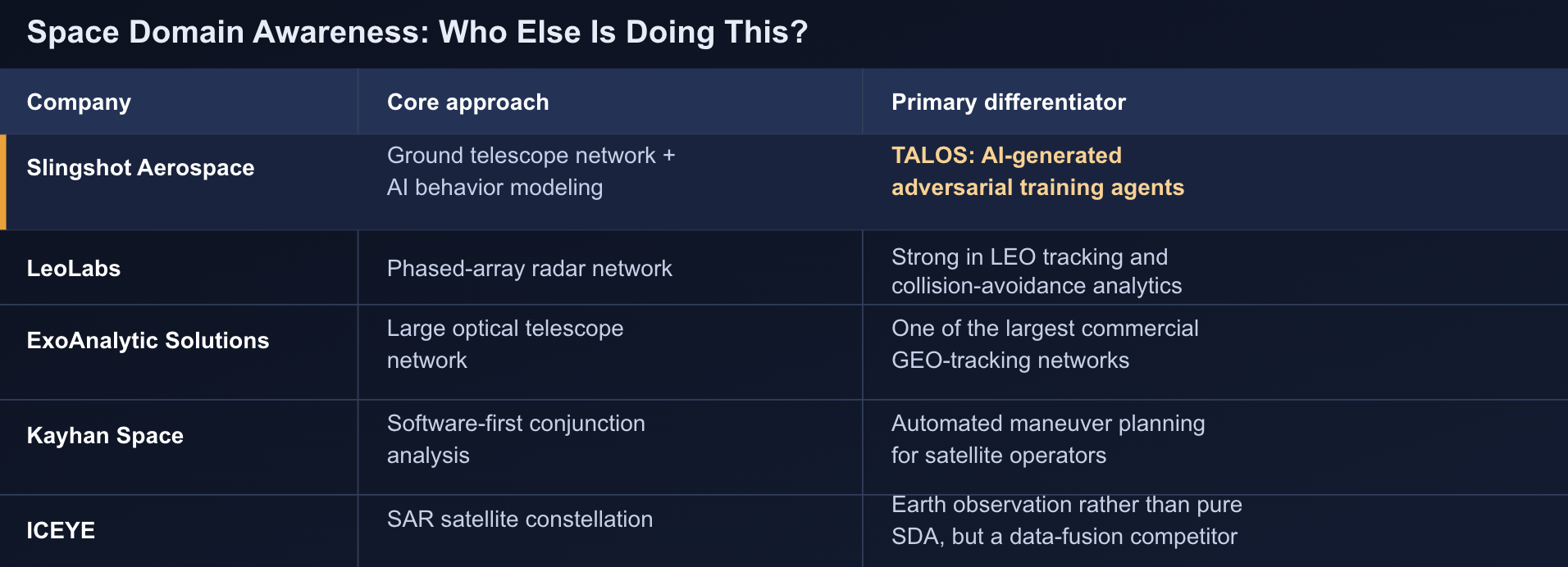
What really sets Slingshot apart isn't just how much it can track other companies track a lot too. It's the choice to turn that tracking data into a tool that generates realistic enemy behavior for training, instead of just detecting and listing objects. That's a different kind of product, and it matches exactly what the Space Force says it needs: more realistic, changing training environments.
6. Why this matters, even outside Slingshot
TALOS is a good example for anyone learning about AI in defense, for a few simple reasons:
● Learning from real data instead of writing rules. Instead of a human writing out "attack scripts" by hand, Slingshot let the AI learn realistic behavior directly from years of real satellite data. This approach works well anywhere there's a lot of past data but no clear rulebook.
● Simulation first, real action later. TALOS is only used for training right now, not for making real decisions during an actual event. This is a careful, step-by-step way of bringing AI into a very high-risk area.
● Testing your own defenses. By creating realistic enemy behavior, TALOS also tests how good the Space Force's own detection systems are. This idea building a tool to attack your own system so you can find its weak points is common in defense AI, cybersecurity, and AI research in general.
Space is becoming a more crowded and more AI-driven place. Tools like TALOS are likely just the beginning more systems like it will probably show up in the next few years. Learning how TALOS is built, and why the Space Force is investing so much in it, gives a good idea of where defense AI spending is heading in 2026.
Sources: Slingshot Aerospace press releases (July 2025, January 2026); Breaking Defense; DefenseScoop; SatNews; SpaceNews; Military.com; PitchBook, Tracxn and Crunchbase company data. This piece reflects publicly reported information only; company performance claims are attributed to Slingshot Aerospace and have not been independently verified.